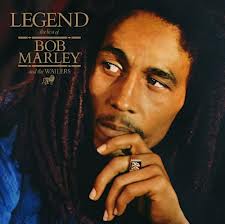
“How long shall they kill our prophets…?”as Bob Marley said, “… while we stand aside and look?”Sir Bob Marley said it all: How long shall we let these conquerors beat us down? bombard us? kill our prophets? What were Lumumba, Sankara, Cabral, Um Nyobé, Ouandié, Khadafi, Ben Barka, or Gbagbo’s sins? To love their country: to want to save their countries from western greed. What were we doing when they were all killed? Why on earth are we, Africans, just looking (and sometimes applauding) while some countries, Côte d’Ivoire, Libya, and now Mali are being bombed? Why and how long are we going to look while our prophets are being killed?
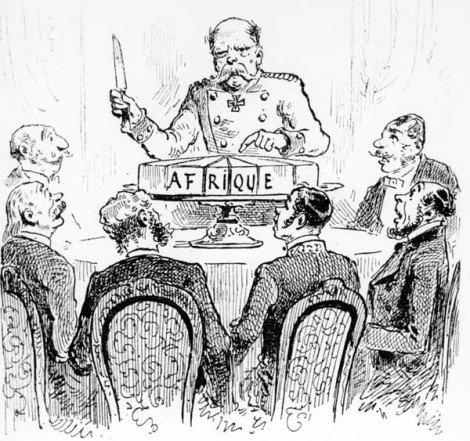
Le partage de l’Afrique a la Conference de Berlin de 1884
I just heard of Charles Blé Goudé being arrested. My heart is broken as I hear some Africans applaud… yes my heart is shattered when I hear people say “oh he deserved it.” Deserved what? Deserve being beaten to death because he stood up for his country while external forces were invading it? Deserve being humiliated because he dared walk out in the streets of Abidjan bare-handed to fight external forces, because he brought the youth together, because he woke Ivorians and Africans to their rights to respect, independence, and fairness? Yes… as Sir Marley said: “Emancipate yourself from mental slavery [slavery of the mind; slavery mentality: ignorant mentality]”… “Have no fear for atomic energy.” Some African head of states said when Côte d’Ivoire and Libya were being bombed ” It is better not to say anything; we will just agree with these westerners otherwise they will bomb us too!” now peaceful Mali is under attack; peaceful and desertic Mali is being bombed. Which other peaceful African country will be next? It is better to rise, save our prophets, and talk… than to drink the milk of cowardice, fear, treachery, and ignorance. Have no fear for atomic energy, just stand against injustice… that is way better than treachery or the cancer of betrayal as Amilcar Cabral called it. Enjoy Sir Marley, and remember that the milk of cowardice never saved our ancestors, and will never save us; our ancestors thought that they were sparing themselves from harm, but 50, 100, 500 years later their children are still fighting the battles they should have fought in the first place. History repeats itself… are we still going to stand aside while our prophets are being killed? are we going to fear atomic energy, and run as cowards? No matter how far we run, or how much we hide, they are coming for us… we might have seeming peace for 20 years, but our children will still have to fight our battles!
J’ai trouvé cet article sur Cameroon Voice du Pr. Chems Eddine Chitour assez interessant. Depuis que les occidentaux se sont lançés a une reconquête du monde: Côte d’Ivoire, Libye, Syrie, et maintenant Mali… on se pose bien des questions. Les questions fondamentales demeurent: à qui le tour? Pourquoi cette politique de la gâchette facile? pourquoi acquérir ce gain si facile, pourquoi tant de paresse? Les Occidentaux devraient reconnaitre que leur systeme capitaliste a bel et bien été la faute de leur chute… et beaucoup de pays tels la France et les Etats-Unis devraient le reconnaître, et faire une réforme de leur système, règler leur dette, et non mettre le reste du monde à feu et à sang, et ensuite prétendre que la Chine est l’ennemi du monde. Franchement… c’est assez difficile de comprendre une intervention aérienne française au Mali, un pays du tiers-monde où les gens n’arrivent même pas à joindre les 2 bouts. C’est assez difficile d’accepter que des petits rebelles pourraient constituer une menace pour la France qui aurait même besoin du support militaire américain. Les attentats récents en Algérie contre des ressortissants américains semblent présenter l’Algérie comme le prochain pays sur la ligne de mire des sanguinaires français qui ont toujours rêvé de mettre l’Algérie à genoux en y commettant les plus grands genocides de l’histoire de l’humanité. Que le bon Dieu nous garde des paresseux, et des envieux! Ces derniers feraient mieux de se mettre au travail comme les Chinois!
========
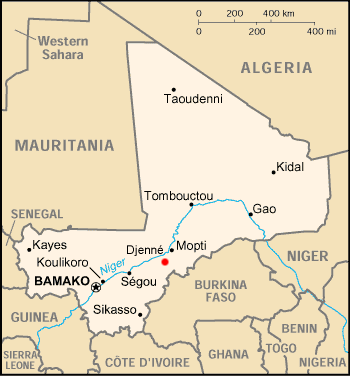
Map of Mali
Ça y est! Comme nous l’avons prédit dans un article précédent, l’Afghanisation du Mali est en marche! Pourquoi l’engouement des redresseurs de tort de l’Empire et de ses vassaux pour un pays qui, en théorie, est un désert au sens qu’il ne contient rien de comestible à moins que nous n’ayons pas toute l’information sur les réelles potentialités de ce pays voisin. […]
Curieusement, ces dernières semaines notamment avec les accords de Ansar Eddine et du Mnla à Alger, qui devaient ensuite être reçus par les responsables de la Cédéao pour une solution négociée, avaient fait miroiter une possible paix sans intervention militaire. Tout s’est précipité. Une résolution fut arrachée aux Nations unies le 20 décembre 2012, elle autorise une intervention en cas d’échec de la diplomatie. Cette diplomatie qui n’a pas eu à faire ses preuves puisque trois semaines après, la France intervenait pour stopper les mouvements se revendiquant d’un Islam fondamentaliste, sans accord du Conseil de sécurité. [surprenant comme ce scenario ressemble a celui de la Libye avec les Nations Unies qui sortent des resolutions suivies des frappes aériennes franco-americaines]. […]
L’intervention au Mali a été engagée après le forcing français pour l’adoption, le 20 décembre 2012, de la résolution 2085 par le Conseil de sécurité de l’ONU. Pour autant, aucune résolution de l’ONU n’autorise (ni n’interdit du reste) l’intervention française. […] Continue reading ““Le Mali en miettes. A qui le tour?” de Chems Eddine Chitour”→
Very often, we, Africans, have been misinformed about our true place in advancing humanity. Very often, we have been told that we were a dark continent, an ignorant race, or rather a non-scientific class? Well… I have news for those nay-sayers. Ancient Africans, Ancient Egyptians used electricity: ancient pyramids were lighted via electricity… yes… you heard me well… not only did they show some of the greatest scientific fits by designing pyramids, but they also had electricity (thousands of years before Nikola Tesla or Alessandro Volta). Just like the great Library of Alexandria, or the University of Timbuktu … we, Africa, also had electricity. Enjoy… and Applaud … and above all be proud of the ingenuity of our ancestors.
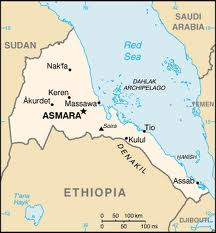
Ever since I was a child, I always loved the sound of the name ‘Asmara,’ not knowing that it was feminine by nature (which might explain my fascination with it). Asmara, the capital of Eritrea, was an Italian built colonial city whose origins date back to 800 BC and 400 BC. The Tigrinya and Tigre people live around there. Originally, there were four clans living in the Asmara area on the Kebessa plateau: the Gheza Gurtom, the Gheza Shelele, the Gheza Serenser, and the Gheza Asmae. These clans fought each other until the women of each clan decided that to preserve peace, the four clans should unite. The men accepted, hence the name Arbaete Asmera. Arbaete Asmera literally means in Tigrinya language, “the four (feminine plural) made them unite.” Eventually Arbaete was dropped and it has been called Asmera, which means “they [feminine, thus referring to the women] made them unite.” Majority of non-Eritreans call it by the Italianized version of the word: Asmara. Only Eritreans, and their neighbors remain loyal to the original pronunciation, Asmera.
Map of Eritrea
In the early days, Asmara was part of the kingdom of Medri Bahri, a medieval kingdom in the Horn of Africa, whose capital was Debarwa. On October 9th, 1876, the Emperor of Ethiopia, Yohannes IV, made his greatest war general Ras Alula, governor of Medri Bahri. Once Ras Alula became governor of this province, he moved the capital from Debarwa to Asmara. He built a palace on top of a hill in the center of Asmara; from there, he devoted himself to defending the northern borders of Ethiopia against Italian, and Anglo-Egyptian aggressors. In 1889, Asmara was occupied by the Italy, and was made the capital city of Eritrea by Governor Martini in 1897.
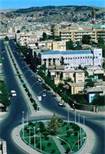
Blvd in Asmara
Since then, Asmara has benefited from a strong Italian architecture, and was called Piccola Roma (Little Rome) because of its strong resemblance to Rome. Asmara represents perhaps one of the most concentrated and intact assemblage of Modernist architecture anywhere in the world. Not built for Eritreans, Italians built Asmara primarily for themselves, as indicated by separate areas designated for Italians and Eritreans, each disproportionately sized. Enjoy this video telling you about the Little Rome of East Africa, Asmara, the beautiful city embodying feminine grace and beauty.
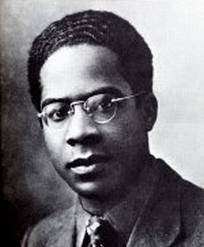
Aimé Césaire, le grand écrivain et poète Martiniquais, présente ici son Ôde à la Guinée… ce chant qui s’élève et embrasse la Guinée, ce pays si cher qui était le premier en Afrique francophone à reclamer son indépendance à la France, ce pays-là qui nous a montré à tous Africains, que comme disait si bien Sékou Touré: ‘nous préférons la pauvreté dans la dignité à l’oppulence dans l’esclavage.‘ C’est bien pour cela que Aimé Césaire a chanté pour la Guinée!
=========
Ôde à la Guinée
Et par le soleil installant sous ma peau une usine de force et d’aigles et par le vent sur ma force de dent de sel compliquant ses passes les mieux sues et par le noir le long de mes muscles en douces insolences de sèves montant et par la femme couchée comme une montagne descellée et sucée par les lianes et par la femme au cadastre mal connu où le jour et la nuit jouent à la mourre des eaux de sources et des métaux rares et par le feu de la femme où je cherche le chemin des fougères et du Fouta-Djallon et par la femme fermée sur la nostalgie s’ouvrant JE TE SALUE Guinée dont les pluies fracassent du haut grumeleux des volcans un sacrifice de vaches pour mille faims et soifs d’enfants dénaturés Guinée de ton cri de ta main de ta patience il nous reste toujours des terres arbitraires et quand tué vers Ophir ils m’auront jamais muet de mes dents de ma peau que l’on fasse un fétiche féroce gardien du mauvais oeil comme m’ébranle me frappe et me dévore ton solstice en chacun de tes pas Guinée muette en moi-même d’une profondeur astrale de méduses.
Aimé Césaire
======
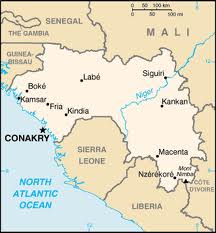
Guinea-Conakry
“Ode to Guinea” by Aimé Césaire
And by the sun installing a power and eagle factory under my skin and by the wind elaborating the passes it knows best over my power of tooth of salt and by the black rising along my muscles in sweet sap-like effronteries and by the woman stretched out like a mountain unsealed and sucked by lianas the woman with the little known cadastre where day and night play mora for springhead waters and rare metals and by the fire of the woman in which I look for the path to ferns and to Fouta Jallon and by the closed woman opening on nostalgia
I HAIL YOU
Guinea whose rains from the curdled height of volcanoes shatter a sacrifice of cows for a thousand hungers and thirsts of denatured children Guinea from your cry from your hand from your patience we still have some arbitrary lands and when they have me, killed in Ophir perhaps and silenced for good, out of my teeth out of my skin let the make a fetish a ferocious guardian against the evil eye as your solstice shakes me strikes me and devours me at each one of your steps Guinea silenced in myself with the astral depth of medusas
from The Collected Poetry of Aimé Césaire, translater by Clayton Eshleman and Annette Smith.
Today I will be talking about a great queen of Madagascar, Queen Ranavalona I who fought against French and British expansionism in Madagascar, and strongly believed in autarky (self-sufficiency).
Born by the name of Mavo(or Ramavo) around 1788, Ranavalona I will later be named Rabodonandrianampoinimerina(which means the smart grand-daughter of Andrianampoinimerina) in reverence to her uncle, the King Andrianampoinimerina. She became Queen of Madagascar after the death of her husband Radama I and was coronated on 12 August 1829. She was also designated by the title Ranavalo-Manjaka I (« Reigning Ranavalona »). She reigned over the Kingdom of Madagascar from 1828 to 1861.
Ranavalona I followed in the footsteps of her predecessors, with the territorial expansion of her kingdom, and led several expeditions to pacify conquered territories such as the meridional Menabe, the Boina, and the north-east regions of the island (Madagascar). Fervent nationalist, she fought against foreign influence, including that of Christian missionaries. During her reign, the power of some castes increased, like that of the andriana or the royal family, or that of the military chiefs, the hova.
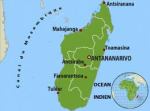
Madagascar
Ranavalona’s 33-year reign was distinguished by an ongoing struggle to preserve the political and cultural sovereignty of Madagascar in the face of increasing European influence and competing French and English bids for domination over the island. In the beginning of her reign, Ranavalona I tried to continue the work of modernization started by her predecessor. Very soon, she faced the hostility of the French, who in 1829, attacked different points on the oriental coast of the island. This unexpected aggression sharpened the queen’s distrust of European ambitions; especially since the British missionaries installed at the heart of the island since 1820 were converting many. Fearing the loss of the independence of her country, she denounced the anglo-malagasy treaty of 1820, and asked the British to give up on the religious extension in her country, and to focus only on the educational works she wanted for her people. However, the British refused, and in 1835, she had them expelled from the island. To counter-balance the European influence on the island, the monarchy created contacts between the ports of Majunga, and Zanzibar.
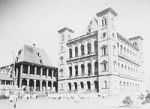
Manjakamiadana, the Royal compound built for Queen Ranavalona IManjakamiadana,encased in stone under the orders of Ranavalona II
Ranavalona I then hired the services of Jean Laborde who accomplished quite a lot of modern upgrades, the most important of these will be providing Madagascar with a metallurgic and chemical industry. He also built the queen a new residence known as the Manjakamiadana, which became the largest structure on the Rova grounds, the royal compound in Antananarivo. The residence was made entirely from wood and bore features of a traditional andriana home, including a central pillar (andry) to support the roof. The palace would eventually be encased in stone in 1867 by James Cameron of the London Missionary Society during the reign of Ranavalona II. The original wooden palace of Ranavalona I and virtually all other structures of the historic Rova compound were destroyed in a 1995 fire, leaving only the stone shell to mark where her palace had once stood. Renovation is on the way.
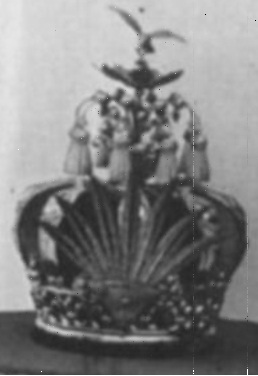
Royal Crown of Madagascar as worn by King Radama II, Ranavalona I’s successor (ca 1862)
Ranavalona pursued a policy of autarky (self-sufficiency) and isolationism, diminishing economic and political ties with European powers, repelling a French attack on the coastal town of Foulpointe, and taking vigorous measures to eradicate the small but growing Malagasy Christian movement initiated under Radama I by members of the London Missionary Society. She made heavy use of the traditional practice of fanompoana (forced labor in lieu of tax payments in money or goods) to complete public works projects and build a standing army of between 20,000 and 30,000 Merina soldiers, whom she deployed to pacify outlying regions of the island and further expand her realm.
Subsequently, to try to eradicate Christianity among her subjects, as she believed (and rightfully so) that this was a means of infiltration of the colonial ambitions of Europeans on the island, she had converts (considered as traitors) run off. As she declared in 1849: « Miala amiko ka mba ialako, mahafoy ahy ka mba foiko ! » (« they [christians] have denied me [ as a living symbol of their homeland], therefore I deny them as well; they have rejected me, I reject them! »).
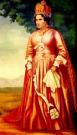
Ranavalona I on the throne
She said in a letter addressed to the Europeans: “To all Europeans, British and French, in recognition for the good you have done to my country by teaching European wisdom and knowledge, I would like to express my thanks. … You can keep following your customs. Have no fear for I have no intention of modifying your habits. But if I see some of my subjects trying to change the rules established by the twelve great kings, my ancestors, I will not possibly consent: because I will not allow men to come and change anything to all the ideas I have received from my ancestors, which I had accepted without shame or fear. You are free to teach my people science and wisdom, but when it comes to touching our ancestors’ customs, it is a vain work, which I will fully oppose….”
Ranavalona I continued the works of Andrianampoinimerina and Radama I. In her country, she is seen as a great sovereign, true symbol of patriotic and national pride. However for Europeans, she has been described as a tyrant… but like her so many great African kings and queens defending their country against foreign invasion/colonization have been portrayed as cruel, and ignorant. Faced with the contempt of Christian converts, she proudly stated: ”ny fomban-drazako tsy mba mahamenatra ahy na mampatahotra ahy!” (“I do not feel any shame or fear about my ancestors’ customs”). Enjoy this great video, and honor one of Africa’s earlier nationalist and independentist: Queen Ranavalona I.
My fellow friends may the year 2013 be the year of all greatness, success, harmony, and peace! I would like to thank all those who visited my blog, and all my future visitors … I am grateful for your trust and faith in my blog. We have more than tripled the number of viewers this year: keep on visiting, keep on sharing, and keep on commenting. I wish you all wonders without borders, grace, and peace for 2013. To all those who witnessed the horrible events in Mali, South Africa, Cote d’Ivoire, and Libya, to all those who felt powerless in 2012, it is time to rise and keep fighting, it is time to stay strong and keep loving our neighbors. We need to stay strong, alert, and open as always. Above all, we need to keep praying for 0ur beautiful continent. We are all agents of hope, we are all agents of good, and we need to be agents for the betterment of Africa. As Franklin Boukaka said of Mehdi Ben Barka, and would say to us now: ‘ our work is that of humanity.’
5. President Laurent Gbagbo‘s hearing at the International Criminal Court (ICC) was scheduled for June 18, 2012, but was postponed to August 13, 2012, and now has been postponed indefinitely. Apparently the ICC cannot find proofs of all their allegations against Laurent Gbagbo, and thus prefer stalling.
The VMK (Source: VMK)
6. Oussama Mellouli, of Tunisia, won Gold in the 10 km marathon open water, to become the first swimmer to ever win olympic medals in both the pool and open water (August 2012).
7. David Rudisha of Kenya, became the first man to break a record at the London Olympics, in the 800m (August 2012).
8. Alaeeldin Abouelkassem of Egypt won silver in fencing, becoming Africa’s first medal in fencing (August 2012).
2012 was a different year with a lot of disappointments, hurts, pains, coup d’etat, and all sorts of things in Africa. We said goodbye to quite a few people in 2012, including:
1. President John Atta Mills of Ghana, who joined his ancestors suddenly on 24 July 2012… So long Prof… May the land of Ghana hold you tight.
2. President Meles Zenawi of Ethiopia, who passed on 20 August 2012… leaving Ethiopia in turmoil.
3. President Bingu wa Mutharika of Malawi, who passed away on 5 April 2012… he is succeeded in power by the second woman president in Africa: Mrs. Joyce Banda.
4. Minister Paul-Antoine Bohoun Bouabre of Côte d’Ivoire left us on 10 January 2012; this is the man who single-handedly saved Cote d’Ivoire from a financial cliff.
5. Cameroonian legendary footballer Théophile Abega, nicknamed ‘The Doctor’, left us on November 15, 2012. He was voted as one of Africa’s top 200 players of the past 50 years.
6. Charles Taylor, former president of Liberia, was sentenced to 50 years for war crimes in May of this year.
7. A coup d’etat deposed the rightful president of Mali, President Amadou Toumani Toure (ATT) on 22 March 2012, one month before scheduled elections. This has left Mali in turmoil; the country is now going down the path of Cote d’Ivoire and Libya: split into two, and eventually … broken apart?
9. Abdoulaye Wade, the négrier of Senegal, was booted out of his presidency by the people of Senegal who voted for Macky Sall on 25 March 2012 (a true example of democracy in Africa).
10. Last but not least, the most hateful one of all: Nicolas Sarkozy, the ‘bourreau’ of Africa was booted out of the French presidency on 6 March 2012 … bye bye Sarko… you went for the recolonization and destruction of Cote d’Ivoire and Libya… and the deck of cards are still falling; now Mali… ? Sarko is gone… but his deeds are still going on.
I had to share this video… Although it is a satirical video, ‘ Africa for Norway ‘ raises such interesting points, points I have always thought about: what if Africa was the one sending aid to other continents? What if during hurricane Katrina, Africans had sent buckets of food? Truthfully, African resources have been feeding countries around the world, and saving some like France, from financial disasters … isn’t this video just reflecting that? After all, our resources keep many countries stuck in their ‘superiority’ complex: do westerners know that the wars waged in Cote d’Ivoire allow them to have cheap chocolate for Valentine day? that the war in Libya, is keeping automobiles in the US running at $3.40 a gallon when the rest of the world is suffering from oil scarcity? that the coltane from the Democratic Republic of Congo keeps everybody’s cell-phones running, etc… do they know? do people know? what if Africa was coming to the rescue of everybody (as it already is)? Enjoy ‘Africa for Norway.’











 African Heritage