I salute the ingenuity of Congolese entrepreneur Verone Mankou, whose smartphone and tablet truly address the needs of Congolese in particular, and of Africans in general. Verone Mankou, the founder of VMK, tailors affordable smartphone and tablet to Africans. He said at the Tech4Africa conference in Johannesburg recently: “Only Africans can know what Africa needs. … Apple is huge in the US, Samsung is huge in Asia, and we want VMK to be huge in Africa.” … I totally agree with him, and I am proud to see an electronic product conceived and engineered by a Congolese for Congolese, and all Africans. Have fun, and enjoy!
Today I would like to talk about Mrs. Gloria Bongekile Ngema-Zuma who just gave an interview to BBC. She is Jacob Zuma (J.Z.)‘s fourth wife, married on April 2012. She is an accomplished woman, educated, and really I have to say it: a contradiction to many young African girls growing. She is an accomplished professional accountant, and IT manager… and for her to become the fourth wife of somebody, even if that somebody is the president of a nation, is simply tasteless. I know that it is prestigious to be a president’s wife, but come’ on for the sake of the young girls out there in South Africa, and Africa… is this really the example to be set? So as a woman, you can be as accomplished as you want, but you are only worth to be a man’s fourth wife? You cannot be your own person? Or he cannot love and respect you enough to leave all his other wives?
Jacob Zuma and his fourth wife, Bongi Ngema
Now, some may ask me if I would have preferred for her to be his mistress? Of course not, but I find it revolting to have a president who has four wives. I find it disgusting to have a president, in modern days, who holds onto the past, and who cannot make up his mind… because truly that’s is what it all boils down to: decisiveness, discipline, and control. No wonder there has been violent attacks on Africa ever since Jacob Zuma became president of South Africa: destruction of Côte d’Ivoire after the 180 degrees turn of Zuma, destruction of Libya under the vigilant eye of Zuma, massacre of defenseless miners at the Marikana’s mines, etc. Is promiscuity now allowed at the top of the state? There is really something to having one wife, committing to marriage to only that person, and above all, having the oneness of mind, or rather a ‘single’ vision. What should a young girl growing up think? She can only be powerful if she is in a polygamous marriage; even educated, she is only worth being somebody’s 2nd, 3rd, or 4th wife? Why can’t she be his only wife?
Flag of South Africa
As I listened to Mrs. Zuma’s interview, I have to admit that I was appalled, as she could not even answer the simple question as to why? The only answer was:” I am a grown woman, making my own choices.” Of course, there are lots of grown women around the world making their own choices, but when you are a first lady, you no longer make choices for yourself, you also have to acknowledge impacts on society. What about young girls? How can you talk about modernism when there is so much contradiction in your thoughts? Now, she says she is Zulu first, and then modern woman second. Yes that’s true, but does she abide by all Zulu rules? Are all Zulu women in polygamous marriages? I am African first, but does that mean that our daughters should undergo excision?I am African first, does it mean that servants in the kingdom should still accompany the king in his grave? I am African first, does that mean that albino children or twins (in some African traditions) should still be killed at birth?Of course not! For somebody, a first lady (or 4th lady), to blurt: “I am Zulu first, then xyz second,” … i.e. that’s why I live in prehistoric ages is simply disgusting. No offense to Mrs Zuma, but I do not want any of our daughters to see her as an example. Now, somebody could argue that: ‘maybe she wanted to influence young girls, and she could only do that as the president’s wife’… Sure, but she was already influencing young girls by being the great manager that she was. If President Zuma and her loved each other, could he not have divorced to marry her? Couldn’t she have waited till the end of his term to be with him? Couldn’t she have influenced the president by demanding that he divorces his other wives? Now, that would have been the symbol of a strong woman whose influence on young girls would have been strongly felt over generations!
Thank goodness there are still other great African women out there who stand for their very own convictions and inspire young African women. What next for J.Z.? A fifth wife for 2013?
Today, We will look at a poem by the most celebrated Ivorian writer Bernard Binlin Dadié. The poem below is titled “Dry your Tears Afrika” or “Sèche Tes Pleurs“. Published in 1967, this poem is basically about Africa and her sons and daughters returning home. It is about healing the wounds of slavery, colonialism, and neo-colonialism. This poem was actually translated into Mende, a language spoken by ~ 46% of Sierra Leone. It was also set to music by American composer John Williams for the Steven Spielberg movie, Amistad. Below is the original poem in French, written by Dadié. The English version can be found below. Enjoy the text, and the video of the poem sung in Mende with the English translation.
Sèche tes pleurs Afrique! Tes enfants te reviennent dans l’orage et la tempête des voyages infructueux. Sur le ris de l’onde et le babil de la brise, Sur l’or des levants Et la pourpre des couchants des cimes des monts orgueilleux Et des savanes abreuvées de lumière Ils te reviennent dans l’orage et la tempête des voyages infructueux. Sèche tes pleurs, Afrique Ayant bu À toutes les fontaines d’infortune et de gloire, Nos sens se sont ouverts à la splendeur de ta beauté à la senteur de tes forêts, à l’enchantement de tes eaux à la limpidité de ton ciel à la caresse de ton soleil Et au charme de ta verdure emperlée de rosée.
Sèche tes pleurs, Afrique! Tes enfants te reviennent Les mains pleines de jouets Et le coeur plein d’amour. Ils reviennent te vêtir De leurs rêves et de leurs espoirs.
Bee ya ma yee ah, bee len geisia bee gammah. Bee ya ma yee ah, bee len geisia tee yamanga. Baa wo, kah ung biah woie yaa. Baa wo, kah ung biah woie yah, yah. Oo be ya ma yee ah, bee len geisia tee yamanga. Mu ya mah mu yeh, Mu ya mah mu yeh, Mu ya mah mu yeh, Afrika. Mu ya mah mu yeh, Mu ya mah mu yeh, Mu ya mah mu yeh, Afrika.Bee ya ma yee ah, bee len geisia tee yamanga. Mu ya mah mu yeh, bee len geisia bee gammah. Oo bee ya mah yee ah Bee len geisia tee yamanga. Mu ya mah mu yeh, Mu ya mah mu yeh, Mu ya mah mu yeh, Afrika. Mu ya mah mu yah, Mu ya mah mu yah, Mu ya mah mu yeh, Afrika.
Be ya mah yee ah, bee len geisia tee yamanga. Be ya mah yee ah, bee len geisia bee gammah. Mu ya mah mu yeh, Mu ya mah mu yeh, Mu ya mah mu yeh, Afrika. Mu ya mah mu yeh, Mu ya mah mu yeh, Mu ya mah mu yeh, Afrika. Mu ya mah mu yeh, Mu ya mah mu yeh, Mu ya mah mu yeh, Afrika.
Où allez-vous chercher de quoi réparer la plomberie dans votre maison? Où achetez-vous les clous et le marteau nécessaires pour clouer un portrait sur votre mûr? et pour arranger la barrière dans votre cour? ou pour construire le petit étang de vos rêves? Aux Etats-Unis, la plupart des gens vont dans une de ces structures super-géantes telles ‘Home Depot’ ou ‘Lowe’s’. Au Cameroun, beaucoup vont dans une quincaillerie en plein air, ou une quincaillerie ambulante. Vous m’avez bien entendu: une quincaillerie en plein air, de la taille d’une chambre ou beaucoup plus petite, ou une entièrement ambulante placée sur un ‘pousse.’ La vidéo ci-dessous présente une quincaillerie en plein air, ou quincaillerie ambulante. Le jeune homme dans cette vidéo vend beaucoup de choses tels des clous, des fils de fer, des seaux, des marteaux, des haches, des houes, et tout ce qu’il vous faut pour deboucher votre douche, ou pour poncer votre sol. Il est basé dans un marché de la ville de Bafoussam. Le soir, il transporte sa boutique qui repose sur un ‘pousse’ et la ramène à la maison. Regardez cette vidéo d’une quincaillerie ambulante au Cameroun.
===========
Some nails
Where do you go when you need to fix plumbing in your house? Where do you go to purchase the nails and hammer needed for you to nail down a portrait on the wall? What about making a fence in your backyard? or to build your dream pond? In the USA most people will go to those super-giant hardware stores: either a ‘Home Depot’ or a ‘Lowe’s’. In Cameroon, many will go to an outdoor hardware store, or a mobile hardware store. You heard me right: an outdoor store, the size of a single room, or even smaller; or simply to a mobile one. The video below presents a mobile outdoor hardware store. The gentleman in the video sells a lot of things such as nails, to wires, to buckets, hammers, saws, and all those things needed to unclog your bathroom, or to sand down a floor. He is based in one of the markets of the city of Bafoussam. In the evening, he will wheel his store back to his home on a cart. Please enjoy the mobile hardware store in Cameroon.
Today, we will be talking about the beautiful city of Tunis, the capital of Tunisia. Where does the name Tunis come from? Is Tunisia, the name of the country whose capital is Tunis, just a derivative of the name Tunis?
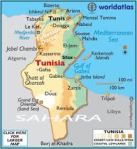
Well for starters the city of Tunis is built on a set of hills that go down towards the lake of Tunis. Tunis was born at the crossroads between the basins of lake Tunis and the Séjoumi. Situated on a large Mediterranean Sea gulf (the Gulf of Tunis), behind the Lake of Tunis and the port of La Goulette (Halq al Wadi), the city extends along the coastal plain and the hills that surround it. At the centre of more modern development (from the colonial era and later) lies the old medina. Beyond this district lie the suburbs of Carthage, La Marsa, and Sidi Bou Said.
Map of Tunisia (from World Atlas)
Tunis is the French transcription of a name, which is pronounced tûnus, tûnasor tûnis(with û sounding like an ‘ou’ in French) in Arabic. The three pronunciations were indicated by the arab geographer Yaqout al-Rumi in his book Mu’jam al-Buldan (Dictionary of countries). The last pronunciation tûnis is the most used of the city’s name tûnisi ou tûnusi. This vocable is defined to mean “to lie down” or “lying down”, and by extension “spending the night,” or “spending the night at”, or “getting somewhere and spending the night.” Among many of the derivatives of this term, one can find tinés (pluriel de ténésé) which indicate “the idea of lying down,” and by extension “the fact of spending the night.”
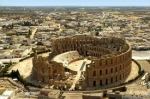
Ancient Tunisia
Thus the name Tunis probably had the meaning of “night camp” or “bivouac” or “stop.” In the ancient toponymy of Roman Africa, several towns carry similar names such as: Tuniza (modern-day El Kala), Thunusuda (modern-day Sidi Meskine), Thinissut (modern-day Bir Bouregba), Thunisa (modern-day Ras Jebel) or Cartennae (modern-day Ténès in Algeria). All these berber localities were located on roman roads, and probably served as road houses, or stops. From the name Tunis, arose the country name Tunisia. The name gained prominence among French historians and geographers, by analogy with the word Algeria derived from Algiers. Today Tunis is well-known for its beauty, its people, and its sunny days; it is one of Africa’s best touristic spots. Enjoy the video below, which gives a quick historical view of Tunis and Tunisia.
Malgré son odeur vraiment désagréable, le bouc est respecté par les autres animaux. Il passe pour un sage et on écoute ses conseils : d’ailleurs n’est-ce pas lui qui porte la barbiche comme un vieillard ? Mais le bouc n’a pas toujours eu cette réputation, et je vais vous dire comment il l’a acquise.
Autrefois, tous les animaux vivaient en paix. L’éléphant, la panthère, le bouc et l’hyène étaient alors de bons amis. Ils travaillaient tous quatre sur une grande plantation qui leur appartenait collectivement. A l’heure des repas, ils partaient, chacun de leur coté, chercher la nourriture. Ils faisaient la cuisine, chacun pour soi. Cela leur prenait beaucoup de temps.
Un jour, ils décident de mieux s’arranger entre eux. C’est l’hyène qui a cette idée. C’est elle aussi qui propose un règlement fort simple que les trois autres acceptent aussitôt. Voici ce règlement qui tient en une seule phrase : Chacun à notre tour, nous fournirons la viande pour nous quatre, pendant toute une semaine.
Le lendemain l’hyène propose d’ajouter une deuxième phrase. Voici ce qu’elle veut faire ajouter : Celui qui n’arrivera pas à rassasier les trois autres sera mangé par eux.
Cette règle est acceptée aussitôt par les quatre amis. Sans réfléchir, le bouc a donné son accord.
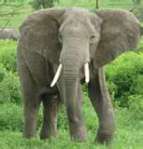
Elephant
La première semaine est celle de l’éléphant. Il va dans la forêt frappant tout ce qui passe à portée de sa trompe. Il rapporte du gibier en grande quantité. Il prépare des repas si copieux que les quatre amis ne peuvent en venir à bout. Les charognards qui viennent mangé les restes ne peuvent plus s’envoler, tellement leur ventre est plein.
La deuxième semaine, c’est la panthère qui reçoit les autres. Elle leur sert d’énormes quartiers de viande. Le soir, elle se cache près du marigot, les hautes herbes, et elle attrape les animaux qui viennent boire : singes, antilopes, phacochères … Les ventres des quatre amis sont si pleins qu’ils peuvent à peine travailler sur leur plantation. La terre parait basse quand on n’arrive plus à se plier.
La troisième semaine est celle de l’hyène. La nuit, elle va voler des morceaux de viande aux autres animaux et elle les traîne chez elle. Cette viande laissée par les lions et les charronnages n’est pas toujours très fraîche. Elle sent parfois mauvais, mais il y en a beaucoup. En se bouchant le nez, chacun peut manger à sa faim.
Enfin arrive le tour du bouc. Jusqu’à maintenant il n’y a pas songé et il a mené joyeuse vie. Quand il s’aperçoit que l’hyène le regarde souvent en se léchant les babines, il commence à comprendre, et il commence à avoir à peur. Elle est sûre qu’il n’arrivera pas à attraper du gibier : est-ce que vous connaissez un seul bouc capable de chasser ?Continue reading “L’Eléphant, la Panthère, l’Hyène et le Bouc”→
After “Les Immortels” by Franklin Boukaka, it is only normal that I would talk about Mehdi Ben Barka himself, and why he brought so much hope to people in Morocco, Africa, and the entire world. Yes, his work encompassed all the oppressed people of the globe.
Mehdi Ben Barka was a Moroccan politician born in January of 1920 in Rabat, Morocco. Although from a middle class background, Ben Barka was among the first to attend the French school (which was mostly for rich people), as he was always the best and brightest in his class. He was the first Moroccan to receive a degree in mathematics in an official French school in 1950. He then taught mathematics in a local Lycée (high school), and at the Royal College, where young Hassan II was one of his students. Working in parallel, Mehdi got involved in politics, and worked to challenge the French “Protectorate” on Morocco. In 1943, he got involved in the creation of the National Istiqlal Party. In 1955, Mehdi took part in negociations which culminated with the return of Sultan Mohammed V, who had been exiled by the French authorities to Madagascar. In 1956, Ben Barka’s other negociations culminated with the end of the French protectorate on Morocco. From 1956 to 1959, Mehdi Ben Barka was president of the consultative assembly of Morocco. In 1959, Mehdi broke off from the National Istiqlal Party after clashes with conservative opponents, and found l’Union Nationale des Forces Populaires – National Union of Popular Forces (UNPF).
King Hassan II
The future King Hassan II, then chief of the army, wanting to inherit his father’s trone as soon as possible, called for repression against subversion, against any opposition in the land. This forced Ben Barka to go on exile in Paris, as Ben Barka was King Hassan II’s principal opponent. After King Mohammed V’s death in 1961, Hassan II ascended to the throne, and claimed to want to make peace with his main opponent. Ben Barka returned from exile in May 1962. On 16 November 1962, Mehdi escaped an attack on his life (car accident, where his car was forced into a ravine by a police car), which had been fomented by the services of General Mohamed Oufkir and colonel Ahmed Dlimi. In June of 1963, Ben Barka was accused of plotting against the monarchy, and once again forced into exile; this was plot by King Hassan II, to dissolve the UNFP, the main opposition to his reign. On 22 November 1963, Ben Barka is sentenced to death in absentia, for conspiracy and attempt to assassinate the king. Some think that this was also caused by Ben Barka’s calling upon Moroccan soldiers to refuse to fight Algeria in the 1963Sand War. Ben Barka first went on exile in Algiers, Algeria, where he met with Che Guevara, Amilcar Cabral, and Malcolm X. Then he went to Cairo, Rome, Geneva (where he escaped several attacks on his life), and Havana, trying to unite the revolutionary movements of the Third World for the Tricontinental Conference to be held in January 1966 in Havana. As the leader of the Tricontinental, Ben Barka was seen as a major figure in the Third World movement, and supported revolutionary, and anti-colonial actions in various states, thus provoking the anger of the United States and France. Just before his death, he was preparing the first Tricontinental Conference scheduled to take place in Havana, Cuba, from 3 -13 January 1966.
Mehdi Ben Barka during an address
On October 29, 1965, Mehdi Ben Barka was abducted (“disappeared”) in Paris by French police officers. He was never to be seen again. On Dec. 29, 1975, Time magazine published an article called “The Murder of Mehdi Ben Barka”, stating that three Moroccan agents were responsible for the death of Ben Barka, one of them former Interior Minister Mohammed Oufkir. Speculation persists as to CIA involvement. French intelligence agents and the IsraeliMossad were also involved, according to the article. Many believe that the abduction and removal of Mehdi Ben Barka on that cold day of October 29, 1965, was to give a blow to the impetus of the Tricontinental Conference,which was going to have effects on liberation movements across the globe, and thus hurt imperialist powers (US, France, UK, Portugal, Spain…).
Indeed Mehdi Ben Barka was a true hero, some refer to him as the Moroccan Che Guevara… To many, he was hope itself… His charisma, and his work went beyond Morocco’s borders and blessed the entire globe, countries which were oppressed by imperialist powers and which over 50 years later are still suffering from neo-colonialism, and ferocious capitalism/imperialism. You can read more on how the French government is still stalling on the “Ben Barka affair” at the Guardian, and check out this interview of Bachir Ben Barka, Mehdi’s son, who was aged 15 at the time of his father’s abduction. Watch this really good documentary below which details the life of Mehdi Ben Barka. 50 years after his disappearance, the “Ben Barka affair” still remains an open dossier. One can only sing, like Franklin Boukaka, ‘Mehdi nzela na yo na bato nyonso’ … Mehdi your work is that of humanity! So long brother, your work and vision will keep guiding us. ‘Oh O Mehdi Ben Barka, Mehdi nzela na yo na bato nyonso.’
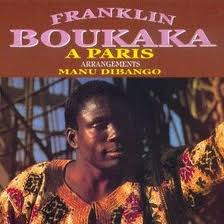
Ici sont les lyriques de la chanson “Les Immortels” de Franklin Boukaka. Lorsqu’on lit ces paroles, on se dit “quelle beauté! Quelle grandeur, quel amour de l’Afrique!”
Africa mobimba e … L’Afrique toute entière
Tokangi maboko e … A croisé les bras
Tozali kotala e … Nous observons impuissants
Bana basili na kokende … La perte de ses enfants
Bana basili na kotekama e … Le trafic de ses enfants
Na banguna a ……………… Auprès des ennemis
Tolati mokuya ata maloba te … Silencieux, nous avons porté un voile noir de deuil
Congo na bana Africa baleli … Le Congo et l’Afrique fondent en larmes (2X)
“Les Immortels” is a song written and composed by Franklin Boukaka, the great Congolese singer, to honor the great Moroccan leader Mehdi Ben Barka, African resistants, and world revolutionaries. Franklin Boukaka was a singer ahead of his time who loved his country, and had a passion for liberty. Franklin Boukaka was a freedom fighter, poet, composer, activist, and fought for African independence both politically, but above all by his great songs which today are still sung across Africa (you all have probably heard of “Aye Africa“). Born into music on 10 October 1940, with musician parents, he was murdered during the coup that deposed Ange Diawara during the night of 23-24 February1972. His greatest album was “Le Bucheron” realized with Manu Dibango, which contains “Les Immortels.” With all that is happening in Africa, with the coup against Laurent Gbagbo in Côte d’Ivoire, the crush of Libya and the guide of the revolution Mouammar Khadafi, and with the destruction of Mali, “Les Immortels” is still of actuality. Enjoy!
Today’s post will be dedicated to a great resistant and leader of Africa, the great Lalla Fadhma N’Soumer (also known as Lalla Fatma N’Soumer), an important figure of resistance against French invasion in Algeria. Lalla Fadhma N’Soumer has been seen as the embodiment of the Algerian struggle. The war of colonization in Algeria was one of the most brutal and repressive in Africa; it is said that Algeria lost 1/3 of its population between 1830 and 1872. The war was quite atrocious, and very often we are told of the courage and charisma of leaders such as the emir Abdel Kader, but often in history books, the names of heroines like Lalla Fadhma N’Soumer are forgotten or simply erased.
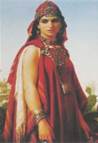
Fadhma N’Soumer
Lalla Fadhma N’Soumer was born in Werja, a village near Ain El Hammam in 1830, the year French occupation started in Algeria. She was from Kabylie. Lalla, the female equivalent of sidi, is an honorific reserved for women of high rank, or who are venerated as saints. Her real name was Fadhma Nat Si Hmed. The title, N’Soumer, was given to her because of her piety and strength and because she lived in the village of Soumer. Fadhma was the daughter of cheikh Ali Ben Aissi, who headed a Qur’anic school, which was linked with the Zawyia Rahmaniya of Sidi Mohamed Ibn Abderrahmane Abu Qabrein. Young Fadhma was extremely gifted, and memorized the Qur’an simply by listening to her father’s disciples when they chanted the various surats. After her father’s death, Fadhma directed the Qur’anic school with her brother Si Mohand Tayeb. She took special care of the children and the poor. She was known for her great piety, notable wisdom, piercing intelligence, and had an excellent reputation throughout the Kabylie region.
Battle of Somah in 1836 (by Horace Vernet)
Fadhma was only 16 when the French occupied Kabylie. In 1847, she joined the resistance leaders of the region: Si Mohamed El-Hachemi and Mohamed El Amdjed Ibn Abdelmalek (nicknamed Bou-Baghla). Bou-Baghla was probably an ex-lieutenant in the army of Emir Abdelkader, defeated for the last time by the French in 1847. Refusing to surrender, Bou Baghla retreated to Kabylie. From there, he began a war against the French armies and their allies, often employing guerilla tactics. He was a relentless fighter, very eloquent, and very religious. Fadhma and Bou-Baghla were kindred spirits fighting for the freedom of their people. After Bou-Baghla’s death in 1854, Fadhma was given command of combat by the great council of combatants and important figures of the Kabylie’s tribes.
She led a strong resistance against Marshal Jacques Louis Randon’s 13,000-strong French army. She gave them a lesson of courage, and determination. Armed with an unshakable faith, Fadhma threw herself in bloody battles to push back the enemy. During the battle of Tachekkirt, led by Bou-Baghla at the time, Randon was captured, but managed to escape later. During the famous battle of Oued Sebaou, Fadhma was only 24 years old, and headed an army of men and women; she took control, and led her people to victory, a victory heralded throughouth Kabylie. The mosques, zawiyas, and Qur’anic schools sang praises in honor of the heroine of the Djurdjura.
Lalla Fadhma N’Soumer during battle (in reality, it is said that she never used weapons)
Not willing to accept defeat, Randon asked for reinforcements, with his forces reaching 35,000 men. He asked the people of Azazga to help him reach Fadhma N’Soumer’s quarters, to end “her legend, and misdeeds.” The response to his emissary was “Go to the one who sent you, and tell him our ears cannot hear the language of him who asks us to betray.” Such was the loyalty and respect of the people for Fadhma. In response, Randon promised the people of Azazga constant exposure to his cannons. One can only imagine the brutality of the French against the Azazga people, which were later defeated. Fadhma did not give up, and mobilized her people to “fight for Islam, the land, and liberty. They are our constant, and they are sacred. They can neither be the object of concessions nor haggling.” Her strong personality and inspirational speeches had a strong influence in all of Kabylie, as shown by the sacrifice and determination of the people during all the battles, especially those of Icherridene and Tachkrit,where the enemy troops were greatly defeated. The latter took place on July 18 – 19, 1854, and resulted in a heavy death toll (over 800 dead) for the French troops.
Monument celebrating Lalla Fadhma N’Soumer, in Algiers
Defeated, Randon finally asked for a ceasefire, which Fadhma N’Soumer agreed to. She was planning to use the ceasefire period to improve her organization and reinforce her troops. Fields were plowed and sowed, and arms factories were installed in all corners of the region. However, just like with Samori Toure, or Behanzin, the French did not respect the ceasefire. In 1857, after only three years, they broke their word (as always) and launched offensives in all large cities which had been hard to overtake until then. History will record that the French were always people of no word during the colonization (and even today); they used every sneaky technique they could find to eliminate others… and even with all their ‘superior’ gunpower, and manpower, they could not have won against our great African leaders without using treachery, and treason.
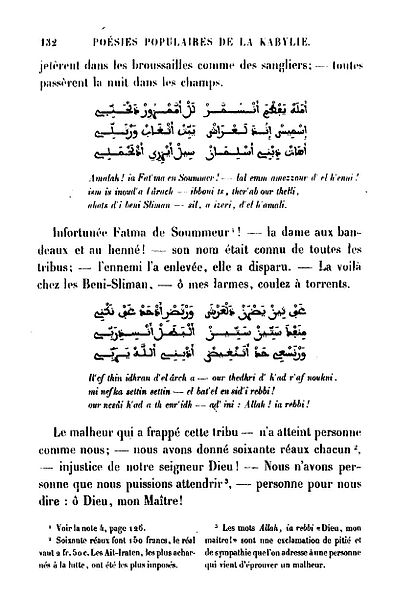
Poem dedicated to Lalla Fadhma N’Soumer (from Poésies populaires de la Kabylie du Jurjura, Paris 1867)
Fadhma N’Soumer, whose influence motivated the freedom fighters, appealed to the people for a last and supreme effort. Surrounded by women of the region, Lalla Fadhma directed the fight and encouraged remaining volunteers. However, they lost the battle, and Fadhma was arrested on 27 July 1857, in the village of Takhlijt Ath Atsou, near Tirourda. The French soldiers destroyed her rich library, which contained a rich source of scientific and religious works from the region. They also spent her fortune, which had been used toward caring for the disciples of her father’s zawiya. Lalla Fadhma N’Soumer died in 1863, from the hardship of incarceration in Béni Slimane, from the news of her brother’s passing, and the frustration from her inability to act against French aggression on her people. She was only 33 years old. The enemy (the French) nicknamed her, the Joan of Ark of theDjurdjura, a comparison that the religious Fadhma never accepted.
To read more about French invasion of Algeria, check out Mediapart. Watch the video below to learn more about Lalla Fadhma N’Soumer (It has 5 parts, and is very instructive). Whenever you think of resistance in Africa, please do remember Lalla Fadhma N’Soumer who by her courage, piety, strength, and charisma was able to defeat the mighty French army, and capture a French marshal/general. Remember that there was a woman who held a rich library of scientific and religious works which was destroyed by the French army (it must have been full of treasures for them to destroy). Remember that this woman served the people, and love them dearly to sacrifice her life for their freedom. Remember, yes, that a woman led men and women to battles, and actually won!






















 African Heritage