Three religious leaders get together and decide to confess their faults and weaknesses to each other so that each prays for the other.
The first says: “My problem is money. I love money too much and I often steal from offerings and tithes. Pray for me because I am not proud of it.”
Relaxed and at ease, the second says: “Mine is women. I love women too much and when I see a woman, I want to sleep with her. I have slept with all the women in my parish. Pray to help me.”
The third starts crying. The other two take two hours to calm him down. Then he finally speaks in tears: “My problem is kpakpato. I don’t know how to keep a secret; so everything you just said, tomorrow everyone will know, even if you pray for me! ”
The original in French is found on Nouchi.com . Adapted and Translated to English by Dr. Y. Afrolegends.com
Very often, our differences are emphasized, rather than our similarities. For instance, our different religions, different political views, different races, different tribes, countries, etc, more emphasis is placed on what divides us, rather than on what unites us: humanity! We are all humans and neighbors on this big planet that is called Earth. In Senegal, Christians and Muslims reinforce their unity and solidarity during the Christian holiday of Easter with the “Ngalakh” dessert. In a country that is mostly Muslim (over 95%), the people of Christian faith share Ngalakh dessert for “Good Friday” with the rest of their community. The dessert has come to symbolize unity and solidarity between Muslims and Christians in Senegal; just like during Eid al-Adha or Ramadan, Muslim families share meat and couscous with their Christian neighbors. Enjoy and learn more about ways that unite us, rather than divide us. Excerpts below are fromAfricaNews.
====
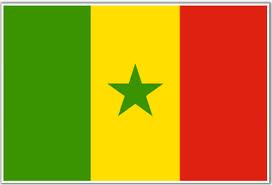
Flag of Senegal
… In Senegal, where approximately 4 percent of the population is Christian, the feverish preparation that started before Easter to be celebrated on 9 April continues unabated. Christian families prepare a special dessert for “Good Friday”, which represents the end of the Great Lent (Careme) fast that the Christian community keeps during the Easter period and coincides with the Friday before Easter Sunday.
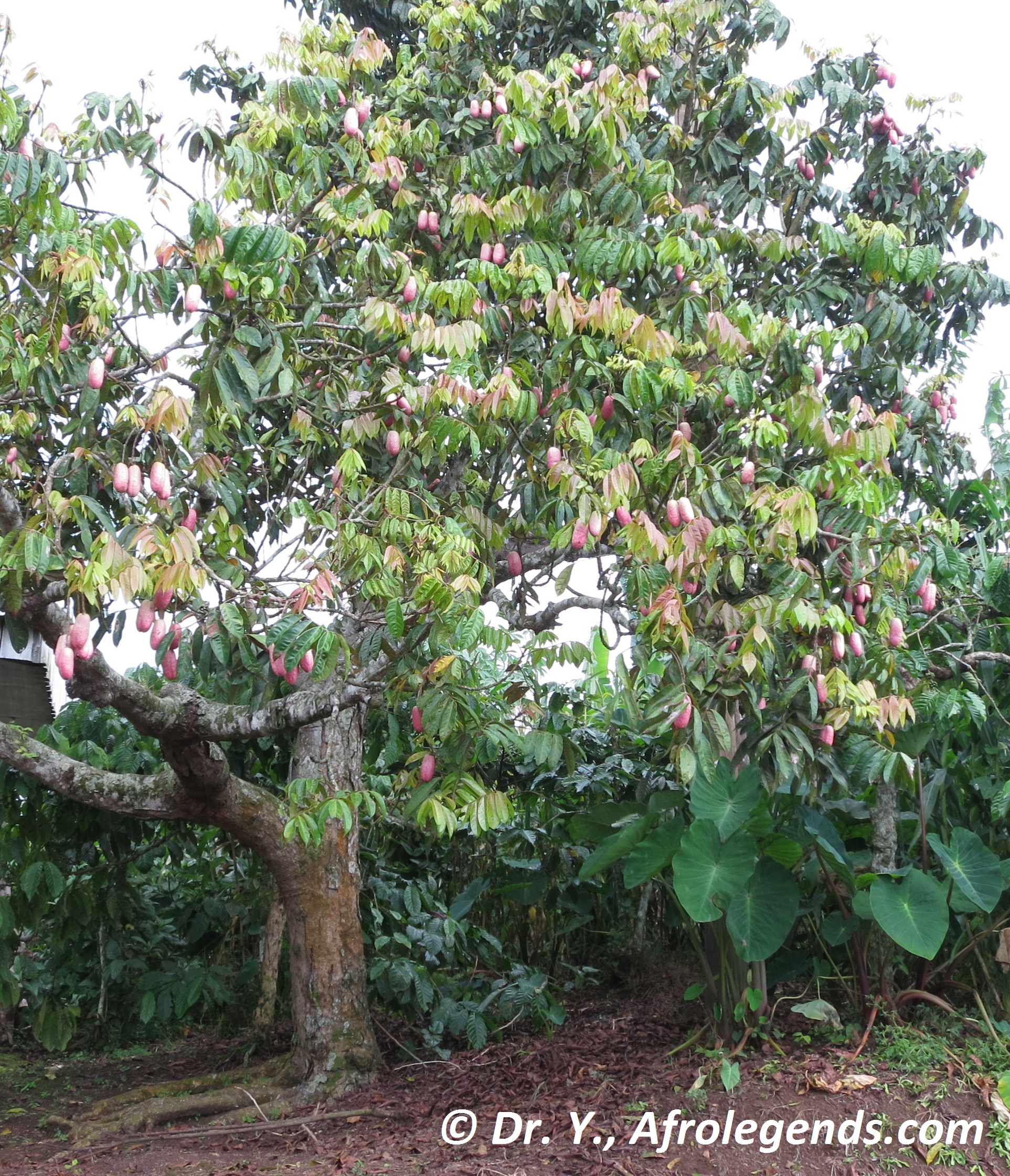
Ngalakh, the first flavour that comes to mind when Easter is mentioned in Senegal, is prepared with “thiakry”, a type of semolina commonly used in West Africa, baobab tree fruit, nutmeg, milk, sugar and peanut cream. Christian families gather early on Friday at the home of a family elder and cook enough Ngalakh for almost the entire neighbourhood. Ngalakh has a liquid consistency and is served with grated coconut, banana slices and raisins.
The young people of the house make a list of Muslim neighbours and acquaintances and distribute most of the dessert to them until Friday afternoon.
Ngalakh, an Easter tradition, is considered one of the symbols of unity and solidarity between Muslims and Christians in Senegal today.
… “This solidarity is unique to Senegal”
… Coly [Adama Manga] said, “In Senegal, everyone respects each other’s religion, no one is in a competition of ‘my belief is superior to yours’. This is a secular country. We live here peacefully together with Christians as well as many sects.“
Have you noticed how nothing lasts anymore? The quality of things has gone down, and the entire society seems to be on programmed obsolescence: even the quality of the roads, furniture, clothing, electronics, etc… everything is focused on profit, profit, profit, and very little on durability, or rather durability for just a few months, enough to buy the next product. We will talk about this programmed obsolescence another day. However, a Kenyan man has found use for old laptop batteries to power bikes. As we are pushed towards electric vehicles, his invention could enable a new way of thinking, focused on recycling and re-using what is readily available, as opposed to creating new waste. This article is not an endorsement of electric bikes, but rather a celebration of ingenuity and new ways of (re)using old things to make new ones. Excerpts below are fromAfricaNews.
====
Paul Waweru is going shopping. He’s on the hunt for old laptop batteries. They cost him just KSH 50 ($0.50) per piece, but this Kenyan high school physics teacher has found an innovative use for the waste product.
They will power bikes. After he collects the items from dealers in Nairobi, he takes the haul back to his workshop. Here, he sorts them, dividing the working cells from those which are not working.
Waweru then assembles them into a battery that can be used to power electric motorbikes. He was inspired to come up with this innovation after running into trouble with a bike he’d bought.
… He’s founded a company called Ecomobilus to supply his laptop-battery powered bikes. He collects frames from old motorbikes, removes the engines and replaces them with a battery and a motor to propel the bike. They run on a 60 V direct current. The batteries take hours to charge but can take 45 minutes if on a fast charger. A fully charged battery can travel a distance of up to 100 kilometres. He says his invention compares very well to traditional motorbikes.
“Ecomobilus bikes are more advantageous compared to other gasoline powered bikes. Number one, because of the cost of maintenance. Ecomobilus bikes require zero maintenance because there are no mechanical parts that need to be repaired every often, we give it at least two years for services because the engines are no longer there, we are dealing with motors,” he says.
A few years ago when we published Dum Diversas or The Vatican’s Authorization of Slavery, many were surprised if not astounded to know that the Catholic Church had authorized and condoned the enslavement of people around the world, the conquest of their lands, the placement of indigenous populations into perpetual servitude, and the genocidal eradication of non Christian populations around the globe. There are still many Catholics today who do not know this! We received quite a few harsh inbox messages about the veracity of our work. Imagine the confirmation we got when last Thursday, March 30, 2023, after decades of indigenous calls, the Vatican itself repudiated the ‘Doctrine of Discovery’ which justified colonialism. A Vatican statement said the papal bulls, or decrees, “did not adequately reflect the equal dignity and rights of Indigenous peoples” and “therefore [the Vatican] repudiates those concepts that fail to recognize the inherent human rights of Indigenous peoples, including what has become known as the legal and political ‘doctrine of discovery.'”
It is not clear what to make out of this “rejection of the ‘Doctrine of Discovery'” by the Vatican. Are we supposed to clap? After centuries of killings, conquistadors killings of indigenous people of Americas, eradication of entire populations, enslavement of African people, land grabs across the globe, resources grab, enrichment, etc. We all know the coffers of the Vatican and European nations are filled with the spoils of these conquests and that their cities and countries were built on the back of all these. We ask again, what are we supposed to do with this “rejection”? Is the Vatican giving back what they took? Will the lands be returned? Words again and again and again… no actions!
The New Scramble for Africa (Source: Source: Dr Jack & Curtis for City Press, National Institute African Studies (NIAS))
As said before, there are no coincidences. There is no coincidence that this comes less than 2 months after the Pope’s visit to Africa, which is said to be the future of the Catholic Church. It is no coincidence that it comes just a few days before the very important Christian celebration of Easter. Could this be linked to the New Scramble for Africa? This New Scramble for Africa needs to be done as before, under the veil of good intentions, purity, and supposed forgiveness; while the impoverished people get ‘honeyed’ out with the ‘rejection’ (just words), the resources get pumped out. Some also think that it is no coincidence that it comes under history’s first Latin American Pope. And You, what do you make of this ‘rejection of the Doctrine of Discovery’ by the Vatican?Excerpts below are from Common Dreams. Please also check out the article in Al Jazeera.
=====
In a historic shift long sought by Indigenous-led activists, the Holy See on Thursday formally repudiated the doctrine of discovery, a dubious legal theory born from a series of 15th-century papal decrees used by colonizers including the United States to legally justify the genocidal conquest of non-Christian peoples and their land.
In a joint statement, the Vatican’s departments of culture and education declared that “the church acknowledges that these papal bulls did not adequately reflectthe equal dignity and rights of Indigenous peoples” and “therefore repudiates those concepts that fail to recognize the inherent human rights of Indigenous peoples, including what has become known as the legal and political ‘doctrine of discovery.'”
Slaves on board a ship
“The church is also aware that the contents of these documents were manipulated for political purposes by competing colonial powers in order to justify immoral acts against Indigenous peoples that were carried out, at times, without opposition from ecclesiastical authorities,” the statement added. “It is only just to recognize these errors, acknowledge the terrible effects of the assimilation policies and the pain experienced by Indigenous peoples, and ask for pardon.”
Indigenous leaders—who for decades demanded the Vatican rescind the discovery doctrine—welcomed the move, while expressing hope that it brings real change.
“On the surface it sounds good, it looks good… but there has to be a fundamental change in attitudes, behavior, laws, and policies from that statement,” Ernie Daniels, the former chief of Long Plain First Nation in Manitoba, Canada, toldCBC Thursday.
“There’s still a mentality out there—they want to assimilate, decimate, terminate, eradicate Indigenous people,” added Daniels, who was part of a delegation that met with Pope Francis last year in Rome and Canada.
… Discovery doctrine is rooted in a trio of papal decrees issued in the second half of the 15th century authorizing the Portuguese and Spanish monarchies to conquer land and enslave people in Africa and the Americas if they were non-Christians and dividing the Americas between the two burgeoning empires.
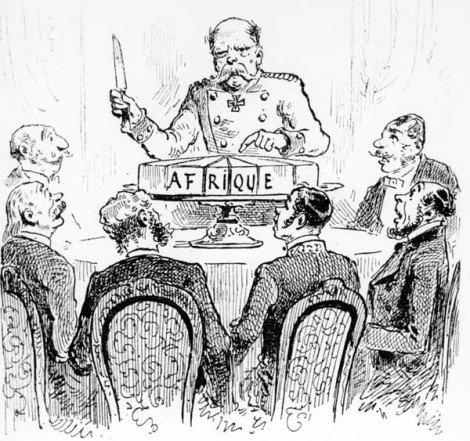
Le partage de l’Afrique à la Conférence de Berlin de 1884
As we talk about neo-colonialism, and the new scramble for Africa, I thought about sharing this poem ‘They Came‘ by Cameroonian writer François Sengat-Kuo published in Fleurs de Latérite, Heures Rouges Éditions Clé, 1971. I had previously shared this poem here. In the poem, Sengat-Kuo talks about colonization and how Africans were fooled by European missionaries who were always preceding European explorers and armies. I particularly like the sentence: “they came, … bible on hand, guns behind.” Jomo Kenyatta, first president of Kenya, said it slightly differently, “When the missionaries came to Africa they had the Bible and we had the land. They said ‘Let us pray.’ We closed our eyes. When we opened them we had the Bible and they had the land.” (Nobel Peace prize Laureate, Desmond Tutu, of South Africa, is said to have popularized the quote). How true! In the days of colonization, Europeans claimed to be bringing civilization and Christianity to pagans across the globe. Today, they bring development, globalization, and democracy… same ol’ thing → submission and slavery to the people. Enjoy!
Recently, I was having a conversation with a friend about leadership in Africa: the endless complaints about our poor leadership, or the killing of our good leaders, and then my friend said talking about Mali, “I wish we had more Assimi Goïta, Choguel Maïga, Abdoulaye Maïga, … on the continent.” Although my heart warmed at this statement, it reminded me that the fight starts at the bottom with each of us. We have to be the leader we want to see; we have to be the Assimi we want to have as a leader. Leadership starts with us, at the individual level. We cannot leave all the task to Assimi or whoever is at the head, we have to do our part; that is the only way to move forward. Otherwise, if something happens to the leader, what will become of our cause? In the article “How do We Continue the Fight when the Head has been Cut Off?”, I wrote, “the prize of freedom is too great to lay on the shoulders of one man, one leader, or a few… we do not follow men, we follow ideas… we are not fighting for men, we are fighting for our right to dignity, our right to humanity, our liberty.“
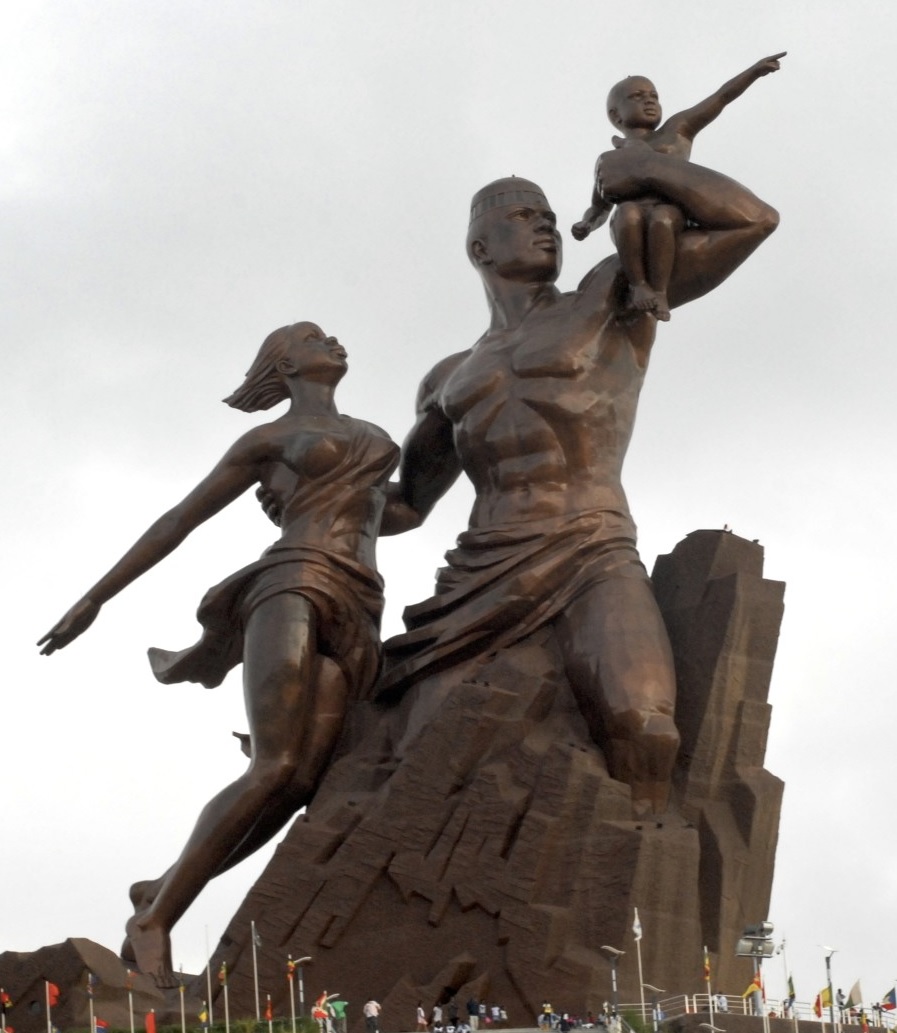
African Renaissance Monument in Dakar (Wikipedia)
Very often it is said among Africans, that we have the leaders we have because that is, at the root, who we are. When you have watched Thomas Sankara, Amilcar Cabral, Patrice Lumumba, Samora Machel, Modibo Keita, Kwame Nkrumah, Ruben Um Nyobe, Felix Moumie, Sylvanus Olympio, Ernest Ouandie, Barthelemy Boganda, Mehdi Ben Barka, Muammar Kadhafi, and many others get assassinated by or in conjunction with foreign forces because of their vision for their countries, it is easy to cower away, and just bend the heads and accept whatever comes in silence. However, cowering in silence, perpetuates the problem endlessly. People often say, we all come on earth and will have to leave at some point, why not leave with dignity? Why cower away? If we start at our level, getting involved in our communities, doing our part (whatever our talents are), being there for each other, do you really think corruption will persist? Let us not wait for Messiahs (and we know how rare those are), but let us start laying the bricks to the foundation of the home we want to live in. If you are an educator, make sure to lay the foundation for the best education possible; if you are a brick layer, do your work with integrity; if you are an okada driver, drive with integrity; if you are a housewife, raise the next leader; if you are a business man, make sure honesty is at the core of your business; if you are a student, arm yourself to be the next leader; … If you want to be led by honest people, then deal with honesty in your daily encounters; if you want to have a transparent government, start with transparency at your level, etc. As my favorite quote by Dr. Martin Luther King Jr goes, “If you are called to be a street sweeper, sweep streets even as Michelangelo painted, or Beethoven composed music or Shakespeare wrote poetry. Sweep streets so well that all hosts of heaven and earth will pause to say, “Here lived a great sweeper who did his job well.” ” We all play a part in this whole that is our homeland, and each one of us is needed!
Thomas Sankara once said in one of his interviews, “if you kill Sankara, you will have a million Sankaras.” Let’s have a million Assimi Goïta, a million Choguel Maïga! Let us have millions of African leaders! Let us have a billion exemplary leaders and more!
The New Scramble for Africa (Source: Source: Dr Jack & Curtis for City Press, National Institute African Studies (NIAS))
American Vice President Kamala Harris is travelling to Africa this week. Her visit comes on the heels of French president Macron’s tour of Africa (Gabon, Angola, DRC, and RC) at the beginning of March, Pope Francis’ visits to the Democratic Republic of Congo and South Sudan at the end of January and February. Less than 2 weeks ago, U.S. Secretary of State Antony Blinkenannounced—during his visit to Niger—that the United States government will provide $150 million in aid to the Sahel region of Africa. Is it a surprise that this aid is going to Niger, country which borders Mali and Burkina Faso? Jill Biden was in Namibia and Kenya in February; and there were many more American envoys crisscrossing the continent. Is it a surprise that the US is increasing the number of its AFRICOM bases in Africa? Just northeast of Niger’s capital Niamey, near the city of Agadez, is Air Base 201, with one of the world’s largest drone bases that is home to several armed MQ-9 Reapers.
Le partage de l’Afrique a la Conference de Berlin de 1884
This sudden open frenzy for Africa reminds us too much of the Scramble for Africa, after the Berlin Conference when Africa was partitioned and shared among European countries. After all, Africa holds over 50% of some of the most valuable minerals in the world, the largest youthful population on earth, and still has the largest mass of arable lands on earth. Truly Africa is the future, and just like during the cold war era when African soil was the theater of the fight between the east and the west, Africa is now once again at the heart of fight for resources. What this does today with Russia, France, the US, China, and all the other nations courting Africa is give Africans more opportunities for better partnerships, or at least deals that actually benefit their populations and not like what France used to do and still does in Africa, exploiting resources for free, not paying taxes to the locals, and not building any schools, hospitals, or even roads. Can Africans unite, and look out for Africa this time around? These promise to be turbulent times, but Africans have to rise up and stand for Africa’s gains, not signing up deals that line up the pockets of only a few, but truly look for the future and the best of our continent. Below is the excerpt about the VP’s visit from the BBC. The American VP promises more investments as usual… they always give aid programs and debt while they take mines, resources, etc… Enough empty promises and paper (valueless) money for resources. Why not teach the people to fish? African people are tired of getting the fish!
====
Map and Flag of Ghana
First it was the US secretary of state who went on a trip to Africa, now it is the vice-president and later in the year the president himself is expected to come.
This flurry of visits by top figures in the US administration reflects a growing awareness that the US needs to deepen its engagement with the continent.
This all comes in the face of growing competition from other global powers, especially China and Russia.
Vice-President Kamala Harris started her nine-day trip in Ghana on Sunday, where she was greeted by drummers and dancers at Kotoko International Airport. She will later go to Tanzania and Zambia.
Ghana, with its focus on strengthening ties with the African diaspora as well as a record of several peaceful democratic transfers of power, provides an ideal launchpad for Ms Harris.
Her trip, according to an official statement, is intended to “build on” December’s US-Africa summit in Washington where President Joe Biden said the US was “all in on Africa’s future“.
But it is that future, boosted by a youthful and growing population as well as the continent’s immense natural resources, that have attracted a lot of other powerful nations vying for influence.
Flag of Ethiopia
While Secretary of State Anthony Blinken’s recent visit to Ethiopia and Niger focused on these countries’ security challenges, the vice-president’s tour will take her to nations facing serious economic problems.
… [University of Ghana Economist and professor of finance, Godfred Alufar Bokpin] told the BBC the interest the US is showing in the country and its debt crisis “is good” but he is worried about what he described as “unfavourable terms of trade” with creditor nations.
… There is a growing sentiment on the continent that Africa should have a free choice in its relationships with the rest of the world.
“Zambia sees the United States in the same way as it sees China and Russia – a friend,” Dr Sishuwa told the BBC.
“When a country turns to China, or Russia, or the US for support, this should not be seen as snubbing one major power bloc or the other.“
He said attempts to seek exclusive relationships with African countries may be counterproductive and unsustainable.
This echoed South African President Cyril Ramaphosa’s comments during a visit to Washington last year when he said: “We should not be told by anyone who we associate with.” …
We have discussed the first genocide of the 20th century, committed by Germany in … Namibia, on African soil. We are not talking about World War II, but instead the real first genocide of the 20th century which almost wiped out all the Herero and Nama people of Namibia, Germany in Namibia: the First Genocide of the 20th Century. It was a campaign of racial extermination and collective punishment that the German Empire undertook in German South-West Africa (modern-day Namibia) against the Herero and Nama people, which took place between 1904 and 1907 during the Herero Wars. Today it is known as the Namibian genocide or the Herero and Namaqua genocide. It was cruel, gruesome, and yet today, many Germans don’t even know that their country had a colonial past! Hello? Germany had 4 colonies in Africa, Togoland (Togo), Kamerun (Cameroon), German East Africa (Tanzania), and German South-West Africa (Namibia), and in most of them great atrocities were committed, yet, it is as if the history annals of the world have refused to acknowledge the humanity of the countless Africans who died. Recently, a German movie producer made a movie to reintroduce the German society to its colonial heritage. Recently, Germany agreed to pay Namibia €1.1bn over historical Herero-Nama genocide, while recognizing the actions as genocide, yet falling short of calling it reparations. Excerpts below are from the Guardian. You will also hear of the painful requests of many families for the return of their ancestors’ skulls (why on earth are these museums still holding onto people’s skulls?) Germany Returns Skulls of Namibians Genocide Victims, Germany Returns Artifacts Stolen From a Namibian Freedom Fighter.
=====
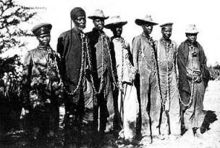
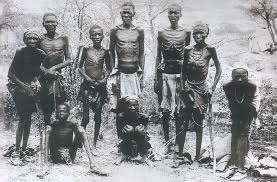
Survivors of the Herero genocide (Wikimedia)
It was one of the darkest eras in German history, and the first genocide of the 20th century: the mass killing of tens of thousands of people in German South West Africa after a rebellion against colonial rule by the Herero and Nama tribes.
More than 100 years later, a feature film about the violence perpetrated by Germany in what is now Namibia explores that brutal colonial past for the first time. Its director hopes Measures of Men will bring the calamitous episode to the attention of ordinary Germans.
“Germany has denied its colonial past for 120 years,” Lars Kraume said, in advance of the film’s domestic release on Thursday. “Most people are unaware Germany even had a colonial past, let alone anything about the brutality of it – it is not even taught in schools.” [Aren’t Africans humans too? are their deaths meaningless?]
… Measures of Men, filmed mainly on location in Namibia using local crew and expertise, tells the story of Alexander Hoffmann – played by Leonard Scheicher – a young, idealistic but wide-eyed ethnologist who questions the evolutionist racial theories of the time, according to which sizes and shapes of skulls determined intelligence. His attempts to rebut the pseudoscientific legitimisation of the superiority of white people over people from the colony of south-west Africa leads him to take first an intellectual and then a romantic interest in Kezia Kambazemi, the interpreter of a delegation of Nama and Herero people who are shipped to Berlin to participate in the Kaiser’s “Völkerschau”, or human zoo exposition.
Despite studying history for his final exams in Germany, Kraume became aware of Germany’s colonial past only when he visited Namibia in the early 1990s, immediately after its independence from South Africa. …
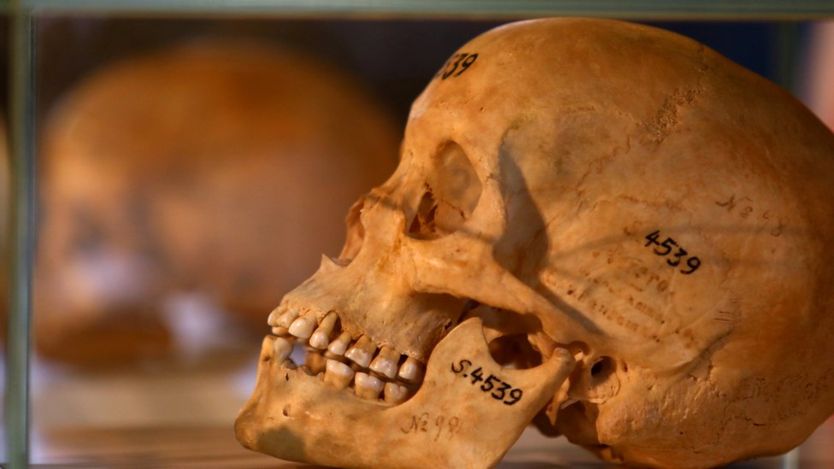
Namibian skulls (Reuters)
Kraume was particularly shocked by the existence of thousands of skulls of people murdered by Germans, which were gathered and shipped to Germany in large quantities and still exist in museums across the country.
“I cannot comprehend the fact that we have these skulls, like artefacts, stored in ethnological museums,” he said. “I cannotunderstand why they are still being kept and have not been given back.
“You ask yourself: ‘Why were the skulls collected in the first place, and why have we not seen fit to give themback?’”
… The film’s relevance to the present day, Kraume said, is also in its depiction of how those in power choose to ignore scientific facts and truth for political gain and in order to maintain the status quo. …
When I was growing up, I was fascinated by images on the television, of women on their motorcycles cruising through the streets of Ouagadougou, the capital of Burkina Faso. Seeing women on motorcycles was always a wonder. It was so refreshing, and seemed like such a simple act, yet a mark of independence. These are not women riding Harleys or fast bikes, but simple women wearing wrappers or boubou (The Boubou: A Traditional African Garment) or Faso dan Fani, everyday women taking their children to school, going to work, etc. Even more amazing is that many of these women are Muslim. It is no secret that women in Ouagadougou love their motorcycles. This means of transportation which particularly boomed in the late 1980s is synonymous with independence, freedom, courage, and near infinite possibilities for the women. After all, for anybody who has ridden on a motorcycle, it feels so freeing to have the wind bashing all over oneself while zipping through the city. Today, the country has trained hundreds of women mechanics.
FESPACO 2023
When Thomas Sankara, the president of the Faso, came in power in 1983, he led a series of changes that emancipated women, bringing them closer to equal rights in the society. It is no wonder that Nigerian filmmaker Kagho Idhebor felt the same way as I did, and was so intrigued by these women on their motorcycles, that he made the documentary”Burkina Babes” which was featured at this year’s FESPACO. Excerpts below are from AfricaNews. Enjoy!
====
‘Burkina Babes’ by Kagho Idhebor
In Burkina Faso’s capital, many ride their motorcycles every day to commute, go to school or move around the city.
In 2020, nearly one Burkinabe in seven owned a motorcycle.
the vehicle is also a tool of emancipation, For women like Valérie Dambré
“This defines the Burkinabe woman, the courage of women. In fact, riding a motorcycle demands courage,” the motorist.
When Nigerian filmmaker Kagho Idhebor first came to Ouagadougou he was blown away by how many women whizzed about on motorcycles. So much so that he directed “Burkina Babes“, a documentary on that. It even ran at Africa’s largest film the FESPACO, the pan-African cinema and TV festival of Ouagadougou.
“I have been to couple of parts of the world and even in Nigeria you see a lot of motorcycles, guys driving motorcycles but I have not seen women in the last country driving motorcycles with so much attitude and very independent and that captivated me, like I was blown away!,” the man in his thirties exlaims.
Since 1977, the Women’s School for Skills Initiation and Training is based in Ouagadougou. It has trained over 700 women to be mechanics and bodywork repairers.
…. During his four years in power in the 1980s, which ended traumatically with his assassination, Sankara “played an emancipating role, breaking down traditional mindsets and thrusting women into the public space, outside the home,” she said. “Young women today were brought up on his ideas.”















 African Heritage