Quoique petit, le poivre est fort par sa saveur piquante (Proverbe Bayombe – Republique Democratique du Congo). – Tout homme a sa valeur, on lui doit du respect.
Although small, the pepper is strong by its pungent flavor (Bayombe Proverb – Democratic Republic of Congo). – Every man has his worth, he should be respected.
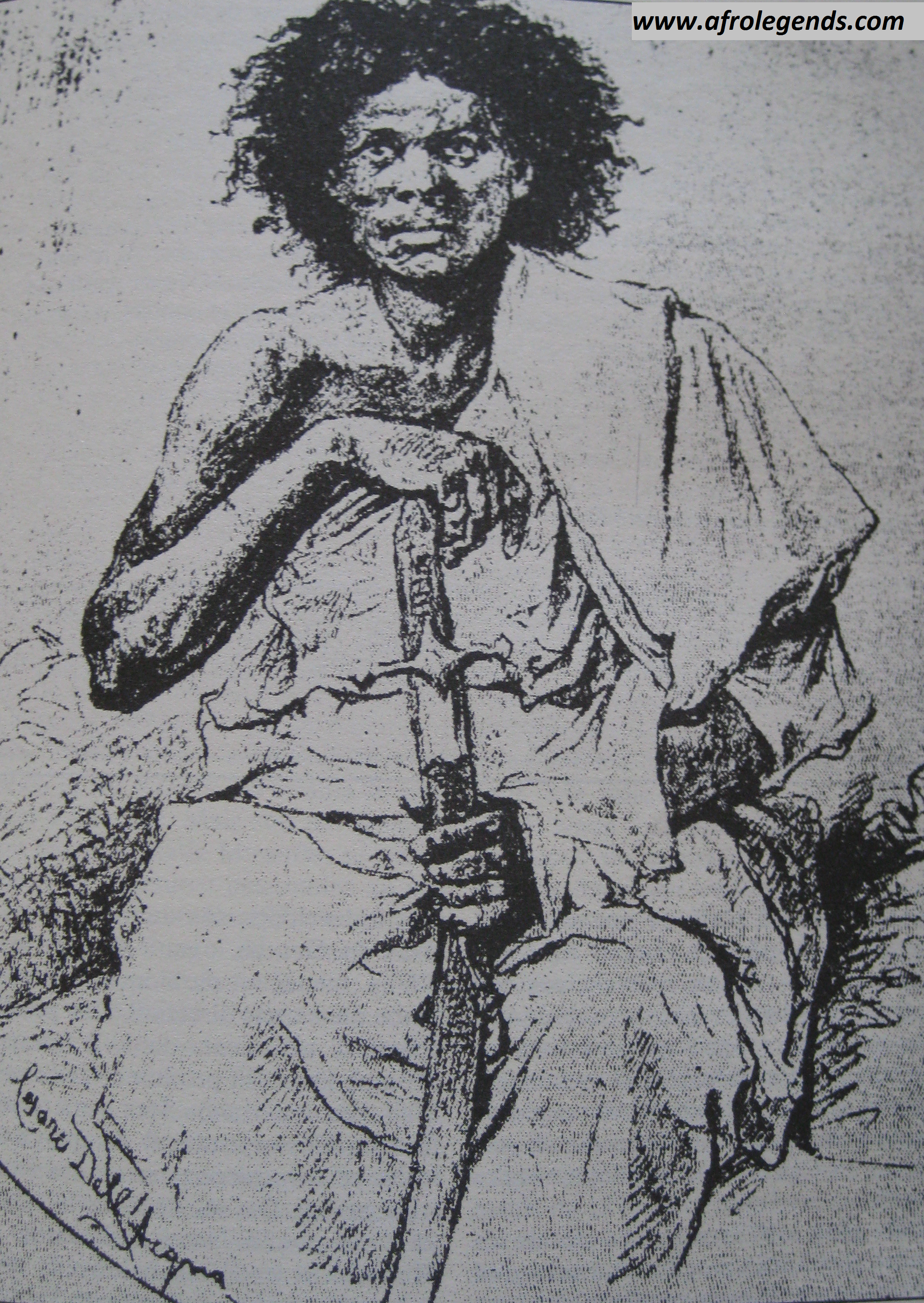
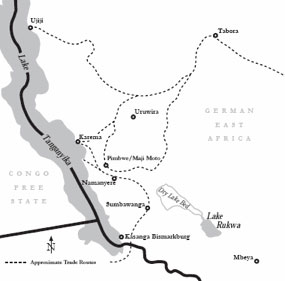
Mirambo, the Black Napoleon (Source: Les Africain, C.-A. Julien, Ed. J.A., Vol, 6, P. 137 (1977))Mirambo’s empire, Urambo (source: Les Africains, C.-A. Julien, Ed. J.A., Vol.6, P. 135 (1977))
Following up on the article on Mirambo, the Black Napoleon or the Black Bonaparte, I propose here a map of his zone of influence after conquest of different regions. I found a map of Mirambo‘s kingdom, the Nyamwezi empire, Urambo, in ‘Les Africains, C.-A. Julien, Editions J.A., Vol. 6, P. 135 (1977).’ You will find his capitals: Iseramagazi and Ikonongo, Tabora, Ujiji, Lake Victoria and Lake Tanganyika the northern and western borders respectively. Enjoy!
Le chien aussi transpire, mais la sueur est absorbée par ses poils (Proverbe Ndebele – Afrique du Sud). – Un travail dur n’est pas toujours remarqué ou apprecié.
The dog also sweats, but its sweat is absorbed by its fur (Ndebele Proverb – South Africa). – A hard work is not always noticed or appreciated.
Today, I will talk about Mirambo, the man the explorer Henry Morton Stanley first referred to as a bandit, and later on as the Napoleon of Africa for his military prowess. Who was Mirambo?
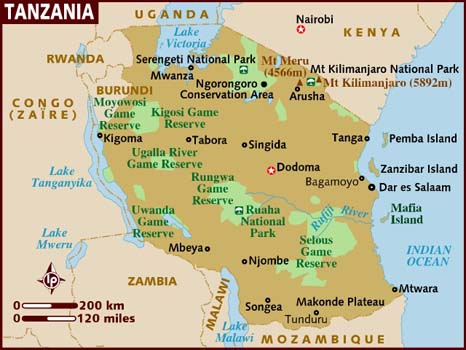
Map of Tanzania
Born Mbula Mtelya, Mirambo is the man who revolutionized nineteenth century Tanzania, and made it hard for the Germans to conquer the region: he united the numerous Nyamwezi tribes, and gained control over Swahili-Arab trade routes. Mirambo was the leader of the Nyamwezi people on a 200,000 km2 territory south of Lake Nyanza (Lake Victoria), and east of Lake Tanganyika. He was not a vulgar chief of brigands as the Arab traders made Stanley believe in 1871, but his links to different families of Ntemi(kings) were a little bit blurred as many historians had mixed up dynastic and genealogical lineages, different in a matrilineal system such as that of the Nyamwezis. In 1858, Mirambo managed to inherit the chiefdom of Uyowa from his father, Kasanda, who was a renowned warrior; he was only 18 years old. In 1860, he joined two chiefdoms located 100 km west of Tabora, in the kingdom of Unyanyembe. He learned the Ngoni language (Ngoni people trace their origin to the Zulu people of KwaZulu Natal), as well as their military techniques. Later in 1860, he conquered the neighboring territory of Ulyankuru.
Map of Mirambo’s kingdom
He then moved his capital to Iseramagazi where he built a Boma, a fortified residence, with walls made up of dry bricks, retrenchments and hedges of euphorbia flowers. From his father and mother, he was a descendent of Mshimba (lion), the last ruler of the legendary kingdom of Usagali, and Mirambo was thus recreating the old empire. Thus in 1860, he created a new Nyamwezi state, the Urambo, from the name he had adopted for himself, ‘corpses‘ in kinyamwezi, Mirambo. From 1860 to 1870, he strengthened his authority along the banks of the river Gombe, i.e. on the road to Ujiji, thereby threatening to block the Arab commerce in the area. In 1871, he defeated the Arab traders at Tabora. The Sultan of Zanzibar, Barghash bin Said, retaliated by sending 3000 soldiers (2000 Swahili, and 1000 Balutchi). Mirambo’s resistance was one of the most fierce: Nyamwezi’s fighters would go as far as melting their copper bracelets to make bullets for their guns. A compromise was made to keep commerce flowing with the coast: caravans could pass after paying a tax (hongo) to Mirambo.
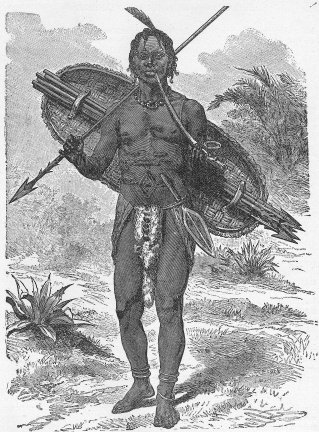
Illustration of the Ntemi of Urambo, Mirambo (from James William Buels Heroes of the Dark Continent (1890))
Every year, during the dry season, Mirambo would dispatch his ruga-ruga in all directions to continue the expansion of his territory. From 1876 to 1878, the territory was expanded to the north, up to the southern banks of Lake Victoria. From 1879 to 1881, expansion to the west toward Uvinza, for the control of Lake Tanganyika. The Muhambwe of King Ruhaga fell under Nyamwezi domination, and the Ruguru of King Ntare had to seek protection from Mirambo and agree to the presence of a ruga-ruga post on the eastern border of his kingdom. In 1879, there was also the expansion towards Burundi. His alliance with the Ngoni fell apart in the early 1880s. He was greatly hated by the Arabs who used to dominate the commerce in the region, and other neighboring kings who feared him, and the Europeans who saw in him as a powerful adversary. After 1881, the Arabs managed to convince the International African Association (AIA – Association Internationale Africaine), a European power created under King Leopold II’s initiative to inflict an embargo on arms and munitions on Mirambo (yup… European unions already inflicted embargo on arms back then). The goal of the AIA was to “open up central Africa to civilization.” At first Mirambo’s army succeeded in entering Burundi by surprise using a feud between the local king and his brother, but in 1884, his army was defeated by Burundi warriors (aided by Ngoni warriors). After his defeat in Burundi, and another defeat against the alliance of the Arabs and the Ntemiof Bukune, Mirambo’s troops were led by Mpandashalo as he was increasingly sick. Mirambo died on 2 December 1884.
Flag of Tanzania
Mirambo was a strong and ambitious leader. He expanded his authority and influence over a number of Nyamwezi chiefs. One of his challenges was to devise a political system that would allow him to consolidate his power, while ever expanding his territory. For that, he made sure not to change the structure of the Nyamwezi’s society: once in power, he would usually choose a successor from the same family. As long as the new chiefs pledged allegiance to him, they would be left to go about their political duties. The conquered chiefs had to provide troops at all times. His greatest strength was military. He used surprise as a tactical ploy. His capital was both a military and economic center. He had two residences: Iseramagazi from 1879, and Ikonongo from 1881.
Mirambo was actually a simple man, deeply rooted in his culture and traditions, but also very curious of the world. He was a man of order and progress, who will set the price of commodities in the capital’s markets, and regulated the consumption of alcohol in his kingdoms (he thought that alcohol weakened societies – just like Gungunyane), and meditated on the decadence of Africa in the 19th century. He was nostalgic of the magnificent ancient African capitals, and kingdoms. In essence, Mirambo had 4 faces: the traditional king, the warrior leader, the state builder, and the modernizer. To learn more, go to: ThinkAfricaPress.com, BlackPast.org, and Les Africains, Vol. 6, editions J.A, C.-A. Julien, P. 127-157, (1977).
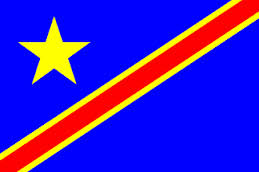
Map of the Democratic Republic of CongoFlag of the Democratic Republic of Congo
I would like to introduce you to the African version of Robocop, or rather the Congolese version of Robocop. This is a traffic cop invented by two women engineers from the Democratic Republic of Congo, one of them is Thérèse Inza. This cop regulates the traffic, and even gives tickets to the cab drivers, and those who do not want to follow the code of the road. The robot is 100% Congolese, and financed by the Women Technology association, the association of Congolese women engineers. Its name is “Robot Roulage” in reference to the name given to traffic cops (policier roulage); it is 2.5 m tall, and is fully autonomous, functioning with solar energy. It was first installed at the Boulevard Lumumba in Kinshasa. I just loved its Congolese accent… it was just music to my ears. Enjoy the Congolese RoboCop!
Un chat poursuit une souris qui se refugie dans un trou. Le chat ayant très faim l’attend pendant plusieurs jours. Un jour de sa cachette, la souris entend des aboiements. Rassurée, elle sort et le chat bondit sur elle. “Mais,” demande-t-elle au chat, “tu es un chat et tu aboies ?” Le chat répond : “Ben oui, tu sais pas que les temps sont durs maintenant ? Je suis devenu bilingue.”
============
A cat runs after a mice which seeks refuge inside a hole. The cat being very hungry, waits for it several days. One day, from its hole, the mice hears barking. Reassured, she steps out of her hiding place, and the cat jumps on it. “But,” she asks the cat, “ you are a cat and you bark?” the cat answers “oh yes, don’t you know that times are hard now? I have become bilingual.”
Ever wondered why a country would be carrying the same name as its capital city? Well … I always wondered what was the meaning of Djibouti, and then why the country carried the same name as its capital city.
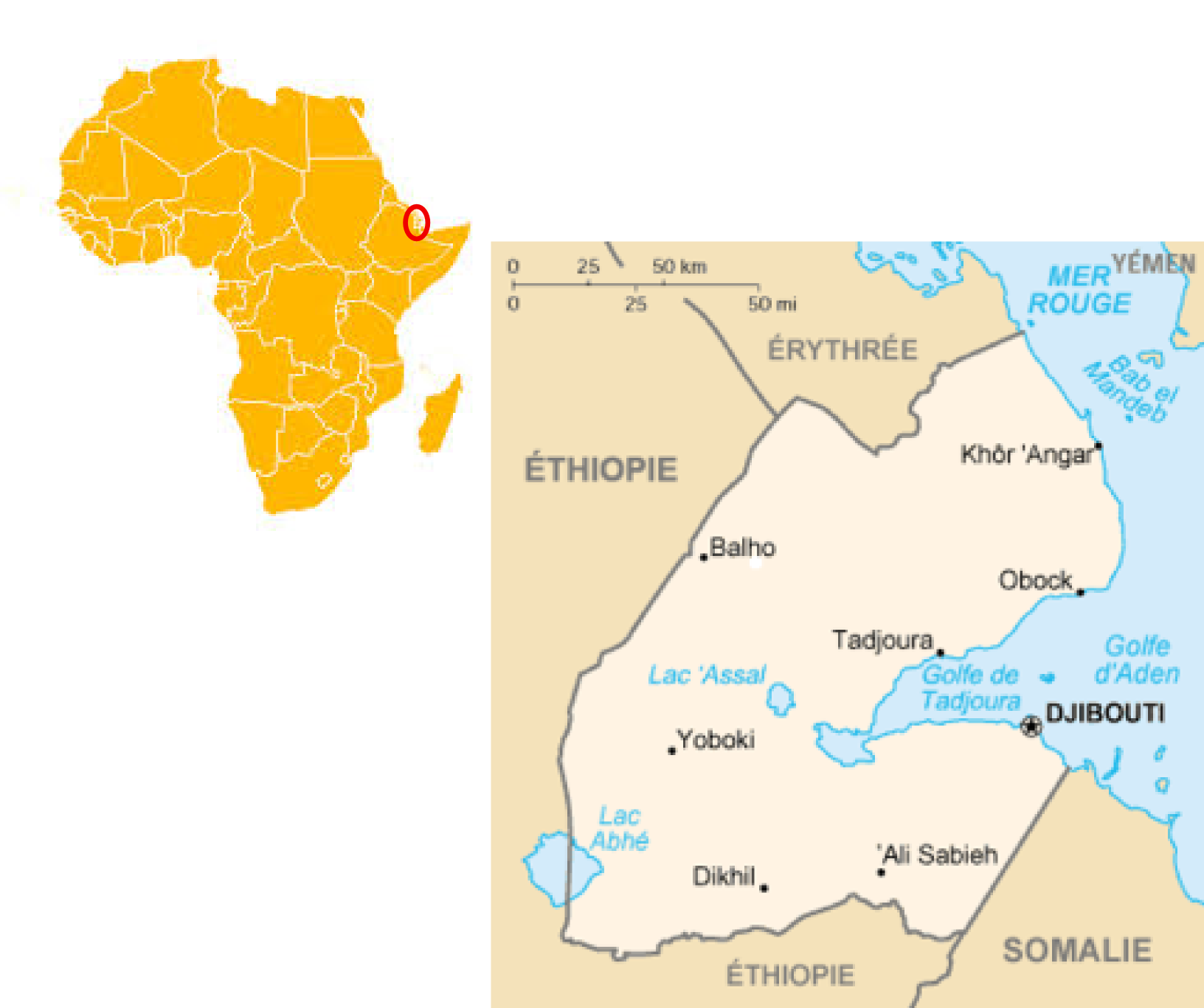
Located in the coastal Djibouti region on the Gulf of Tadjoura, Djibouti is known as the Pearl of the Gulf of Tadjoura. The origin of the name Djibouti is very controversial. However, there are two versions which are more or less plausible.
The first one is based on an ancient Issa legend whereby the name Djibouti (Jab Bouti) came from a fabulous animal Boutiwhich used to live in those areas and was a ferocious beast killing goats, and sheeps, and terrorizing people. After a relentless hunt, the men defeated the beast, and named the area Jab Boutior the Bouti’s defeat.
The second version comes from the Afar people. The Afar named the current region of Djibouti Gaboodfor plateaux or uplands; there is the thought that the Afar word gabouti, meaning “plate“, was possibly referring to the geographical features of the area. The Arab sailors called it Gabouti, and later on, the French turned it into Djibouti.
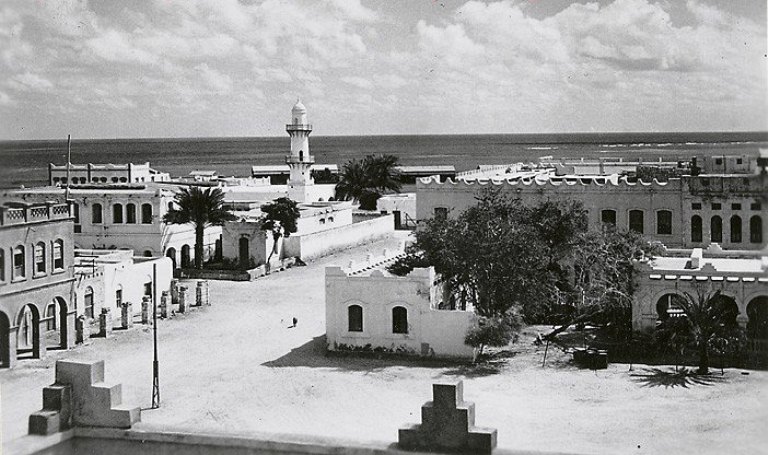
Djibouti in 1940 (Source: Wikimedia Commons)
As you read these two versions, you realize quickly that Djibouti is the land of two main groups: the Issa and the Afar. From 1860 to 1894, the region north of the Gulf of Tadjoura was known as Obock, and was ruled by Issa Somali, and Afar Sultans, with whom the French signed several treaties to start the colonization of the area. That is why they (the French) later (between 1967 and 1977) called it the French Territory of the Afars and Issas (Territoire Français des Afars et des Issas (TFAI)). The French founded Djibouti city in 1888, and later made it the capital of French Somaliland in 1896. In the 1900s, the city considerably grew in size thanks to the construction of the Imperial Ethiopian Railway which linked Djibouti to southern Ethiopia and the Ogaden.
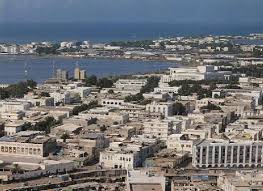
Djibouti, today (Placesbook.org)
Djibouti city is strategically positioned near the world’s busiest shipping lanes (the Red Sea and the Gulf of Aden) and acts as a refueling and transshipment center. The Port of Djibouti is the principal maritime port for imports to and exports from neighboring Ethiopia. Additionally, the city hosts a number of foreign embassies, foreign military bases (French, American, German, Japanese, etc), and is the headquarters of many international organizations, non-profit organizations and companies. Djibouti-Ambouli International Airport is the main domestic airport, connecting the capital to various major global destinations. Since 1977, the city has served as the capital of the Republic of Djibouti. Together with northern Somalia, Eritrea, and the Red Sea territory of Sudan, the Republic of Djibouti is thought to be the most likely location of the land known to ancient Egyptians as Punt (the “Land of Tehuti“, or “Land of Thoth“, after the Egyptian Moon God), a kingdom which had close ties with Ancient Egypt during the reign of Pharaoh Sahure and Queen Hatshepsut.
As I live you with this video of the pearl of Gulf of Tadjoura, Djibouti, I would like to ask this question: which of the two legends, in your opinion, is closer to the real origin of the name Djibouti?
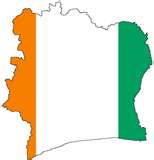
In memory of the victims of the post-electoral crisis of 2011 in Côte d’Ivoire, I selected this movie titled “A minute of silence from Côte d’Ivoire” for you. Everyone remembers those days in early April 2011, and in particular 11 April, when the planes of the ONUCI and the French army bombed all strategic sites in Abidjan including the military camps, the TV station, and the presidential palace, killing thousands, and dragging the president out like a mere bandit. Now, to have just one side of the post-electoral crisis present at the International Criminal Court (ICC) in The Hague is simply a farce! To have Laurent Gbagbo and Charles Blé Goudé at the Hague is a farce, when we all know that the violence grew out of a contentious presidential election between two parties. Where are Alassane Ouattara and Guillaume Soro? It is also sad to note that only Africans are being judged at The Hague, when crimes were also committed in Irak, Afghanistan, Syria, etc. This video is to all the victims of the post-electoral crisis of Côte d’Ivoire, to all those who stood for their convictions, to all those who believed in casting a peaceful vote, and to all those who believed in their beautiful country, peace to all.












 African Heritage