I would like to share with you letters from Ndate Yalla Mbodj, the last Lingeer (Queen) of the Waalo, addressed to the French Governor of Senegal in the 1850s. These are treasures from history, and I thought it very interesting to translate them from French to English. Reading these letters, one can see the duplicity of the French who would take lands from the Waalo people without asking, and will treat the people of the Waalo with great disdain. These are from the National archives of Senegal. For the French version, visit: Seneweb.
=========
National Archives of Senegal 13 G 91
Correspondence of the Kings of the Waalo
Letter number 85 received by the governor
of Saint Louis on May 23rd, 1851
Ndatte Yalla to Mr. the Governor,
The goal of this letter is to let you know that the island of Boyo* belongs to me, from my grandfather down to me today. There is nobody who can claim that that country belongs to them; it belongs to me only. I did not sell this country to anybody. I did not entrust it to anybody, nor to any white person. The people to whom I entrusted my land have to right to do anything to it, I will have nothing to say. Nobody can take this land without their authorization; to prove to you that this letter comes from me, when the dispute had been settled in Lampsar, you went back to the fort. There I came to see you with my husband, you were accompanied by Mr. Alsace and de Bamar, you told me that you wanted to see me alone to talk, I told you that there was only my husband and brother present.
You also asked me who was the King of the Waalo today. I replied that the King of the Waalo was me. If this is true, and this letter comes from me, I desire that no one should take possession of my territory.
The island of Boyo is located in Mauritania, 15 km north of Saint-Louis in Senegal. It houses the village of N’Diago. It is the cradle of the Boye family of Saint-Louis.
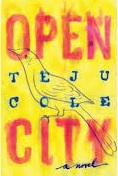
I really liked what Nigerian writer Teju Cole had to say about fighting rape culture, and how it should be a fight for all mankind, because when women are dehumanized, the entire society is. The author of Open City reacts to the Bill Cosby’s controversy in a very articulate manner, and we should all take the time to read it. Enjoy! For the entire text, visit the New Inquiry website, where it is titled ‘Improving on Silence’ by Teju Cole.
=========
Last night, reading the accounts by women who had been assaulted by Cosby, I was overcome with sorrow.
Tricky to say anything about this, but silence is simply not an option. This is everybody’s business. But I’ll say some things to the men who are reading.
“Open City” by Teju Cole
We men benefit, all of us men benefit, from rape culture. We benefit from the pain it causes women because we sprint ahead obliviously; we benefit from the way it knocks them off circuit and opens space for us; we benefit from the way it dehumanizes them so that our own humanity can shine more greatly; and we benefit from the aura of power it gives us as perpetrators or as beneficiaries. And because we benefit, explicitly or implicitly, we are not vociferous enough in our opposition to it. […]
We must fight rape culture, even in its allegedly mild manifestations, we must be grieved with the grief of those who commit the crime and those who benefit from a world built on such crimes, we must oppose men who wade in with stupid explanations and caveats and distractions, we must surrender the poisonous sentimentality that makes us believe a “great artist” over a less well-known woman. Indeed, we must be willing to let anyone go—think of any man you admire, any man at all, alive or in history, close to you or far away, and think to yourself that you must be willing to let him go—if such things are true of him too. And understand that such things can be true of any of them, of any of us. […]
And above all we must listen, to women, and to the significant but vastly smaller number of men who have also been assaulted. So that, gradually, we can collectively begin to slough off this wretched state of affairs in which the first thing someone who has been assaulted thinks is “no one will believe me.”
That’s to men.
And to women: I believe you. And I’m heartbroken about the many ways in which I fail to live up to that belief.
I really enjoyed South African law student, humanitarian, and poet Puno Selesho‘s TEDx Pretoria 2015 speech on “raising up a super-humanity”. I simply loved the way she recited her poem, full of energy, and emotions, and above all ready to empower humanity. Enjoy and rise up to be the Super-human you are meant to be!
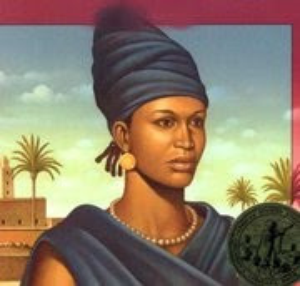
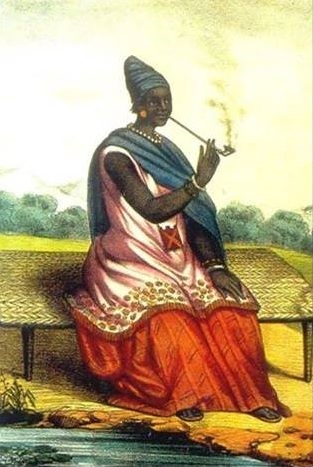
Queen Ndate Yalla Mbodj (from the cover of Kings and Queens of West Africa, by S. Diouf)
In 1855, when the French arrived to colonize Senegal, the first power of resistance they encountered was a woman. Her name was: Ndate Yalla Mbodj. While in France, women were not recognized as citizens until 90 years later, the French were stunned by this woman of beautiful stature, face, and strong body, and who headed an immense army. She was a beautiful and proud warrior, who inherited a rich tradition of bravery and gallantry.
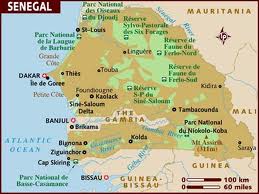
The Lingeer or Queen Ndate Yalla Mbodj (1810 – 1860) was the last great queen of the Waalo, a kingdom in the northwest of modern-day Senegal. She was a heroine of the resistance against French colonization and Moors invasion. She was also the mother of Sidya Leon Diop or Sidya Ndate Yalla Diop, who went on to become one the greatest resistants to the colonization of Senegal.
Map of modern-day Senegal
Queen Ndate succeeded to her sister Ndjeumbeut Mbodj. She was officially crowned Queen of the Waalo on October 1st 1846 in Ndar (now called Saint-Louis), the capital of the Waalo. Her reign was marked by an ongoing defiance of the French against which she fought a fierce battle. By 1847, she opposed the free passage of Sarakolé people by sending a letter to the governor expressing her willingness to defend the respect of her sovereignty over the valley in these terms: “We guarantee and control the passage of cattle in our country and we will not accept it the other way. Each leader governs his country as he pleases.“
Warrior from the Waalo Kingdom, 1846
She fought both the Moors who happen to encroach on her territory, and the colonialist army led by Louis Faidherbe, the butcher, and bandit, who later became governor of Saint-Louis and colonial head of administration and army. Almost 10 years into her reign in 1855, she encountered the greatest colonialist pirate Faidherbe, with an army of 15,000 strong, fully armed and ready to fight her, dethrone her, and colonize Waalo and Senegal. Faidherbe defeated her army in bloody battles, before capturing Saint-Louis. In February 1855, while the Faidherbe’s troops were entering the Waalo, the Lingeer spoke to the principal dignitaries of her country as such: “Today, we are invaded by the conquerors. Our army is in disarray. The tiedos of the Waalo, as brave warriors as they are, have almost all fallen under the enemy’s bullets. The invader is stronger than us, I know, but should we abandon the Waalo to foreign hands?” (Aujourd’hui nous sommes envahis par les conquérants. Notre armée est en déroute. Les tiédos du Walo, si vaillants guerriers soient-ils, sont presque tous tombés sous les balles de l’ennemi. L’envahisseur est plus fort que nous, je le sais, mais devrions-nous abandonner le Walo aux mains des étrangers?) … “This country is mine alone!”
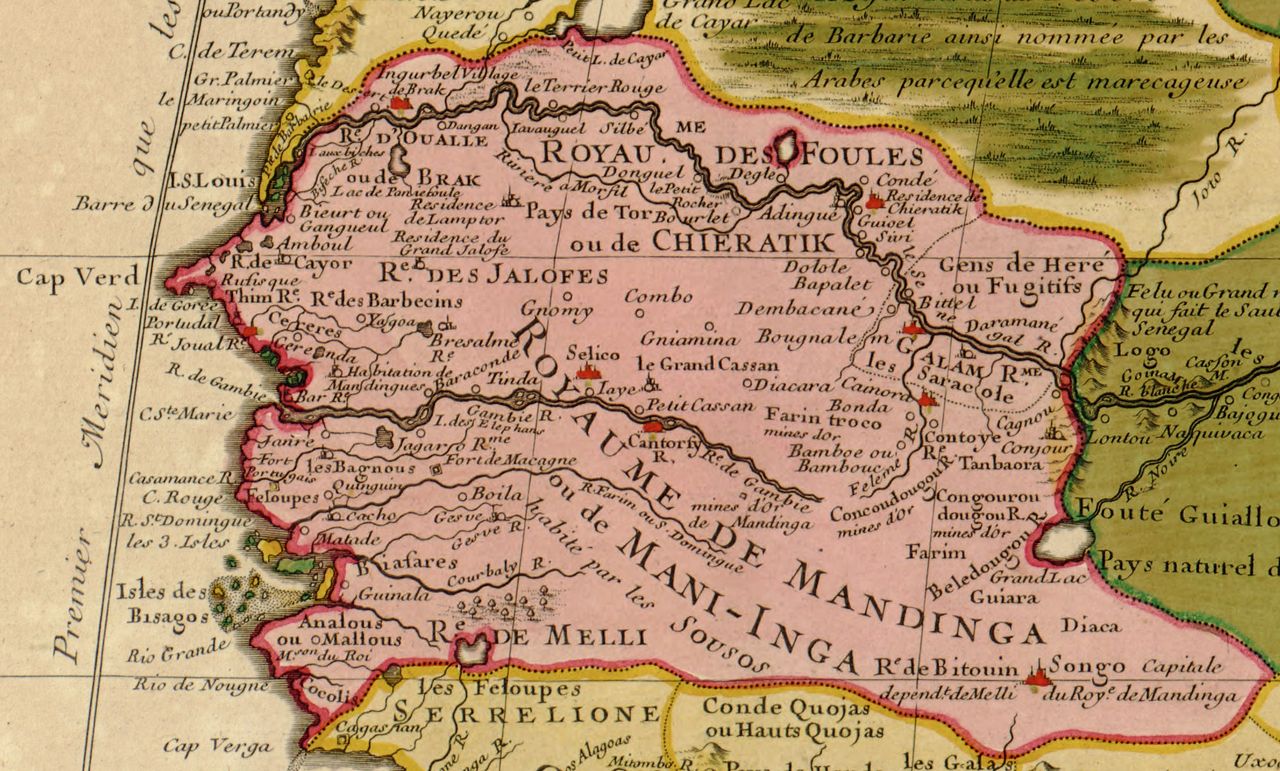
She eventually lost the battle, but not the war; which continued to be a war of resistance until the early part of the twentieth century by Lat Dior Diop, and many other ‘Gelewars’. This conquest would forever change the trajectory of her reign and the geopolitical, military, and geographical road map of Senegambia, “Ganaar” (now called Mauritania), Mali (formerly called French Sudan), and Fouta.
Senegambia in 1707, with the Kingdom of Waalo written as ‘R. d’Oualle ou de Brak’
Her father was Brak (King) Amar Fatim Borso Mbodj, and mother was Lingeer (Queen) Awo Fatim Yamar Khuri Yaye Mboge. Her son, Sidya Leon Diop, who would later too become an anti colonialist, and fight the French until his capture, and exile to die in Gabon in 1878. Her son Sidya was captured as a hostage in Saint-Louis by General Faidherbe during their bloody war with Ndate, and was baptized ‘Leone’ and sent to Algiers for schooling in 1861. When he returned to Senegal two years later in 1863, he was enlisted in the French colonial army; the first African or Senegalese to hold such a post. But as the saying goes —like mother, like son, he refused to do their dirty job of joining forces with the European colonial foreigners and mercenary apparatus, against his mother’s kingdom and people. He then changed strategy and rallied with Lat Dior Diop and others, which resulted in his betrayal, and capture by the colonial forces; and exile to Gabon (just like Samori Toure).
Ndate Yalla Mbodj
Queen Ndate Yalla Mbodj, as a true ‘lingeer’, developed the women’s army as one of the most formidable forces to recon with in her reign. The story of this Senegambia Queen is best amplified in oral tradition by the local griots. Her women army was similar to the “Amazon” women army of Benin, Behanzin’s fearless protective women’s army. She later went into exile in Ndimb in the northern part of the Waalo and died in Dagana, where today a statue has been erected in her honor (the only one erected in honor of a queen nationwide). To learn more, check out: Maafanta.com, Matricien.org, au-Senegal.com; the book Kings and Queens of West Africa by Sylviane Diouf has an entire chapter dedicated to this great queen.
Most people have heard of Stevie Wonder, the American blind R&B virtuoso, who was discovered at the tender age of 11. Most people versed in classical music have probably heard of the Italian classical tenor Andrea Bocelli, who was born with poor eyesight, and turned blind by the age of 12. But how many of you have heard of the Cameroonian blind singer André Marie Tala who influenced an entire generation of Cameroonian and African artists? the singer who was even plagiarized by the mighty James Brown?
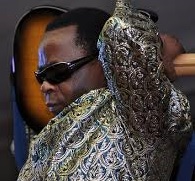
Andre Marie Tala and Sam Fan Thomas (Source: Rfi)
To those who visit my blog, you have probably listened to two of his classic songs, which are odes to some of Africa’s beautiful capitals: Yaoundé, and N’Djamena, the capitals of Cameroon and Chad respectively. Only after I wrote about N’Djamena did I realize that André Marie Tala had performed at the Olympia (with Sam Fan Thomas, another giant of Cameroonian music) on May 17th to celebrate his 45year anniversary in the music industry.
André Marie Tala
Unlike all the singers cited earlier, Tala plays the guitar. Born in the mountains of the Western province of Cameroon in 1950, Tala loses his mother at the tender age of 4, and then his father at 16. He totally loses sight at the age of 15, and will be taken in by his grandmother. He builds his very first guitar with threads made out of nylon, and bamboo, and works on reproducing sounds from his favorite musicians. He starts his first group, the Rock Boys, with which he goes on to have immediate success. The Rock Boys later morphed into the Black Tigers in 1967 with his friend, guitar player, Sam Fan Thomas. At the age of 20, he moves to Paris and collaborates with the great Cameroonian saxophone player Manu Dibango; he lands his first big musical contract. Thus were born the titles Sikati, Po tak Si nan(laissez Dieu tranquille ! – leaveGod in peace), and Namala Ébolo. Big success! Po tak Si nanis a mixture of soul, jazz, and rhythm n’ blues, blend in with a mix of Cameroonian musical styles such as Makossa and Bikutsi. Tala calls his style “Tchamassi”.
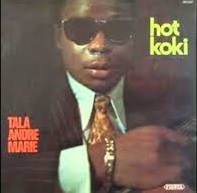
The album “Hot Koki” by André Marie Tala
In 1973, his album “Hot Koki” knows international success, and his single “Hot Koki” is even plagiarized by the great James Brown under the new title “The Hustle”. In 1978, after 4 years of judiciary struggles, Tala is awarded justice, and James Brown is condemned to pay him back all his rights.
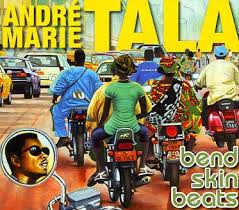
The big themes of Tala’s music are peace, love, and harmony. In the 90s, he brings Bend Skinto the forefront of Cameroonian music, a folkloric fusion of styles from the grasslands of Cameroon. It is often associated with the moto-taxis which are called by the same name Bend-Skin.
Album of André Marie Tala
By choosing the Olympia (the quintessential stage for music in France), for his musical jubilee, André Marie Tala wants to launch a new beginning for the Cameroonian music which has always been rich and influenced millions, but for the past decade has stagnated. Happy 45th-anniversary to Andre Marie Tala, and to many more albums of great music. I live you here with one of my favorite Tala’s song, Nomtema. Do not forget to check out “HOT KOKI” and check out the similitude with James Brown’s “THE HUSTLE“; it is the same, just in English!
I was first introduced to B.B. King‘s music by my father. As a child, what impressed me was not just my father’s love for good music, but his love for Blues, and in particular for B.B. King’s music. I mean, when you listened to the way the king played that guitar of his, you were instantly projected to another dimension. His voice touched your soul. He created a unique genre mixing country blues to big-city rhythms, recognizable by millions across the globe, and when he touched that stinging guitar of his with a shimmering vibrato, notes just leapt out. His biggest hit, “The Thrill is Gone” was a magnificent poem of love, pain, and perseverance written after his second divorce; and that is true of most of his other hits. His songs deeply connected with human emotions at their core. He influenced some of the world best guitarists: Eric Clapton, Jimi Hendrix, and U2, to name just a few. The NY Times and BBC had a good article about B.B. King, the maestro… don’t forget to check out his Official website. I always dreamed of seeing him on stage… never had the chance. Enjoy “The Thrill is Gone” by B.B. King, the King of Blues.
Ethiopia is known as the cradle of humanity, but also as one of the best stables for long distance runners in the world. Ethiopia has produced a lot of super stars of the long distance running, but one who stands out above all is Haile Gebrselassie, the king of the distance. As a child, I remember being glued to the TV waiting to watch Haile’s performances. It was like watching a maestro at work. I loved seeing him run the whole 9600 m, then sprint through the last 200-400 m like he had just started the race. Gebrselassie has inspired me, and thousands of youths to run. We have all dreamed of running the distance the way he ran.
Haile Gebrselassie, of Ethiopia, defeating Paul Tergat of Kenya in the 10000 m run at the Sydney 2000 Olympics in a historic finish.
So it is with sadness that I learnt of Gebrselassie’s retirement from competitive running. I am delighted to have had a chance to see him in his prime years, and watch him transition from 10000 m to marathon running, and there still express perfection. Truly, everything he did in his running was done with perfection, striving to be the very best every stride he took, and that is the message to everyone out there: strive for perfection, strive to do the very best you can in everything you do, every single day. To that effect, Gebrselassie said: “You need three things to win: discipline, hard work, and, before everything commitment. No one will make it without those three, sport teaches you that;” and “When you run the marathon, you run against the distance, not against the other runners, and not against time.” I am leaving you with the article I wrote three years ago about him, and with this great video on some of his accomplishments.
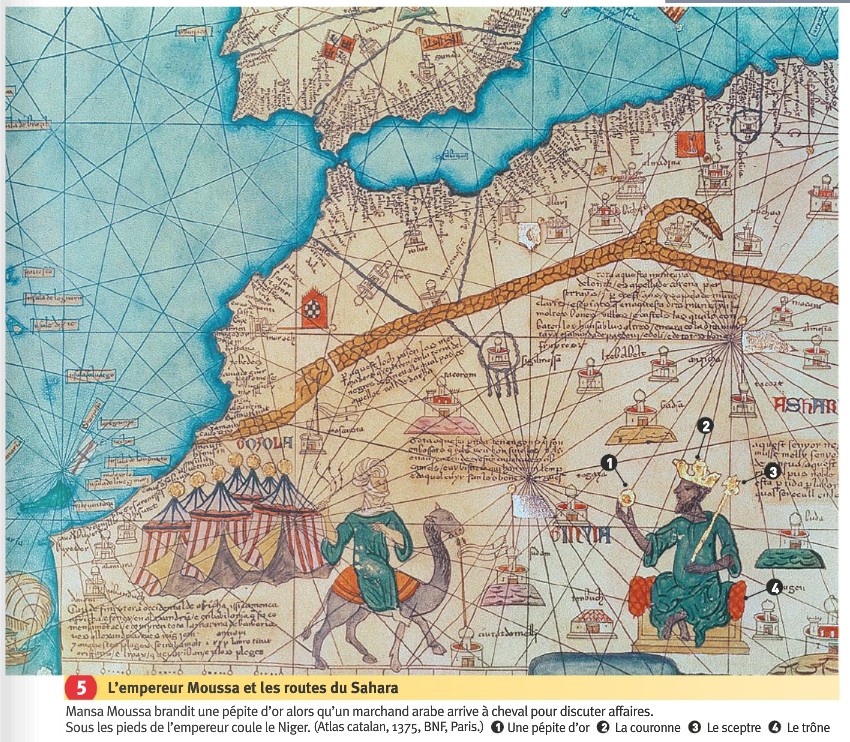
Today, I would like to talk about the richest man planet earth has ever seen… yes, you heard me right, the richest man whose fortune was estimated to be over 400 billion dollars, or 310 billion euros. Did you guess who that was ? If you thought Bill Gates, I am sorry to disappoint you. It is the great Emperor of Mali, Kankan Musa, also written Kankan Moussa, or Mansa Musa, or MansaMoussa, or KankouMoussa.
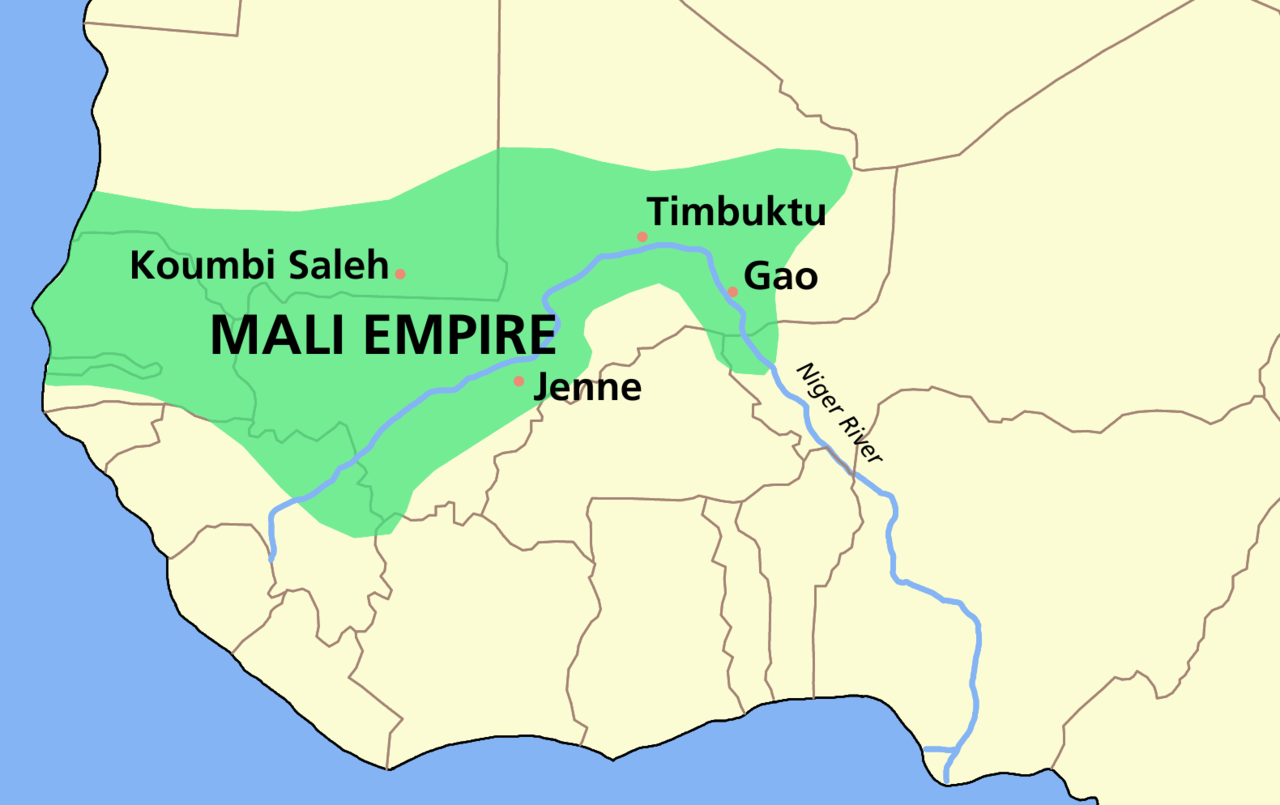
Kankan Musa was the tenth Mansa, King of Kings, or Emperor of the great Empire of Mali from 1312 to 1337. At the time of Musa’s accession to the throne, the Empire of Mali consisted of territories which had belonged to the Empire of Ghana and Melle, and surrounding areas.
Emperor Kankan Musa
His name, Kankan Musa or Kanga Musa meant « Musa, son of Kankou Hamidou », in reference to his mother (In those days, the Mandinka people were a matriarcal society). Kankan Musa is often referred to, in literature, as Mali-koy Kankan Musa, Gonga Musa, and Lion of Mali. He had lots of titles, including Emir of Melle, Lord of the Mines of Wangara, Conqueror of Ghanata, Fouta Djallon (also written Futa Jallon), and at least a dozen other areas.
Empire of Mali (Wikipedia)
He took the Empire of Mali to its peak, from the Fouta Djallon to Agadez (in northern Niger), including the ancient Ghana, and Songhai Empires. He established diplomatic relationships with Portugal, Morocco, Tunisia, and Egypt. His reign corresponds to the golden era of the Malian Empire.
Assemblée constitutive de l’empire du Mandé (Source: Wikipedia.fr)
Kankan Musa’s pilgrimage to Mecca made him popular in North Africa, and in the Middle East. Musa made his pilgrimage to Mecca in 1324, with a procession of 60,000 men, 12,000 servants who each carried four pounds of gold bars, heralds dressed in silks who bore gold staffs, organized horses and handled bags. Also in the train, were 80 camels, which carried between 50 and 300 pounds of gold dust each (Gold was the currency in Mali). He gave away gold to the poor along his route. Musa not only gave gold to the cities he passed on his way to Mecca, includingCairoandMedina, but he also traded gold for souvenirs. Moreover, he would also build a new mosque every Friday in any city he so happened to pass by. Musa’s journey was documented by several eyewitnesses along his route, who were in awe of his wealth and extensive procession, and records exist in a variety of sources, including journals, oral accounts and histories. Musa’s visit with the Mamluk sultanAl-Nasir Muhammad of Egypt in July 1324 is well-recorded.
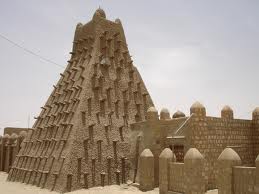
Sankore Mosque in Timbuktu
Musa’s generosity, however, inadvertently devastated the economy of the region. In the cities of Cairo, Medina and Mecca, the sudden influx of gold devalued the metal for the next decade. Prices on goods and wares greatly inflated. To rectify the gold market, Musa borrowed all the gold he could carry from money-lenders in Cairo, at high interest. This is the only time recorded in history that one man directly controlled the price of gold in theMediterranean. Imagine a single man controlling the economy of not only one country, but of an entire region!
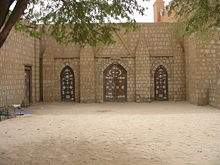
Sankore University in Timbuktu
Mansa Musa was a great builder. He had several mosques and madrasas built in Timbuktu and Gao. The most important of its constructions is the University of Sankore. In Niani, his capital, he built an Audience Hall, a building communicating directly with the royal palace through an interior door. It was “an admirable Monument” surmounted by a dome, adorned with arabesques of striking colours. The windows of the upper floor were plated with wood and framed with silver, while those of a lower floor were plated with wood, framed in gold. This palace no longer exists. Like the Great Mosque, the Hall was built in cut stone. The Italian art and architecture scholar Sergio Domian said: “At the height of its power, Mali had at least 400 cities, and the interior of theNiger Deltawas very densely populated.” Can you imagine that? In this day and age, how many countries in this world can boast 400 densely populated cities? Yet, the Mali of Kankan Musa claimed it all.
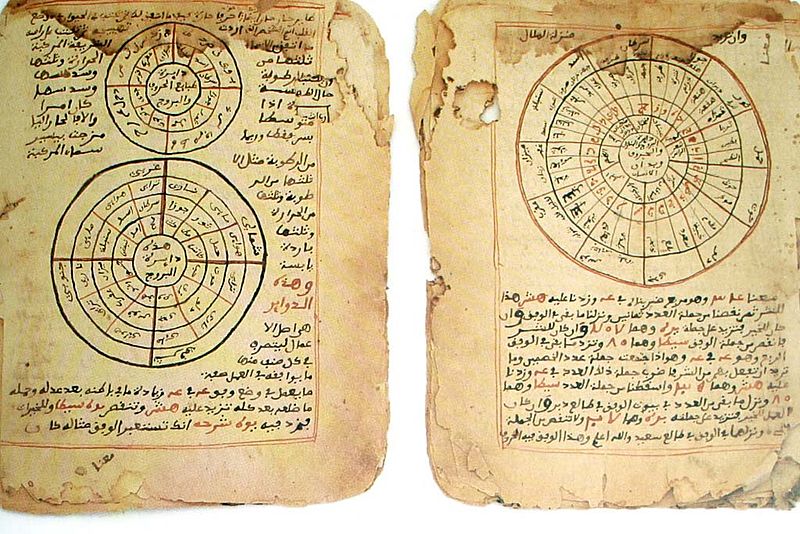
Manuscripts a Tombouctou (Mali) montrant de l’astronomie et mathematique
At the end of his life, in 1332 or 1337, the Empire of Mali limits were from the Atlantic Ocean to the Eastern shores of the Niger River, and to the forests of Taghaza in the middle of the Sahara. Kankan Musa was not only a rich man who gave to all, built mosques, and great places of worship, he was also a just conqueror, and a great builder. He took the Empire Mali to its peak, and made it the talk of places as far as the Middle East and Europe. Many Europeans and Middle Easterns would send delegations of architects, merchants, writers, astronomers, mathematicians and teachers, to study in his great university at Timbuktu. So next time someone asks you who was the richest man on planet earth, remember to tell them that before Bill Gates, there was Kankan Musa!
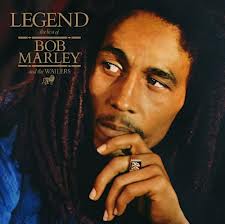
On February 6th, the world celebrated Sir Bob Marley‘s 70th birthday or earth day. People around the world gathered to commemorate the life of the great Reggae legend. There were lots of live performances and exhibitions in Jamaica, and around the world. From February 1-6, there were five-day celebrations featuring international reggae acts, tribute shows, art and food. All these festivities take us back to Bob Marley’s strong message of unity, oneness, and universality, or ONE LOVE: love for all mankind, love for our fellow brothers, love for ourselves, love for our planet, and above all love for our Creator. Someone said that if we were busy loving, there will be no war, and that is truly Sir Marley’s message: “One Love, One Heart.Let’s get together and feel all right.”
In celebration of Valentine’s Day, I would like to talk about one of Africa’s great love songs, ‘AMI O‘. Many songs have made the entire continent shake, but few have had the dimensions of ‘AMI O‘ of Ebanda Manfred. ‘AMI O‘ is to Cameroonian and African music what ‘Guantanamera‘ is to Cuban and Latin music: a world classic. But ‘AMI O‘, ‘AMIO‘, ‘AMIE OH’, or ‘AMI OH’, or ‘AMIYO‘ is first and foremost a love song. It is a declaration of love, a love anthem. It has been reprised by over 20 world class artists among which, Bébé Manga, Papa Wemba, Francis Bebey, Angelique Kidjo, Manu Dibango, Monique Séka, Bisso Na Bisso, Nayanka Bell, Jacky Biho, Naima, Henri Salvador, AndréAstasié, and so many more.
Ebanda Manfred
Where did it all start? In 1960, 24-years old Ebanda Manfred fell head over heels in love with a teenage single mother from Yaoundé, Cameroon. The girl, Amié Essomba Brigitte, had to quit school to take care of her child. Madly in love, Ebanda Manfred told her of his feelings, but she told him that she could not start a love relationship until her child was weaned. Finding the wait too long, especially since he had to return to Douala the following year, Ebanda Manfred sang his despair and asked: “Amié, njika bunya so mo, oa mo o ma dubè no, na mba na tondi oa?”. Translation: “Amié, when will you finally believe in my love?” Thus the song “Amié ” was born. It became an instant hit when it came out in 1962. A year later, it was reprised by Francis Bebey. In 1980, the great Bébé Manga made an adaptation which brought her to the international stage, as she won the “Golden Maracas.” The song will be reprised by artists around the world, from the Carribbean to Latin America, and Europe.
Bebe Manga
In celebration of Valentine’s day, I live you with this great African love song. In Bébé Manga’s English version, the song clearly states “Amie (friend) oh, you are all I ever hoped for, everything I ever dreamt of,…” So tomorrow, don’t forget to sing AMI O to that special one, that one you longed for, and dreamt of, that special one in your life.