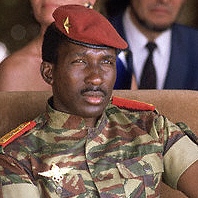
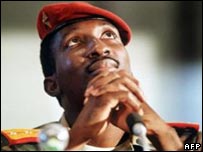
This is what Thomas Sankara uttered on April 21, 1982 in opposition to the regime’s anti-labor drift: “Misfortune to those who gag the people (Malheur à ceux qui baîllonnent le peuple)”. Funny how 33 years later, general Diendéré, one of those complicit of killing Sankara himself, had to face the people’s wrath. Indeed, Diendéré‘s coup and presidency lasted 7 days: 7 days when he took and gagged the people of Burkina Faso. At the beginning of the week when he took over, many ‘international’ newspapers (as usual, supporters of coups against the liberty of the African people) were writing about him, praising him as
Thomas Sankara a Ouagadougou
one of Compaoré‘s boys, very calm, charismatic, courageous, etc. At the end of the 7 days, after the people of Burkina Faso, backed up by their army, rose up as a single man against the ugly coup, the same newspapers were calling him a ‘stupid’ general. Diendéré thought he could gag the people again and again and again. That time is long gone, because the people of Burkina Faso have decided against it, and have said, like Sankara: “Homeland or death, we shall overcome!” I used to wonder, sadly, why the people of Burkina Faso, who had had the great Sankara, could not rise against Compaoré… well it took them 27 years to overtake the tyrannical system, but they overtook it and now they are rising as a single man! “La patrie ou la mort, nous vaincrons!”
In view of recent events in Burkina Faso, and to continue our fight for democracy, for equal rights, for the right of a nation to choose its leaders without military/external forces dictating it, I live you with a quote by President Thomas Sankara, president of Burkina Faso. It was previously published in a “prayer for Cote d’Ivoire.” As the quote goes:
================
La patrie ou la mort nous vaincrons!
Telle était la devise de Thomas Sankara, notre grand Che africain, ce grand maitre de la révolution Burkinabé, le president du Faso. Telle est la devise que nous nous devons de garder dans nos coeurs en ce moment pour le Burkina Faso: savoir que nous nous battons pour notre liberté, pour notre patrie, pour la seule terre que le bon Dieu a bien voulu nous donner! Amandla!… Ngawethu!
Flag of Burkina Faso
Homeland or death, we shall overcome!
Such was the motto of Thomas Sankara, our great African Che, this great master of the Burkinabe revolution, the president of Burkina Faso. This is the motto that we must keep in our hearts for Burkina Faso right now: to know that we are fighting for our freedom, for our country, for the only land God ever gave us! Amandla! …Ngawethu! Power to the People!
Patria o muerte, venceremos!
Tal era el lema de Thomas Sankara, nuestro gran Che de África, este gran maestro de la revolución de Burkina Faso, el presidente de Burkina Faso. Este es el lema que debemos tener en nuestros corazones para Burkina Faso en este momento: saber que estamos luchando por nuestra libertad, para nuestro país, por la tierra sólo Dios nunca nos dio! Amandla!… Ngawethu!
Burkina Faso
Pátria ou morte, venceremos!
Esse foi o lema de Thomas Sankara, o nosso grande Africano Che, este grande mestre da revolução burkinabe, o presidente do Burkina Faso. Este é o lema que devemos ter em nossos corações para Burkina Faso agora: saber que estamos lutando por nossa liberdade, para o nosso país, para a única terra que Deus já nos deu! Amandla!… Ngawethu!
I would like to share with you letters from Ndate Yalla Mbodj, the last Lingeer (Queen) of the Waalo, addressed to the French Governor of Senegal in the 1850s. These are treasures from history, and I thought it very interesting to translate them from French to English. Reading these letters, one can see the duplicity of the French who would take lands from the Waalo people without asking, and will treat the people of the Waalo with great disdain. These are from the National archives of Senegal. For the French version, visit: Seneweb.
=========
National Archives of Senegal 13 G 91
Correspondence of the Kings of the Waalo
Letter number 85 received by the governor
of Saint Louis on May 23rd, 1851
Ndatte Yalla to Mr. the Governor,
The goal of this letter is to let you know that the island of Boyo* belongs to me, from my grandfather down to me today. There is nobody who can claim that that country belongs to them; it belongs to me only. I did not sell this country to anybody. I did not entrust it to anybody, nor to any white person. The people to whom I entrusted my land have to right to do anything to it, I will have nothing to say. Nobody can take this land without their authorization; to prove to you that this letter comes from me, when the dispute had been settled in Lampsar, you went back to the fort. There I came to see you with my husband, you were accompanied by Mr. Alsace and de Bamar, you told me that you wanted to see me alone to talk, I told you that there was only my husband and brother present.
You also asked me who was the King of the Waalo today. I replied that the King of the Waalo was me. If this is true, and this letter comes from me, I desire that no one should take possession of my territory.
The island of Boyo is located in Mauritania, 15 km north of Saint-Louis in Senegal. It houses the village of N’Diago. It is the cradle of the Boye family of Saint-Louis.
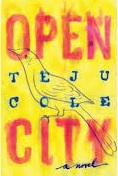
I really liked what Nigerian writer Teju Cole had to say about fighting rape culture, and how it should be a fight for all mankind, because when women are dehumanized, the entire society is. The author of Open City reacts to the Bill Cosby’s controversy in a very articulate manner, and we should all take the time to read it. Enjoy! For the entire text, visit the New Inquiry website, where it is titled ‘Improving on Silence’ by Teju Cole.
=========
Last night, reading the accounts by women who had been assaulted by Cosby, I was overcome with sorrow.
Tricky to say anything about this, but silence is simply not an option. This is everybody’s business. But I’ll say some things to the men who are reading.
“Open City” by Teju Cole
We men benefit, all of us men benefit, from rape culture. We benefit from the pain it causes women because we sprint ahead obliviously; we benefit from the way it knocks them off circuit and opens space for us; we benefit from the way it dehumanizes them so that our own humanity can shine more greatly; and we benefit from the aura of power it gives us as perpetrators or as beneficiaries. And because we benefit, explicitly or implicitly, we are not vociferous enough in our opposition to it. […]
We must fight rape culture, even in its allegedly mild manifestations, we must be grieved with the grief of those who commit the crime and those who benefit from a world built on such crimes, we must oppose men who wade in with stupid explanations and caveats and distractions, we must surrender the poisonous sentimentality that makes us believe a “great artist” over a less well-known woman. Indeed, we must be willing to let anyone go—think of any man you admire, any man at all, alive or in history, close to you or far away, and think to yourself that you must be willing to let him go—if such things are true of him too. And understand that such things can be true of any of them, of any of us. […]
And above all we must listen, to women, and to the significant but vastly smaller number of men who have also been assaulted. So that, gradually, we can collectively begin to slough off this wretched state of affairs in which the first thing someone who has been assaulted thinks is “no one will believe me.”
That’s to men.
And to women: I believe you. And I’m heartbroken about the many ways in which I fail to live up to that belief.
I really enjoyed South African law student, humanitarian, and poet Puno Selesho‘s TEDx Pretoria 2015 speech on “raising up a super-humanity”. I simply loved the way she recited her poem, full of energy, and emotions, and above all ready to empower humanity. Enjoy and rise up to be the Super-human you are meant to be!
Rihanna rocking a Stella Jean’s creation (allthingsankara.com)
I couldn’t help but notice the African influence seeping its way through the wardrobe of some of the world’s celebrities. Last fall, Rihanna stunned the world by wearing Ankara fabric at the White House. She was sporting Haitian designer Stella Jean‘s creation, and she was stunning.
Wax Hollandais
I also recently heard about Zimbabwean designer Farai Simoyi, the one behind Nicki Minaj‘s fashion line. Before that Farai Simoyi was a Senior designer at the House of Dereon, the clothing house by mega-artist Beyoncé and her mother Tina Knowles.
So watch out: next time you shop, you may be unconsciously buying some African designs. Enjoy this video about some of the up and coming African designers on the international scene.
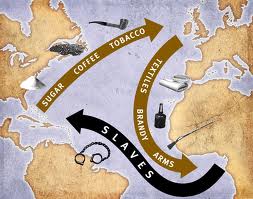
Yesterday, David Olusoga of BBC Two published a documentary on Britain’s Slave Owners part 1: Profit and Loss. His work was very profound, and was of course very painful, as it dealt with slavery. Here is the synopsis, from BBC Two website:
“In 1834 Britain abolished slavery, a defining and celebrated moment in our national history. What has been largely forgotten is that abolition came at a price. The government of the day took the extraordinary step of compensating the slave owners for loss of their ‘property’, as Britain’s 46,000 slave owners were paid £17bn in today’s money, whilst the slaves received nothing.
The Transatlantic slave trade
For nearly 200 years, the meticulous records that detail this forgotten story have lain in the archives virtually unexamined – until now. In an exclusive partnership with University College London, historian David Olusoga uncovers Britain’s Forgotten Slave Owners. Forensically examining the compensation records, he discovers the surprising range of people who owned slaves and the sheer scale of the slavery business.
Slaves on board a ship
What the records reveal is that the slave owners were not just the super-rich. There were widows,clergymen and shopkeepers; ordinary members of the middle-classes who exploited slave-labour in distant lands. Yet many of them never looked a slave in the eye or experienced the brutal realities of plantation life.”
Check out the BBC Two website which has an interactive view of it. I also liked the video link below about some instruments of torture used in Jamaica to punish slaves. I invite you to find this outstanding documentary by David Olusoga. Below is an interview he gave.
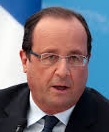
It took over 70 years for a French President to finally admit the genocide perpetrated in Cameroon by France between 1950 and 1970, a genocide which claimed over 400,000 lives, and displaced countless others. In his visit to Cameroon last Friday, French president François Hollande acknowledged that French forces had tried to quash colonial separatists in the 1950s and said he was ready to open up the history books. He said, “I recognize that there have been extremely traumatic and even tragic episodes.” Should we jubilate?
Ruben Um Nyobé
I say NO. It is true that this is somewhat a step forward: recognition of wrong done. However, I call it arrogance to wake up one day, and finally say, “Oh, yes, I killed your fathers, mothers, brothers, or sisters, … I showered many of your cities with Napalm, … I decapitated so many of your freedom fighters and hung their heads in the villages’ square, … I killedRuben Um Nyobé, Felix-Roland Moumié, Castor Osende Afana, Ernest Ouandié, and so many others, … I forced some of you into exile, … and I displaced countless others inside and outside your borders.” And so what? Should we clap for you? where is the apology? Didn’t you think we knew you did that? Where is the reparation?
Maquisards’ heads during the genocide in Cameroon
During the Maquis years, many lost a loved one; is there a reparation for that loved one? that father who never saw his children grow up? that mother who never saw her son again? What about those who kept waiting, and waiting, hoping that after so many years the loved ones would come back home?… What about the pain of that young girl walking to school who had to watch the decapitation of ‘maquisards’ on the public place: she was scarred for life! What about those entire villages burnt with napalm? And those who were displaced internally from French Cameroon to British Cameroon, running for their dear lives and leaving behind their lands? What about Ruben Um Nyobé and his family? Felix-Roland Moumié, and his widow who suffered years of imprisonment in the harshest places? and Ernest Ouandié… and all the children who had to watch in horror as he took his last breath under the firing squad’s shots? What about the remaining population whose history was erased from textbooks, those who now have a gap in their past?
UPC Leaders (L. to R.) front row: Castor Osende Afana, Abel Kingué, Ruben Um Nyobé, Felix Moumié, and Ernest Ouandié
And to stand up there, and say “yes I recognize that we killed you”… it’s like Hitler waking up today, and telling Holocaust survivors and their descendants, “I killed you, jailed your parents, forced you into exile, brought fear into your souls, and decimated every part of you… what can you do?” It is simply arrogant! It is just too easy. Until there is a clear “I am sorry”, until there is a clear “here is what we will do to correct the wrong”, until there is a clear “arrest of all perpetrators”, until there is a clear “story in the history textbooks, opening of all the classified documents”…. until there is a clear “respect for those killed,” until then, there will be no respect for arrogant presidents of the hexagon in our dictionaries!
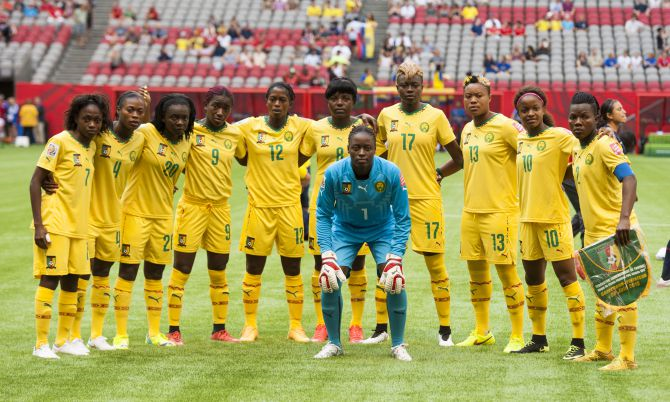
I was quite proud of the Cameroonian team who succeeded in going through the first round of the 2015 Women FIFA’s World Cup in Canada. This was Cameroon’s first World Cup participation. With no government support, barely any equipment, and little organization, they managed to do well with so little. Here is a quote by the Cameroonian coach Enow Ngachu, “The day we prepare and organize very well, I think an African nation will one day win the World Cup. … We just hope that with our performance many things will change in Cameroon and in Africa.”
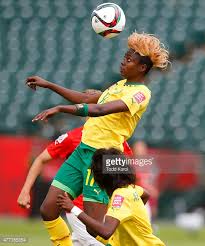
Gaelle Enganamouit in action (Getty Images)
On June 20th, China PR survived a tough examination from Cameroon with a lone early strike from Wang Shanshan, thus ending the Lionnes of Cameroon’s journey. Both teams played with high-tempo and intensity from the opening whistle in Edmonton with chances aplenty at either end, but it was the Chinese who remained resilient at the back to advance into the last-eight. We are very proud of these Cameroonian sisters who showed that African women, and women in general, can play very good, entertaining, and amazing football/soccer, and should be equally cared for by their governments and people. My hat to Gaelle Enganamouit, Madeleine Ngono Mani, Christine Manie, Gabrielle Aboudi Onguene, and all the other sisters who made us proud. Indomitable Lioness Gaelle Enganamouit became the first African to score a hat-trick at the Women’s World Cup. Below is a highlight from the game Cameroon – Switzerland, which was quite intense and beautiful to watch. Enjoy!
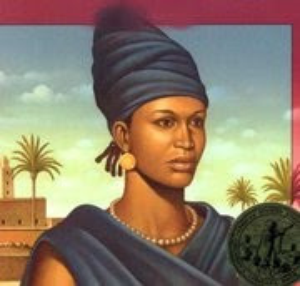
Queen Ndate Yalla Mbodj (from the cover of Kings and Queens of West Africa, by S. Diouf)
In 1855, when the French arrived to colonize Senegal, the first power of resistance they encountered was a woman. Her name was: Ndate Yalla Mbodj. While in France, women were not recognized as citizens until 90 years later, the French were stunned by this woman of beautiful stature, face, and strong body, and who headed an immense army. She was a beautiful and proud warrior, who inherited a rich tradition of bravery and gallantry.
The Lingeer or Queen Ndate Yalla Mbodj (1810 – 1860) was the last great queen of the Waalo, a kingdom in the northwest of modern-day Senegal. She was a heroine of the resistance against French colonization and Moors invasion. She was also the mother of Sidya Leon Diop or Sidya Ndate Yalla Diop, who went on to become one the greatest resistants to the colonization of Senegal.
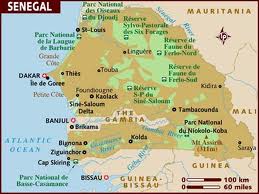
Map of modern-day Senegal
Queen Ndate succeeded to her sister Ndjeumbeut Mbodj. She was officially crowned Queen of the Waalo on October 1st 1846 in Ndar (now called Saint-Louis), the capital of the Waalo. Her reign was marked by an ongoing defiance of the French against which she fought a fierce battle. By 1847, she opposed the free passage of Sarakolé people by sending a letter to the governor expressing her willingness to defend the respect of her sovereignty over the valley in these terms: “We guarantee and control the passage of cattle in our country and we will not accept it the other way. Each leader governs his country as he pleases.“
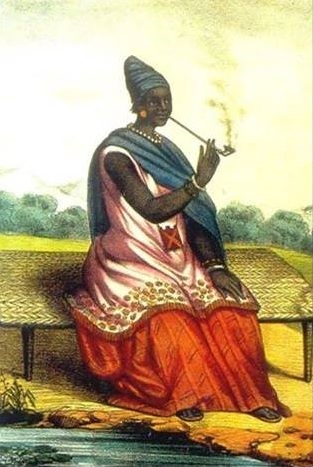
Warrior from the Waalo Kingdom, 1846
She fought both the Moors who happen to encroach on her territory, and the colonialist army led by Louis Faidherbe, the butcher, and bandit, who later became governor of Saint-Louis and colonial head of administration and army. Almost 10 years into her reign in 1855, she encountered the greatest colonialist pirate Faidherbe, with an army of 15,000 strong, fully armed and ready to fight her, dethrone her, and colonize Waalo and Senegal. Faidherbe defeated her army in bloody battles, before capturing Saint-Louis. In February 1855, while the Faidherbe’s troops were entering the Waalo, the Lingeer spoke to the principal dignitaries of her country as such: “Today, we are invaded by the conquerors. Our army is in disarray. The tiedos of the Waalo, as brave warriors as they are, have almost all fallen under the enemy’s bullets. The invader is stronger than us, I know, but should we abandon the Waalo to foreign hands?” (Aujourd’hui nous sommes envahis par les conquérants. Notre armée est en déroute. Les tiédos du Walo, si vaillants guerriers soient-ils, sont presque tous tombés sous les balles de l’ennemi. L’envahisseur est plus fort que nous, je le sais, mais devrions-nous abandonner le Walo aux mains des étrangers?) … “This country is mine alone!”
She eventually lost the battle, but not the war; which continued to be a war of resistance until the early part of the twentieth century by Lat Dior Diop, and many other ‘Gelewars’. This conquest would forever change the trajectory of her reign and the geopolitical, military, and geographical road map of Senegambia, “Ganaar” (now called Mauritania), Mali (formerly called French Sudan), and Fouta.
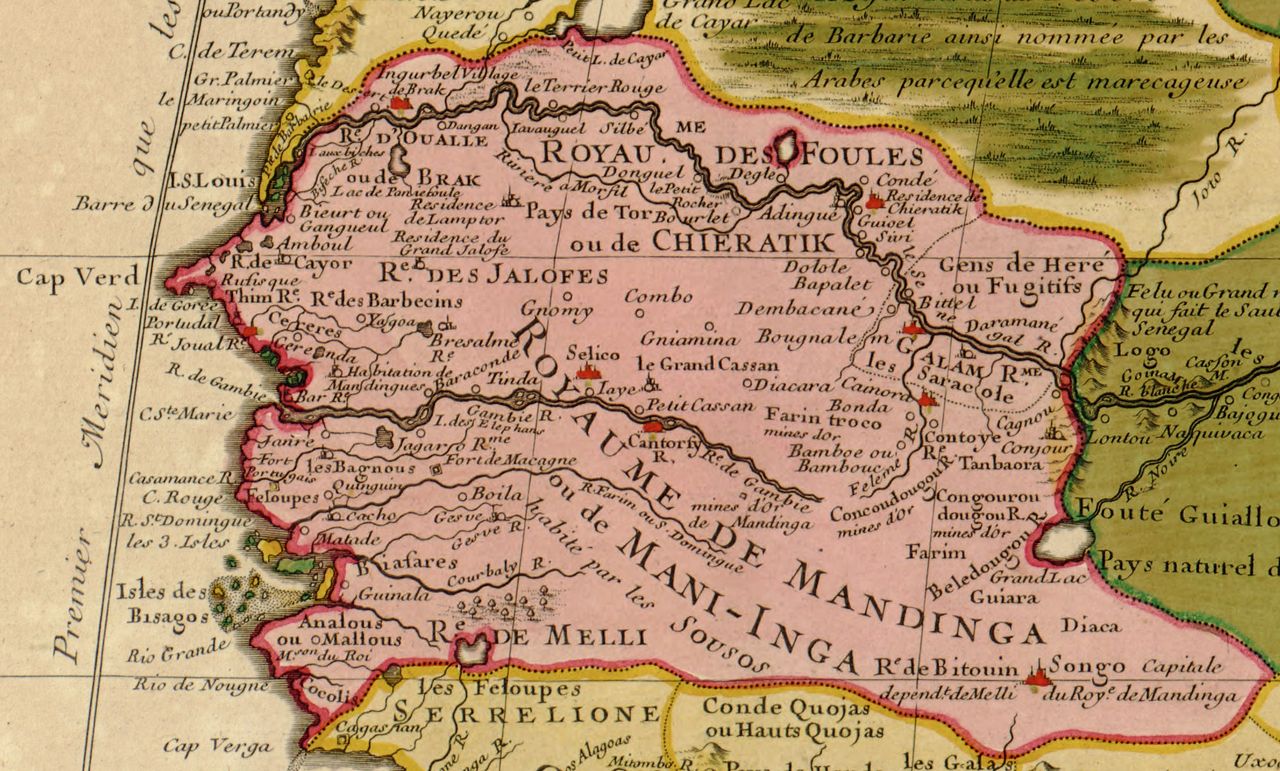
Senegambia in 1707, with the Kingdom of Waalo written as ‘R. d’Oualle ou de Brak’
Her father was Brak (King) Amar Fatim Borso Mbodj, and mother was Lingeer (Queen) Awo Fatim Yamar Khuri Yaye Mboge. Her son, Sidya Leon Diop, who would later too become an anti colonialist, and fight the French until his capture, and exile to die in Gabon in 1878. Her son Sidya was captured as a hostage in Saint-Louis by General Faidherbe during their bloody war with Ndate, and was baptized ‘Leone’ and sent to Algiers for schooling in 1861. When he returned to Senegal two years later in 1863, he was enlisted in the French colonial army; the first African or Senegalese to hold such a post. But as the saying goes —like mother, like son, he refused to do their dirty job of joining forces with the European colonial foreigners and mercenary apparatus, against his mother’s kingdom and people. He then changed strategy and rallied with Lat Dior Diop and others, which resulted in his betrayal, and capture by the colonial forces; and exile to Gabon (just like Samori Toure).
Ndate Yalla Mbodj
Queen Ndate Yalla Mbodj, as a true ‘lingeer’, developed the women’s army as one of the most formidable forces to recon with in her reign. The story of this Senegambia Queen is best amplified in oral tradition by the local griots. Her women army was similar to the “Amazon” women army of Benin, Behanzin’s fearless protective women’s army. She later went into exile in Ndimb in the northern part of the Waalo and died in Dagana, where today a statue has been erected in her honor (the only one erected in honor of a queen nationwide). To learn more, check out: Maafanta.com, Matricien.org, au-Senegal.com; the book Kings and Queens of West Africa by Sylviane Diouf has an entire chapter dedicated to this great queen.