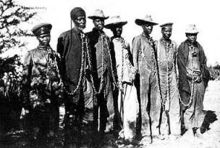
How many think that the first big genocide of the 20th century happened during world war II, and was the holocaust? If you thought so, then think again. The Holocaust was not Germany’s first genocide. The very first genocide of the 20th century occurred in Namibia, on the African continent.It was perpetrated by Germans on the Herero and Nama people of Namibia. It was extremely brutal and almost wiped out all Herero people. It was a campaign of racial extermination and collective punishment that the German Empire undertook in German South-West Africa (modern-day Namibia) against the Herero and Nama people. It took place between 1904 and 1907 during the Herero Wars. Today it is known as the Namibian genocide or the Herero and Namaqua genocide. For the longest time, the German government denied it until 2004 when they finally acknowledged and recognized for the atrocities they perpetrated to wipe out an entire race. However, they ruled out financial compensation for the victims’ descendants. They still refuse to officially name these actions as “genocide”.
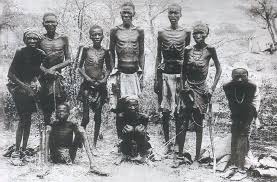
Chained Herero men
In total, between 24,000 and 100,000 Herero and 10,000 Nama died. The genocide was characterized by widespread death from starvation and dehydration due to the prevention of the retreating Herero from leaving the Namib Desert by German forces. Some sources also state that the German colonial army systematically poisoned desert water wells. Moreover, the Germans also tested the very first use of concentration camps on the Herero and Nama people.
Before the genocide, the tribe numbered 80,000; after it, only 15,000 remained. Enjoy the video below which tells it all.
The presidential election last week in Benin stunned all. Most thought that the candidate of the hexagon Lionel Zinsou, the candidate of colonialism, was going to win. We all thought that, France, was going to crush the people’s will and have its man be handed the country. But the people of Benin said NO! The people of Benin resoundly said NO! The country of Béhanzin said NO! The country of the beloved Mathieu Kérékou said NO to France and its puppet and elected Patrice Talon. Vive la Démocratie! In some other African countries (I will not name them), France’s will would have been almighty… but in the land of the fierce Amazons said NO! We, the people has spoken!
I live you here with an excerpt of this victory, and its meaning to all Africans. We have a lot to learn from the people of Benin who have taken a hold of their destiny. Check out these articles by the Brookings Institute, AlJazeera and the BBC on this historic win. And of course, when ‘We the people’ wins, the imperialistic forces are bitter and unhappy, and want to brush it aside in the press.
To all around the world, I would like to wish a Happy Easter or happy renewal day. This is celebration of renewal, restoration, and re-birth. I love this idea, particularly when spring comes or when the new harvest comes. The flower below shows all of it: it is slightly drooping on the sides, but still budding; it shows promises and life with its vibrant colors. This is the same for each one of us: a new day has arrived, a new dawn, a new chance at life; and this day is a gift, an opportunity to do right, to live life to its fullest, a new page. Enjoy! Happy Easter! Happy renewal!
For today, in celebration of millions, and billions of women out there, I choose to re-post this poem which always stood on the door to my Mother’s office for many years. This poem, “WOMAN” is from Gold Touch International, and was originally posted on March 8th, 2012 on Afrolegends. Enjoy, and yes salute all the strong women in your lives.
The poem below ‘To My Homeland’ by Huda Sha’arawi shows her love for her country and the extent to which she is willing to fight for her country’s well-being, for her country’s dignity. Her poem was written at the time when Egypt was under British rule, or had just gained independence. In the poem, one senses Huda’s love for her homeland which she refers to as if it were a woman, a mother. Enjoy! The original in French was published in L’Egyptienne, Number 69 of May 1931. The translation to English is brought to you by Dr. Y. on Afrolegends.com
Ama Patrie
J’ai fait voeu de t’offrir tout ce qui m’appartient
O ma belle Patrie,
mon bras, mon Coeur, mon âme ainsi que tous mes biens
sans excepter ma vie.
J’ai fait voeu de peiner, de lutter, de souffrir,
de braver l’infamie.
Sans froncer le sourcil, sans poser au martyre,
sans même une aide amie.
J’ai juré de franchir les frontières des mers
si ton honneur l’exige,
afin de rehausser, aux yeux de l’univers,
ton nom et ton prestige.
J’ai juré d’oublier les affronts des déments
Et la haine et l’insulte
que l’envie incita, contre mon dévouement
à ta cause et ton culte.
Peu m’importe l’exil, leur courroux, la prison,
j’accepte la mort même.
Puisque leurs vils exploits n’auront jamaisraison
de l’humble coeur qui t’aime.
To my Homeland
I vowed to offer you all that is mine
O my beautiful homeland,
my arm, my heart, my soul, as well as all my belongings
not excepting my life.
I vowed to struggle, to fight, to suffer,
to brave infamy.
Without frowning, without asking for martyrdom,
without even using a friend.
I have sworn to cross the borders of the seas
if your honor depends on it,
to enhance, in the eyes of the universe,
your name and your prestige.
I have sworn to forget the offenses of the demented
and the hatred and insult
Which prompted envy, against my dedication
To your cause and your worship.
I do not care about exile, their anger, the prison,
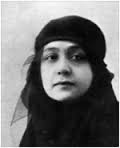
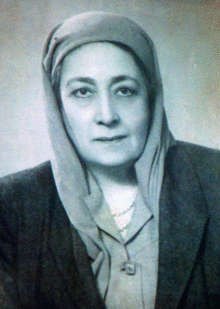
Today, we will be talking about Huda Sha’arawi (also Hoda Shaarawi, or Hoda Charaaoui), one of Egypt’s top feminists. She was a pioneering Egyptianfeminist leader, nationalist, and founder of the Egyptian Feminist Union. Sha’arawi’s work was immense in redefining the place of the woman in Egyptian society, and led to a new dawn for Egyptian women.
Huda Sha’arawi (Wikipedia)
Sha’arawi was born in a wealthy family in Minya on 23 June 1879. Her father was Muhammad Sultan, the first president of the Egyptian Representative Council, and the first Egyptian to rise through all the ranks of government at the time. Her father passed away when she was 4 years old. She was married at the tender age of 13 (very common in those days) to Ali Sha’arawi, a widower, cousin, and tutor with 4 children. The independent teen could not stand the austere life with her spouse and ran back to her mother where she stayed for the next 7 years. During those years of separation, she got further education and grew more independent. At the end of the 7 years, she returned to her husband with whom she later had 2 children. Her husband, Ali Sha’arawi was a political figure, and he associated his wife to his fight against British rule.
Hatshepsut (Wikipedia – MET Museum)
At the end of the 19th and beginning of the 20th centuries, women in Egypt were confined to houses or harems, and wore veils… This, in an Egypt which had seen Hatshepsut the female Pharaoh, Queen Cleopatra and Sultana Shajar al-Durr. As seen in all her pictures, Huda is wearing a Hijab. Sha’arawi resented such restrictions on women’s movements, and started organizing lectures for women on topics of interest to them. This brought many women out of their homes and into public places for the first time. Sha’arawi even convinced them to help her establish a women’s welfare society to raise money for the poor women of Egypt. In 1910, Sha’arawi opened a school for girls where she focused on teaching academic subjects rather than practical skills such as midwifery.
After World War I, as Egyptian men started to rise loudly for their rights, many women took part in political actions against the British rule as well. In 1919, Sha’arawi helped organize the largest women’s anti-British demonstration. In defiance of British orders to disperse, the women remained still for three hours in the hot sun. Such a thing had never been heard of in the history of Egypt and even of Islam.
The first 3 Egyptian Ladies to abandon the veil: Nabaireya Moussa, Hoda Chaaraoui, and Ceza Nabaroui
Sha’arawi made a decision to stop wearing her veil in public after her husband’s death in 1922. In March 1923, Sha’arawi founded and became the first president of the Egyptian Feminist Union, after returning from the International Woman Suffrage Alliance Congress in Romeshe removed her face veil in public for the first time, a signal event in the history of Egyptian feminism.
She fought for the suppression of precocious marriage for young girls, giving them access to all levels of education. She led Egyptian women pickets at the opening of Parliament in January 1924 and submitted a list of nationalist and feminist demands, which were ignored by the Wafdist government, whereupon she resigned from the Wafdist Women’s Central Committee. The Egyptian Feminist Union campaigned for various reforms to improve women’s lives. Among them were raising the minimum age of marriage for girls to sixteen, increasing women’s educational opportunities and improving health care. Egypt’s first secondary school for girls was founded in 1927 as a result of this pressure. In 1933, a new law is agreed in parliament (through her push) regulating the work of women in industry: making sure a woman could not be made to work more than 9 hours per day, giving her a rest day, one month of maternity leave, and 15 days of leave at half-salary after delivery of a child. This was a victory for the Union.
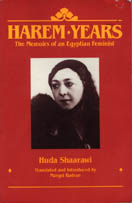
‘Harem Years: The Memoirs of an Egyptian Feminist’ by Huda Sha’arawi
She continued to lead the Egyptian Feminist Union until her death, publishing the feminist magazine L’Égyptienne (and el-Masreyya), and representing Egypt at women’s congresses in Graz, Paris, Amsterdam, Berlin, Marseilles, Istanbul, Brussels, Budapest, Copenhagen, Interlaken, and Geneva. She advocated peace and disarmament. Even if only some of her demands were met during her lifetime, she laid the groundwork for later gains by Egyptian women and remains the symbolic standard-bearer for their liberation movement. In 1943, King Farouk decorated Huda Sha’arawi with the Order of Kamal. Sha’arawi wrote poetry in both Arabic and French. In 1944, she founded the All-Arab Federation of Women. Huda Sha’arawi died in 1947. Sha’arawi later recounted her early life in her memoir Harem Years: The Memoirs of an Egyptian Feminist, 1879-1924. To learn more about her, check out her memoir, read Casting Off the Veil: The Life of Huda Shaarawi, Egypt’s First Feminist by Sania Sharawi Lanfranchi, this article on Forbes, and this amazing chapter dedicated to her in Les Africains, Tome 10, ed. J.A. 1978, P. 107-141. With her strong personality, unique blend of western-style feminism with her own country’s customs, culture, and Egyptian nationalism, Huda Sha’arawi influenced millions of Egyptian and Arab women and people all around the world.
What is the definition of feminism? Is it the same when applied to African women? Is there such a thing as African, or Asian, or European feminism? Why should feminism be dismissed as something only good for women, and not men as well? The condition of the woman is closely linked to that of the man, and as a woman is empowered, as she is given her rightful place in society, then are we ALL empowered as a human species. I live you here with a TED speech by Chimamanda Ngozi Adichie, the Nigerian author of the Top New York Times Bestseller book of the year 2014. Yes, she talks about feminism, but in reality, she talks about the reason why ALL of usshould be feminists: including MEN. Imagine for instance a working couple, where the woman in the couple is paid lower than men doing the same job, imagine the impact of that salary on the entire family budget if she was paid the same as a man, the opportunities for her children, healthcare, vacation, well-being, etc. Enjoy! Adichie’s speech ‘We Should All Be Feminists‘ has now been made into a book, which is going to be thought in schools in Norway and Sweden (The Guardian article). And yes feminism is not about angry females or beating men out of the world, it is about girls being given the same chances as boys, women being recognized for their impact on society, being allowed to rise, being intelligent and bright.
Fellow readers, I wish you all an AMAZING new year, may the year 2016 be the year of all great achievements, joys, successes, and awesomeness. I would like to express my sincere gratitude to all those who visited my blog, reblogged articles, and to all future visitors. 2015 was a beautiful year: the number of subscribers on Afrolegends.com has tripled, with over 200,000 new visitors viewing the blog, and many articles getting reblogged on multiple sites. For 2016, I wish you wonders without borders, peace, grace, and love. May there be peace and happiness in the world.
The 5 top posts of 2015 can be seen below. For the first time in 3 years, the article on Samori Toure was surpassed as the top post for the blog Afrolegends.com; the article on Adinkra symbols was also particularly loved. Keep trusting, reading, sharing, and liking. Keep your heads up, and may your year be as beautiful as the petals of this flower!
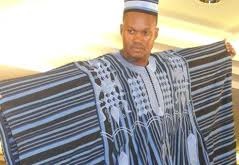
Today we will be talking about the Faso Dan Fani, known as Burkina Faso‘s national cloth. For starters, the Faso Dan Fanimeans “woven cloth of the homeland” (pagne tissé de la patrie). All the words are Dioula: Fani = cloth/wrapper(pagne), Dan = woven(tissé), Faso = homeland (patrie). It is known locally as FDF. As you have probably guessed, the Faso Dan Fani is a handwoven cotton cloth. The weaving style and patterns differ depending on the ethnic group. As you all know, weaving cotton is an ancient African tradition (African textiles): in the old days, the spinning was done by women, while the men were left with weaving the cotton threads into cloth. With time, women took over the weaving business as well.
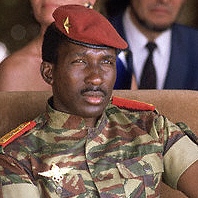
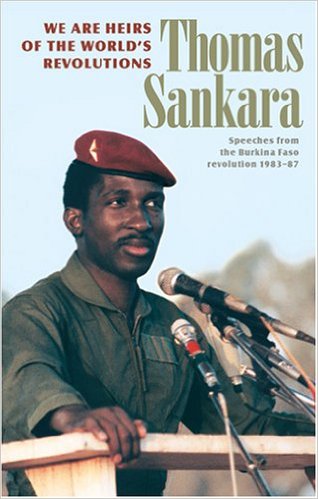
Thomas Sankara a Ouagadougou
In 1986, the President of the Faso, Thomas Sankara, declared that it was important to “produce and consume Burkinabé“. Thus, he declared “In all the villages of Burkina Faso, we know how to grow cotton. In all villages, women know how to spin cotton, men know how to weave it into cloth, and other men know how to sew those threads into clothes... [Dans tous les villages du Burkina Faso, l’on sait cultiver le coton. Dans tous les villages, des femmes savent filer le coton, des hommes savent tisser ce fil en pagnes et d’autres hommes savent coudre les pagnes en vêtements …]” and further “We should not be slave of what others produce[Nous ne devons pas être esclave de ce que les autres produisent].” For the president, “wearing the Faso Dan Fani is an economic act, cultural, and political to challenge imperialism[porter le Faso Dan Fani est un acte économique, culturel, et politique de défi à l’impérialisme].”
Faso Dan Fani
Thus under Thomas Sankara’s revolution, the traditional attire was imposed in work places. … Many were not pleased with it, to the extent that some had nicknamed the FDF, “Sankara is coming“ [Sankara arrive] since the PF was known to do impromptu visit of his ministries. Under him, the FDF had become the signature of Burkinabé outside the country. Sankara even made a speech at the United Nations where all the members of his delegation and himself were dressed with the Faso Dan Fani entirely made by local Burkinabé artists to be consumed by Burkinabe.
On October 4th, 1984, Thomas Sankara addressed the General Assembly of the United Nations. It was a historical speech, as only he, the great orator, could speak. It was moving, it was strong, and it was good. Below is an extract of his speech. For the whole speech, go to thomassankara.net. Enjoy!!!
============
“I speak on behalf of the millions of human beings … thrown out of work by a system that is structurally unjust and periodically unhinged, who are reduced to only glimpsing in life a reflection of the lives of the affluent. I speak on behalf of women the world over, who suffer from a male-imposed system of exploitation. … Women who struggle and who proclaim with us that the slave who is not able to take charge of his own revolt deserves no pity for his lot. This harbors illusions in the dubious generosity of a master pretending to set him free. Freedom can be won only through struggle, and we call on all our sisters of all races to go on the offensive to conquer their rights.
I speak on behalf of the mothers of our destitute countries who watch their children die of malaria or diarrhea, unaware that simple means to save them exist. The science of the multinationals does not offer them these means, preferring to invest in cosmetics laboratories and plastic surgery to satisfy the whims of a few women or men whose smart appearance is threatened by too many calories in their overly rich meals, the regularity of which would make you—or rather us from the Sahel—dizzy. We have decided to adopt and popularize these simple means, recommended by the WHO and UNICEF.
I speak, too, on behalf of the child. The child of a poor man who is hungry and who furtively eyes the accumulation of abundance in a store for the rich. The store protected by a thick plate glass window. The window protected by impregnable shutters. The shutters guarded by a policeman with a helmet, gloves, and armed with a billy club. The policeman posted there by the father of another child, who will come and serve himself—or rather be served—because he offers guarantees of representing the capitalistic norms of the system, which he corresponds to.
“We are heirs of the revolution” by Thomas Sankara
I speak on behalf of artists—poets, painters, sculptors, musicians, and actors—good men who see their art prostituted by the alchemy of show-business tricks.
I cry out on behalf of journalists who are either reduced to silence or to lies in order to not suffer the harsh low of unemployment.
I protest on behalf of the athletes of the entire world whose muscles are exploited by political systems or by modern-day slave merchants.
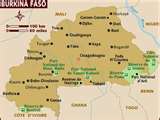
Burkina Faso
My country is brimming with all the misfortunes of the people of the world, a painful synthesis of all humanity’s suffering, but also—and above all—of the promise of our struggles. This is why my heart beats naturally on behalf of the sick who anxiously scan the horizons of science monopolized by arms merchants. My thoughts go out to all of those affected by the destruction of nature and to those 30 million who will die as they do each year, struck down by the formidable weapon of hunger. As a military man, I cannot forget the soldier who is obeying orders, his finger on the trigger, who knows the bullet being fired bears only the message of death. …. I protest on behalf of all those who vainly seek a forum in this world where they can make their voice heard and have it genuinely taken into consideration. Many have preceded me at this podium and others will follow. But only a few will make the decisions. Yet we are officially presented as being equals. Well, I am acting as spokesperson for all those who vainly see a forum in this world where they can make themselves heard. So yes, I wish to speak on behalf of all “those left behind,” for “I am human, nothing that is human is alien to me.”
Flag of Burkina Faso
Our revolution in Burkina Faso embraces misfortunes of all peoples. It also draws inspiration from all of man’s experiences since his first breath. We wish to be the heirs of all the world’s revolutions and all the liberation struggles of the peoples of the Third World. Our eyes are on the profound upheavals that have transformed the world. We draw the lessons of the American Revolution, the lessons of its victory over colonial domination and the consequences of that victory. We adopt as our own the affirmation of the Doctrine whereby Europeans must not intervene in American affairs, nor Americans in European affairs. Just as Monroe proclaimed “America to the Americans” in 1823, we echo this today by saying “Africa to the Africans,” “Burkina to the Burkinabè.”





 For today, in celebration of millions, and billions of women out there, I choose to re-post this poem which always stood on the door to my Mother’s office for many years. This poem, “