
Yalla yalla bay sa tool
Il vaut mieux cultiver son champ que de prier pour lui (proverbe Wolof – Senegal, Gambie).
It’s better to farm your field than to pray for it (Wolof proverb – Senegal, Gambia).

Yalla yalla bay sa tool
Il vaut mieux cultiver son champ que de prier pour lui (proverbe Wolof – Senegal, Gambie).
It’s better to farm your field than to pray for it (Wolof proverb – Senegal, Gambia).
Early this month, the World Bank made recommendations to the government of Nigeria, asking them to open the country’s borders to allow imports of premium motor spirit imports. This is seen as a way to edge Dangote refineries. On April 7, the World Bank, in its Nigeria Development Update, recommended that Africa’s most populous country prioritize imports, stating that imported fuel will be cheaper than domestically produced petrol. Days later, after the outcry of Nigerians, the World Bank deleted its NDU report and clarified that its recommendation is not a blanket stamp on fuel importation but a broader strategy linked to reforms and consumer protection in Nigeria. It later reversed its earlier stance on downstream oil sector liberalization, stating, “In the case of Nigeria, the focus should be to provide targeted support to the most vulnerable people through their well-functioning social safety net system, and the World Bank Group stands ready to step up its existing support.”
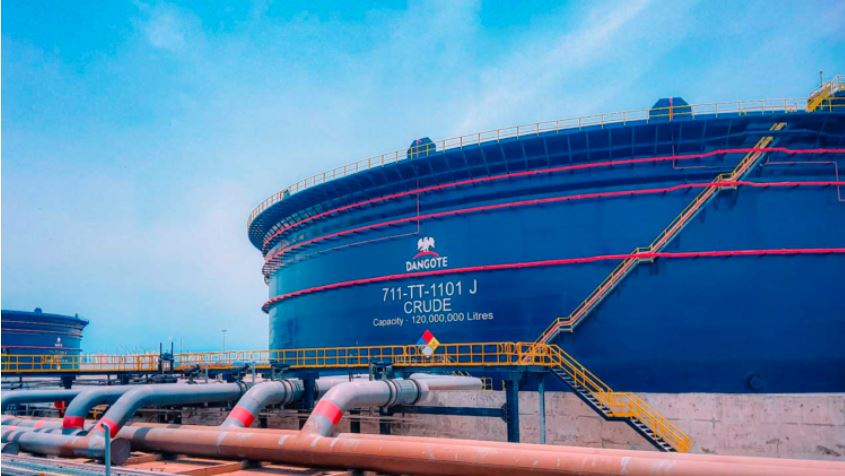
Recall that Aliko Dangote, Africa’s Richest Man Built One of the World’s Largest Oil Refineries in Nigeria, and is now supplying countries in the midst of the Iran war and blockade in the strait of Ormuz. This has been a major game changer for the country and for Africa as a whole. Picture this, you are an oil producer, yet you export the crude oil to be refined elsewhere and later on import it at a higher price and very often low-grade quality (Swiss Firms poison Oil destined for Africa). Dangote has changed this, and at a time where the world is in turmoil because of the blockade in the strait of Ormuz which supplies over 20% of the world’s oil, his refinery has been able to meet demands. The West could not see this ‘independence’ too well, because their oil companies used to own the oil in Nigeria and refine it, and sell it back at premium prices.
My question to the ‘caring’ (sarcasm) World Bank is this: where were you when your oil companies, Shell, BP, … were spilling oil in the Niger delta, thus creating major oil pollution? Justice at last from Shell … for Nigerians! Did you recommend that they clean up? Did you recommend that they compensate for all the environmental damages, the loss of livelihood, water contamination, health problems, forced migration, and loss of lives, caused while making humongous benefits? Did you stop Shell when it sold its subsidiary to absolve itself from paying for damages? Yet, your sister organizations at the UN and several human-rights organizations have said that the scale and duration of the oil pollution in the Niger Delta amounts to such a severe environmental injustice that some activists and scholars have described it as an “environmental genocide.” Now the World Bank wants us to believe that it cares so much for Nigerians that it wants them to save money at the pump by allowing foreign imports! REALLY???
After the World Bank redacted their statement, how can sane ‘experts’ make a recommendation to any country that imports is better for their livelihood? particularly to an oil producing country to import oil? They must think we are idiots.
Nigeria should not bow down to that institution which has never helped any country in the world except the imperialist ones that it serves. Nigeria and Africa should stick to working towards its independence (economic, political, cultural, etc) from these vipers!
To learn more, check out the articles at Guardian.Ng, The Africa Report, or the Daily Post Nigeria.
 Si Dieu ne prend pas ta vie, personne ne peut te l’enlever (Proverbe Mossi – Burkina Faso).
If God does not take your life, no one can take it from you (Mossi proverb – Burkina Faso).
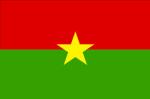
On April 18, 2026, during the AES-ECOWAS summit in Lomé, Togo, President of the National Commission of the Alliance des États du Sahel (AES) for Burkina Faso, Bassolma Bazié set the record straight. His intervention was fiery and strongly contrasted the AES with the ECOWAS/CEDEAO bloc. He reacted to current political tensions in West Africa, while delivering a forceful political address in Lomé. He spoke in defense of the AES, and made a call for African sovereignty. His speech was a call to action, and at the same time a summary of the progress Burkina Faso and the AES countries have made on their own. I felt proud to be African!
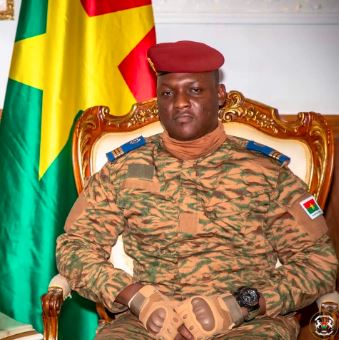
He detailed some of the progress Burkina Faso has seen between 1960 to 2022 when it was ‘independent and democratic’ and ruled by the Western puppets, and since 2023 under the ‘junta’. The progress in 3 years is amazing, should be applauded and copied by all. Burkina Faso which never had air force bases, now has at least 4. Every citizen is happy to join in the effort of liberating their country. There were months when doctors and nurses who did not protest and understood the dire situation facing their countries did not receive pay; the President of the Faso, once the money came in, paid all the arrears. Burkina Faso saw its very first renal transplant operation last month; a first since forever! All citizens contributed, from their savings and salaries, over $2 billion to the cause of their country. Now that they are owners of their own destinies, they can do transactions without passing through the French slave currency FCFA, which gives them freedom to bargain with other countries and choose partners.
Here are some of the points President of the National Commission of the AES, Bassolma Bazié covered:
In his April 2, 2026 interview, the President of Burkina Faso, Ibrahim Traoré, showed, through simple examples, like his illustrious predecessor Thomas Sankara, that true sovereignty is impossible without industrialization.
He used simple everyday objects, in layman’s terms, including a spoon, to illustrate how Africa remains trapped in a colonial economic model where it exports raw materials and imports the finished goods at a much higher cost. He took the example of soy beans that are grown locally, yet soy oil is imported; similarly with cotton which is produced locally, yet, clothing is imported from abroad even though there is a local industry. He said that Burkina Faso must stop exporting raw resources only to buy back manufactured items. Doesn’t this remind you of Sankara at the UN tribune? The Faso Dan Fani: Woven Cloth of the Homeland.
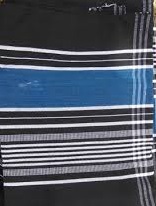
In 1986, the President of the Faso, Thomas Sankara, declared that it was important to “produce and consume Burkinabé.” Thus, Sankara declared “In all the villages of Burkina Faso, we know how to grow cotton. In all villages, women know how to spin cotton, men know how to weave it into cloth, and other men know how to sew those threads into clothes... [Dans tous les villages du Burkina Faso, l’on sait cultiver le coton. Dans tous les villages, des femmes savent filer le coton, des hommes savent tisser ce fil en pagnes et d’autres hommes savent coudre les pagnes en vêtements …]” and further “We should not be slave of what others produce [Nous ne devons pas être esclave de ce que les autres produisent].”
Traoré argued that Africa must produce locally, adding value to its own resources instead of enriching foreign industries. Like currently, the world is held up by the energy crisis caused by the Iran war and the blockade of the strait of Ormuz. Can you imagine that some African oil-producing countries like Cameroon, Congo, Gabon, have an oil/fuel penury? How come? well, for instance, Cameroon’s oil refinery burnt down a few years back, and Cameroonian oil is exported to Europe, bought back from them to be imported into the country as cheap toxic fuel! There are countless examples like that: Swiss Firms poison Oil destined for Africa. This is why Africa’s Richest Man Dangote has built one of the world’s largest oil refineries.
Traoré explained that Burkina Faso cannot remain dependent on foreign factories for basic goods. He insisted that local transformation of resources is the only path to real independence. To come back to the spoon example, Burkina Faso exports metal ore, while foreign countries turn it into spoons or tools, and Burkina buys those finished products back. This is not development; it is dependency!
This development must be led by Burkinabe, and Africans themselves. It cannot be dictated by foreign institutions (IMF, World Bank, UN, etc) which do not serve our interests. Africa must build its own industries, and the opportunities and job creations are endless, from the example of the spoon, plates, medicine, clothing, housing materials, etc. True Burkinabe and African sovereignty cannot be done with industrialization!
On April 2, 2026, President Ibrahim Traoré of Burkina Faso addressed the local and international press for more than 2 hours. He focused on several major themes central to Burkina Faso itself and its relationship with foreign powers. It was a real masterclass. He did not fall for the numerous press’ traps.
Below are some key themes he focused on:
Sovereignty and independence
Traoré emphasized that Burkina Faso must strengthen its sovereignty in all areas: political, economic, and security-related. He framed the country’s current path as a struggle for real independence, and not symbolic autonomy which many African countries have had since their ‘independence‘ in the 1960s. It is important to reclaim our sovereignty! He highlighted that Burkinabé are now in charge of their own army, and is funded and trained by Burkinabé themselves; thus the mindset and strategy have changed and lent to victories against terrorism.
Economic Liberation
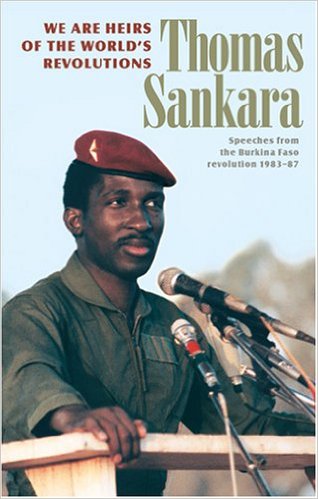
Optimal management of our resources and end the dependency on foreign powers and for Africa to build its own systems. He reminded us, almost like President Thomas Sankara before, that we have to build and plant what we need to achieve self-sufficienty (Thomas Sankara in His Words, Thomas Sankara’s Speech at the United Nations / Discours de Thomas Sankara aux Nations Unies, Thomas Sankara Speech on Debt and Unity, “The National Economy: Independent, Self-Sufficient, and Planned at the Service of Democratic and Popular Society” — Thomas Sankara). Taking the example of a spoon that we use to eat, but yet is imported; or Africa which imports food from other countries, when it is the continent with the most arable lands in the world. Something has to change.
Security and the war against terrorism
For a country like Burkina Faso, Western-style democratic systems cannot be simply grafted or copied to a nation like his, fighting terrorism and dealing with Western embargo, and deep institutional corruption. Security and stability must come before adopting external political needs.
Democracy and Media Reactions
President Traoré said that “Burkinabé must forget democracy,” and many Western media were triggered by it. In reality, the president of the Faso (PF) was trying to say that western electoral models cannot function effectively in Burkina Faso during wartime and when it is trying to free itself from imperialist chains. Moreover, as we have discussed here before, Africans must stop falling into the trap of democracy; the West has cheated Africa for far too long with that word called democracy that most of them do not even apply! The PF also reminded us about the “Charte du Mandé” the very first declaration of human rights in the world established in Africa and which shows that Africa’s ancestral governance should be made more relevant today and is adapted to our struggles.

Justice and institutional reform
The PF highlighted that the focus is on rebuilding institutions and creating systems that are resistant to corruption and external manipulation. He also showed how old traditional/local/ancestral governments could live in harmony with the modern republican government for the benefit of the homeland.
Africa’s geopolitical position
He positioned Burkina Faso within a broader African struggle for independence. As the leader of the Alliance of Sahel States (AES), he stated that priorities would be on the operationalization of the unified force, the acceleration of regional integration, and the implementation of major economic initiatives. He urged Africans everywhere to see themselves as part of one global community which should fight for its independence.
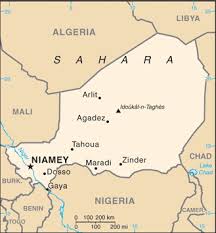
Today, we are going to talk about the city of Agadez, which is one of Niger’s most historic and culturally important cities. Agadez is a UNESCO World Heritage Site, a Tuareg stronghold, and the traditional “gateway to the Sahara.” It is famous for its mud‑brick architecture, its ancient role in the trans‑Saharan trade, and its striking desert landscapes. It is the fifth largest city of the country.
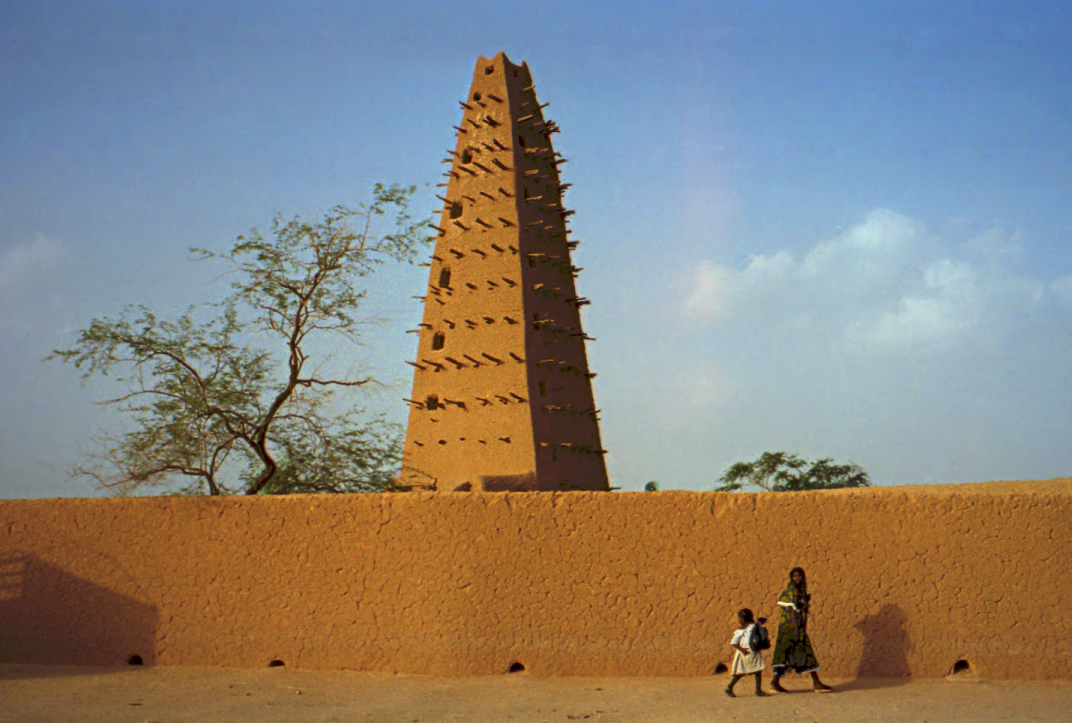
Located deep in the Sahara Desert, it serves as the capital of the Agadez Region and the historic Aïr Tuareg federation. Its historic city center, the Old City, is a UNESCO World Heritage Site, since 2013 because of its narrow alleys, traditional Tuareg houses, and centuries-old urban design showcasing the great architectural continuity and cultural significance. Another landmark of the city is the Grand Mosque of Agadez. Built in 1515, the Grand Mosque of Agadez, is a masterpiece of Sudano-Sahelian architecture entirely made of earth and wood, and is one of the most iconic structures in the Sahel with its tall mud-brick minaret. It was a landmark for caravans crossing the Sahara.
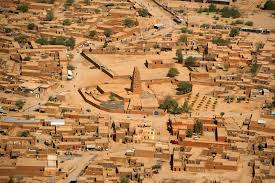
The name Agadez is said to come from egadaz which means “to visit someone” in Tamashek, a Berber language from the Tuareg people of the region. It used to be the crossroad of caravans that linked North Africa to Subsaharan Africa and huge commercial center. It was founded by Tuareg tribes (Ifadalan, Massoufa, …) in the 11th century before becoming an important crossroad for major trans-Saharan roads in the 16th century. With its strategic position, it is a key stop for caravans moving salt from Bilma in Niger, gold from West Africa, textiles and goods from North Africa. The Sultanate of Agadez became a Tuareg sultanate in 1449, and was conquered by the Songhai Empire in 1515 before later regaining its autonomy. It became the most important city of the Tuareg people, to the point of becoming the capital of the Tuareg rebellions in the 1990s and 2007.
Modern Agadez is home to the University of Agadez and an international airport. It continues to be a Tuareg cultural center known for its skilled craftsmanship, silver jewelry, leatherwork, music and festivals. While in the past, it was a trade hub, today it is still a hub, but for modern migration routes. It is also located on the road to the uranium mines of Arlit, and the gold mines Akokan and Tabelot.
In his book Description of Africa (published in Italian as Della descrittione dell’Africa et delle cose notabili che ivi sono, per Giovan Lioni Africano in 1550), Leo Africanus described Agadez as a “city surrounded by murrals“, with “houses well built“, and “sumptuous palace.” Agadez kept the vestiges of its murrals up until the 1960s.
To learn more, check out Around the world in 80 clicks or this Al Jazeera article or NigerHeritage. Enjoy! If you ever get the chance to visit Agadez, remember that it sits on an ancient crossroad trade hub in the middle of one of the world’s largest desert, and imagine yourself as part of those commercial caravans of old.
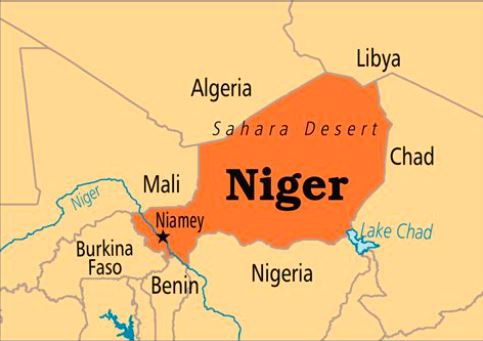
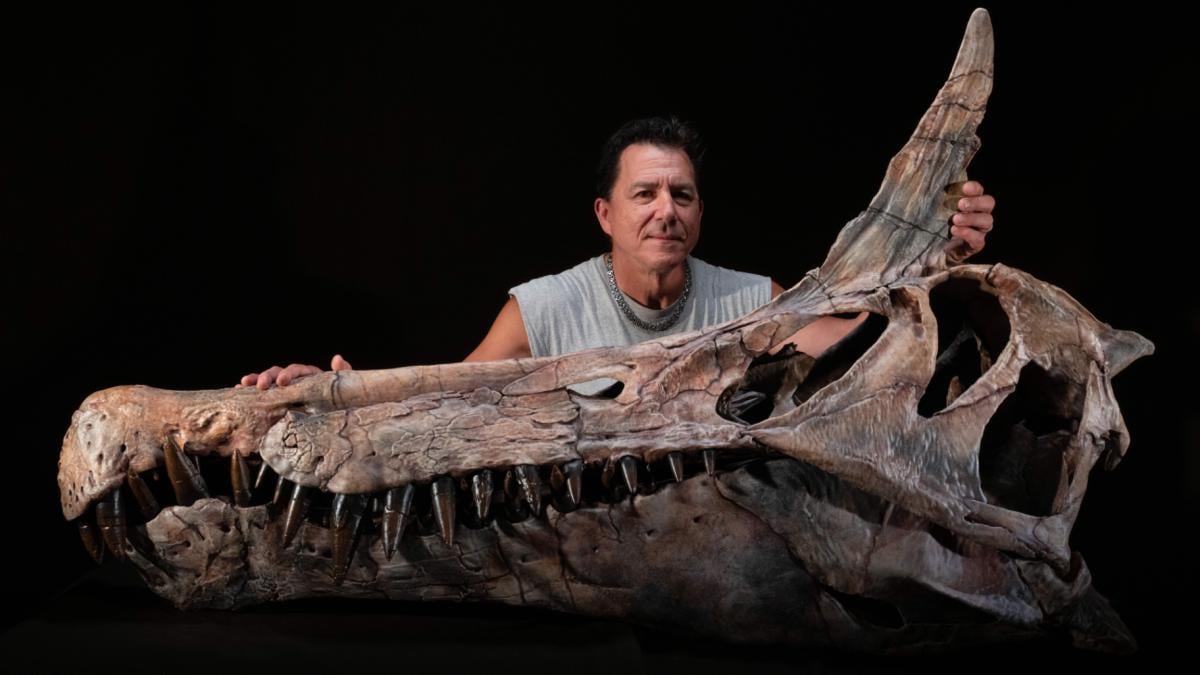
In the Sahara desert, in the country of Niger, near the city of Tesker, a team of scientists has discovered a new species of dinosaur which lived in the area 95 million years ago. The new species, named Spinosaurus mirabilis, measures 12 m long, has a long snout adapted for catching fish, and features a spectacular curved crest on its head which is the largest ever found on a predatory dinosaur.
The expedition has been led by American paleontologist Paul Sereno from the University of Chicago who explains that the crest was likely ornamental, similar to features seen in some modern birds, rather than a weapon; this could later be found not to be the case, as we, humans, often interpret some ancient findings through our modern eyes. The dinosaur also had interlocking teeth, ideal for gripping slippery fish, showing its adaptation to life near water. This rare finding was cause for great joy within the team. Using modern tools including solar-powered laptops, members of the team were able to digitally assemble the images of the bones right in the middle of the Sahara.
The team will be returning to Niger for further work. Sereno and his team are helping to establish a Heritage Center at the University of Niamey and planning 2 museums, one in the capital and the other in Agadez to showcase the country’s rich paleontological history.
This discovery sheds a light on the fact that the Niger’s desert is a major dinosaur fossil site, with many more discoveries to be made. There is a great need to train Nigerien and African archaeologists, paleontologists, and museum specialists as the field is overall a virgin field in Africa. Africans need to learn, so that they can tell their own history!
Check out Sci News, Discover Magazine, UChicago News, as well as the interview in RFI for more.
A teacher in Tanzania asks his class:
“If you had 10 goats and a hyena came and ate 4, how many goats would you have left?”
One student raises his hand confidently: “None”
The teacher frowns almost angry, “None? but 10 minus 4 is 6.”
The student shakes his head :
“Sir, if a hyena comes for my goats, I am running away; I am not staying to count anything!”


