Reclaiming African History: Gorée and the Slave Trade in Senegal

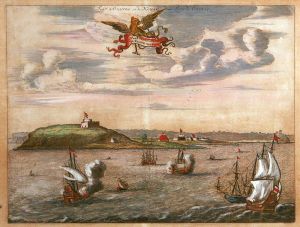
Goree_Le_fort_d'Orange_et_de_Nassau_à_l'île_de_Gorée_17th century
Goree Island: Fort of Nassau and Orange, 17th century (Wikipedia)

Today I will be talking about the island of Gorée, in Senegal. Located less than 4 km from the city of Dakar, Gorée island offers a sure route for ships. Since the 15th century, it has been the center of rivalries between diverse European nations which used it for slave trading. Locally known as “Beer” or “Ber” or “Bir” in Wolof, it was first named “La Palma” by Portuguese in 1444, with some ancient maps also showing the name “Beseguiche” for it. The Dutch navy named it “Goede Reede” or “Good Harbor” in 1588. In 1677, the island was occupied by the French.

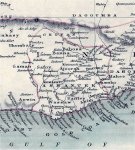
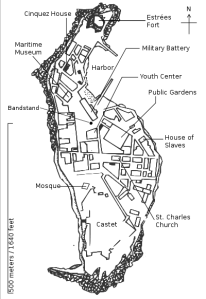
Goree_Map_of_Goree
Map of Goree (Wikipedia)

Before I dive further into the atrocities of human trading on the island, I would like to address ideas circulated by some stating that the island of Gorée was never really used for slave trading and that slave trading had been done in Saint Louis in the north or south in Gambia. These claims were so outrageous that the Senegalese government sponsored an international conference on the history of the island, and researched and found original archives from the French Port of Nantes showing that between 1763 and 1775 alone, one port had traded more than 103,000 slaves from Gorée; this thus shows that Gorée was indeed at the epicenter of slave trading, and stating otherwise is an attempt at falsifying history. The first slaves were taken from Gorée in 1536, and the trade continued at least until 1848.

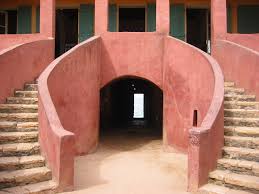
Goree1w
House of Slaves (Wikipedia)

Now back to the island itself. One of the most important if not the main stop on the island is the house of slaves. Of Reddish/pinkish color, this house was first built by the Dutch in 1776, and is the last standing slave house on the island. At the end of the 18th century, the island was a prosperous crossroad of merchants, soldiers, and administrators, with at its center slave trade. Today, it serves as a museum and a memorial to humanity. The upper part of the building like most slave houses was used by the Europeans who lived there; while the bottom part was used to house slaves packed on top of each other in humid, sordid, and disgusting rooms built for 15-20 people but housing sometimes over 100 people, while waiting to be taken to the Americas. On the bottom floor, there is a room used to pack young women among which the slave traders would come every night and choose those who will be used for their sexual pleasures; if any of these women were found pregnant from these traders’ visits, they were freed on the island or sent to Saint Louis. There were also rooms to house strong men, children, and women. There was also a dark tiny room where the most defiant ones were stacked on top of each other, and salty water was seeped through the walls to force dehydration and later death. The value of a man depended on his weight and muscles; the minimum weight was 60 kg. The value of a child depended on his/her denture, while that of a woman on her breasts.

Goree_Jeunes filles
Cell for young girls in the House of Slaves

The small size of the island made it easy for merchants to control their captives. The surrounding waters are so deep that any attempt at escaping would mean sure drowning. With a 5kg metal ball permanently attached to their feet or necks, a captured African who ever tried running away would surely drown in deep sea.

From the door of no return, the slaves were loaded onto ships which took them across the Atlantic. This was their last time on African soil.

Entire families were captured and brought to Gorée, but their destinations were seldom the same: the father could be shipped to America, while the Mother to Brazil, and the child to Haiti or the West indies. Separation was irrevocable.

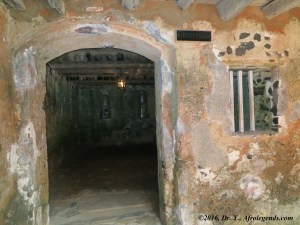
Goree_Cellule
Cell in the House of Slaves

Not too far from the house of slaves is the castle which was used as a warehouse for millions of captured slaves.

After the abolition of slavery in 1848, the island’s population declined, with many moving to Dakar. Since 1978, the island is a UNESCO World Heritage Site.

Today the island of Gorée is a memorial to all those who were separated from their loved ones, their lands, their society, their culture, uprooted and sold like cattle across the globe. It serves as a reminder of humanity’s ugly past, and what it is capable of for capital gain, hatred, and greed. Gorée is and should remain all of that, but also a true reminder to future generations that mankind should be loved, and a man’s life is precious, not to be sold like cattle. Attempts by some to absolve themselves from their ugly pasts should not stop those who were hurt from remembering, for celebrating the lives of those who perished, who were uprooted, and those who survived. Truth is truth whether beautiful or not, it is truth, and remembering is acknowledging all the good those who lost their lives, those who survived, gave to the world, because America will not be America without the Slaves’s lives and hard labor; Brazil will not be Brazil without the blood of those slaves; France will not be France, or Great Britain will not be Great Britain without the sweat and blood of African slaves. So Gorée is a reminder of all of that, and should be cherished for it.

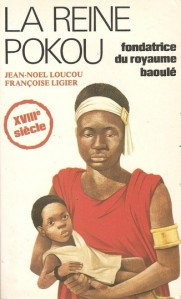
Queen Abla Pokou

Pokou1Just to add a bit more to the story of Queen Abla Pokou, the outstanding queen who led a group of the Ashanti people who later became the Baoule people of Cote d’Ivoire, I leave you here with a snipet of the 3D movie: POKOU Princesse Ashanti.
Queen Abla Pokou and the Origin of the Baoule People

Abla Pokou
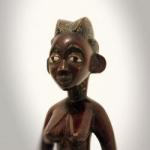
Baoule mask representing Queen Abla Pokou

The story of Queen Abla Pokou (Abla Poku in English) is the story of the creation of the Baoule people of Côte d’Ivoire. She was a strong and loving queen who made a profound sacrifice for the well-being of her people, and thus was granted their deep love.

In the 17th century, King Osei Kofi Tutu I founds the Ashanti Empîre of Ghana. Given that in the Ashanti culture the law is matrilineal, when King Oseï Tutu dies, his nephew succeeds him. However, when his nephew dies shortly after, a war for the throne starts in Kumasi, the capital of the kingdom; this war opposes an old uncle of the royal family named Itsa, and Dakon, the second brother of the future queen Abla Pokou (born at the beginning of the 18th century). Dakon will also die in this fratricide war. Quickly, Abla Pokou, understanding that she and her followers will be next to die, decides to flee. Led by her, they walk for several days and nights, fleeing from those threatening to kill them. They soon arrive on the shores of the Comoé River, located on the frontier between Ghana and Côte d’Ivoire. But the river is unsurmountable, its waters are dangerous, and their enemies are getting closer. After having overcome so many obstacles, and walked for days, it is impossible to stop there.

AblaPokou2Queen Pokou looks to her court wizard for advice, saying, “wizard, tell us what the genie of the river wants from us in order to cross its treacherous waters!” The wizard replies, “Queen, the river is quite irritated, and would only stop once an offering of what is most dear to us is made to it.” Thus, the women of the court start taking off their gold and ivory jewelry, and the men bring their cattle for offering. But the wizard, shaking his head sadly, states “What is most dear to us is our sons!
Looking upon her people, the queen decides to make the most difficult sacrifice ever: that of her toddler son wrapped on her back. After untying him, she says to him, “Kouakou(‘Kwaku’ in English), my only child, forgive me, but I have understood that I need to offer you to the river for the survival of our people. More than a woman or mother, a queen is first a queen!” She then stoically, without shedding a tear, offers her son as a sacrifice to the Comoé River.

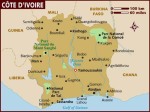
Map of Cote d'Ivoire

Once the offering made, a path quickly appears within the waters of the Comoé river allowing the queen and her people to cross it. Once the river crossed, the queen finally cries, “BA OULI!” meaning “the child is dead.” This will become the name of the people “Baoulé”. Once they arrived in a good place, the tribe holds a funeral for the sacrificed child. In memory of this, the place will be called Sakassou, meaning “place of funerals.” Queen Abla Pokou will rule over her people for many years, and news of her good reign will travel very far. She will die around 1760.

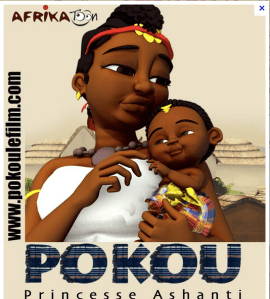
Pokou1
Poster for the 3D movie: Pokou Ashanti Princess

Some historians claim that a big tree bent over to let the Queen and her people cross, while others maintain that a group of hippopotamuses lined up a path across the river for the queen. Either way, the story of the queen’s great courage remains the same. Queen Abla Pokou, the founder of the Baoulé people of Côte d’Ivoire, was a great queen and woman who sacrificed what she held most dear for the well-being of her people. Many African presidents would learn a lot from Queen Abla Pokou’s courage, determination, and love of her people. Today in Côte d’Ivoire, her story has just been made into a 3D movie: POKOU Princesse Ashanti. The Ivorian author Véronique Tadjo has also published a book Reine Pokou: concerto pour un sacrifice in 2005. The story of Queen Pokou and the Baoule was retold by Maximilien Quenum in his Légendes africaines. Check out the websites Naforo-Ba and Matricien.org to learn more about it.

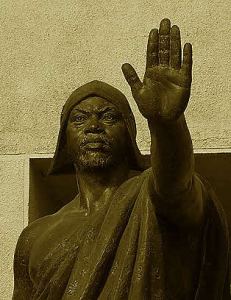
Why Behanzin should stay in Blida

Statue of Behanzin in Abomey, Benin

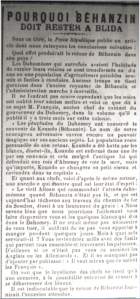
The article below is from 1906 giving reasons why the French government refused to return Béhanzin to his country. The English translation is brought to you by Dr. Y., Afrolegends.com .

===========

Under this title, La Petite République published an article from which we extract the following conclusions:

What will be the effect of Béhanzin’s return in his country?

The Dahomeans, who in the old days, used to raid their neighbors have been transformed under 10 years, into a population of peaceful docile peasants and easy to be led. No troops are stationed in the ancient kingdom of Behanzin and the administration is working amazingly.

Do not for one instant believe that the negroes have forgotten their old master and here is what M. Francois, ancient chief of cabinet of the governor of Dahomey, says about this in the volume he published three months ago on this colony.

Behanzin_18 Juillet 1906
The original article from La Petite Republique, in French

The people of Dahomey have kept the memory of Kondo (Béhanzin). The name of our courageous adversary still exerts a magical power on his old subjects. The population remains certain of his return. They say, Kondo was defeated by the whites, Kondo is imprisoned on an island by his enemies and this despite the ancient law which guards the Kings of Abomey from seeing the sea, but anyhow, Kondo will transform himself into a small bird and will come back to his capital.

As for the chiefs, here is, from the same author, an anecdote which shows their state of mind:

“The old Alloan who used to command the Dahomean army when Béhanzin was not here, and who today is a worker on the Sudan railroad, was telling one of the engineers, “We know well that we could easily make you disappear, you and the other white people who are in the Dahomey. It would not even be necessary to kill you, it will suffice not to bring you any food for a few days. But what will be the point of this? You will come back, by the thousand, with guns which fire all at once and traverse palm trees. Moreover, if it wasn’t you, it will be the British or the Germans.” And he politely added, “better if it is the French.”

One can see that the loyalty of the chiefs holds onto a fine thread, an occasion, a possibility, to rid their land of the whites.

It is undeniable that the return of Béhanzin will provide this anticipated occasion.

Why the Name: Windhoek?

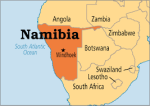
Nambia2Ever wondered what the name of the capital city of Namibia, Windhoek, mean? To me, thinking about the English beginning ‘Wind‘, I wonder if its name has something to do with wind, even though Namibia was never a British colony? However the end part ‘Hoek‘ does not sound English at all. Could the name be a European ‘deformation’ of a local name, the way Yaoundé or Abidjan are?
Windhoek_19eme siecle
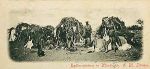
Windhoek settlement at the end of the 1800s

Well, imagine my surprise when I found out that Windhoek stand for ‘wind-hoek‘ or “Wind Corner” in Afrikaans (Windhuk in German). Knowing that the country was a German colony, why will it have an Afrikaans’ name? The two languages being so close together, maybe the name was first German, and later on Afrikaans, given that the country fell under South African ‘administration’ after Germany lost first world war.  Well, it is said that the city was founded in 1844, by Captain Jonker Afrikaner who named it Windhoek after the Winterhoek Mountains at Tulbagh in South Africa, where his ancestors originated from.

Windhoek_2
Windhoek settlement at the end of the 1800s

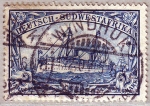
In its history, the city of Windhoek has had at least 7 different names: “Aigams” for hot springs as named by the local nomadic Khoekhoe people; “Otjomuise” for the place of steam as named by the local Herero people; both names referring to the hot springs located near today’s city center. It was later named “Queen Adelaide’s Bath” by English explorers in 1836. Then it was named “Concordiaville” by Rhenish Missionaries. In 1840, it was named “Winterhoek” by Jonker Afrikaner and his group of Nama people who were emigrating from the Cape. It became “Windhuk” in 1890 with the German colonization of the country, and it has been “Windhoek” since 1920 under South African administration and has remained so after independence in 1990.

Windhoek_Stamp
Windhoek settlement at the end of the 1800s

Located in the Khomas Highland plateau area, in central Namibia, Windhoek stands at around 1700 m above sea level. It is the social, economic, political, industrial, and cultural center of the country. It is a bustling, growing city, and tourism is playing a big part in the city’s life as well. Enjoy the video below about Windhoek.


The Black People of Mexico

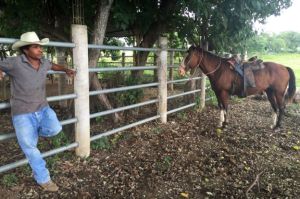
Afro_mexican_3_Black Cowboy
Afro-Mexican cowboy (Source: BBC)

I found this article on the BBC this week about the Afro-Mexican people, or Black people of Mexico, and thought of reposting parts of it. For the full article, go to: the BBC .

===========

More than a million people in Mexico are descended from African slaves and identify as “black“, “dark” or “Afro-Mexican” even if they don’t look black. But beyond the southern state of Oaxaca they are little-known and the community’s leaders are now warning of possible radical steps to achieve official recognition.

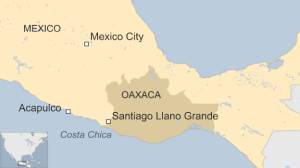
[…] Black Mexicans have been living in the Costa Chica area, on the Pacific coast of Oaxaca, since their ancestors were brought from Africa as slaves in the 16th Century.

Colonial Spanish cattle ranchers often used them as foremen, in charge of indigenous Mexican workers who were not used to animals the size of cows or horses.

Afro_mexican_2
The state of Oaxaca (Source: BBC)

But outside the Costa Chica area there is little awareness of their existence.  

An interim census in 2015 indicated a black population of 1.4 million, or 1.2% of the Mexican population. Even in Oaxaca state they only account for 5% of the total. By comparison, indigenous peoples made up nearly 10% of Mexico’s population, as measured in the 2010 census. The appearance of those who identify as black Mexicans varies considerably. Some are hard to distinguish from indigenous Mexicans.

[…] But there is frustration here that the Afro-Mexicans are not more widely known in Mexico and are not officially recognised as a minority by the Mexican government.

According to Humberto Hebert Silva Silva, head of the Bureau for Afro-Mexican Affairs in Oaxaca, this is because Afro-Mexicans speak Spanish, like most other Mexicans – they do not have their own language.

Afro_mexican_1
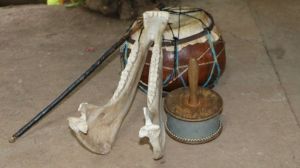
Afro-Mexican musical instruments: quijada and bote (BBC)

When we go and ask [for recognition as a minority], they come up with excuses, or say that we don’t have an indigenous mother tongue. Language is the real criterion,” he says.We are being discriminated against.”

If Afro-Mexicans were classified as a minority they would receive extra funding for promotion of their culture and public health programs.

But activists including Israel Reyes, a teacher, want more than money, it’s also important to them that the existence of Afro-Mexicans is recognized at the level of the Mexican state.

[…] “The story of the black population has been ignored and erased from history.”

Idris Alooma: Warrior King of the Bornu Empire

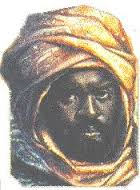
Idris Alooma
Idris Alooma

Today, I will be talking about Idris Alooma (also Idris Alaoma, or Idris Alauma), the only Bornu King whose name has survived the test of time. This article is long overdue, as it focuses on the Bornu and Kanem-Bornu empires.

Idris Alooma’s reign belonged to the great Sayfawa or Sefuwa dynasty which ruled the Bornu empire from the 16th and 17th centuries. According to the Diwan al-salatin Bornu, Idris Alaoma was the 54th King of the Sefawa dynasty, and ruled the Kanem-Bornu empire located in modern-day Chad, Cameroon and Nigeria. In many works, he is known by his mother’s name, Idris Amsami, i.e. Idris, son of Amsa. The name Alooma is a posthumous qualificative, named after a place, Alo or Alao, where he was buried. He was crowned king at the age of 25-26. According to the Diwan, he ruled from 1564 to 1596. He died during a battle in the Baguirmi where he was mortally wounded; he was later buried in Lake Alo, south of the actual Maiduguri, thus the name Alooma.

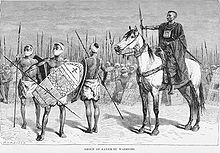
Group of Kanem-Bu warriors in the 1800s

Idris was an outstanding statesman, and under his rule, the Kanem-Bornu touched the zenith of its power. He is remembered for his military skills, administrative reforms and Islamic piety. His feats are mainly known through his chronicler Ahmad bin Fartuwa. During his reign, Idris avoided the capital Ngazargamu, preferring to set his palace 5 km away, near the Yo river (Komadugu Yobe), in a place named Gambaru. The walls of the city were red, leading to a new architecture using red bricks characteristic of his reign. To this day, some murals still exist in Gambaru and are over 3m tall. These are vestiges of a flourishing empire. Idris Alooma was known by the Kanuri title of Mai for king.

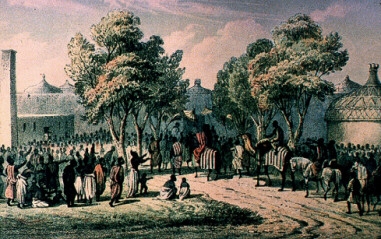
Kanem-Bornu court in the 1700s

His main adversaries were the Hausa to the west, the Tuareg and Toubou to the north, the Bulala to the east, and the Sao who were strongly implanted in the Bornu region (and will be decimated by Alooma’s military campaigns). One epic poem extols his victories in 330 wars and more than 1,000 battles. His innovations included the employment of fixed military camps with walls, permanent sieges and scorched earth tactics where soldiers burned everything in their path, armored horses and riders as well as the use of Berber camels, Kotoko boatmen, and iron-helmeted musketeers trained by Ottoman military advisers. His active diplomacy featured relations with Tripoli, Egypt, and the Ottoman Empire, which sent a 200-member ambassadorial party across the desert to Alooma’s court at Ngazargamu. Alooma also signed what was probably the first written treaty or ceasefire in Chadian history.

Alooma introduced a number of legal and administrative reforms based on his religious beliefs and Islamic law. He sponsored the construction of numerous mosques and made a pilgrimage to Mecca, where he arranged for the establishment of a hostel to be used by pilgrims from his empire. As with other dynamic politicians, Alooma’s reformist goals led him to seek loyal and competent advisers and allies, and he frequently relied on eunuchs and slaves who had been educated in noble homes. Alooma regularly sought advice from a council composed of heads of the most important clans. He required major political figures to live at the court, and he reinforced political alliances through appropriate marriages (Alooma himself was the son of a Kanuri father and a Bulala mother).

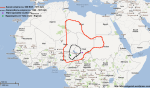
Map of the Kanem and Kanem-Bornu empires

Kanem-Bornu under Alooma was strong and wealthy. Government revenue came from tribute (or booty if the recalcitrant people had to be conquered) and duties on and participation in trade. His kingdom was central to one of the most convenient routes across the Sahara desert. Many products were sent north, including natron (sodium carbonate), cotton, kola nuts, ivory, ostrich feathers, perfume, wax, and hides, but the most profitable trade was in slaves. Imports included salt, horses, silk, glass, muskets, and copper.

Alooma took a keen interest in trade and other economic matters. He is credited with having cleared the roads, designed better boats for Lake Chad, introduced standard units of measure for grain, and moving farmers into new lands. In addition, he improved the ease and security of transit through the empire with the goal of making it so safe that “a lone woman clad in gold might walk with none to fear but God.” To learn more, check out the books: History of the first twelve years of the reign of Mai Idris Alooma of Bornu (1571-1533) by his Imam: Ahmed ibn Fartua; together with the “Diwan of the sultans of Bornu” and “Girgam” of the Magumi; and The Africans, ed. J.A. Tome 3, 1977.


Afro Hair: Crown Jewel of African Women and Men

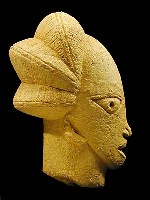
Nok sculpture of a woman
Have you ever looked at sculptures of women from the Nok civilization? Then you have probably noticed that Nok women wore their hair braided similar to the Fulani women of today, in beautiful goddess braids, and amazing styles. Ever looked at images of Queen Nzingha? She wore her hair in Afro, fully out.
Queen Nzingha of Angola
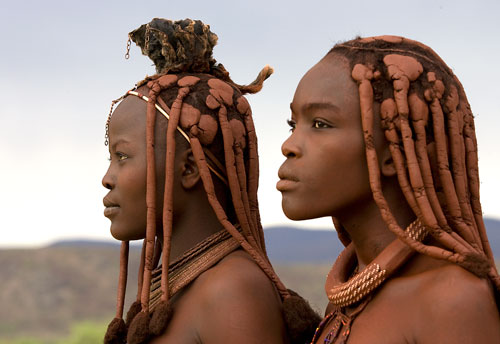
What about the great Amanishakheto of Nubia, well, hieroglyphs at Meroë, show her sporting a gorgeous ‘Fro. And the fierce amazons of King Behanzin wore either braids, or shaved their heads, or sported afros. Today the tradition persists: the Himba women of Namibia and Angola wear dreadlocks decorated with red ochre, while Maasai women shave their heads and Maasai men sport dreadlocks. For their wedding, the Wodaabe women wear amazing braids decorated with cauris, and jewelry. In our culture, there were intricate hairstyles for different occasions: passage of a girl into womanhood, courting, weddings, funerals, etc.
Himba women (absoluteafrica.com)
Isn’t it amazing how our crown jewel, our hair, can be worn in so many different ways? Isn’t it amazing that one could change hairstyle every two-three weeks, or even
Fulani woman (Wodaabe)
every month? After all, nature gifted the African race with a lion’s mane, which can be dressed a thousand ways, why not take advantage of it? Nigerian photographer J.D. Okhai Ojeikere captured some of these different hairstyles from women in the 1960-70s. Many African women from the 1960s-70s can be seen wearing tresses; and if you ever dig up pictures of your parents, you will see your mothers wearing those as well. His collections and books are amazing. Enjoy!


The Faso Dan Fani: Woven Cloth of the Homeland

Flag of Burkina Faso

Today we will be talking about the Faso Dan Fani, known as Burkina Faso‘s national cloth. For starters, the Faso Dan Fani means “woven cloth of the homeland” (pagne tissé de la patrie). All the words are Dioula: Fani = cloth/wrapper (pagne), Dan = woven (tissé), Fasohomeland (patrie). It is known locally as FDF. As you have probably guessed, the Faso Dan Fani is a handwoven cotton cloth. The weaving style and patterns differ depending on the ethnic group. As you all know, weaving cotton is an ancient African tradition (African textiles): in the old days, the spinning was done by women, while the men were left with weaving the cotton threads into cloth. With time, women took over the weaving business as well.

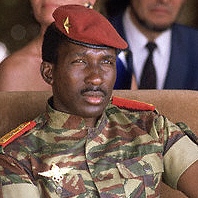
Thomas Sankara
Thomas Sankara a Ouagadougou

In 1986, the President of the Faso, Thomas Sankara, declared that it was important to “produce and consume Burkinabé“. Thus, he declared “In all the villages of Burkina Faso, we know how to grow cotton. In all villages, women know how to spin cotton, men know how to weave it into cloth, and other men know how to sew those threads into clothes... [Dans tous les villages du Burkina Faso, l’on sait cultiver le coton. Dans tous les villages, des femmes savent filer le coton, des hommes savent tisser ce fil en pagnes et d’autres hommes savent coudre les pagnes en vêtements …]” and further “We should not be slave of what others produce [Nous ne devons pas être esclave de ce que les autres produisent].” For the president, “wearing the Faso Dan Fani is an economic act, cultural, and political to challenge imperialism [porter le Faso Dan Fani est un acte économique, culturel, et politique de défi à l’impérialisme].”

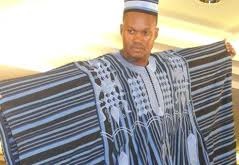
Faso Dan Fani
Faso Dan Fani

Thus under Thomas Sankara’s revolution, the traditional attire was imposed in work places. … Many were not pleased with it, to the extent that some had nicknamed the FDF, “Sankara is coming [Sankara arrive] since the PF was known to do impromptu visit of his ministries. Under him, the FDF had become the signature of Burkinabé outside the country. Sankara even made a speech at the United Nations where all the members of his delegation and himself were dressed with the Faso Dan Fani entirely made by local Burkinabé artists to be consumed by Burkinabe.

Model wearing Faso Dan Fani (Ecodufaso.com)

Today, the Faso Dan Fani is seen as a symbol of national pride, and people are starting to wear it again. Check out ThomasSankara.net to learn more about it, and this article “Faso Dan Fani: what if Thomas Sankara was right?” and this article on AfriqueFemme.com. Enjoy!

Portrait of Samori Touré

Samori Toure holding the Coran

All, I am giving you below a portrait of Samori Touré made by Commandant Binger, a contemporary of Samori Touré, one of the great kings and fighters for African freedom. Bear in mind that this description is certainly  tainted by the European (Binger) colonizer’s stereotypes of Africans. The original text in French is found on page 255 of Les Africains, Tome 1. Translation to English by Dr. Y. Afrolegends.com. Enjoy!

=============

Samori Touré
Samori Touré

The almamy is a tall handsome man of about 50 years of age; his features are a bit hard, and, unlike men of his race, he has a long slim nose, which gives a refined expression to his entire physiognomy; his eyes are very mobile, but he does not often look across his interlocutor.

His exterior appears to me affable rather than hard: very attentive when a compliment is made to him, he can be distracted and indifferent when he does not want to answer a question categorically. He speaks with great volubility, and I think him capable of being warm and persuasive when the occasion arises.

Sitting in a cotton hammock with white and blue rays brought to him from Paris by his son, he holds in his hands, a big piece of tender wood which is called in Bambara niendossila, or ngossé (it is sotiou in Wolof) and with which he cleans his teeth.

"L'Almami Samori Toure" de Khalil Fofana
“L’Almami Samori Toure” de Khalil Fofana

He is dressed with a big doroké in purple florence, of inferior quality, and wears indigenous cotton pants with black and red rays of European make; his legs, a brown chocolate lighter than his face, are coated with shea butter; he is wearing indigenous red leather sandals.

On his head is a red fez of sharpshooter around which is wrapped a thin white turban which goes on his mouth and frames his black face. On his shoulders, he negligently wears a haïk of low price.

Imaginary portrait of Samori Touré

Sitting at his feet are: an old kokisi who never leaves him, two marabouts, a few griots, and the four captives assigned to the hammock, the chair, the camping  bowl in which he washes his hands, and the kettle containing water for occasional rinsing of the mouth. These objects and captives rarely leave his side; wherever he goes, this paraphernalia follows.

Within his reach, and under the same shelter (sort of shed to which the hammock is docked), two tailors are busy sewing yellow florence for his wives. One of the griots carries a big red umbrella, while the other one carries a crank-rod gun. All the objects mentioned above are of English make, except the hammock and the camping bowl, which is a regular bowl.

Commandant Binger

“From Niger to the Gulf of Guinea”