
The opening ceremony of the Dakar 2026 Youth Olympic Games was an outstanding success. For the first time in the history of the Olympic Movement, the African continent is hosting an Olympic competition. Although the Youth Olympic Games are a smaller event than the Summer Olympics, this milestone is significant. One could even argue that the International Olympic Committee wished to address the fact that, in more than a century since the Games were founded, no edition of the Olympics has ever been hosted in Africa.
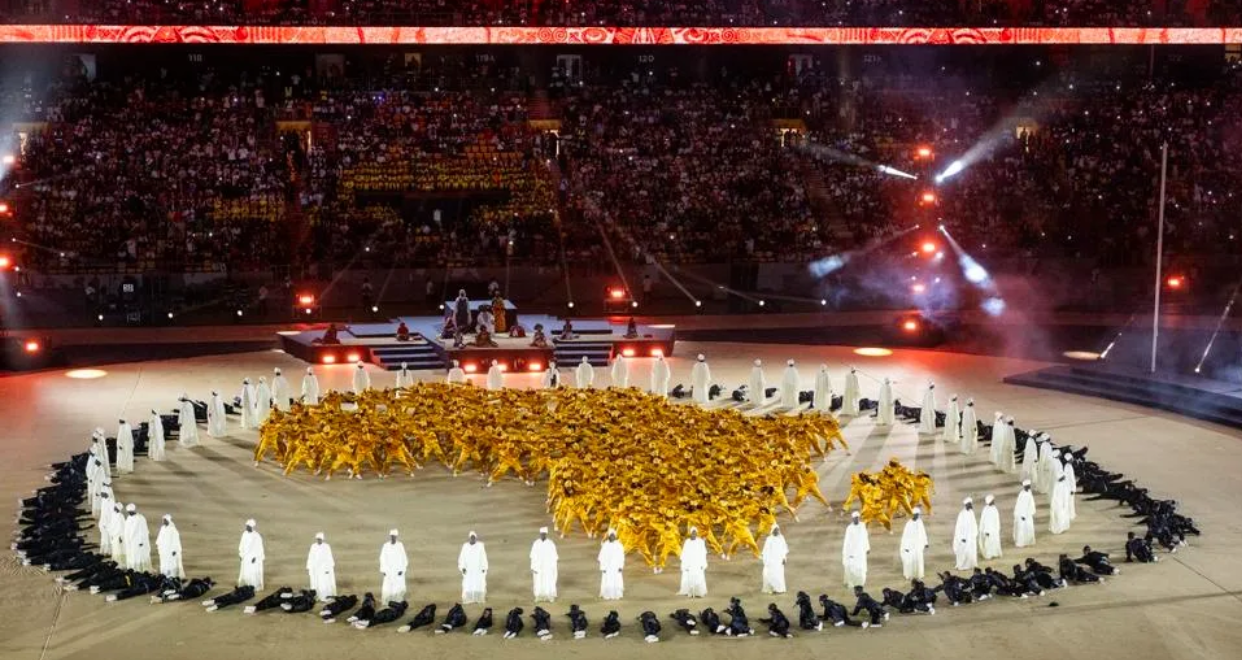
It was a true celebration of color, unity, and joy. A giant map of Africa was formed by performers dressed in yellow, black, and white traditional Senegalese boubous, dancing in unison during a grand ceremony that featured West African griot storytelling, performances by Senegalese musicians, and a parade of athletes.
The ceremony was rich with historical references. For starters, the arrival of Alkebulan, the Queen Mother, on horseback served as a metaphorical representation of Africa. According to many historians, including Cheikh Anta Diop, “Alkebulan” was the original name of the continent. The inclusion of traditional Senegalese wrestling was also a powerful expression of national pride.
The horse and the song performed by Kiné Lam, for instance, referenced King Lat Dior Ngoné Latyr Diop, the former king of Cayor who resisted colonial rule. The character “Little Sitoe” was a tribute to Aline Sitoé Diatta, a Jola spiritual leader from Casamance who was among the first to resist French colonization. Likewise, the singer who performed the national anthem evoked the legacy of Yandé Codou Sène.
The motorcycle featured during the ceremony was a reference to the iconic poster of Touki Bouki by Djibril Diop Mambéty. Bravo to Senegal for choosing a Senegalese and African artistic director, Ibrahima Cissé, a Senegalese and African stage director, Adama Diop, and African designers. While this should be commonplace, it is particularly meaningful on a continent where we too often entrust others with the task of representing us. It is inspiring to see Senegal maintain ownership of its narrative and present Africa to the world through an authentically African lens. These references portrayed Africa not through stereotypes, but as it truly is: the cradle of humanity.


