I admire this African anthropologist’s determination. Thanks to his perseverance, he was able to make a discovery which changes our understanding of humanity, or rather of what humans’ ancestors may have looked like. Isaiah Nengo of DeAnza College in the US, made a discovery in Kenya, in the Turkana Basin, of a 13-million-year-old ape skull. When he embarked on his research, no one wanted to follow him, and everybody told him what a waste of time this would be. But determined, he set out by himself, hired 5 local Kenyan fossil finders, and went off to the area he thought would bring results. A month went by without results, and at the end, as the team was leaving the area, they stumbled upon the skull. He had made a discovery, as it turned out, the team found what is thought to be the most complete skull of an extinct ape species in the fossil record. His findings have just been published in the Aug. 10 issue of the journal Nature. You can also read more in this article published in the Washington Post. Talk about perseverance!
I had to share with you this video of Akon at the YouthConnekt in Kigali, Rwanda, this past July. I am not a fan of Akon, but what he says about rebranding Africa is so true. It is just the reason I started this blog, to talk about Africa, the part that we should know: our history, our lives, our realities! The fact that Africa is being represented by wars, when there is only war in maybe 4 countries out of 54, makes me mad. I remember talking to Americans, and they thought I lived on trees in the jungle; when I told them that we had real cities, and that their city in America looked worst than where I came from, they couldn’t believe me. Rebranding Africa is so important… we have to tell OUR own story, and stop letting others tell it! This is also similar to Chimamanda Adichie’s talk: The Danger of a Single Story.
I never thought of flying a rhino until the BBC published an article on the subject the other day. Imagine flying a 1.5 tonne animal in an airplane: what does it entail? what are the challenges? why do it in the first place? Here are a few excerpts from the article; for the full version, check out the article ‘How do you get a rhino to fly‘. At the end of the article, I felt sad that humanity has come to this in order to preserve an endangered species from humans! Is the answer to relocate all endangered species all over the world to avoid extinction? Any ideas?
=======
Several rhinoceroses (Source: ndtv.com)
… 12 white rhinos have just left their native South Africa for a new life in a nearby country, as part ofan anti-poaching project.
The beasts spent 15 hours in a truck, plane, and helicopter to get from a game park in KwaZulu Natal, on South Africa’s east coast, to their new location.
Step 1: Blindfold and ear plugs
“The animals are caught and put into a steel crate that’s specially designed to contain them, and designed to fit in the aircraft.”
… “You have to immobilize them – make them go to sleep completely, and then blindfold them. And then you put earplugs in their ears.
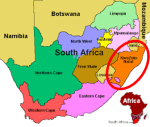
Original location of the rhinos
And then, you slowly give them a little bit of [sedative] reversal, enough so they can stand up. They’re uncoordinated at that stage – so then you put a rope round their heads and you pull them slowly into the crate.
“They have to walk on their own feet because they’re very heavy. You can’t move a tonne of sleeping meat!”
The rhinos need to be awake throughout the flight so they can move their legs and regulate their own breathing. “The problem with a flight that long and an animal this big, is that if it lies for too long, that restricts circulation to the leg. And they get pins and needles – and then occasionally the animal could lose the use of that leg.”…
Step 2: Roll it into the plane
Then comes the heavy lifting.With the rhinos safely in their transport crates, a crane lifts them onto the back of a truck bound for the airport.
Rhinos being sedated (Source: Getty images)
Next,the crane deposits them on a loading vehicle, which will move them on to a plane.
“In this case we had rollers on the floor,” … “We just laid them onto the rollers, and then rolled them into the aircraft. …
The process involves a significant team of human helpers. “The loading – you’ve normally got between10 or 12 people per rhino. Andwe normally do two at a time, so 25 people.”
Sadly,the move requires an armed security contingent due to the threat from poachers. Trading in rhino horn has been banned globally for four decades, but the substance – traditionally used in Chinese medicine – has a higher black market value than gold or cocaine.
… there are four rhinos airborne at any one time, “in a big military transport plane”.
Everybody on the blog loved this video of Timbuktu about its great university, one of the world’s oldest universities. I loved these centuries’ old manuscripts on medicine, art, literature, astronomy, and other subjects. The idea that my ancestors knew all these things, and that even today people are still trying to decipher these, make me so proud. The great historian Ibn Battuta talked about Timbuktu’s great universities, scientists, and scribes, and the beauty and wealth of the place when he visited in the 1300s. Enjoy the video below.
Africa has a rich naming tradition, which varies across the continent.This article by theBBCgoes over some of the African naming traditions. I added a few more, and removed their ‘celebrity culture’ section, given that naming children after celebrities is not an African thing but a world thing, and dates as far back as the world. Don’t forget to check out the article I wrote on‘My Name’ by Magoleng wa Selepe. You can read the full article onBBC.
================
Traditional African names often have unique stories behind them. From the day or time a baby is born to the circumstances surrounding the birth, several factors influence the names parents choose for their children. Whichever ethnic group you look at, these local names reveal a wealth of information about the bearer. Here are [eight] different ways African parents name their children:
Events surrounding birth
African Woman
Among several ethnic groups, picking out names can be influenced by positive or negative circumstances the family finds themselves in around the time a child is born. Often, such names are complete sentences.
Ayodele (joy has come home) is a unisex name for a baby whose birth brought happiness to their Yorubaparents in Nigeria. …
Adetokunbo (crown/wealth has come back home) is a unisex Yorubaname often given to a child born abroad.
Ajuji (born on a rubbish heap) is a Hausaname given to a baby after those born before it failed to survive. It is believed that giving the child a “terrible” name will deceive evil spirits into thinking the child is not loved and as a result, allow it to live.
Kgomotso and Pumza (comfort) are given to babies born shortly after a death or tragedy in Sesothoand Xhosafamilies in South Africa.
Kiptanui and Cheptanui are often given to babies whose mothers may have suffered extreme difficulties during childbirth among the Kalenjinethnic group in Kenya. …
Lindiwe (we have waited) is an isiZuluname often given to a baby girl after a long line of boys.
Emotional warnings
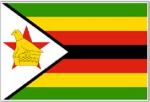
Flag of Zimbabwe
Some names, especially in Zimbabwe, [and Nigeria] reflect the mood or circumstance of the family at the time of birth. Some of them serve as warnings or rebukes.
Nhamo means misfortune
Maidei asks the question “What did you want?”
Manyara tells someone “You have been humbled“
Yananiso means bringing the family together
… But this is not unique to Zimbabwe. [It can be found across the continent, from Malawi, to Nigeria, to Ghana, etc.] …
Order of birth
In many African cultures, there is no need for someone to explain whether they are the eldest or youngest of their siblings. This is because their names can reveal that much. This is especially true of twins.
Twins
If you meet a Ugandan boy or man called Kakuru or Wasswa, he is likely to be an elder twin. The younger male twin is usually called Kato. These are names specially reserved for twins.
Similarly, the Kalenjins in Kenya refer to the first born as Yator (first to open the way) and the last born Towett meaning last.
The Yorubas call the first twin Taiwo (taste the world) and the second Kehinde (came after).
In Ghana, the unisex names Panyin and Kakra, which basically mean older and younger, are used for twins.
[InCameroon, in theBamilekeculture, the child who follows directly after twins is given names such asKenfack, Kengne or Kammagni. While the parents of twins are given the special names ofMagne (mother of twins) andTagne (father of twins), and the Magne used to have a special place in the society just like the twins. Moreover, babies born breach are also given a particular name,Tcheutchoua, to show how difficult the delivery had been.]
Day-born names
… Among some Ghanaian [and Ivorian] ethnic groups like the Akan, Ga, Ewe and Nzema, a name is automatically assigned based on the day the child is born. These day names correspond to the day of the week someone is born and so by default, everybody has one – though the name may not necessarily appear on official documents.
Monday – Kojo (male), Adwoa (female)
Tuesday – Kwabena (male), Abena (female)
Wednesday – Kwaku (male) [Kouakou in Cote d’Ivoire], Ekua (female)
Thursday – Yaw (male) [Yao in Cote d’Ivoire], Yaa (female)
Saturday – Kwame (male) [Kouame in Cote d’Ivoire], Ama (female)
Sunday – Akwesi (male), Akosua, (female)
These day names can vary slightly depending on the ethnic group.
Faith-based names
… Across the continent, several local names have religious links. Among the Igbo and Yoruba ethnic groups in Nigeria, a name that starts or ends with Chi (Igbo), Chukwu (Igbo) or Oluwa (Yoruba) has some kind of reference to God.
Olusegun means God conquers (Yoruba, Nigeria)
Hailemariam means the power of Mary (Ethiopia) …
Makafui means I will praise God (Ewe ethnic group in Togo, Ghana, Benin)
Day and night
Among some groups in eastern and southern Africa, certain names are selected depending on the time of the day or season a child is born.
Kibet means dayand Kiplagat means night(Kalenjin in Kenya)
Mumbua and Wambua means rainy season for boys and girls (Kamba in Kenya) …
Yunwa means hunger or time of famine (Hausa)
African tree at dusk
While the Luos are very specific:
Omondi (dawn)
Okinyi (morning)
Onyango (mid-morning)
Ochieng‘ (sunny midday)
Otieno (night)
Oduor (midnight)
Girls are given the same names but starting with an A instead of an O. [For instance,Atieno(night).]
Meet the ancestors
Respected elders of the family may be dead but they continue to live on through their grandchildren. Parents often name babies after senior members of the clan whether dead or alive. But it is considered disrespectful to casually shout or call out the name of a senior family member that has been given to a child, so instead it is common to hear a child affectionately called Ouma (grandma) or Oupa (grandpa) in southern Africa.
Similarly in Senegal, a child who is named after a grandfather tends to bear the grandfather’s nickname as well. So a baby boy often ends up being called Vieux (old man), [orPape, orPapa].
An antelope at dusk, with the African sun
Rude nicknames
Somalia has a unique system. Most people have three names – the ones they were given, as well as that of their father and grandfather [same in Sudan]. But many also have nicknames, which are so common that they can find their way onto official ID cards.
These nicknames often pick on the negative physical traits of the bearer, if he is male. Some common nicknames for men include Langare (limpy), Coryaan (handicapped), Lugay (one leg) or Genay (missing tooth).
Women, however, mostly get flattering nicknames like Lul (diamond), Macanay (sweet), Cod Weyne (rich voiced), Dahable (golden) and Indho Daraleey (gazelle eyes). …
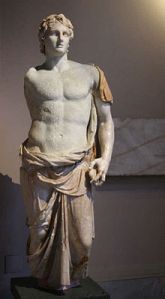
It is about time we talked about Alexandria, the light of Egypt. So why the name Alexandria? If you thought about Alexander the Great, then you are absolutely right! Yes. The second largest city and major economic center of Egypt was named and founded by Alexander the Great.
3rd century BC bust of Alexander the Great (Wikipedia)
To me, Alexandria, has always had a special place in my heart because of its Great Library. Imagine thousands upon thousands of ancient papyri, scrolls, and books on mathematics, philosophy, medicine, architecture, etc. Just the thought of it makes my eyes shine with light. Isn’t it thrilling? And then to know that this library had been burnt down by the army of Julius Caesar in 48 BC (more like a repeat of history: Palmyra, The giant Buddhas of Afghanistan, Timbuktu, …) also makes my heart ache at the thought of all this knowledge gone down in flames. Today, we remember the Great Library of Alexandria thanks to what poets and writers of the past said about it, but there are no vestiges of it. I also remember Alexandria because of the brilliant female mathematician Hypatia who chaired a department of philosophy and astronomy, and the world-renowned mathematician Euclid.
Today, Alexandria is Egypt’s largest seaport, serving approximately 80% of Egypt’s imports and exports. It is an important industrial center because of its natural gas and oil pipelines from Suez. Alexandria is also an important tourist destination. Enjoy the video below about Alexandria, the beautiful!
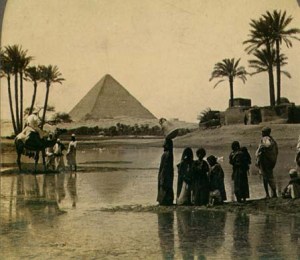
An ancient city has been unearthed in Egypt and dates back more than 5,000 years and contains houses, tools, pottery, and huge graves. The city lies by the River Nile, close to the temple of Seti I in Abydos. It is said to have been the city of tomb builders and architects. The rest below is from the BBC:
=================
It is believed the city was home to important officials and tomb builders and would have flourished during early-era ancient Egyptian times.
Archaeologists have made a range of finds in the newly-discovered city including buildings, shards of pottery and tools.
It is believed that this location was home to important officials and tomb builders who may have been engaged in the construction of royal graves in the nearby sacred city of Abydos – a place of many temples, and a capital in an early period of ancient Egyptian history.
The area is in the southern province of Sohag, in Upper Egypt, home also to the city of Luxor, one of the country’s most popular tourist sites.
“About a mile behind where this material is said to be we have the necropolis with royal tombs going from before history to the period where we start getting royal names, we start getting identifiable kings,” Prof Chris Eyre, an Egyptologist based at the University of Liverpool, told the BBC.
“So, this appears to be the town, the capital at the very beginning of Egyptian history.”
The discovery was made by an archaeological mission that belongs to the country’s Antiquities Ministry, and not a foreign group, officials quoted in Egypt Independent website said.
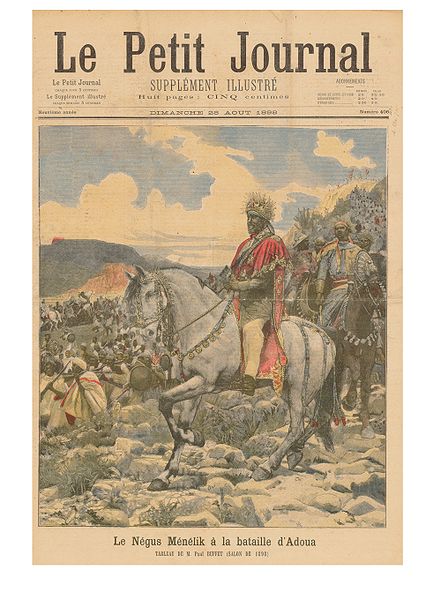
Edition of the Petit Journal of August 1896 titled: “Negus Menelik II at the Battle of Adwa”
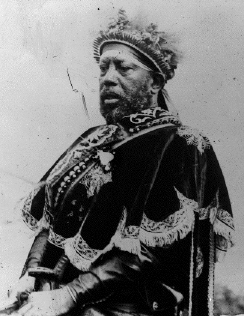
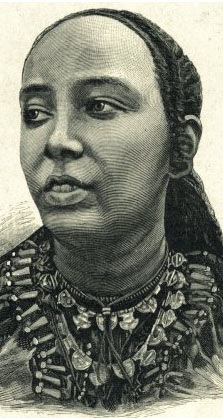
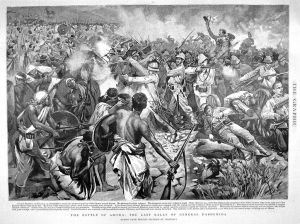
In Africa, Ethiopia is the only country which was never colonized by a European power. This was the result of the famous Battle of Adwa on March 1, 1896, which marked the Ethiopian victory against Italian colonialism. The Battle of Adwa against Italy arose from the deceitful 1889 Treaty of Wuchale between the Ethiopian Empire and Italy, a treaty whose article 17 had two different meanings in Amharic and Italian versions: The Amharic version recognized the sovereignty of Ethiopia and its relationship with Italy as just a diplomatic partnership, while the Italian version made Ethiopia Italy’s protectorate. The moment that discrepancy/trickery was uncovered, Empress Taytu Betul was the first to agitate Emperor Menelik II and other men to stand up for liberty, and dignity against Italian aggression. I am publishing here the Treaty of Wuchale. Special thanks to the Horn Affairs website for publishing the English version in its entirety. Some claim that Article 3 actually paved the way for Italians to claim Ethiopian lands (Eritrea). Well, here is the document of one of those treacherous treaties signed or rather forced upon Africans by European powers. Thank goodness for Taytu Betul,Menelik II, and their team of loyal and intelligent ministers and interpreters. I have attached the pdf version too.
===============
Treaty of friendship and trade between the kingdom of Italy and the Empire of Ethiopia (Treaty of Wuchale)
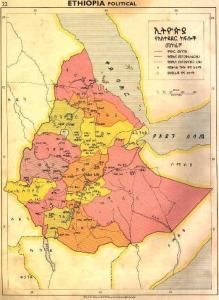
Map of Ethiopia before 1911
His Majesty King Umberto I of Italy and Menelik His Majesty The King of Kings of Ethiopia, in order to make meaningful and lasting peace between the two Kingdoms of Italy and Ethiopia have agreed to conclude a treaty of friendship and commerce .
And His Majesty the King of Italy having delegated as his representative, Count Pietro Antonelli, Commander of the Crown of Italy, Knight SS. Maurice and Lazarus, his extraordinary posted by His Majesty the King Menelik, whose full powers were found in good and due form, and His Majesty the King Menelik concluded in his name as King of Kings of Ethiopia, agreed and concludes the following Articles:
Article 1. There will be perpetual peace and friendship between His Majesty the King of Italy and His Majesty the King of Kings of Ethiopia and between their respective heirs, successors, servants and protected populations.
Article 2. Each Contracting Party shall be represented by a diplomatic agent accredited to I’altra and may appoint consuls, agents and consular officers in the other. Such officials shall enjoy all the privileges and immunities according to the customs of the European governments.
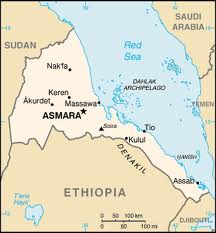
Map of Eritrea
Article 3. To remove any ambiguity about the limits of the territories over which the two Contracting Parties shall exercise sovereign rights, a special commission composed of two delegates and two Ethiopians will draw on Italian soil with special signals a permanent boundary line whose strongholds are established as below: a) the line of the plateau will mark the Ethiopian-Italian border; b) from the region Arafali Hala, Sagan and Asmara are villages in the Italian border; c) Adi and Adi Nefas Joannes Bogos will be on the side of the Italian border; d) by Adi Joannes a straight line extended from east to west will mark the border between Italy and Ethiopia.
Article 4. The monastery of Debra Bizen with all their possessions will remain the property of the Ethiopian government but will never use it for military purposes.
Article 5. The caravans from or to Massawa to Ethiopian territory pay on one single law of the customs entry of 8 per cent on the value of the goods.
Emperor Menelik II, of Ethiopia
Article 6. The trade of arms and ammunition from or through Massawa to Ethiopia will be free for the only King of Kings of Ethiopia. Whenever they want to get the passage of such kinds will make regular application to the Italian authorities, bearing the royal seal. The wagons with load of weapons and ammunition will travel under the protection and cover of Italian soldiers until alconfine Ethiopia.
Article 7. The subjects of each of the two Contracting Parties will be free to enter, travel, go out with their merchandise and effects in the other country and will enjoy greater protection of the Government and its employees. And, therefore, strictly forbidden to people on both sides armed contractors to meet many or few and pass their borders in order to impose itself on people and groped by force to provide food and livestock.
Article 8. The Italians in Ethiopia and Ethiopians in Italy or Italian possessions can buy or sell, take or lease and in any other manner dispose of their property no less than the natives.
Article 9. And fully guaranteed in both states the option for other subjects to practice their religion.
Article 10. Any disputes or quarrels between the Italians in Ethiopia will be defined by the Italian in Massawa or his delegate. The fights between Italians and Ethiopians will be defined by the Italian in Massawa or his delegate and a delegate of the Ethiopian.
Empress Taytu Betul of Ethiopia
Article 11. Dying in an Italian in Ethiopia or an Ethiopian in Italian territory, the local authorities were carefully kept all his property and held at the disposal of government to which the deceased belonged.
Article 12. In any event, circumstance or for any Italians accused of a crime will be judged by the Italian. That is why the Ethiopian authorities shall immediately deliver to the Italians in Massawa accused of having committed a crime. They also accused the Ethiopians of crime committed on Italian soil will be judged by the Ethiopian.
Article 13. His Majesty the King of Italy and His Majesty the King of Kings of Ethiopia is obliged to deliver criminals who may have become refugees, to escape punishment by the rulers of one on the other domains.
Article 14. The slave trade was against the principles of the Christian religion, His Majesty the King of Kings of Ethiopia is committed to prevent it with all his power, so that no caravan of slaves can cross its member.
Article 15. This Treaty shall be valid throughout the Ethiopian Empire.
Article 16. While in the present Treaty, after five years from the date of signature, one of two High Contracting Parties may wish to introduce some modifications to do so, but he must prevent the other a year earlier, while remaining firm and every single concession on territory.
The Battle of Adwa, 1896
Article 17.His Majesty the King of Kings of Ethiopia can [1] use the Government of His Majesty the King of Italy for all treatments that did business with other powers or governments.
Article 18. If His Majesty the King of Kings of Ethiopia intends to grant special privileges to nationals of third state to establish businesses and industries in Ethiopia, will always be given, under equal conditions, preference to the Italians.
Article 19. This treaty being drafted in Italian and Amharic and the two versions agree with each other perfectly, both texts shall be deemed official, and will in every respect equal faith.
Article 20. This Treaty shall be ratified.
In witness whereof, Count Pietro Antonelli on behalf of His Majesty the King of Italy, His Majesty the King of King Menelik of Ethiopia, in his own name, signed and affixed their seal to this Treaty, at the camp Uccialli of 25 miazia 1881 corresponding to May 2, 1889.
Imperial Seal of Ethiopia For His Majesty the King of Italy Pietro Antonelli
Ratification of MS, Monza, September 29, 1889
****************
[1] Article 17 has an obligatory sense in the Italian language version of the Treaty.
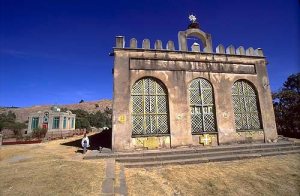
The Church of St Mary of Zion with the Treasury containing the Ark of the Covenant in the background (left) is the oldest church (Christian church) on the African continent. First built in the 4th century AD in Aksum, Ethiopia. It is the most important church in Ethiopia.
In the 4th century AD, the Axumite prince Ezana, the first Christian ruler of the Kingdom of Axum (Present-day Eritrea and Ethiopia), was instructed in Christianity by two Syrian monks shipwrecked on the Red Sea coast. The prince promoted Christianity when he became King Ezana, and he is regarded as a saint in both the Ethiopian Orthodox and Catholic churches. The original church is believed to have been built during the reign of Ezana, and has been rebuilt several times since then, including during the reign of Fasilides in the 17th century. St. Mary of Zion was the traditional place where Ethiopian Emperors came to be crowned. And indeed, if an Emperor was not crowned at Axum, or did not at least have his coronation ratified by a special service at St. Mary of Zion, he could not be referred to by the title of “Atse” or Emperor of Ethiopia.
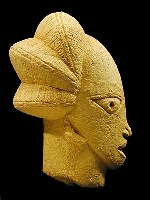
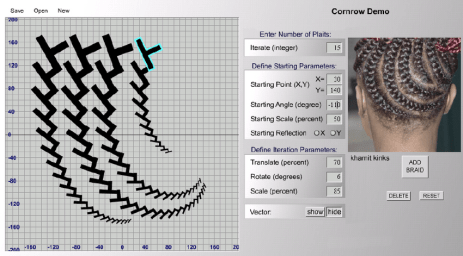
Today, we will be talking about hair, African hair, and hairstyles. One of the very common hairstyles used for Afro hair is cornrows. These were worn by women and men of centuries past as seen on Nok sculptures dating back 3rd century AD, Mende masks, Benin Kingdom masks, and are still worn today with great pride. Kings and queens adorned those like crowns. The great Emperor Tewodros II of Ethiopia wore them proudly! Imagine my surprise when I found a website where they had computed the way cornrows are made. Cornrows use about 4 geometrical concepts: translation, rotation, reflection and dilation. The styles are numerous ranging from simple linear compositions to complex curves and spirals. Check out this website and learn about the mathematics behind cornrows! Enjoy!