A blog about African history, and heritage, through audio and video files.
Author: Dr. Y.
I am an African in love with the history of the world, and particularly that of Africa. I am a child of love, an artist, a scientist, a lover, a friend, a human.
I am in love with nature and beautiful things, art, history, geography, travel, dance, food, science, and technology, and much more.
It is important to cultivate integrity in all our actions. Muhammad Ali, born Cassius Clay, was a man of great integrity. What do I mean by that? When drafted to go to war, he said NO. He said he could not understand why he was being made to fight a people who had done nothing to him. He thought, how could he, a Black man in America with newly acquired rights, could go kill people (the Vietnamese people), who were victim of the white man’s greed? He probably thought, “they did nothing to me, why should I kill them? Who gives me the right to kill them?” He stood his ground, and refused to serve. For this, he was punished, banned for 5 years. For many, this could have been a descent into depression, alcoholism, drugs, etc… for he had lost his source of income; he was eventually arrested, found guilty of draft evasion charges and stripped of his boxing titles. He successfully appealed in the US Supreme Court, which overturned his conviction in 1971, by which time he had not fought for nearly four years—losing a period of peak performance as an athlete. Many thought he was arrogant, but he stood for his beliefs. Instead of falling down, he stood up, he became an activist, and worked tirelessly to end the war in Vietnam… he rallied masses.
Muhammad Ali was also the first international boxer of his stature to fight in Africa. Who has not heard of “The Rumble in the Jungle” the 1974 fight which took place in Kinshasa, Zaire (now Democratic Republic of Congo)? This was a historic game not only because it was deemed the fight of the century, and featured Ali vs. Foreman, but also because it took place on African soil. It brought in representatives from all over the continent, and singers from around the world. In the emission on the Origin of Rumba, the late Papa Wemba clearly stated that he had been at that game and met several legends of music James Brown, Celia Cruz and the Fania All-Stars, B.B. King, Miriam Makeba, Johnny Pacheco, and it had been an experience like none other.
So let us remember Muhammad Ali, a man of integrity, who inspired so many by his spirit, strength, determination, and courage. So long Ali… the Greatest.
Today, I thought that this poem by Bernard Dadié will be very appropriate. We wear a lot of chains, and the oppressed people of this world may want all the gags removed. Enjoy!
Chaînes
Quelles sont lourdes, lourdes, les chaînes,
Que le Nègre met au cou du Nègre.
Pour complaire aux maîtres de l’heure.
De grâce n’arrêtez pas l’élan d’un peuple !
Brisons les chaînes, les carcans, les barrières, les digues.
Pour inonder l’univers en eaux puissantes qui balaient les iniquités.
Quelles sont lourdes, lourdes les chaînes
Que le Nègre met aux pieds de Nègre
Pour complaire aux maîtres du jour !
Lourdes, les chaînes,
lourdes, lourdes,
les chaînes que je porte aux mains.
Que tombent tous les baîllons du monde !!
Chains
They are so heavy, heavy, the chains,
That the negro puts on the neck of the negro.
To please the masters of the hour.
Please do not stop the momentum of a people!
Let us break the chains, the shackles, the barriers, the dams.
To flood the universe with powerful waters that will sweep away iniquities.
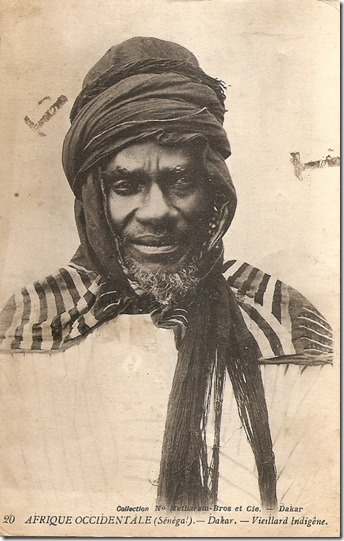
I recently learned about the Diisa, a long fringed indigo shawl worn by men in Mali, and men across the Sahara Desert. I knew of the shawl, but never knew its name. I also knew of the shawl and always wondered why it was always blue, and not any other color. The Diisa has been worn by African men for centuries. Its ‘blue-ness’ comes from the ‘diisatogène‘ which is one of the strongest artificial component of Indigo dye.The shawl itself takes a long time to weave, and is later on indigo dyed. Our ancestors probably knew all this chemistry that I just learned today, and probably honed down the recipe. Samori Toure, the great African leader, can be seen wearing his diisa shawl on several occasions.
Malian artist and master dyer Aboubakar Fofana commented:
Samori Toure wearing his diisa
“… The dissa shawl was such an important piece for a man from this region.It was given to a young man by his mother when he got married. She would have saved for this shawl since her son was very young–they were a lot of workand wereworth the same as 10 head of cattle. They wereindigo dyed, andwhen the man died, this shawl would be his shroud. The celestial blue of indigo would help him pass from this world to heaven. I’m very proud to be making a modern interpretation of the dissa, with its long fringes, and I hope I am carrying on the tradition of something important in my culture.”
And Belgian art historian Patricia Gerimont, who is working on a book on indigo dyeing in Mali, supplied this information on indigo in Burkina Faso (my translation): “the indigo shawls and wrappers in Burkina are dyed by a specific group called the Yarsé, and also by other groups of Marka dyers. The Yarsé speak Mossi but are of Marka origin, you also find them in Dogon country under the name Yélin.”
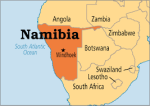
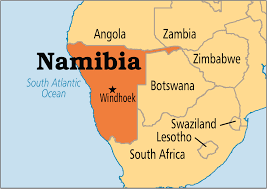
Ever wondered what the name of the capital city of Namibia, Windhoek, mean? To me, thinking about the English beginning ‘Wind‘, I wonder if its name has something to do with wind, even though Namibia was never a British colony? However the end part ‘Hoek‘ does not sound English at all. Could the name be a European ‘deformation’ of a local name, the way Yaoundé or Abidjan are?
Windhoek settlement at the end of the 1800s
Well, imagine my surprise when I found out that Windhoekstand for ‘wind-hoek‘ or “Wind Corner” in Afrikaans (Windhuk in German). Knowing that the country was a German colony, why will it have an Afrikaans’ name? The two languages being so close together, maybe the name was first German, and later on Afrikaans, given that the country fell under South African ‘administration’ after Germany lost first world war. Well, it is said that the city was founded in 1844, by Captain Jonker Afrikaner who named it Windhoekafter the Winterhoek Mountains at Tulbagh in South Africa, where his ancestors originated from.
Windhoek settlement at the end of the 1800s
In its history, the city of Windhoek has had at least 7 different names: “Aigams” for hotsprings as named by the local nomadic Khoekhoe people; “Otjomuise” for the place ofsteam as named by the local Herero people; both names referring to the hot springs located near today’s city center. It was later named “Queen Adelaide’s Bath” by English explorers in 1836. Then it was named “Concordiaville” by Rhenish Missionaries. In 1840, it was named “Winterhoek” by Jonker Afrikaner and his group of Nama people who were emigrating from the Cape. It became “Windhuk” in 1890 with the German colonization of the country, and it has been “Windhoek” since 1920 under South African administration and has remained so after independence in 1990.
Windhoek settlement at the end of the 1800s
Located in the Khomas Highland plateau area, in central Namibia, Windhoek stands at around 1700 m above sea level. It is the social, economic, political, industrial, and cultural center of the country. It is a bustling, growing city, and tourism is playing a big part in the city’s life as well. Enjoy the video below about Windhoek.
Here is an excerpt of an article by Kwame Opoku from Pambazuka about Germany’s recognition (?) of the Namibian genocide. For the full article, go to Pambazuka.
========
[…] For a long time, successive German governments have sought to avoid taking responsibility for the genocide of the Herero and Nama of South-West Africa, now Namibia, in 1904-1908. …
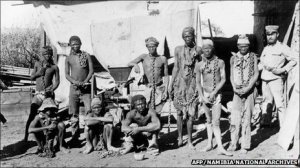
Herero people being enslaved in Namibia by Germans (Source: AFP/Namibia National Archives)
The attempt to deny historical evidence of German genocide was bound to fail in so far as all the elements of German responsibility have been fully documented in German official papers and writings of German scholars. The extermination order of the German General in South West Africa, General von Lothar should have been sufficient evidence of the declared intention to exterminate Herero and Nama: ” I say to the people: anyone who hands over one of the chiefs to one of our stations as prisoner shall receive 1,000 marks and whoever delivers Samuel Maharero will receive 5,000 marks. The Herero people must however leave the land. If the people refuse to do so, I shall force them with the Great Rohr [cannon”>. Any Herero found within the German borders, with or without a gun, with or without cattle, will be shot. I no longer receive women or children. I will drive them back to their people or order them to be shot. These are my words to the Herero people. ‘The great General of the mighty German Kaiser.” Vernichtungsbefehl (Extermination Order) by the German commander, General Lothar von Trotha.
[…] After what has been written above, Lammert concludes that: “According to present day international law, the suppression of the Herero uprising was genocide. International law stipulates that if acts are committed with intent “to destroy, in whole or in part, a national, ethnical, racial or religious group, as such ”the criminal act of genocide has occurred Such is the interpretation of many, also German historians.”
At a Government press conference on 10 July, 2015, the question was raised as to whether, in view of the various pressures on the German government to define the massacres of the Herero and Nama as genocide, there was a chance the government might modify its position. Dr Schafer, Spokesperson of the Foreign Ministry, defined the Governments position as follows: “Firstly, the basis of all actions and for our political motivation is the guiding principle that the Federal Government-against the background of the brutal colonial war of Imperial Germany in South West Africa acknowledges Germany’s special historical responsibility towards Namibia and its citizens and especially towards the Herero, Nama, San and Damara. … “We Germans accept our historical-political and moral-ethical responsibility and the guilt incurred by Germans at that time. The atrocities committed at that time would today be termed genocide”.
Survivors of the herero genocide (Wikimedia)
[…] Frankly, I was surprised and worried by the various statements indicating that the Germans and the Namibians have been having negotiations and discussions aimed at finding “a common position and common language in dealing with the cruel colonial war of 1904-1908”. This is a remarkable statement. Does anybody really believe Germans and Namibians can find a common position and a common language regarding the cruel and inhuman atrocities of the Germans in South –West Africa? Is this really serious or is this intended to persuade the Namibians to get involved in a dangerous rewriting of history that would present the Germany in a less inhuman light? There are probably fewer aspects of recent African history that are as well documented as the German presence and atrocities in Namibia. What is there more for non-historians and politicians to discover and present as a common position and common language of the colonized and the colonizer, of the oppressor and the oppressed?
This can only be an attempt to modify the role of the perpetrator of atrocities and to make the victims partially responsible for the heinous crimes committed against them. The victim becomes involved in the criminal acts against him. Colonized victims cannot evaluate the events of which they were victims in the same way as the oppressive colonizers. …
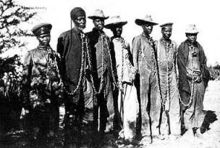
Chained Herero men (Wikimedia)
Could it be that the Germans, supported by the French, British, and Belgians and other former colonial powers are frightened about the effect of German recognition of genocide in Namibia? They would all like to avoid having to pay adequate compensation to their African victims and so urge the Germans to avoid setting a precedent; they are probably trying to find a formula, short of admitting genocide in Namibia that allows them to pay some compensation, less than what they would have to pay under the application of normal rules.
[…] Given what the Herero, Nama, San, Damara and all the Namibian peoples have gone through in their encounter with German colonial rule, it is amazing that these issues still remain unsolved. There is no way the Government of Germany can continue to evade assuming openly and fully the consequences of the 1904-1908 exterminations wars.
How many think that the first big genocide of the 20th century happened during world war II, and was the holocaust? If you thought so, then think again. The Holocaust was not Germany’s first genocide. The very first genocide of the 20th century occurred in Namibia, on the African continent.It was perpetrated by Germans on the Herero and Nama people of Namibia. It was extremely brutal and almost wiped out all Herero people. It was a campaign of racial extermination and collective punishment that the German Empire undertook in German South-West Africa (modern-day Namibia) against the Herero and Nama people. It took place between 1904 and 1907 during the Herero Wars. Today it is known as the Namibian genocide or the Herero and Namaqua genocide. For the longest time, the German government denied it until 2004 when they finally acknowledged and recognized for the atrocities they perpetrated to wipe out an entire race. However, they ruled out financial compensation for the victims’ descendants. They still refuse to officially name these actions as “genocide”.
Chained Herero men
In total, between 24,000 and 100,000 Herero and 10,000 Nama died. The genocide was characterized by widespread death from starvation and dehydration due to the prevention of the retreating Herero from leaving the Namib Desert by German forces. Some sources also state that the German colonial army systematically poisoned desert water wells. Moreover, the Germans also tested the very first use of concentration camps on the Herero and Nama people.
Before the genocide, the tribe numbered 80,000; after it, only 15,000 remained. Enjoy the video below which tells it all.
If you are called to be a street sweeper, sweep streets even as Michelangelo painted, or Beethoven composed music or Shakespeare wrote poetry. Sweep streets so well that all hosts of heaven and earth will pause to say, “Here lived a great sweeper who did his job well.”
I really liked this Pambazuka article on the brief history of the passport. For those of us coming from ‘third-world’ countries, the act of applying for visas is both quite expensive and time-consuming. I always wondered why citizens of the ‘developed’ world could enter most countries in the world free of charge, while citizens of underdeveloped countries needed visas. The logic always seemed twisted to me, especially given that the converse was not true. For instance, a South African citizen needs a visa to enter the USA for tourism/business, but an American citizen does not need a visa to enter South Africa for the same reasons, and the list goes on. The article below goes over it. For the full article go to: Pambazuka . Here are some excerpts.
=========
Fatou Diome
[…] In spring 2015, Senegalese author Fatou Diome, whose works include The Belly of the Atlantic, caused a stir during the French talk show Ce soir ou jamais!. Only a month earlier, over 1,000 had drowned in one week in the Mediterranean Sea after their boat had capsized en route from the Tunisian coast to Italy. Diome vented her anger about the current European perspective and discourse on migration. And she expressed her belief that there is an underlying global problem that is rooted in the privileged treatment of a small percentage of the world’s population that depends on a document:
“Europeans see Africans arriving, ok. This migratory movement of populations is tracked and visible. But you don’t see the migratory movement of Europeans going to other countries. This is the migratory movement of those with power, with money. Those who have the right kind of passport. You go to Senegal, you go to Mali, you go to any country in the world, to Canada, to the U.S. Everywhere I go […], I meet French people, German people and Dutch people. I run into them everywhere on this planet because they have the right kind of passport.” (translated from French) (Diome 2015)
‘The Belly of the Atlantic’ by Fatou Diome
Apart from unmasking a very selective European perception and use of the word ‘migration’, Diome addressed an apparent inequality. There is a structural force which privileged nationals can ignore while the unprivileged are confronted with it every day, namely the power of a passport. Clearly, this inequality is not a natural development, but has evolved over time, as a look at the history of this small document shows.
[…] The focus here will be on the international passport. This document is used to control the departure from the home country, entering a foreign country and returning to the home country. All those who have crossed a national border know the process of handing his or her passport to a border official behind a glass panel. This guard checks you and your passport very thoroughly and sometimes asks questions about your purpose of travelling.
Nonetheless, a German passport allows the holder to enter 172 of the Earth’s 192 countries without a visa. Reversely, people from only 81 countries can enter Germany without a visa – an imbalance that quantifies a passport’s power. The development of a passport hierarchy is an advanced process, which has only been taking place for some decades. It leaves citizens from countries such as Somalia, Eritrea, Sudan, South-Sudan, Ethiopia, Congo or Liberia at the bottom of this hierarchy and enforces a restrictive and often arbitrary system of visa issuance on them. This system allows economically and politically powerful nations to use people’s mobility as a bargaining resource and reinforces their dominance. An example of this mechanism is the 2014 FIFA world cup in Brazil: European countries had a keen interest in granting their football-mad citizens free access to the host country. Brazil managed to secure liberalized visa regulations for its own citizens traveling to Europe in return. In this instance, the cultural event gave Brazil negotiating power and that in turn increased its economic and political power. When states lack these material and symbolic resources, they are less able to give their populations access to international networks, exchanges, education and jobs.
World map (Wikipedia)
Alternatives become possible when we start deconstructing the perceived ‘naturalness’ of the status quo. A growing number of intellectuals, scholars, artists and political activists are pointing to the historical development of borders and making us aware of their violence and their arbitrariness. They argue in favor of social and economic advantages that non-existent borders might yield…a world in which we can claim that the passport was just an episode that lasted for little more than a century. It would be a world in which Diome’s statement would ring true for everyone:
“We live in a globalized world in which an Indian might live and make a living in Dakar, someone from Dakar in New York, someone from Gabon might live and make a living in Paris. Whether you like it or not, this is an irreversible fact. So let’s find a collective solution, or move away from Europe, because I intend to stay.” (translated from French) (Diome 2015)


 C’est un grain de sable qui dit à un autre grain de sable

 Ever wondered what the name of the capital city of


 […] After what has been written above, Lammert concludes that: “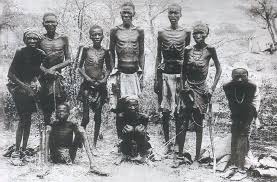


 When we fall in the mud, we do not deny getting soiled
 I really liked this

 Nonetheless,

 African Heritage