Papa Wemba: The King of Rumba and King of La SAPE

Papa Wemba1
Papa Wemba

In high school, while on our way to school, my father would play Papa Wemba‘s album in the car: Emotion. Rightfully titled ‘Emotion‘, Wemba’s album featured a whole range of emotions which added to his unique ‘Rooster-like‘ voice to  make me, as a teenager, feel those emotions, and go to school happy. Try it… listen to the up-beat Yolele, or Fafafa-fa, Sala Keba, or Awa Y’ Okeyi,  … and tell me how you feel, truly, because Papa Wemba rocked my childhood.

Papa Wemba3
The album ‘Emotion’ by Papa Wemba

So when I learnt that this great man, Papa Wemba, the one who had accompanied me with his voice to school every day, this man who had made me so proud of music, Congolese music, African music, this flamboyant stylish man who had introduced the world to SAPE, the King of Congolese Rumba, this man whose words I still quote “Y a pas match, Kaokokokorobo” had collapsed on stage and was no longer… I was devastated. Oh Papa Wemba, I thought you were going to ride with my kids to school, the way you did with me…. I thought I would always dance to the rhythm of O’Koningana,…Ye te oh, Wake Up, …

When life was hard, I would hum to the tune of your song in the movie ” La Vie est Belle” and instantly life became beautiful again. And ‘Mama‘ was just a loving song to a mother. When I felt lost, I would sing “Show me the way.”

Papa Wemba5
The movie ‘La Vie est Belle’ starring Papa Wemba

Yes… Papa Wemba was truly a genius. He was born Shungu Wembadio Pene Kikumba in June 1949 in Lubefu, in the Democratic Republic of Congo. His love of music can be attributed to his mother, who was a professional “wailing woman” at funerals. Mixing traditional African music with Western rock, he and his successive bands – Zaiko Langa LangaIsifi Lokole, Yoka Lokole, and Viva la Musica – enjoyed hit after hit, including L’Esclave, Maria Valencia, Analengo, and Le Voyageur. He shaped Congolese music in the 1970s -90s, he made Soukous the most popular sound across Africa, and attracted international music figures like Peter Gabriel. I am not sure if there is a great African star he had not sung or collaborated with: from Brenda Fassie, Tabu Ley Rochereau, Pepe Kalle, Lokua Kanza, Barbara Kanam, Manu Dibango, Koffi Olomidé, Bisso Na Bisso, JB Mpiana, Angélique Kidjo, Salif Keïta, Alpha Blondy, Singuila, to Youssou N’dour, and countless others. He also collaborated with the great diva Aretha Franklin. He was a talented man, and he also sought to reveal young talents. He loved to share his gift, his voice, with all.

Papa Wemba
Papa Wemba, the King of Sape

So I was sad… But then I realized that Papa Wemba had trained generations of musicians, had inspired numerous people, sang his lungs out for so many of us… then I realized that his flamboyant spirit lives on. His music keeps on… The dress style he created, la SAPE,  still goes on. And yes, I will keep playing Yolele. So is Papa Wemba really gone? Is this great African baobab really gone? No, he has just changed his postal address. However, his music stays with us, and will lead some of us to school or work… always.


How Malawi Technology is teaching UK Children

This is a continuation to the previous post, Technology helping students in Malawi, where the technology used to teach children in Malawi, is helping children in the  United Kingdom (UK). Educators found out that the apps used to teach primary school children in Malawi was helpful to improve the education of children in the UK. Talk about globalization!

Technology helping students in Malawi

I really like the way technology is revolutionizing lives across the globe. Today, we will talk about education in Malawi. Actually, this could be any school in many African countries, where teachers very often have 60-80 students in their classrooms. So it is hard to control the students, and let’s face it, it is hard for the teacher to assess their students’ learning and to grade homework. The video below shows how technology is helping teachers in Malawi ensure proper learning of English, mathematics, and Chichewa. Enjoy!

Proverbe sur les défauts / Proverb on bad traits

Leopard_6
Leopard

Chaque colline a son léopard. (Proberbe Bahaya – Tanzanie). – Chacun a son défaut dominant. 

Every hill has its leopard (Proverb Bahaya – Tanzania).- Everyone has a predominant fault.

The Black People of Mexico

Afro_mexican_3_Black Cowboy
Afro-Mexican cowboy (Source: BBC)

I found this article on the BBC this week about the Afro-Mexican people, or Black people of Mexico, and thought of reposting parts of it. For the full article, go to: the BBC .

===========

More than a million people in Mexico are descended from African slaves and identify as “black“, “dark” or “Afro-Mexican” even if they don’t look black. But beyond the southern state of Oaxaca they are little-known and the community’s leaders are now warning of possible radical steps to achieve official recognition.

[…] Black Mexicans have been living in the Costa Chica area, on the Pacific coast of Oaxaca, since their ancestors were brought from Africa as slaves in the 16th Century.

Colonial Spanish cattle ranchers often used them as foremen, in charge of indigenous Mexican workers who were not used to animals the size of cows or horses.

Afro_mexican_2
The state of Oaxaca (Source: BBC)

But outside the Costa Chica area there is little awareness of their existence.  

An interim census in 2015 indicated a black population of 1.4 million, or 1.2% of the Mexican population. Even in Oaxaca state they only account for 5% of the total. By comparison, indigenous peoples made up nearly 10% of Mexico’s population, as measured in the 2010 census. The appearance of those who identify as black Mexicans varies considerably. Some are hard to distinguish from indigenous Mexicans.

[…] But there is frustration here that the Afro-Mexicans are not more widely known in Mexico and are not officially recognised as a minority by the Mexican government.

According to Humberto Hebert Silva Silva, head of the Bureau for Afro-Mexican Affairs in Oaxaca, this is because Afro-Mexicans speak Spanish, like most other Mexicans – they do not have their own language.

Afro_mexican_1
Afro-Mexican musical instruments: quijada and bote (BBC)

When we go and ask [for recognition as a minority], they come up with excuses, or say that we don’t have an indigenous mother tongue. Language is the real criterion,” he says.We are being discriminated against.”

If Afro-Mexicans were classified as a minority they would receive extra funding for promotion of their culture and public health programs.

But activists including Israel Reyes, a teacher, want more than money, it’s also important to them that the existence of Afro-Mexicans is recognized at the level of the Mexican state.

[…] “The story of the black population has been ignored and erased from history.”

The Origin of the Milky Way

Milky WayA strong-willed girl became so angry when her mother would not give her any of a delicious roasted root, that, she grabbed the roasting roots from the fire and threw the roots and ashes into the sky, where the red and white roots now glow as red and white stars, and the ashes are the Milky Way.  And there the road is to this day.  Some people call it the Milky Way; some call it the Stars’ Road, but no matter what you call it, it is the path made by a young girl many, many years ago, who threw the bright sparks of her fire high up into the sky to make a road in the darkness.

This is a South African tale about the origin of the Milky Way, from the Road Travel Africa.

Blague Africaine: La Sauce et le Riz / African Joke: Sauce and Rice

sauce_riz2C’est l’histoire d’un évangéliste dans un village Bété en Côte d’Ivoire.

Il dit :JESUS n’aime pas la SORC-E -LE-RIE“.

En appuyant sur le mot sorcellerie, le traducteur dit ceci en Bété :Jésus n’aime pas la sauce et le riz.”

La foule répondhin !C’est à koz de ça dans ses films, c’est pain seulement il mange !

=======

bread1It is the story of an evangelist in a Bété village in Côte d’Ivoire.

He says:JESUS does not like SOR-CE-RY“.

Putting an emphasis on the word sorcery, the translator says in Bete:Jesus does not like sauce’n rice.”

The crowd respondsAh ! That is why in his movies, he only eats bread!”

Proverbe sur la Protection du Plus Faible / Proverb on Protection of the Weakest

strength3La jambe est intelligente: elle met l’os devant et la chair derriere (Proverbe Bahumbu – République Démocratique du Congo). – Le plus fort protège le plus faible.

The leg is intelligent: it puts the bone in the front, and the flesh behind (Bahumbu proverb – Democratic Republic of Congo).- The strongest protects the weakest.


Bogolan: The art of making mudcloth

I thought of re-posting this great article on the Bogolan, the Malian fabric used for centuries. This article was first posted on Afrolegends.com on 11 Sept 2009. Enjoy!

==================

Bogolan
A piece of Bogolan cloth

I would like to introduce you to Bògòlanfini commonly known as bogolan which is a traditional Malian fabric dyed with fermented mud, particularly associated with the Bamana people of Mali. The name is a Bamana word meaning “earthcloth” or “mud cloth” (Bogo = earth, lan = by means of, fini = cloth; the cloth obtained from the earth). Bogolan became mainstream when the genius stylist Chris Seydou (who worked with stylists such as Yves Saint Laurent) modernized its use in society, incorporating it into western coats, and dresses. Today, as you walk down the streets of New York City, you would definitely encounter beautiful African American ladies wearing Bogolan coats in the midst of winter. The Bamana people have used Bogolanfini in all parts of their lives for centuries, and the art of making it is centuries old, and is passed from generations to generations.

Couvre-Lit en Bogolan

The Smithsonian made a beautiful page about the Bogolan and some of its artists, including the great Chris Seydou. One of the artists, Nakunte Diarra says that in the Bamana creation, “Since God created the world, … Bogolan was there.” What a beautiful way to emphasize the importance of Bogolan in the Bamana society, and in today’s Malian life.

Please check out the website by the Smithsonian, and get a chance to make your own bogolan: http://www.mnh.si.edu/africanvoices/mudcloth/index_flash.html

The video below was chosen particularly because the artist, Issiaka Dembele, gives a historical background to the art of making Bogolan. You will find shorter videos on how Bogolan is made, but this one was the most profound!

When Benin Stuns All!

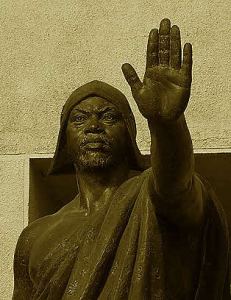
Statue of Behanzin in Abomey, Benin

The presidential election last week in Benin stunned all. Most thought that the candidate of the hexagon Lionel Zinsou, the candidate of colonialism, was going to win. We all thought that, France, was going to crush the people’s will and have its man be handed the country. But the people of Benin said NO! The people of Benin resoundly said NO! The country of Béhanzin said NO! The country of the beloved Mathieu Kérékou said NO to France and its puppet and elected Patrice Talon. Vive la Démocratie! In some other African countries (I will not name them), France’s will would have been almighty… but in the land of the fierce Amazons said NO! We, the people has spoken!

I live you here with an excerpt of this victory, and its meaning to all Africans. We have a lot to learn from the people of Benin who have taken a hold of their destiny. Check out these articles by the Brookings Institute, AlJazeera and the BBC on this historic win. And of course, when ‘We the people’ wins, the imperialistic forces are bitter and unhappy, and want to brush it aside in the press.