Thomas Kanza was a Congolese diplomat who served as Congo (now Democratic Republic of Congo (DRC))’s first ambassador to the United Nations from 1960 to 1962. He also served as a minister of foreign affairs at some point. He wrote a memoir entitled, The Rise and Fall of Patrice Lumumba: Conflict in the Congo, which covered his own personal experiences as the Congo became independent, and his interactions with Patrice Emery Lumumba. He said, about Lumumba in an interview to Jeune Afrique:
“Patrice Lumumba represents for Congo what Fidel Castro represents for Cuba, Nasser for Egypt, N’krumah for Ghana, Mao Zedong for China, and Lenin for the Soviet Union.
Despite his short political life and his tragic end, perhaps because of them, Patrice-Emery Lumumba has entered history through the front door : that of heroism and martyrdom.
He is at once the flag and the symbol. He is all.He embodies everything : the struggle, the courage, even temerity, the suffering, the action and the perseverance. He lived as a free man, as an independent thinker : his writings, his words, his acts were those of the responsible man, conscious of his vocation as a liberator.”
(Lumumba et le lumumbisme, Jeune Afrique, nº 268, 13 Février 1966) Translated to English by Dr. Y., Afrolegends.com
As always, ahead of June 30, the ‘independence’ day of the Democratic Republic of Congo (DRC), we write about Patrice Emery Lumumba, the first Prime Minister of Congo. This time, we will take a trip down memory lane with the great article by the prominent anti-colonial thinker, activist and writer, Frantz Fanon, which was published earlier here on Afrolegends in French in 2011. (You will find the original here). In view of all the events occurring in Africa (The New Scramble for Africa, Creation of the AES and destabilization attempts) with the United Nations (UN) approval, I thought that this article, published in 1964, was so important that I had translated it into English for all to read! In the article, Fanon talks about the kind of Africans who betray their people, and the uselessness (to us, Africans) of the UN which only serves Western interests. The scenario is the same and has not changed over the past 6 decades: wherever the UN lands in a country, all of sudden there are troubles, tensions, massacres, (ONUCI, MINUSMA, MONUSCO, …), etc. Enjoy… For the full article, check out: Lumumba’s death: Could we (Africans) have acted differently?
—————————————————
Frantz Fanon
The great success of the enemies of Africa is to have corrupted the Africans themselves. It is true that these Africans had vested interest in the murder of Lumumba. Heads of puppet governments, in a fake independence, faced everyday by massive opposition from their peoples, it did not take long to convince themselves that the real independence of the Congo would put them personally at risk. And there were other Africans, a little less puppet, but who get frightened when it comes to disengaging Africa from the West. It seems as if these African Heads of State are still afraid to face Africa. These, also, though less actively, but consciously, contributed to the deterioration of the situation in Congo. Little by little, we were reaching the agreement in the West that there was a need to intervene in Congo, we could not let things evolve at this pace.
Gradually, the idea of a UN intervention was taking shape. So we can say today that two simultaneous errors were committed by Africans.
Patrice Lumumba
And first by Lumumba when he sought the intervention of the UN. He should have never called on the United Nations.The UN has never been able to properly solve problems brought to man’s consciousness by colonialism, and whenever it has intervened, it was to actually come to the aid of the colonial power to the oppressed country. Look at Cameroon. What kind of peace do the subjects of Mr. Ahidjo kept in check by a French expeditionary force, which most of the time, made its debut in Algeria, enjoy? The UN, however, controlled the autodetermination of Cameroon and the French government has set up a “Provisional Executive” there.
Look at Viet-Nam. Look at Laos.
It is not true to say that the UN fail because the causes are too difficult.
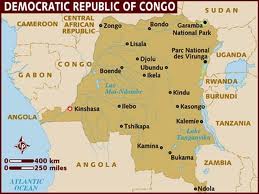
Map of the Democratic Republic of Congo
In reality the UN is the legal card used by imperialist interests when brute force has failed. The sharing, the mixed controlled joint committees, under guardianship are international means of torture to break the will of the people, cultivating anarchy, banditry and misery.
… Lumumba’s fault was then initially to believe in the impartiality of the UN. He forgot that the UN, particularly in the current state, is only a reserve assembly established by the Greats to continue, between two armed conflicts, the “peaceful struggle” for the balkanization of the world. …
Africans should remember this lesson. If outside help is necessary to us, let us call on our friends. Only they can truly and fully help us achieve our goals precisely because the friendship between us is a friendship of struggles.
… Our mistake, as Africans, is to have forgotten that the enemy never backs down sincerely. He never understands. He surrenders, but is not converted.
Our mistake is to have believed that the enemy had lost its militancy and its harmfulness. If Lumumba disturbs, Lumumba should disappear.
Hesitation in commiting murder has never been a feature of imperialism.
Every June30, we commemorate the “independence” of the Democratic Republic of Congo (DRC) by posting a speech or letter by its first prime minister Patrice Emery Lumumba. The word independence is placed in quotes because we know that independence cha-cha never really occurred and that many African countries including the DRC are still suffering from the sequels of neo-colonialism.
Patrice Lumumba gave the speech below on December 11, 1958 in Accra, Ghana, at a conference sponsored by Kwame Nkrumah, Ghana’s first president who also succumbed to imperialism. In his speech, all the evils that plague Congolese and African societies are cited: Western domination, external domination, balkanization of the Congolese territory (and Africa), and all the ‘ism‘ that undermine the unity of Africa. His speech is still very current today. The speech can be found in its entirety on Blackpast.org.
====
Kwame Nkrumah
On December 11, 1958, 34 year old Patrice Lumumba, president of the Congolese National Movement, spoke at the Assembly of African Peoples, an international Pan African Conference sponsored by Kwame Nkrumah, the Prime Minister of newly independent Ghana. His remarks appear below. Two years later Lumumba would become the first Prime Minister of the Congo.
…
Our Program of Action
The Congolese National Movement, which we represent at this great conference, is a political movement, founded on October 5, 1958.
This date marks a decisive step for the Congolese people as they move toward emancipation. I am happy to say that the birth of our movement was warmly received by the people for this reason.
The fundamental aim of our movement is to free the Congolese people from the colonialist regime and earn them their independence.
Flag of the Democratic Republic of Congo
We base our action on the Universal Declaration of the Rights of Man — rights guaranteed to each and every citizen of humanity by the United Nations Charter — and we are of the opinion that the Congo, as a human society, has the right to join the ranks of free peoples.
We wish to see a modern democratic state established in our country, which will grant its citizens freedom, justice, social peace, tolerance, well-being, and equality, with no discrimination whatsoever.
In a motion we recently transmitted to the minister of the Congo in Brussels, we clearly stipulated — as did many other compatriots of ours — that the Congo could no longer be treated as a colony to be either exploited or settled, and that its attainment of independence was the sine qua non condition of peace.
In our actions aimed at winning the independence of the Congo, we have repeatedly proclaimed that we are against no one, but rather are simply against domination, injustices and abuses, and merely want to free ourselves of the shackles of colonialism and all its consequences.
These injustices and the stupid superiority complex that the colonialists make such a display of, are the causes of the drama of the West in Africa, as is clearly evident from the disturbing reports of the other delegates.
Map of the Democratic Republic of Congo
Along with this struggle for national liberation waged with calm and dignity, our movement opposes, with every power at its command, the balkanization of national territory under any pretext whatsoever.
From all the speeches that have preceded ours, something becomes obvious that is, to say the least, odd, and that all colonized people have noticed: the proverbial patience and good-heartedness that Africans have given proof of for thousands of years, despite persecution, extortions, discrimination, segregation, and tortures of every sort.
The winds of freedom currently blowing across all of Africa have not left the Congolese people indifferent. Political awareness, which until very recently was latent, is now becoming manifest and assuming outward expression, and it will assert itself even more forcefully in the months to come. We are thus assured of the support of the masses and of the success of the efforts we are undertaking.
This historical conference, which puts us in contact with experienced political figures from all the African countries and from all over the world, reveals one thing to us: despite the boundaries that separate us, despite our ethnic differences, we have the same awareness, the same soul plunged day and night in anguish, the same anxious desire to make this African continent a free and happy continent that has rid itself of unrest and of fear and of any sort of colonialist domination.
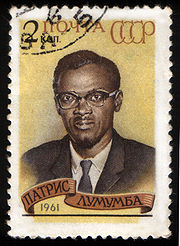
Lumumba on a USSR commemorative stamp in 1961
We are particularly happy to see that this conference has set as its objective the struggle against all the internal and external factors standing in the way of the emancipation of our respective countries and the unification of Africa.
Among these factors, the most important are colonialism, imperialism, tribalism, and religious separatism, all of which seriously hinder the flowering of a harmonious and fraternal African society.
This is why we passionately cry out with all the delegates:
Down with colonialism and imperialism!
Down with racism and tribalism!
And long live the Congolese nation, long live independent Africa!
Recently, I was having a conversation with a friend about leadership in Africa: the endless complaints about our poor leadership, or the killing of our good leaders, and then my friend said talking about Mali, “I wish we had more Assimi Goïta, Choguel Maïga, Abdoulaye Maïga, … on the continent.” Although my heart warmed at this statement, it reminded me that the fight starts at the bottom with each of us. We have to be the leader we want to see; we have to be the Assimi we want to have as a leader. Leadership starts with us, at the individual level. We cannot leave all the task to Assimi or whoever is at the head, we have to do our part; that is the only way to move forward. Otherwise, if something happens to the leader, what will become of our cause? In the article “How do We Continue the Fight when the Head has been Cut Off?”, I wrote, “the prize of freedom is too great to lay on the shoulders of one man, one leader, or a few… we do not follow men, we follow ideas… we are not fighting for men, we are fighting for our right to dignity, our right to humanity, our liberty.“
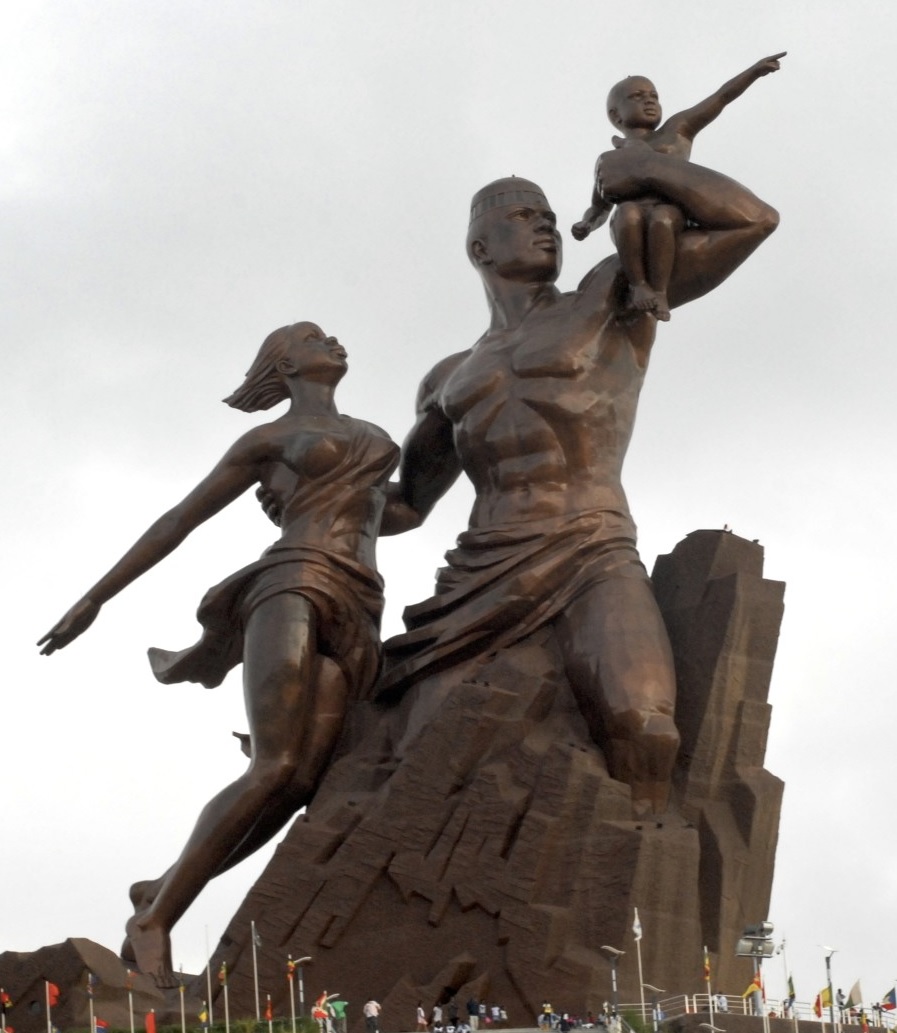
African Renaissance Monument in Dakar (Wikipedia)
Very often it is said among Africans, that we have the leaders we have because that is, at the root, who we are. When you have watched Thomas Sankara, Amilcar Cabral, Patrice Lumumba, Samora Machel, Modibo Keita, Kwame Nkrumah, Ruben Um Nyobe, Felix Moumie, Sylvanus Olympio, Ernest Ouandie, Barthelemy Boganda, Mehdi Ben Barka, Muammar Kadhafi, and many others get assassinated by or in conjunction with foreign forces because of their vision for their countries, it is easy to cower away, and just bend the heads and accept whatever comes in silence. However, cowering in silence, perpetuates the problem endlessly. People often say, we all come on earth and will have to leave at some point, why not leave with dignity? Why cower away? If we start at our level, getting involved in our communities, doing our part (whatever our talents are), being there for each other, do you really think corruption will persist? Let us not wait for Messiahs (and we know how rare those are), but let us start laying the bricks to the foundation of the home we want to live in. If you are an educator, make sure to lay the foundation for the best education possible; if you are a brick layer, do your work with integrity; if you are an okada driver, drive with integrity; if you are a housewife, raise the next leader; if you are a business man, make sure honesty is at the core of your business; if you are a student, arm yourself to be the next leader; … If you want to be led by honest people, then deal with honesty in your daily encounters; if you want to have a transparent government, start with transparency at your level, etc. As my favorite quote by Dr. Martin Luther King Jr goes, “If you are called to be a street sweeper, sweep streets even as Michelangelo painted, or Beethoven composed music or Shakespeare wrote poetry. Sweep streets so well that all hosts of heaven and earth will pause to say, “Here lived a great sweeper who did his job well.” ” We all play a part in this whole that is our homeland, and each one of us is needed!
Thomas Sankara once said in one of his interviews, “if you kill Sankara, you will have a million Sankaras.” Let’s have a million Assimi Goïta, a million Choguel Maïga! Let us have millions of African leaders! Let us have a billion exemplary leaders and more!
As the remains, the golden tooth, of Patrice Lumumba is finally getting returned to his family and his nation after over 60 years, I felt it was necessary to share here Patrice Lumumba’s beautiful letter to his wife which happens to be his last letter. Although it is a sad letter, it is full of hope at the thought that one day Congo will be free. Roland Lumumba, his son, said in his interview to France24, “Only the dead can forgive, the living do not have the right to forget.” Entirely true… Lumumba would not allow us to forget his fight for the Congolese freedom, just as he would not want us to forget those who died at the hands of King Leopold II in the rubber plantations of Congo (King Leopold II and the Congolese genocide)… it is part of our history. As we fight for our freedom, we need to remember, and get inspired from the fight of those who came before us.
Ma compagne chérie, Je t’écris ces mots sans savoir s’ils te parviendront, quand ils te parviendront et si je serai en vie lorsque tu les liras. Tout au long de ma lutte pour l’indépendance de mon pays, je n’ai jamais douté un seul instant du triomphe final de la cause sacrée à laquelle mes compagnons et moi avons consacré toute notre vie. Mais ce que nous voulions pour notre pays, son droit à une vie honorable, à une dignité sans tache, à une indépendance sans restrictions, le colonialisme et ses alliés occidentaux—qui ont trouvé des soutiens directs et indirects, délibérés et non délibérés, parmi certains hauts fonctionnaires des Nations, cet organisme en qui nous avons placé toute notre confiance lorsque nous avons fait appel à son assistance—ne l’ont jamais voulu.
Ils ont corrompu certains de nos compatriotes. Ils ont contribué à déformer la vérité et à souiller notre indépendance. Que pourrai je dire d’autre ?
Que mort, vivant, libre ou en prison sur ordre des colonialistes, ce n’est pas ma personne qui compte. C’est le Congo, c’est notre pauvre peuple dont on a transformé l’indépendance en une cage d’où l’on nous regarde du dehors, tantôt avec cette compassion bénévole, tantôt avec joie et plaisir. Mais ma foi restera inébranlable. Je sais et je sens au fond de moi même que tôt ou tard mon peuple se débarrassera de tous ses ennemis intérieurs et extérieurs, qu’il se lèvera comme un seul homme pour dire non au capitalisme dégradant et honteux, et pour reprendre sa dignité sous un soleil pur.
Nous ne sommes pas seuls. L’Afrique, l’Asie et les peuples libres et libérés de tous les coins du monde se trouveront toujours aux côtés de millions de congolais qui n’abandonneront la lutte que le jour où il n’y aura plus de colonisateurs et leurs mercenaires dans notre pays. A mes enfants que je laisse, et que peut-être je ne reverrai plus, je veux qu’on dise que l’avenir du Congo est beauet qu’il attend d’eux, comme il attend de chaque Congolais, d’accomplir la tâche sacrée de la reconstruction de notre indépendance et de notre souveraineté, car sans dignité il n’y a pas de liberté, sans justice il n’y a pas de dignité, et sans indépendance il n’y a pas d’hommes libres.
Ni brutalités, ni sévices, ni tortures ne m’ont jamais amené à demander la grâce, carje préfère mourir la tête haute, la foi inébranlable et la confiance profonde dans la destinée de mon pays, plutôt que vivre dans la soumission et le mépris des principes sacrés.L’histoire dira un jour son mot, mais ce ne sera pas l’histoire qu’on enseignera à Bruxelles, Washington, Paris ou aux Nations Unies, mais celle qu’on enseignera dans les pays affranchis du colonialisme et de ses fantoches. L’Afrique écrira sa propre histoireet elle sera au nord et au sud du Sahara une histoire de gloire et de dignité.
Ne me pleure pas, ma compagne. Moi je sais que mon pays, qui souffre tant, saura défendre son indépendance et sa liberté.
Vive le Congo ! Vive l’Afrique !
Patrice Lumumba
My beloved companion, I am writing these words not knowing whether they will reach you, when they will reach you, and whether I shall still be alive when you read them. All through my struggle for the independence of my country, I have never doubted for a single instant the final triumph of the sacred cause to which my companions and I have devoted all our lives. But what we wished for our country, its right to an honourable life, to unstained dignity, to independence without restrictions, was never desired by the Belgian imperialists and their Western allies, who found direct and indirect support, both deliberate and unintentional, amongst certain high officials of the United Nations, that organization in which we placed all our trust when we called on its assistance.
They have corrupted some of our compatriots and bribed others.They have helped to distort the truth and bring our independence into dishonour. How could I speak otherwise?
Dead or alive, free or in prison by order of the imperialists, it is not myself who counts. It is the Congo, it is our poor people for whom independence has been transformed into a cage from whose confines the outside world looks on us, sometimes with kindly sympathy, but at other times with joy and pleasure. But my faith will remain unshakeable. I know and I feel in my heart that sooner or later my people will rid themselves of all their enemies, both internal and external, and that they will rise as one man to say No to the degradation and shame of colonialism, and regain their dignity in the clear light of the sun.
We are not alone. Africa, Asia and the free liberated people from all corners of the world will always be found at the side of the millions of Congolese who will not abandon the struggle until the day when there are no longer any colonialists and their mercenaries in our country. As to my children whom I leave and whom I may never see again, to be told that the future of the Congo is beautiful and that their country expects them, as it expects every Congolese, to fulfill the sacred task of rebuilding our independence, our sovereignty; for without justice there is no dignity and without independence there are no free men.
Neither brutality, nor cruelty nor torture will ever bring me to ask for mercy, for I prefer to die with my head unbowed, my faith unshakable and with profound trust in the destiny of my country, rather than live under subjection and disregarding sacred principles. History will one day have its say, but it will not be the history that is taught in Brussels, Paris, Washington or in the United Nations, but the history which will be taught in the countries freed from imperialism and its puppets. Africa will write its own history, and to the north and south of the Sahara, it will be a glorious and dignified history.
Do not weep for me, my dear wife. I know that my country, which is suffering so much, will know how to defend its independence and its liberty.
In 2020, Patrice Lumumba’s Children asked the Belgian King Philip for their Father’s Remains in an open letter. Today, Lumumba‘s golden tooth has been returned to his family and country 61 years after his assassination. For the history, Patrice Lumumba was the prime minister of Congo in 1960, and was assassinated by a coalition led by Belgium, and the US in 1961. At the time of his assassination, it was decided that no trace would be left of his body; thus Belgian officer Gerard Soete and his team dug up and, with a saw dismembered the corpse of Lumumba and his comrades Joseph Okito and Maurice Mpolo, and dissolved them in sulfuric acid while the bones were ground and scattered. We know this from a documentary which aired in 2000 where Soete showed two teeth which he said had belonged to Lumumba. He had taken Lumumba’s teeth as souvenir. In 2016, Ludo De Witte, author of the book “The assassination of Lumumba,” lodged a legal complaint against Soete’s daughter after she showed a gold tooth, which she said had belonged to Lumumba, during an interview with a newspaper. De Witte’s work has been essential in shattering the official Belgian government silence regarding the assassination of Lumumba.
I cannot imagine what Lumumba’s children, grandchildren, and great grandchildren and all children of mother Congo must feel… it is so painful! It is like the beginning of some closure for the family. Is what was done to Lumumba not considered a crime against humanity? Isreturning Lumumba’s tooth supposed to be enough?
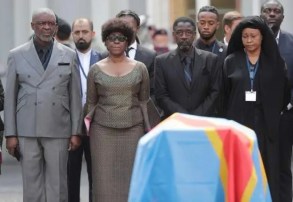
Lumumba’s Children during the return of his tooth in Belgium (Source: TheBusinessExecutive.net)
A gold-crowned tooth is all that remains of assassinated Congolese independence hero Patrice Lumumba.
Shot dead by a firing squad in 1961 with the tacit backing of former colonial power Belgium, his body was then buried in a shallow grave, dug up, transported 200 km (125 miles), interred again, exhumed and then hacked to pieces and finally dissolved in acid.
The Belgian police commissioner, Gerard Soete, who oversaw and participated in the destruction of the remains took the tooth, he later admitted.
He also talked about a second tooth and two of the corpse’s fingers, but these have not been found.
The tooth has now been returned to the family at a ceremony in Brussels.
Soete’s impulse to pocket the body parts echoed the behaviour of European colonial officials down the decades who took remains back home as macabre mementoes.
… For Lumumba’s daughter, Juliana, the question is whether the perpetrators were human. “What amount of hatred must you have to do that?” she asks.
“This is a reminder of what happened with the Nazis, taking pieces of people – and that’s a crime against humanity,” she told the BBC.
… Nevertheless, there seemed to be a personal element to the way Lumumba was vilified and pursued. The total destruction of the body, as well as a way to get rid of the evidence, seems like an effort to obliterate Lumumba from the memory. There would be no memorial, making it almost possible to deny that he existed at all. It was not enough just to bury him.
But he is still remembered.
… [Juliana Lumumba] recognises that her father “belongs to the country, because he died for Congo… and for his own values and convictions of the dignity of the African person“.
She acknowledges that the handing over of the tooth in Belgium and bringing it back to the Democratic Republic of Congo is symbolic “because what remains is not really enough. But he has to come back to his country where his blood was shed.”
The tooth will be taken around the vast country before being buried in the capital.
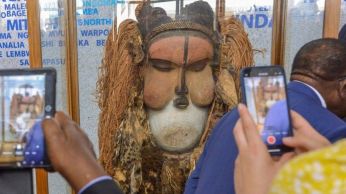
Suku mask known as Kakuungu returned by King Philippe to the DRC during his visit (Source: AFP/BBC)
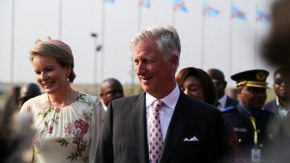
Some ‘visible’ highlights of King Philippe’s visit last week were: 1) The Belgian king returned a giant mask known as Kakuungu used during healing ceremonies by the Suku people from the southwest region of the DRC; the king said the object was on “indefinite loan” to the DRC… The monarch said, “I wanted, during our visit at the National Museum and in your presence, to return to you this exceptional work in order to allow Congolese to discover and admire it. …It marks the symbolic beginning of the reinforcement of the cultural collaboration between Belgium and Congo.” 2) King Philippe acknowledged the last surviving Congolese World War II veteran soldier, 97 year-old Corporal Albert Kunyuku, who served for Belgium; at a memorial of former fighters a wreath was laid, and King Phillipe presented Corporal Kunyuku with a medal. 3) King Philippe lamented the racial colonial past; the monarch said, “On the occasion of my first trip to Congo, here, in front of the Congolese people and those who still suffer from it today, I wish to reaffirm my deepest regrets for these wounds of the past.”
Map of the Democratic Republic of Congo
Honestly, this is so pathetic! First can we all stop and imagine how much this 1-week visit of the Belgian Sovereign must have cost the people of the DRC? How much were taken from the country’s coffers to accommodate the King and Queen of Belgium? How many hospitals/schools/roads will not be built because of his majesty’s visit? Then the king comes and gives one mask! One mask! Seriously? One? Of all the masks that fill up the Royal Museum of Central Africa as an example, only one? Why that one in particular? Then the mask is given as an “indefinite loan”, the height of disdain! Then, he acknowledges the last surviving soldier to have given his blood and sweat to Belgium… Although we are happy for Corporal Kunyuku, how convenient for the Belgians to wait for all of those they needed to pay pensions to die to have a ceremony with only one survivor left? … What about the families of others who served, did they get recognition from the King, medals, pensions?
Patrice Lumumba
Oh how I wish Patrice Lumumba was alive… he would have told the king to shove it! And actually we should all be telling his majesty just that! Keep your fake visit! Instead, tell us the true reasons of your visit: the needs for Belgium to reinforce economic partnership (get free deals from the old colony) amidst the Ukraine/Russia war; isn’t it easier to come sign and make sure all the diamonds, cobalt, and other minerals continue to flow to Belgium (let’s not forget the other European nations and the US) … Will we really want the mighty Belgium to starve without energy from Ukraine/Russia? And more importantly make sure that the DRC, the reservoir of minerals used in all electronics in the world, does not start a friendship with Russia and much more… O poor Africa, you that the King of Belgium visits with one of your masks in hand and expresses regrets without actions… O poor Congo, after getting maimed, and dying on the frontline for Belgium, you get one little medal… the metal of which is not even as pure as what comes out of your own soil!
As you all know, we have seen in recent coups and throughout history, that the colonizers/oppressors in Africa tend to install fake chiefs, or rather puppets to serve their interests. Remember when Agoli-Agbo (French puppet) was installed after King Behanzin was deposed in 1894? or Patrice Lumumba with Joseph Mobutu in 1961, or more recently Thomas Sankara by Blaise Compaoré in Burkina Faso in 1987, and countless others … history repeats itself. This behavior is not just observed at the top of the country, but even at the levels of the local traditional chiefs… where the successions are contested thus breaking the will of the people, and the passing on of a culture, effectively destroying the oppressed. I could not have said it better than Amilcar Cabral, himself during his February 20, 1970 speech, as part of the Eduardo Mondlane Memorial Lecture Series at Syracuse University, Syracuse, New York, under the auspices of The Program of Eastern African Studies. Enjoy!
Amilcar Cabral
====
… the colonizer who represses or inhibits significant cultural activity on the part of the masses at the base of the social pyramid, strengthens and protects the prestige and the cultural influence of the ruling class at the summit. The colonizer installs chiefs who support him and who are to some degree accepted by the masses; he gives these chiefs material privileges such as education for their eldest children, creates chiefdoms where they did not exist before, develops cordial relations with religious leaders, builds mosques, organizes journeys to Mecca, etc. And above all, by means of the repressive organs of colonial administration, he guarantees economic and social privileges to the ruling class in their relations with the masses. All this does not make it impossible that, among these ruling classes, there may be individuals or groups of individuals who join the liberation movement, although less frequently than in the case of the assimilated “petite bourgeoisie.” Several traditional and religious leaders join the struggle at the very beginning or during its development, making an enthusiastic contribution to the cause of liberation.
But here again vigilance is indispensable: preserving deep down the cultural prejudices of their class, individuals in this category generally see in the liberation movement the only valid means, using the sacrifices of the masses, to eliminate colonial oppression of their own class and to re-establish in this way their complete political and cultural domination of the people.
… among the oppressor’s most loyal allies are found some high officials and intellectuals of the liberal professions, assimilated people, and also a significant number of representatives of the ruling class from rural areas.
… Without minimizing the positive contribution which privileged classes may bring to the struggle, the liberation movement must, on the cultural level just as on the political level, base its action in popular culture, whatever may be the diversity of levels of cultures in the country. The cultural combat against colonial domination–the first phase of the liberation movement–can be planned efficiently only on the basis of the culture of the rural and urban working masses, including the nationalist (revolutionary) “petite bourgeoisie” who have been re-Africanized or who are ready for cultural reconversion. Whatever may be the complexity of this basic cultural panorama, the liberation movement must be capable of distinguishing within it the essential from the secondary, the positive from the negative, the progressive from the reactionary in order to characterize the master line which defines progressively a national culture.
… Confronted with such a necessity, the liberation struggle is, above all, a struggle both for the preservation and survival of the cultural values of the people and for the harmonization and development of these values within a national framework.
A recent case has had my head spinning with this fundamental question: how do we keep going when the movement has been decapitated? Or when the leader is no longer fit to lead? I do not claim to have the answers as this is a crucial question, but it is worth pondering.
Thomas Sankara
I recently read “The Cost of Sugar” by Cynthia McLeod, where she talks about the fight of the Maroons or Boni or Alukus of Surinam for freedom. Surinam was a Dutch colony, and so the Dutch crown sent troops to fight the rebellious slaves; they also hired local slaves to whom they promised liberty and land in return for fighting the Maroons. The Maroons never gave up! They were well organized, even though they had very little and were under-armed, and lived in the bush. Their leaders were very often killed, but they kept the fight… they were fighting for their freedom: men, women, and even children contributed to the fight. Yes… they terrorized the planters for many years, they were defeated, and fled to neighboring French Guyana, but kept the fight. Why? Because the prize of freedom is too great to lay on the shoulders of one man, one leader, or a few… the fight must continue in spite of some men (betrayers and others)… we do not follow men, we follow ideas… we are not fighting for men, we are fighting for our right to dignity, our right to humanity, our liberty.
Amilcar Cabral on a stamp with the flag of Guinea Bissau
We have to keep the fight. Yes, it is okay to cry, it is okay to fall, feel discouraged, but we have to rise up, and keep up the fight. We might be disappointed by the so-called leaders who may turn their backs on us and betray us [“The Cancer of Betrayal” by Amilcar Cabral, J.J. Rawlings in His Own Words: African Identity, Betrayal, and More], or we might get discouraged when our leaders and hopes have been killed, but we have to keep the fight. We rise up! Dust off ourselves, and keep on fighting! The enemy will try many tactics to distract us from our goals, because the enemy lives on our ignorance, the enemy flourishes on our divisions, our disappointments, and discouragements. We cannot afford to cry too long! When a leader no longer matches our ideals, we put him to the side and keep on fighting. We are not fighting for ourselves, we are fighting for our ancestors who died fighting, we are fighting for our children who should not be beggars on their own lands while the enemy feasts on it. We fight because it is more than just us. Dignity, freedom, is a divine right, and it is ours… we need to claim it!
It took 100 years for China to reclaim Hong Kong and Macao from the British… China was able to do so because its leaders kept telling them how Great Britain made them sign treacherous treaties and stole their lands, they did not hide it from their people like many African leaders do [Did You Know about the 999-year Lease granted to Europeans in Kenya ?]. As a result, 100 years later, the Chinese leaders went to the British, and said “time is up, give us back our lands”. The leaders who were forced to sign these treaties 100 years prior were no longer alive, but the history, the preparation, the muscling up, the battle continued!… so we have to plan over decades, generations, to ensure continuity in the battle, implying education, real knowledge of our history (our triumphs as well as our defeats and the causes), the stakes, and keeping a living memory of our history. It may take years, decades, even a century like China with Macao, but we have to grow, know, and muscle up… we cannot keep crying.
Early this month, I shared with you that the Belgian King Expressed his ‘Deepest Regrets’ for Colonial Past in Congo, by sending a letter to the President of the Democratic Republic of Congo (DRC) Felix Tshisekedi on the day of the celebration of the DRC’s independence from Belgium. I told you that those were empty words, and that coincidentally, King Philippe had forgotten to include the period from 1908 to the independence of Congo, and the treacherous role played by Belgium in the assassination of the Congolese Prime Minister Patrice Lumumba.
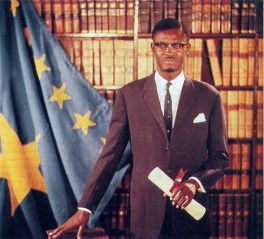
Lumumba detained, a few days before his death
Now the children of Patrice Lumumba, led by his daughter Juliana Amato Lumumba, have asked the Belgian king to prove his good faith by sending back the remains of their father. These remains are parts that were taken, like Lumumba‘s teeth, from his body at the time of his murder. We know from a documentary which aired in 2000 that Belgian Police Commissioner, Gerard Soete, told AFP that he and acolytes had decapitated Lumumba’s body and those of two others, Joseph Okito and Maurice Mpolo, and subsequently dissolved them in acid. In another documentary that same year, Soete showed two teeth which he said had belonged to Lumumba. He took Lumumba’s teeth as souvenir. In 2016, Ludo De Witte, author of the book “The assassination of Lumumba,” lodged a legal complaint against Soete’s daughter after she showed a gold tooth, which she said had belonged to Lumumba, during an interview with a newspaper.
According to AFP, Juliana Lumumba’s letter was written and addressed to the Belgian monarch on June 30, which happens to be the 60th anniversary of the Independence of the Democratic Republic of Congo from Belgium.
“We, Lumumba’s children, call for the just return of the relics of Patrice Emery Lumumba to the land of his ancestors,” Juliana said in the letter.
In Juliana Lumumba’s letter, which she said was written on behalf of her “wider family”, she said that her father was a “hero without a grave”.
“The remains of Patrice Emery Lumumba are being used on the one hand as trophies by some of your fellow citizens, and on the other as funereal possessions sequestered by your kingdom’s judiciary.”











 African Heritage