The German King: A Movie Series about Rudolf Douala Manga Bell, one of Cameroon’s First Resistants to Colonization

Rudolf Douala Manga Bell – ca 1900s

For anyone who has been watching the acclaimed series, The Chosen about the life of Jesus, projects from the Angel Studios are always of great quality. An upcoming series coming from the Angel Studios will be the series, The German King directed by Adetokunboh M’Cormack, entirely based on the life of Rudolf Duala Manga Bell, one of the resistants to German colonization, as a young prince born in Kamerun, raised in Germany alongside Kaiser Wilhelm II, and who fought for the freedom of his people upon his return.  When Rudolf Duala Manga Bell returned home to assume the throne of the Duala people in 1910, he led a rebellion against the oppressive German rule. In 1910, the German governor of Kamerun, Theodor Seitz, approved an urbanization project for the city of Douala (Kamerunstadt had been renamed Douala) set to turn it into one of the largest ports of Africa. The project outlined a plan to relocate the Douala people inland from the Wouri river to allow European-only settlement of the area (European-Only Neighborhoods in African Cities before Independence).  Neighborhoods such as Neu Bell, Neu Akwa, and Neu Deido were to be created for the indigenous people; these new allotments were going to be separated from the ‘European city’ by a barrier 1 km wide (early version of apartheid!).  The expropriations affected most of the Douala clans, who were angered and formed a united front behind Manga Bell.  Rudolf Duala immediately refused, and told the Germans that the treaty signed in 1884 did not stipulate the removal/expulsion of the locals from their lands, and that this separation constituted a form of apartheid. For his rebellion, Duala Manga Bell was later condemned and hanged in 1914.

Rudolf Douala Manga Bell, Leader of Douala people

A poignant scene from the movie is where Rudolf’s wife tells him, as he is torn, having grown with Kaiser Wilhelm II whom he considers a friend and brother: “Wilhelm is not your family! Your family is here! You may talk like them, act like them, dress like them, but you will never be them. Your skin will always be the color of the rich Cameroonian soil, and they will always walk over it, as if they own it. … Rudolf, you do this so that your sons, and your sons’ sons, and their sons will have a land they can call their own.”

I cannot wait for the series to come out, as it shows a very important part of the history of Kamerun during German colonization as well as other leaders like Sultan Njoya, Martin Paul Samba, and others. Please check out the story on the Angel Studios’ website, and above all, do not forget to support the project. Let us all celebrate Rudolph Douala Manga Bell,  the Tét’èkombo (the king of kings), a uniter of Cameroon (already reaching out to other kings), and one of Cameroon’s biggest resistant.

Most are Unaware of Germany’s Colonial Past and the First Genocide of the 20th Century

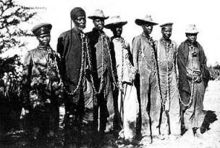
Chained Herero men

We have discussed the first genocide of the 20th century, committed by Germany in … Namibia, on African soil. We are not talking about World War II, but instead the real first genocide of the 20th century which almost wiped out all the Herero and Nama people of Namibia, Germany in Namibia: the First Genocide of the 20th Century. It was a campaign of racial extermination and collective punishment that the German Empire undertook in German South-West Africa (modern-day Namibia) against the Herero and Nama people, which took place between 1904 and 1907 during the Herero Wars. Today it is known as the Namibian genocide or the Herero and Namaqua genocide. It was cruel, gruesome, and yet today, many Germans don’t even know that their country had a colonial past! Hello? Germany had 4 colonies in Africa,  Togoland (Togo), Kamerun (Cameroon), German East Africa (Tanzania), and German South-West Africa (Namibia), and in most of them great atrocities were committed, yet, it is as if the history annals of the world have refused to acknowledge the humanity of the countless Africans who died. Recently, a German movie producer made a movie to reintroduce the German society to its colonial heritage. Recently, Germany agreed to pay Namibia €1.1bn over historical Herero-Nama genocide, while recognizing the actions as genocide, yet falling short of calling it reparations. Excerpts below are from the Guardian. You will also hear of the painful requests of many families for the return of their ancestors’ skulls (why on earth are these museums still holding onto people’s skulls?) Germany Returns Skulls of Namibians Genocide VictimsGermany Returns Artifacts Stolen From a Namibian Freedom Fighter.

=====

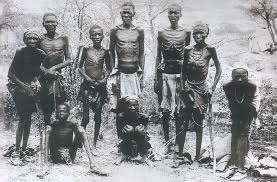
Survivors of the Herero genocide (Wikimedia)

It was one of the darkest eras in German history, and the first genocide of the 20th century: the mass killing of tens of thousands of people in German South West Africa after a rebellion against colonial rule by the Herero and Nama tribes.

More than 100 years later, a feature film about the violence perpetrated by Germany in what is now Namibia explores that brutal colonial past for the first time. Its director hopes Measures of Men will bring the calamitous episode to the attention of ordinary Germans.

Germany has denied its colonial past for 120 years,” Lars Kraume said, in advance of the film’s domestic release on Thursday. “Most people are unaware Germany even had a colonial past, let alone anything about the brutality of it – it is not even taught in schools.” [Aren’t Africans humans too? are their deaths meaningless?]

… Measures of Men, filmed mainly on location in Namibia using local crew and expertise, tells the story of Alexander Hoffmann – played by Leonard Scheicher – a young, idealistic but wide-eyed ethnologist who questions the evolutionist racial theories of the time, according to which sizes and shapes of skulls determined intelligence. His attempts to rebut the pseudoscientific legitimisation of the superiority of white people over people from the colony of south-west Africa leads him to take first an intellectual and then a romantic interest in Kezia Kambazemi, the interpreter of a delegation of Nama and Herero people who are shipped to Berlin to participate in the Kaiser’s “Völkerschau”, or human zoo exposition.

Despite studying history for his final exams in Germany, Kraume became aware of Germany’s colonial past only when he visited Namibia in the early 1990s, immediately after its independence from South Africa. …

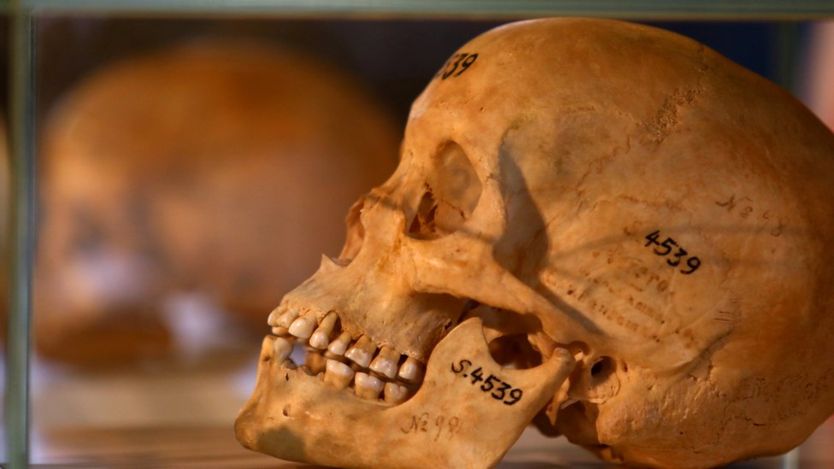
Namibian skulls (Reuters)

Kraume was particularly shocked by the existence of thousands of skulls of people murdered by Germans, which were gathered and shipped to Germany in large quantities and still exist in museums across the country.

I cannot comprehend the fact that we have these skulls, like artefacts, stored in ethnological museums,” he said. I cannot understand why they are still being kept and have not been given back.

You ask yourself: ‘Why were the skulls collected in the first place, and why have we not seen fit to give them back?’”

… The film’s relevance to the present day, Kraume said, is also in its depiction of how those in power choose to ignore scientific facts and truth for political gain and in order to maintain the status quo. …

Colonial Treaties in Africa: Pre-treaty to the 12th July 1884 Germano-Duala Treaty

Cameroon_Kamerun 12 Juillet 1884.jpg
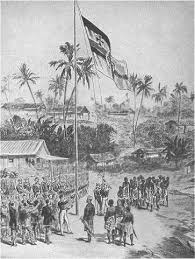
German flag on the Joss plateau in Cameroons Town (Douala) on 14 July 1884

Here is the text to the Pre-treaty approved by King Ndumbé Lobé Bell and King Akwa of Cameroons River (Wouri River, Douala) before agreeing to signing the 12th July 1884 Germano-Duala treaty. It is called the “Wünsche der Kamerun” (or the Cameroonians’ wishes) and was signed by the German consul. Note that only the German consul signed to engage his country into this pre-treaty; and no Cameroonian party signed it.  It is only once this was done, that the Kings Bell, and Akwa signed the treaty of sovereignty. Here is the text of the pre-treaty.

Cameroons River, July 12th, 1884

Our wish is that white men should not go up and trade with the Bushmen, nothing to do with our markets; they must stay here in this River, and then give us trust so that we will trade with our Bushmen.

We need no protection; we should like our country to annex with the government of any European Power.

We need no alteration about our marriages, we shall marry as we are doing now.

Our cultivated ground must not be taken from us, for we are not able to buy and sell as other countries.

We need no Duty or Custom House in our country.

We shall keep bullocks, pigs, goats, fowls as it is now and also no duty on them.

No man should take another man’s wife by force or else a heavy fine.

We need no fighting and beating without fault and no imprisonment on paying the trust without notice and no man should be put to Iron for the trust.

We are the Chiefs of Cameroons.

The Imperial German Consul

Emil Schulze

Source: L’Afrique s’annonce au rendez-vous, la tête haute! Du Pr. Kum’a Ndumbe III, P. 145-146, Ed. AfricAvenir/Exchange & Dialogue 2012