Imagine stumbling across your history, and learning that you are the descendant of a very powerful king? Imagine that all your life, you have lived a tough life, unconscious of your heritage, doing things, and just knowing that somehow, somewhere things should be different? Well, in 2013, during a trip to Ghana, Promise Adamah who has lived in England for over 50 years, found out that her grandfather was a very prominent Ewe King in Ghana, King Togbui Adamah II. She was handed a lot of papers in plastic bag by her aunt, and when she got home, opened it, and found out the truth about herself, and her family. Her family then decided to donate over 100 old letters and papers, official and personal documents, dating as far back as the 1880s to the Black Cultural Archives (BCA) in Brixton, London. These give a snapshot into the life for an Ewe Fia (king). Togbui Adamah II was a paramount Ewe Fia of Some in south eastern Ghana. The findings are believed to be the first of its kind to be found in such quantity and entirety in the Ewe community. Promise Adamah’s rich family history is now exposed at the Black Cultural Archives of London, it is Family Ties – The Adamah Papers exhibition. Enjoy the video below from the BBC.
For this year’s Mother’s Day celebration, I introduce you to another African classic: Elvis Kemayo – Mama. Elvis Kemayo hails from Cameroon, and is particularly well-known for this song, and ‘Cameroun, berceau de mon enfance (Cameroon, craddle of my childhood)’ Enjoy ‘MAMA’, and do remember to cherish your mother!
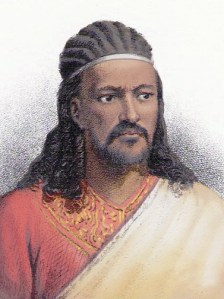
Prince Alemayehu, son of Emperor Tewodros II, as photographed in 1868 by Julia Cameron
Here is another outrageous article about British looting in Africa, and particularly in Ethiopia. The remains of Prince Alemayehu, son of the Emperor Tewodros II are still in Great Britain 150 years after his death. How preposterous is this! When the Ethiopian government asks, the British say that they cannot identify his bones, when in this day and age the remains of King Richard III of England have been identified 500 years after his death (Body found under parking lot is King Richard III, scientists prove). This makes you wonder: After King Mkwawa, and Prince Alemayehu, how many African kings, princes, and queens’ remains are still stuck in Europe?
Below are snippets of the article; for the full version, go to: The Guardian.
=====
For150 years, Ethiopians have been asking when Prince Alemayehuwill come home. The orphan prince, a descendant of Solomon, was taken to England – some say “stolen” – after British soldiers looted his father’s imperial citadel following the Battle of Magdala in1868. The fortress was looted and razed to the ground. It is said to have taken 15elephants and 200 mules to remove the loot.
Emperor Tewodros II
He died at the age of18, after an unhappy childhood, and was buried at St George’s Chapel at Windsor Castle at the request of Queen Victoria. Now, as discussions take place with the Victoria & Albert Museum about the return of royal treasures taken by British forces during the battle, the Ethiopian government told the Observer it is “redoubling” its efforts to finally bring back the prince’s remains. Last week there were celebrations in Addis Ababato commemorate the life of the prince’s father, Tewodros II, on the 150th anniversary of his death in the battle. A selection of the objects in the V&A’s possessionwent on display last week.
[The poet Lemn Sissay said:] “The first corrupt theft of an Ethiopian child was this one in 1868,” Sissay said. “He was taken from his family. He deserves, too, for his remains to go back to Ethiopia, back to where he was stolen from.”
In the aftermath, as the British forces carried off crowns, scrolls and fine clothing, a war artist cut a lock of Tewodros’ hair. The lock of hairis now at the National Army Museum in London. Sissay and others believe that a DNA test could establish whether any of the remains in the grave match it. …
After the sacking of Maqdala, a British officer named Tristram Speedy took the prince and his mother, the Empress Tiruwork Wube, to Britain. The empress died on the way and before the party was due to embark on a ship from Alexandria in Egypt, the officer ordered all the other Ethiopians to return. …
The intensity of feeling among Ethiopians is growing, according to the Ethiopian embassy. “Ethiopians revere Prince Alemayehu as a young prisoner of war – he was only seven years old when taken hostage,” it said in a statement. “Prince Alemayehu remains the son of a hero, who chose to end his own life, rather than surrender to foreign soldiers. Ethiopians view the Prince with the same level of affection and respect.”
As you travel around Africa, have you ever wondered about the name of the second largest city of Angola, Huambo ?
Previously called Nova Lisboa (New Lisbon) after the capital of Portugal, Huambogot its name from Wambu, one of the 14 old Ovimbundu kingdoms of the central Angolan plateau. The Ovimbundu, an old tribe of Angola, which originally arrived from Eastern Africa, had founded their central kingdom of Bailundu as early as the 15th century. Wambuwas one of the smaller kingdoms and was hierarchically under the King of Bailundu, though it enjoyed, as the other kingdoms, a considerable degree of independence.
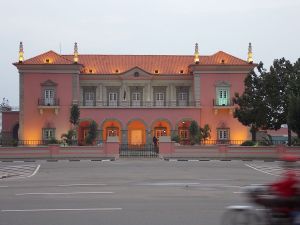
The House of the Governor in Huambo (Source: Wikipedia)
Situated in the Angolan central highlands, Huambois located near the headwaters of the Kunene River. It was founded in 1912 by Portuguese colons and was called Nova Lisboa until 1975, when it resumed its name of Huambo. It is located 600 km southeast of the capital Luanda, and 220 km east of Benguela; it is at high altitude, on a plateau 1800 m above sea level. Huambo is a main hub on the Caminho de Ferro de Benguela (CFB) (the Benguela Railway), which runs from the port of Lobito in Angola, to the Democratic Republic of the Congo‘s southernmost province, Katanga. It is the second industrial city of the country, and a big agricultural center.
If you ever visit Huambo, as you tour its neighborhoods, and get on the Caminho de Ferro de Benguela, remember that it was once an old Ovimbundu kingdom, Wambu, and reconnect with the feel of this ancient kingdom!
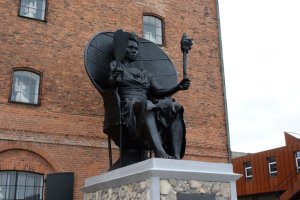
Sculpture of Queen Mary in Copenhagen (Source: NY Times – Nick Furbo)
If you are like me, you probably did not know that Denmark (and Norway) was involved in slavery in Africa, and that Denmark had several colonies, and forts in Africa, and exported slaves to its colonies in the Americas. Just last week, Denmark erected its first public statue of a Black woman, a rebel Queen, in Copenhagen; this was the statue of Queen Mary, a Black slave who led the slave uprising in the Virgin islands. The sculpture was inspired by Mary Thomas, known as one of “the three queens.” Thomas , along with two other female leaders Agnes and Matilda, unleashed an uprising in 1878 called the “Fireburn.” Fifty plantations and most of the town of Frederiksted in St. Croix were burned, in what has been called the largest labor revolt in Danish colonial history.
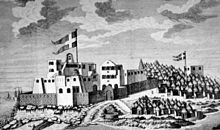
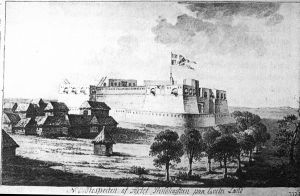
Fort Christiansborg (now Osu Castle in Ghana)
Denmark was one of the Signatory Powers to the Berlin Act of26th February, 1885 (No. 17), as well as to the Brussels Act of 2nd July, 1890 (No. 18); she has also entered into Treaty Arrangements with the Congo Free State (No. 45).
By a Convention dated 17th August, 1850, ‘the Danish forts and Possessions on the Gold Coast were ceded to Her Britannic Majesty for the sum of £10,000.
The following are extracts from that Convention:—
Preamble.
“ HIS Majesty the King of Denmark having offered to cede to Her Majesty the Queen of the United Kingdom of Great Britain and Ireland all the forts and Possessions belonging to the Crown of Denmark, situated on that part of the coast of Africa which is called the Gold Coast, or the Coast of Guinea, and Her Britannic Majesty having resolved to accept that offer, their said Majesties have named as their Plenipotentiaries to conclude a Convention for carrying such cession into effect, that is to say :”
[Here follow the names of the Plenipotentiaries.]
Cession of Danish Forts and Territorial Rights on the Gold Coast, or Coast of Guinea.
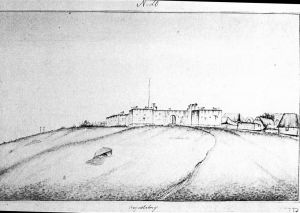
Fort Kongensteeen
“ART. I. In consideration of the sum of£10,000sterling, to be paid by Her Majesty the Queen of the United Kingdom of Great Britain and Ireland to His Majesty the King of Denmark, on the exchange of the Ratifications of the present Convention,+‘
Fort Prindsensteen
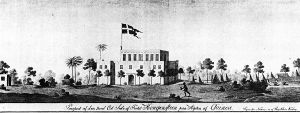
His Danish Majesty cedes to Her Britannic Majesty, to be possessed by Her Britannic Majesty, her heirs and successors, in full property and Sovereignty, all the forts belonging to the Crown of Denmark, which are situated on that part of the Coast of Africa called the Gold Coast or the Coast of Guinea, and which comprise Fort Christiansborg,1Fort Augustaborg,2Fort Fredensborg,3 Fort Kongensteen,4 and Fort Prindsensteen,5 with their appurtenances and all the guns and stores contained therein, together with all other Possessions, property, and territorial rights whatever belonging to His Danish Majesty on the said coast.” The exact extent of the Possessions thus ceded was not at that time clearly defined; but, on the9th May, l887, the Kings and Chiefs of the country of Aquamoo signed a Declaration acknowledging that they and their country formed part of the Protectorate of Her Majesty the Queen of Great Britain and Ireland on the Gold Coast, and that they were subject to the jurisdiction and authority of Her Majesty, and declaring that they had that belief inasmuch as their country of old enjoyed similar protection from His Majesty the King of Denmark, who, they said, they understood had ceded his right and title to their country to the British Crown in1850.
Fort Augustaborg
On the1st July, 1890, an Agreement was entered into between Great Britain and Germany, for defining their respective spheres of influence on the Gold Coast and in other parts of Africa (No. 129); and on the14th April, l893, a further agreement was entered into between the two countries for defining the limits of their respective spheres from the Gulf of Guinea into the Interior (No. 131).
A crown from the Maqdala exhibition at the V&A in south-west London. (Source: V&A Museum)
I was stunned by the title of this article on the Guardian, and the preposterous thought that a country whose treasure it is, Ethiopia, would have to be loaned its own treasures which were looted by the British and taken to Great Britain. It is just so outrageous that such a thought could even be uttered! Below are snippets of the article. For the full article, go to The Guardian.
===
” Victoria and Albert Museum director says artefacts could be sent to Africa on long-term loan.
Treasures including a gold crown and a royal wedding dress, which were taken from Ethiopia by the British 150 years ago, could be returned to Africa by the Victoria and Albert Museumon long-term loan.
Emperor Tewodros II
Ethiopialodged a formal restitution claim in 2007 for hundreds of important and beautiful manuscripts and artefacts being held by various British institutions, all plundered after the 1868 capture of Maqdala, the mountain capital of Emperor Tewodros II in what was then Abyssinia.
That request has been refused. But in the run-up to a Maqdala display opening this week at the V&A, a compromise has been offered bythe museum’s director, Tristram Hunt, who said: “The speediest way, if Ethiopia wanted to have these items on display, is a long-term loan … that would be the easiest way to manage it.”…
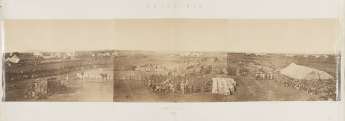
British Camp at Zoola, Abyssinia expedition 1868-9 (Source: Victoria and Albert Museum, London)
They have never been on public display because of their religious importance and can only be seen, even by a curator, with the agreement of the Ethiopian Orthodox church.
Other objects are on display but the British Museum argues the value of them being seen by the public is in a global context. A spokeswoman said the museum would consider any loan request from Ethiopia.



 Il faut souffrir pour être belle








 African Heritage