French Colonial Treaties in Africa: 7 February 1869 in Petit Bassam in Cote d’Ivoire

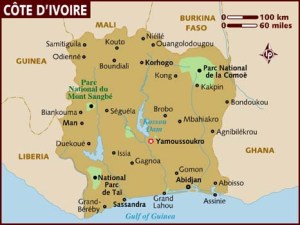
Map of Cote d'Ivoire
Map of Cote d’Ivoire

Since we were talking about Côte d’Ivoire, I thought about taking us down memory lane with this 1869 treaty between France and the King of Petit Bassam in modern-day Côte d’Ivoire. Today, on the island of Petit Bassam are neighborhoods such as TreichvilleKoumassi, and Marcory; these are all parts of the city of Abidjan, Côte d’Ivoire‘s most populous city. The treaty below was signed between the French navy lieutenant Vernet and King Bogny of Petit Bassam.

The English translation of the treaty is by Dr. Y., Afrolegends.com. For the French original click here: Cote d’Ivoire_Traite relatif a la souverainete de la France sur le territoire de Petit Bassam 7 Fev 1869.

======

Cote dIvoire_Abidjan map
The city of Abidjan and its neighborhoods, from colonial times to now

Treaty between M. VERNET, navy lieutenant, Knight of the Legion of Honor, Senior Commander of the Gold Coast trading posts, on behalf of the M. the Counter-Admiral, Commander in Chief of the navy of the western coast of Africa, Gabon, Gold Coast and BOGNY, King of the country of Petit-Bassam.

Article 1

The king and chiefs of Petit-Bassam, desiring to place their country under the protection of France, concede the full and entire sovereignty of their territory to H.E. Napoleon III, Emperor of the French.

Article 2

The French flag will be on all points where the Admiral Commander-in-Chief will deem necessary as a mark of sovereignty.

Article 3

The king and chiefs give up in full ownership to the French the lands which will be necessary to  them [the French] to build a fortification or commercial establishment that they [the French] will judge suitable.

Article 4

In the event of the sinking of a ship, to whatever nation it belongs, they must lend their hands to the rescue; one-third of the cargo will be conceded to the rescuers.

La ville d'Abidjan
La ville d’Abidjan (source RFI)

Article 5

In the event that disputes arise between the locals and Frenchmen or foreigners, if the matter cannot be arranged amicably, it will be brought to the court of the Senior Commander of Grand-Bassam who will judge in the last resort, unless approved by the admiral commander chief.

Article 6

Any ship, from whatever nation it belongs to, may deal with the villages of Petit-Bassam, in accordance with the orders of the admiral commander-in-chief and subject to a customs duty of 4% on exported goods, fixed by the decree of September 12th 1868. This right will be levied by the French agents from May 1st 1869.

Article 7

In exchange for these concessions, it will be granted to the king, chiefs, and inhabitants of the villages of Petit-Bassam protection of the colonial outpost and French warships.


The said treaty, read and re-read in the French language and the language of the country, will start its course today.

Cote dIvoire_Port Bouet le phare de Petit Bassam_2
The lighthouse of Petit Bassam, Port Bouet

It was made double and in good faith between us, and a copy was issued to each of the parties.

In the village of Petit-Bassam, the seven of February one thousand eight hundred and sixty nine.

The Senior Commander of the Outposts of the Gold Coast

            Signed: VERNET.

Signature of BOGNY.

Mark made by the King

+

Certified True:

            Signed: VERNET

                        Signature of DÉDÉ, translator.

                        The doctor of 2nd class of Grand-Bassam

                                    Signed: Le BUNETEL


Approved:

The Counter-Admiral, Commander-in-chief of the naval division of the Western coasts of Africa and Senior Commander of the trading posts of the Gold Coast and Gabon.

Signed: A. Dauriac


Proverbe sur l’Experience / Proverb on Experience

Balai africainUn vieux balai nettoie mieux qu’un nouveau (Proverbe Ga – Ghana).
An old broom cleans better than a new one (Ga proverb – Ghana).

Yaa Asantewaa, the Great Ashanti Queen fighting for Freedom

asantewaa
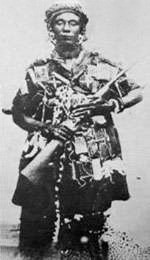
Queen Yaa Asantewaa in Batakarikese (Ceremonial war dress)

With the liberation of Simone Gbagbo last week, it is good to explore other strong women in African history. I would like to talk about the great queen Yaa Asantewaa who was a queen in the neighboring country of Ghana, when it was still called Gold Coast, and fought against the European colonizers. I explored her story amply in the article: Yaa Asantewaa or the Ashanti Cry for Freedom.

ashanti_golden_stool_31_january_1935
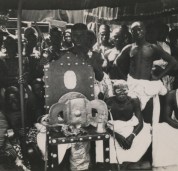
The golden stool in 1935

At a time when the British exiled many of the Ashanti leaders to the Seychelles, including the King of AsantePrempeh I, and other members of the Asante government, Yaa Asantewaa became regent of the Ejisu-Juaben District. After the deportation of Prempeh I, the British governor-general of the Gold CoastFrederick Hodgson, demanded the Golden Stool. This request led to a secret meeting of the remaining members of the Asante government at Kumasi, to discuss how to secure the return of their king. Many of the men were afraid, undecided, and unwilling to take any action. Yaa Asantewaa said these strong words to them: “Now, I see that some of you fear to go forward to fight for our king. If it was in the brave days of Osei TutuOkomfo Anokyeand Opoku Ware Ichiefs would not sit down to see their king to be taken away without firing a shot. No European could have dared speak to chiefs of Asante in the way the governor spoke to you this morning. Is it true that the bravery of Asante is no more? I cannot believe it. It cannot be! I must say this: if you, the men of Asante, will not go forward, then we will. We, the women, will. I shall call upon my fellow women. We will fight! We will fight till the last of us falls in the battlefields.

The BBC recently made a very short cartoon of the story of the great Queen Yaa Asantewaa. Although I applaud the effort, it is at best a very flimsy take on such a great historical moment in Ghanaian history, and I await the day when Ghanaians and Africans will undertake to tell her story properly for all Ashanti, Ghanaian, and African children around the globe. As you watch the cartoon, remember that before the BBC, you first read her story here on Afrolegends.com! Enjoy!

Free at Last: Simone Gbagbo Liberated

Simone Gbagbo
Simone Gbagbo, after her liberation

Yesterday, on 08/08/2018, the former first lady of Côte d’Ivoire, Simone Ehivet Gbagbo, was freed from imprisonment. It has taken 7 years for Simone Gbagbo to be free! 7 years of humiliation, 7 years of pain, 7 years of Lord knows what, for Simone Gbagbo to finally be free! And why was she imprisoned? For her deep love for her country, a country she believed needed to be respected, and whose people needed their dignity restored. She did not fit in the world’s agenda to let her country be pillaged, and so she paid the price when Ouattara, the infamous, made its way to the presidency of Côte d’Ivoire via the war planes and military forces of France and the UN led by the infamous Sarkozy and Ban-Ki Moon. Well, 7 years later, Ouattara the infamous, has granted amnesty to 800 people in the country, 800 political prisoners, 800 who were a ‘threat’ to his system. The amnesty comes as a way to reconcile the country, but it probably comes because of the political climate which makes it so that Ouattara needs some sort of an opposition to break the rank of his current opponent Konan Bedié: this is the politic of ‘divide and conquer’. Whatever the political scheme, we are grateful for it. We salute this step toward reconciliation, and we do hope that more will follow, and that Laurent Gbagbo and Charles Blé Goudé will be free at last. We thank all the people around the globe for their tireless prayers, and wish the land of Côte d’Ivoire peace in dignity and harmony forever. A luta continua e la vitoria e certa.

Proverbe Burundais / Burundi Proverb on Having Enough

Le crocodile sort du fleuve et lèche la rosée (Proverbe Kirundi – Burundi). – Il n’a jamais assez. crocodile

The crocodile comes out of the river and licks the dew (Kirundi proverb – Burundi). – There is never enough.


Quote on Hurting Others by Angélique Kidjo

Angelique Kidjo2“We cannot hurt ourselves just for the sake of it. When you hurt somebody you hurt yourself. Down the line, the ripple of it comes back to you.” Angélique Kidjo

Proverbe sur l’estime / Proverb on Esteem

mouth4Si tu ne me connais pas, tu ne peux m’estimer (proverbe Maure – Mauritanie, Algérie, Tunisie, Maroc, Niger, Mali, Sahara Occidental).

If you don’t know me, you cannot esteem me (Moor proverb – Mauritania, Algeria, Morocco, Tunisia, Niger, Mali, Western Sahara).

Why some African countries don’t want charity clothes

second-hand clothes
Second-hand clothes

In recent years, the textile industry in African countries has taken a hit because of second-hand clothes from the Western world. Remembering the great and rich African Fabrics and Textiles industry of years and centuries prior, many have thus decided to stop accepting these to keep building or rather re-building their own textile industry. Over 30 years ago, President Thomas Sankara of Burkina Faso instituted the Faso Dan Fani in the workplace to encourage the local textile workers. Today, our wish is that other African countries will follow suit, and that throughout the world there will now be clothes worn with the label ‘Made in Senegal,’ or ‘Made in Mali,’ or ‘Made in Tanzania,’ or simply ‘Made in … [the African country’s name]’. Below is the excerpt of the article from the BBC. For the full article, go to The BBC.

====

Faso dan fani2
Faso Dan Fani

Claim: Donating second-hand clothes has had a negative effect on textile industries in African countries.

The Rwandan President, Paul Kagame, has said: “We are put in a situation where we have to choose – you choose to be a recipient of used clothes… or choose to grow our textile industries.”

Rwanda is planning to ban the import of second-hand clothes by 2019 and has already put up tariffs.

Verdict: Imports of cheap second-hand clothes from the West have had an impact on local clothes manufacturers – but so have changes in world trade policies and the rise of Asian garment producers.

… African countries once had large textile industries – and some critics blame the flood of cheap second-hand clothes from abroad for the continent’s shrunken textile sector.

[…]  In 2015, member states of the East African Community (EAC), which comprises Burundi, Kenya, Rwanda, Tanzania, and Uganda, announced they would ban second-hand imports from 2019 to protect their own clothing manufacturers. 

Kente cloth
Kente cloth

East African countries, which account for 13% of the global market in second-hand textiles (worth a total of $274m (£208m) in 2015, began imposing tariffs. But then, under pressure from the United States, countries in the EAC reduced tariffs and withdrew the proposed ban. Rwanda, however, refused to back down.

And in March 2018, the US temporarily suspended Rwanda from an arrangement allowing sub-Saharan countries preferential access to the US market.

But Rwanda stood firm and maintained its import tariffs, saying it wanted to build up its own “Made in Rwanda” textile industry. …

Why the Name: Morocco?

Morocco
Flag of Morocco

If you are like me, there are many countries whose name you have pondered upon. One of them is Morocco! I have wondered about the name Morocco and its origin: was it a Portuguese or Spanish adaptation? did the French version ‘Maroc‘ derive from a Berber word or Almoravid name? Or was it a European name given to an African land? How did the initial inhabitants call their land?

Morocco2
Map of Africa and Morocco

Well, the word ‘Morocco‘ derives from the Berber Ameṛṛuk, the shortened version of « Amurakuc », the original name « Marrakesh», itself arising from the Berber « amur n ukuc » meaning «land of God» or «sacred land». The full Arabic name al-Mamlakah al-Maghribiyyah translates to “Kingdom of the West” or the “Kingdom where the sun sets.” For historical references, medieval Arab historians and geographers sometimes referred to Morocco as al-Maghrib al-Aqṣá (meaning “The Farthest West“) to distinguish it from neighboring historical regions called al-Maghrib al-Awsaṭ (meaning “The Middle West“) and al-Maghrib al-Adná (meaning “The Nearest West“). Marrakesh was Morocco’s capital under the Almoravid dynasty and Almohad Caliphate. In Turkish, Morocco is known as Fas, a name derived from its ancient capital of Fes. However, this was not the case in other parts of the Islamic world: until the middle of the 20th century, the common name of Morocco in Egyptian and Middle Eastern Arabic literature was Marrakesh; name still used in some languages such as PersianUrdu and Punjabi. The English name Morocco is an anglicisation of the Spanish and Portuguese Marruecos and Marrocos respectively; which all derived from Marrakesh.

Morocco_Rabat

Morocco’s capital, Rabat (Source: visitMorocco.com)

Morocco was known as the Kingdom of Marrakesh under the three dynasties that made Marrakesh their capital. Then, it was known as the Kingdom of Fes, after the dynasties which had Fez as their capital. In the 19th century, European cartographers still mentioned a “Kingdom of Morocco“, indicating the ancient capital “Morocco” (for Marrakesh). Under the Alaouite dynasty, the country moved from the appellation to the Empire of Sharif in the 19th century, to that of Kingdom of Morocco.

Morocco_King-Mohammed-VI
King Mohammed VI of Morocco

Morocco is a monarchy, and is governed today by the King of Morocco, Mohammed VI, who holds executive and legislative powers, especially over the military, foreign policy and religious affairs.

Morocco has a coast by the Atlantic Ocean that reaches past the Strait of Gibraltar into the Mediterranean Sea. It is bordered by Spain to the north (a water border through the Strait and land borders with three small Spanish-controlled exclavesCeutaMelilla, and Peñón de Vélez de la Gomera), Algeria to the east, and the annexed Western Sahara to the south. Since Morocco controls most of Western Sahara, its de facto southern boundary is with Mauritania.

Marrakesh
Marrakesh

The capital of Morocco is Rabat; and its largest city is its main port, Casablanca. Other major Moroccan cities are FesMarrakeshMeknesSalé and Tangier. Morocco has become a major player in African economic affairs, and is the 5th African economy by GDP (PPP). Tourism accounts for a big part of its economy. Morocco is an ethnically diverse country with a rich culture and civilisation; and this diversity can be seen in its architecture, and cuisine as well.

Next time you visit Morocco, do not forget to enjoy its rich culture, cuisine, beautiful scenery, and remember that its name stands for the Land of God or the Sacred land, and enjoy its sacred treasures.

Proverbe Arabe sur la paresse / Arabic Proverb on Laziness

Ostrich1L’autruche, quand il faut voler, dit: “Je suis chameau”; et quand il faut porter un fardeau, elle dit: “je suis oiseau” (Proverbe Arabe – Mauritanie, Maroc, Algerie, Tunisie, Libye, Soudan). – Un paresseux avance toujours des raisons pour fuir le travail.  

camelThe ostrich, when it is time to fly, says: “I am a camel”; and when it is time to carry a burden, she says, “I am a bird” (Arabic proverb – Mauritania, Egypt, Algeria, Morocco, Tunisia, Libya, Sudan). A lazy person always gives reasons for fleeing work.Bird_1