Le Bœuf, le Cochon et l’Araignée

Bœuf
Bœuf

Il y avait une fois un village bien malheureux car, malgré tous les efforts des villageois, les cultures n’avaient pas poussé. La nourriture manquait et tout le monde était devenu maigre et bien affamé. Cochon, Bœuf et Araignée, trois habitants de cette infortunée région, erraient chaque jour dans la brousse en quête de quelque chose à se mettre sous la dent.

Un beau matin, Cochon, tout affaibli par la disette, se lamente sur le chemin à l’entrée du village lorsque, compère bœuf vient à passer. Surpris de la mine florissante de celui-ci, cochon  l’interpelle: « Holà, mon compère, d’où te vient ta belle mine alors que, tous ici, nous mourons de faim et tombons en faiblesse? »

Bœuf accélère son allure et passe devant le cochon sans répondre, comme s’il n’avait pas entendu la question.

Cochon comprend qu’il y a là quelque chose de louche et se met à observer attentivement son ami. Plusieurs jours de suite, il se cache dans des arbustes au bord du chemin, et voit passer chaque matin Bœuf qui va toujours dans la même direction.

Cochon
Cochon

Chaque soir, Bœuf revient tranquillement au village et tandis que la faim ronge son malheureux compère, il semble lui au contraire, prendre un embonpoint de plus en plus dodu. Alors n’y  tenant plus et sentant sa fin prochaine, cochon s’écrie en lui barrant la route. « Compère! Compère! Tu grossis à vue d’œil alors que je me meurs .Par pitié, dis-moi ou tu trouves tant de nourriture, ou j’appelle tous les habitants du village pour leur signaler ta conduite. A nous tous, nous  saurons bien t’obliger à nous révéler ton secret. »

Bœuf s’arrête, réfléchit et déclare enfin: « Frère, tu me fais pitié. Jure-moi de ne rien révéler à personne et je viendrai à ton secours.

-Je le jure

-Demain matin, accompagne-moi dans la forêt et tu sauras tout. »

Le lendemain, tous deux s’en vont ensemble à travers la foret. Parvenus à une clairière, ils trouvent une grosse meule. Alors Bœuf s’approche et dit haute voix : « Meule, prépare-moi a manger! » En un instant, la meule prépare un bon repas et Les deux compagnons le dévorent. Quand il a fini, cochon ordonne à la meule :

« Meule prépare-moi encore à manger!»  La meule obéit aussitôt. Bien repus les deux amis reviennent au village. Et, tous les matins désormais, ils vont dans la clairière et la meule magique les nourrit. Bientôt, cochon à son tour devient très gros. Ce phénomène attire l’attention d’Araignée. Il attend que ses compagnons soient revenus chez eux et va rendre visite à cochon. « Cochon, mon bon ami, aide-moi. Je vois que tu sais trouver assez de nourriture pour devenir gros et gras. Si tu ne viens pas à mon secours, je vais appeler tous les habitants du village et on saura bien te contraindre à nous dire ou tu trouves à manger! »

Cochon répond aussitôt: « Garde le silence! Si tu me promets le secret, demain matin, avant le lever du soleil, je te conduirai aux victuailles. »

Araignée
Araignée

Araignée jure tout ce qu’il veut, et le lendemain à l’aube ils vont ensemble jusqu’à le lendemain à l’aube ils vont ensemble jusqu’à la clairière, trouvent la meule qui leur prépare à manger, puis reviennent au village.

Araignée, une fois rentré chez lui, s’assoit dans sa concession et se met à  réfléchir. « Tout cela est bien joli. Mais Bœuf et Cochon sont des goinfres. Ils mangent trop, grossissent à vue d’œil et vont bientôt attirer l’attention de tous les villageois. Si nous sommes nombreux à connaître le secret, le meule ne voudra plus nous nourrir. Il faut que je trouve une solution! »

Il réfléchit  encore, encore, encore puis il se lève et malgré la nuit, se dirige vers le foret. Quand il est arrivé à la clairière, il  s’approche de la meule et lui dit :

« Meule, ne sois pas fâchée contre moi. Je vais te transporter jusqu’à ma maison pour te mettre à l’abri des curieux, et des goinfres! Laisse-toi soulever ! » Ceci dit, il se baisse, soulève la meule et la charge sur son dos. Alors la meule devient de plus en plus lourde et l’écrase.

Celui qui se croit plus malin que les autres rencontre toujours un plus malin que lui.

Conte Mina tiré de “Contes des Lagunes et Savanes,” Collection ‘Fleuve et Flamme,’ édition Edicef, 1975.

Ngugi wa Thiong’o: world acclaimed Kenyan writer

Ngugi wa Thiong'o
Ngugi wa Thiong'o

Ngugi wa Thiong’o is a world-acclaimed Kenyan writer cut from the same cloth as African veteran Chinua Achebe. Ngugi is the author of several novels, plays, short stories, critical pieces, and children books. Ngugi reached fame writing in English, and then decided to write in Gikuyu, his mother-tongue. Today, his books are written in Gikuyu, and then translated into English. His first books Weep not child (1964) followed by The river between (1965) were on the secondary school syllabus in Cameroon, and a friend of mine used to love  reading The river between.

The wizard of crow
The wizard of crow

When Ngugi first started writing in Gikuyu, he was threatened by the Kenyan government, and in the late 70’s, the political overtone of his play I will marry when I want, got him arrested by the then vice-president Daniel Arap Moi (who later became president, and ruled Kenya for 22 years). After his release from jail, Ngugi spent two decades in exile, and tried returning to Kenya in 2004 under the new government, but was viciously attacked in his hotel and his wife was sexually assaulted… after that he returned to the USA where is a professor at New York University. His latest novel, The wizard of crow which is 1000-pages long, and which I own, discusses a dictatorship in an imaginary country in Africa.

Please enjoy an interview with Ngugi wa Thiong’o conducted by Granta magazine. To learn more about one of the greatest African literary geniuses, check out: http://www.ngugiwathiongo.com/, Wikipedia, Penpoints, Gunpoints, and Dreams. If you have never read Ngugi wa Thiong’o’s books, I recommend that you start with The river between, Petals of Blood, A grain of wheat, and Weep not Child.

Weaving African baskets

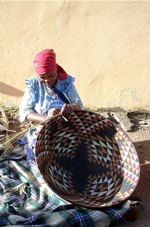
South African lady weaving a basket

The other day I went to the museum of arts where I visited the Native American section, and realized that there was a strong difference between Native American baskets and African baskets. This is when I thought of discussing African baskets on my blog.

Wolof basket (Senegal)

Well, first of all, you should know that African baskets are different from country to country. You will find out that West African baskets (Togo, Senegal, Ghana…) are different from Central African baskets (Cameroon, DRC, Burundi…), which are different from Southern African baskets (Zimbabwe, South Africa, etc…). This difference is mostly due to the fact that different ethnic groups inhabit those regions, like the bantus in the South, the Nilotes in the North, etc… plus our own experiences in life, and the climate give us different tools to make baskets.

Beaded Bamileke basket (Cameroon)

For instance, in Cameroon (my country), baskets are made out of dried palm leaves, bark wood, or Raffia also known as African bamboo, in Rwanda they are made out of sisal fibers, banana leaves, or grass; in Senegal, njodax grass is used; while in South Africa, they are made out of llala palm leaves, sisal leaves, etc.

Burundi basket
Burundi basket

The styles and patterns on the baskets also vary from sub-regions on the African continent. Baskets are dyed with either natural plant pigments, bark, berries, leaves, clay, roots, dung, or tea leaves as well as with commercial dyes.

Zulu basket (South Africa)

Weaving baskets is truly an art, and you can usually recognize which area and sometimes which country in Africa they are coming from.

The Handicraft Center in Dschang, Cameroon, has beautiful beaded baskets and other art work.

Please discover, and enjoy the art of making African baskets!

The forgotten kingdom of Nubia

Pyramids of Nubia
Pyramids of Nubia

The general public is familiar with Egypt and the pharaohs, but is not so aware that there was a highly important, sophisticated, and independent ancient civilization in Nubia, which is south of Egypt in present-day Sudan.  For over a century, Nubian pharaohs dominated Egypt, and their kingdom extended from Lake Chad and well into the middle east.  The conquest of Egypt started with Pharaoh Piye of Nubia, and continued with Taharqa who launched the most audacious building campaign of any pharaoh since the New Kingdom (around 1500 B.C.).  Under Taharqa, the capitals were Napata and Thebes, and Jebel Barkal the holy mountain.

Black Pharaohs of Nubia

Nubia is a kingdom with 3 times as many pyramids as Egypt.  Their language still needs to be decoded, and archaeologists are searching for a Rosetta stone similar to that discovered by Champollion which allowed the translation of Egyptian hieroglyphs.  The Nubians were well known for their military genius, and Egyptian pharaohs will sometime hire Nubian mercenaries to fight their battles.  Theirs was a civilization of strong queens such as Amanishaket, and Amanitore.  One of these queens Candace Amanirenas defeated the roman army of Augustus Caesar.

Pyramids of Meroe
Pyramids of Meroe

To learn more, check out some of these great websites: http://www.thenubian.net/index.php, http://www.ancientsudan.org/index.html. National Geographic also had a series of articles on Nubia: Black Pharaohs, Rare Nubian King statues uncovered in Sudan. The site of Gebel Barkal was added to the UNESCO list of world treasures in 2003… check it out on the UNESCO World heritage website, and the Society of Nubian Cultures.

Please discover Nubia, and revel in African genius!

Don’t forget to watch Part 2-5 .

Haiti and Toussaint Louverture

Map of Haiti
Map of Haiti

I have been so stricken by the recent tragedy in Haiti, that I thought it would only be fit to talk about Haiti, and celebrate the first Black independent nation in the western hemisphere, and in the world. What better way than to salute Toussaint Louverture, the great black general who defeated Napoleon’s army, and French, British, and Spaniards? What better way than to salute the genius of Toussaint! Think about this: Napoleon, one of the greatest generals that ever lived, being beaten by a… self-educated slave with no military training… being driven off the shores of Haiti by Toussaint who then led his country to independence.

Toussaint Louverture

Well, Toussaint Louverture was a military genius like none other. He was actually born a slave and worked on a plantation, and then earned his freedom. By the time the slave rebellion started, he did not want to join in at first; but later on joined the slave rebellion only to realize that their leaders were inept and would compromise with the white farmers. Toussaint rose through the ranks and became the undisputed leader of the rebellion. He also had two great generals under him: Jean-Jacques Dessalines and Henri Christophe, who would both later become presidents of Haiti.

Toussaint and Haitian revolutionToussaint’s struggle was a struggle for freedom, equal rights, and justice for all. Having earned his freedom before, he knew what it meant to be free, and drafted a constitution. After sending out the French in Saint-Domingue (present day Haiti) in 1799, he turned to spanish Santo Domingo where slavery was still in effect, and took control of the entire island defeating the spaniards, and freeing the slaves. He then started to draft a constitution in 1801 for the entire island of Hispaniola (present-day Haiti and Dominican Republic). The French, the Spanish, and even the Americans hated Toussaint, because of his effect on people. Imagine this: a Black leader freeing slaves, a nation where slaves had taken control of their destiny did not sit well with Americans who still owned slaves and could not bear such a news. By 1803, Napoleon ready to surrender Haiti, decided to meet with Toussaint on a peace deal; but the French tricked Toussaint, and when Toussaint came to the rendez-vous, he was arrested and taken to France by ship where he was put in the coldest prison of France. Toussaint, a tropic guy, died of cold and starvation in this prison.

Toussaint Louverture
Statue of Toussaint

The most important and beautiful about the story of Toussaint and Haiti, is that this was the first time a people rose up, an enslaved people rebelled and succeeded in getting their freedom, and in founding a country…. they were able to defeat the establishment. This is why Haiti is a treasure to the world. Haiti represents a people fighting for their rights, for their freedom, and for their voice to be heard. In the wake of this devastating earthquake, I know the Haitian people will rise from ashes just like the phoenix!

Please watch this documentary about “Toussaint Louverture and the Haitian revolution” from ITVS. To learn more, you can read about Toussaint on Wikipedia, A biography of Toussaint by J.R. Beard, Toussaint Louverture Historical Society, and check out the website Filmsdocumentaires.com which has a snippet of a documentary on Toussaint.

Le Singe et le Crocodile

Singe
Singe

Il était une fois un jeune singe très farceur et qui faisait plus de grimaces que tous ses frères réunis. Un jour, il s’amusait sur les branches d’un cocotier, tout près de la berge d’un fleuve dans lequel vivaient bons nombres de crocodiles.

Le jeune singe venait de réussir trois pirouettes particulièrement acrobatiques et se reposait en s’éventant avec les palmes de l’arbre, lorsque seigneur crocodile surgit de l’eau et rampe au soleil sur la rive.

Petit frère, dit-il d’une voix caverneuse, il me semble que tu as l’air bien triste ce soir. Pourquoi donc n’exécutes-tu pas tes gambades habituelles ?

Je crois que j’ai deviné! Tu as faim et ton cocotier ne porte pas des fruits. Regarde l’autre rive, là-bas, couverte d’arbres aux belles palmes. Vois-tu toutes ces noix de coco? Pourquoi ne vas-tu pas là-bas?

Le jeune singe pousse un soupir, se gratte l’oreille et répond:

Crocodile
Crocodile

Oncle crocodile, il y a longtemps que je les ai aperçues. J’en ai l’eau à la bouche. Mais ces cocotiers sont de l’autre cotés du fleuve. Comment faire pour y aller? Je ne sais pas nager.

-Qu’à cela ne tienne, mon petit ami. Je t’y transporterai. Tu me réjouis si bien les yeux avec tes jeux et tes acrobaties, que, pour te rendre la gaîté, je vais te charger sur mon dos. Je traverserais le fleuve et, en un rien de temps, tu seras de l’autre coté.

-Grand merci, mon oncle. J’arrive tout de suite, s’écrie le jeune animal sans méfiance. Il descend le long d’une branche et hop! saute  sur le dos de seigneur crocodile. Celui-ci se glisse jusqu’à l’eau et la traversée commence.

Quand ils sont parvenus au beau milieu du fleuve, là ou le courant est le plus vif, seigneur crocodile se met à rire:

Coeur
Coeur

Petit sot! Tu crois n’importe quelle histoire! Si je t’ai pris sur mon dos, ce n’est pas par pitié! Sais-tu que ma chère mère est malade depuis deux semaines? Pour la guérir, il n’y a qu’un seul remède, a dit le féticheur, il faut qu’elle mange le cœur d’un jeune singe! Voilà pourquoi je te transporte jusqu’à son domicile!

Petit singe réfléchit très vite et s’écrie d’un air désolé :

Quel malheur! Cher oncle, pourquoi ne m’avez-vous pas dit cela auparavant ?

Voilà qu’il nous faut rebrousser chemin! Je me suis tellement dépêché de partir avec vous que j’ai oublié mon cœur en haut du cocotier! Quel étourdi je fais! Vite! Vite! Oncle crocodile, revenons là-bas le chercher.

Singe
Singe rigole

D’un coup de queue brusque, Seigneur crocodile fait demi-tour et se dirige rapidement vers leur point de départ. Dès qu’ils sont parvenus sur la berge, petit singe saisit la branche qui lui a permis de descendre et, hop! En deux gambades, il est en haut du cocotier. A peine arrivé, il fait deux ou trois vilaines grimaces au seigneur crocodile et lui crie en se moquant de lui.

Cher oncle, qui de nous deux est le plus sot ? Qui de nous deux est le plus crédule ? Vous non plus, vous n’y voyez pas plus loin que le bout de votre nez ! Vous avez cru une histoire qui ne tient pas debout ! Quel animal pourrait vivre sans cœur, même quelques instants? Allez, ignorant! Cherchez une autre dupe!

Conte tiré de
“Contes des Lagunes et Savanes,” Collection ‘Fleuve et Flamme,’ édition Edicef, 1975.

Amilcar Cabral: Discours sur le cancer de la trahison

Amilcar Cabral
Amilcar Cabral on a stamp

“Le cancer de la trahison” est le titre du discours prononcé par Amilcar Cabral (père de l’indépendance Cap-Verdienne et Bissau-Guinéenne) après l’annonce du decès de Kwame N’krumah, 1er président du Ghana. Dans ce discours, Cabral dénonce la trahison qui ronge les rangs de tous les mouvements indépendantistes africains. Nombreux de ces mouvements ou révolutions africaines ont été rongés par le cancer de la trahison. Triste de savoir que Amilcar Cabral lui-même a été assassiné par un traître!

Suivez son discours!

Dambisa Moyo: Africa and Dead Aid

Dambisa Moyo
Dambisa Moyo

For the start of this new year, 2010, I would like to introduce to you a bright young African writer hailing from Zambia: Dambisa Moyo. Dambisa Moyo, ivy-league educated economist from Harvard and Oxford, was elected one of the world’s 100 most influential people by Time Magazine for the year 2009. Why is she deemed influential? Well, Dambisa Moyo is an economist whose book, Dead Aid: Why Aid Is Not Working and How There Is a Better Way for Africa, was on the New York Times bestseller in 2009. She argues that foreign aid has harmed Africa’s development, and should be phased out.

Dead Aid: Why aid is not working ...

She has been under a lot of fire, because of criticism of foreign aid, Bono, Geldorf, etc… She represents the upcoming young talented African force, which stands up and say “Enough” to aid that fuels corruption, and instead should focus on job creation and support of local entrepreneurship! It is interesting because I always felt that aid was not the answer to the problems of Africa. Like the Chinese proverb says: “Give a man a fish, and feed him for a day. Teach a man to fish, and you feed him for a lifetime.

For more information, check out Ms. Moyo’s website: http://www.dambisamoyo.com/, an interview she gave to the New York Times and the The Huffington Post. Please enjoy this video from Dambisa Moyo’s channel on Youtube.

The Forgotten Angel of Rwanda: Capt Mbaye Diagne

Rwanda
Rwanda

I still remember the day the Rwandan genocide started. I was just in “4eme”, and the images of the genocide on TV made me cry at night! What could I do, me… a simple school child in Cameroon, except watching on television and praying for someone or something to stop this butchery! Well… among all the heroes mentioned in books and documentaries about Rwanda, a fellow African heard my cry, a Senegalese UN soldier who was in Rwanda decided to act… with no guns, no arms, and no authorization from the UN, he decided to take destiny in his hands…. He is almost forgotten when people talk of Rwanda: few ever mention the act of bravery from this African soldier stationed there.

Yes… I am talking about the young Senegalese captain Mbaye Diagne who was working for the UN in Rwanda. From the first hours of the genocide, he decided to take destiny in his hands, ignoring orders from the UN telling him to just be an observer. He probably thought: “how can I just look when human beings are being slaughtered? how can I just look when I am a blue beret, a UN officer supposed to maintain peace in the world?” From the first hours of the genocide, he was able to save the children of the prime minister Agathe Uwilingiyimana who was murdered; he hid them in his house, and was later able to take them to safety at the “Hotel des Mille Collines.” From then on, he saved many lives, some even think that he probably saved at least 600 -1000 people.

Capt Mbaye
Capt Mbaye in Rwanda

During the genocide, he was constantly rushing and never stayed put. He had a gift to make people laugh and always wore a smile on his face. He could be familiar with anyone within minutes! He could joke with the Interahamwe at all checkpoints, share a cigarette with them, talk with them… and in the midst of the genocide, even the interahamwe probably liked to see a smile in the midst of all the killings, a glimpse of light in all the darkness! He had to save hundreds of people by carrying 3-5 at a time in his vehicle, not to raise suspicion, and pass at least 23 checkpoints at which he had to stop each time and explain himself each time. All of this was done unarmed! Imagine, … saving hundreds of people unarmed, 3-5 at a time!

Yes… Capt Mbaye with his toothy smile was a light in Rwanda… an African angel sent to save people, an answer to some of our prayers. While learning about Capt’ Mbaye, I couldn’t help but cry, tears of happiness… happiness because all I ever heard in documentaries or books were these acts of bravoure by Europeans (or Rwandans like Rusesebagina in “Hotel Rwanda”)… but no-one mentioned this African child saving another African child! No one ever mentioned that the only UN officers left with Gen. Dallaire in Rwanda were mostly Ghanaians and other Africans like Senegalese Capt Mbaye!

Capt Mbaye at the "Hotel des Mille Collines"

One thing is sure, Capt Mbaye showed that in the midst of uglyness, we have a choice to be either observers or actors! We have a choice to protect, and help others! From the very first day of the genocide, Capt Mbaye decided to listen to his conscience and save people! He gave his life for others and stood on the side of justice; he extended his arms to fellow humans in distress… he loved! He was not superman, he was just Mr. ‘everyone’ reaching to the human side in every single one of us: he talked, negotiated, and smiled with the Interahamwe so-called monsters.

Please watch parts of this great documentary from PBS Frontline, and raise your hat to a true African hero! We, Africans, are the only ones who can truly praise the acts of bravoure, courage, and love of this forgotten angel of Rwanda! What can I say… words cannot express my profound gratitude to have learned the story of someone ordinary who decided to do extraordinary things, and saved hundreds of lives!

Don’t forget to watch Part 2: http://www.youtube.com/watch?v=hgdU1B2bzxw

Turtle and Spider

Anansi
Anansi

One day Anansi the spider picked some very fat and tasty yams from his garden. He baked them with much care and they came out smelling quite delicious. He could not wait to sit down and eat them.

Just then there was a knock at his door. It was Turtle, who had been traveling all day and was very tired and hungry.

Hello, Anansi,” said Turtle. “I have been walking for so long, and I smelled the most delicious yams I’ve ever smelled. Would you be so kind as to share your meal with me?

Turtle
Turtle

Anansi could not refuse, as it was the custom in his country to share your meal with visitors at mealtime. But he was not very happy, for Anansi was a little too greedy and wanted the delicious yams all to himself.

So Anansi thought to himself and came up with a scheme.

Please do come in, Turtle. I would be honored to have you as my guest this evening. Sit down, have a chair and help yourself.

Turtle came inside and sat down, but just as he reached for a yam, Anansi yelled, “Turtle, don’t you know better than to come to the table with dirty hands?

Turtle looked down at his hands and saw that they were filthy. He had been crawling all day and had not had a chance to clean up.

Turtle washing his feet

Turtle got up and went to the river to clean his feet. He walked all the way back up to the house and Anansi had already begun to eat.

I didn’t want these tasty yams to get cold, so I had to begin,” said Anansi. “But please do join me now, Turtle.”

Turtle sat down again and reached for a yam, but again Anansi yelled at him.

Turtle, did you not hear me before? It is not polite to come to the table with dirty hands!

He looked down and saw that his clean hands had turned dirty once more, since he had to crawl on them to get back to the house.

So he walked down to the river once more to wash himself off. And when he returned this time, he was careful to walk on the grass so his hands would stay clean.

Yellow yam… mmmmhhh tasty!!!

But by the time he sat down at the table, Anansi had finished up the last bit of the tasty yams and not so much as a morsel was left.

Turtle looked at Anansi for a moment and then said, “Thank you for sharing your meal with me. If you ever find yourself near my house, please let me return the favor.” And then he slowly walked out the door and continued on his way.

The days went by and Anansi thought more and more of that meal that Turtle had offered. He got more and more interested in a free dinner and finally could not stand it anymore. He set off one day to find Turtle’s house.

He found Turtle sunning himself on a river bank just around dinner time.

Turtle looked up and saw him and said, “Hello, Anansi, have you come to share evening meal with me?

Oh yes, yes!” said Anansi, who was growing hungrier and hungrier by the minute.

Turtle went underwater to his house to set up the dinner table for the two of them. Soon he came back to the bank and said, “Your place is waiting and the food is ready. Please join me, Anansi.

And then he dived underwater and began to slowly eat his meal.

Anansi
Anansi floating unable to get underwater

Anansi jumped into the water, but could not get down to the bottom of the river. He tried to swim down, but he was so light that he kept popping back up to the surface.

He tried diving. He tried belly flops. He tried a running jump, but nothing would help him get down to the river bottom.

In the meantime, Turtle was slowly eating his meal.

Anansi was not about to give up a free meal, and was running around wondering what he would do. Finally he had an idea. He started grabbing stones and rocks and stuffed them into his jacket pockets.

Now when he jumped into the water he sank right down to the bottom and was able to take his place at the table.

The table was so beautiful and full of delicious foods. Anansi could hardly believe how many tasty foods were before him and could not wait to start his meal.

But just as he reached for the first morsel, Turtle stopped eating and spoke. “In my country, we do not wear our jackets to the table.” Anansi noticed that Turtle had removed his own jacket before sitting down.

Anansi started to remove his jacket, and as soon as it was off of his shoulders, he went zooming back up to the surface and popped out onto the river bank.

He stuck his head down into the water and saw Turtle slowly enjoying that wonderful banquet.

When you try to outsmart someone, you may find that you’re the one outsmarted.