Je voulais partager avec vous ce rare bijou: une interview de la grande écrivain Maryse Condé dans laquelle elle discute de son livre Ségou, le premier roman épique africain.
——–
Dear All,
I just wanted to show you this rare jewel: an interview of the great writer Maryse Conde where she talks about her book Segu, the first epic African novel. Enjoy!
Cette histoire se passe au temps de la famine la plus terrible qu’ait connue notre pays. Les animaux mouraient par milliers. Ils quittaient les forêts ou ils ne trouvaient plus de nourriture et remontaient vers les rivières, à travers la savane et les montagnes. Les plus faibles d’entre eux finissaient sous la dent et la griffe des plus forts. Voici comment compère lièvre, le héros aux mille tours, est parvenu, malgré sa petite taille, à se tirer d’affaire.
Compère lièvre n’avait pas mangé depuis plusieurs jours. Très affaibli, il s’était caché sous un buisson et réfléchissait. Je n’ai plus assez de forces pour courir très vite et échapper ainsi aux ennemis qui me guettent. Il faut que je trouve une solution. Si cela continue, je vais mourir. Non ! Je ne veux pas! Si seulement j’avais un compagnon ! A Nous deux, nous pourrions peut-être parvenir à survivre. Cependant, si je choisis un compagnon plus fort que moi, il me dévorera sans nul doute lorsqu’il me verra dans cet état mais une idée lui vient enfin! il va trouver son ami Kpedza, le rat palmiste trop petit, lui aussi pour être dangereux.
Compère, écoutez-moi. J’ai besoin de vous, et vous de moi. Ensemble, nous pouvons survivre car j’ai idée d’une ruse qui nous sauvera.
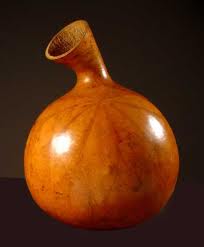
Lièvre explique alors: Comme vous étés tout petit, mon ami, vous entrerez facilement dans la gourde que voici. Je la mettrai sur mon dos et irai à travers tous les marchés du sud ou ne sévit pas la famine, affirmant partout que je suis un grand magicien. Comme preuve, je montrerai aux gens que je capable de faire parler une gourde.
En effet, chaque fois que je taperai sur la gourde, vous qui serez à l’intérieur, vous pousserez de grands cris. Tout le monde s’émerveillera et nous offrira à manger !
– Idée merveilleuse! s’écrie Kpedza, mettons-la tout de suite à exécution.
In view of the current debt crisis grabbing the western hemisphere these days, and the floods of austerity measures brought in by the IMF/World Banks/European Central Banks/Federal Reserve, etc…, austerity measures which never solve a thing but make the situation worse than ever… I thought about showing you this great documentary entitled “Globalization: When the IMF manufactures Misery (Mondialisation: Quand le FMI fabrique la Misere).” It reminds me of all these austerity measures implemented on third world countries by the IMF/World Banks in the 1980s and 1990s, which totally crippled their economies, and created even greater poverty. Not a real solution… but a way for the big banks and corporations of the Western hemisphere to fill their pockets, and keep the other people of the world in chains. Watch and enjoy!
I always thought that since the Chinese invented the compass and the gunpowder, they should have been great navigators and explorers. I also always thought that they should have been among the first to navigate around the globe. What an amazing surprise when I learned that the most venerated Chinese maritime admiralZheng Hehad reached the horn of Africa beforeVasco da Gama, challenging the claim that VdG had been the first on the Eastern side of Africa. Indeed, Zheng He’s great armada rich of more than 300 ships and as many as 30,000 troops entered the coastal town ofMalindi in modern day Kenya in 1418. He also visited Mogadishu and Barawa in present-day Somalia, and went as far as the coast Mozambique. It is said that he brought a giraffe from Somalia back to Emperor Yongle (1415).
Giraffe brought from Somalia (AD 1415) painting by Shen Du
There are tribes in Kenya which have clear Chinese ancestry… they descent probably from some of Zheng He’s crew members. In 1999, a journalist for the New York Times, Nicholas D. Kristof, reported a surprising encounter with the Shanga people on Pate island, just off the coast of Kenya. There, in a village of stone huts set amongst dense mangrove trees, Kristof met a number of elderly men who told him that they were descendants of Chinese sailors, shipwrecked on Pate many centuries ago. Their ancestors had traded with the local Africans, who had given them giraffes to take back to China; then their boat was driven onto the nearby reef. Kristof noted many clues that seemed to confirm the islanders’ tale, including their vaguely Asian appearance and the presence of antique porcelain heirlooms in their homes. You can read his account entitled: 1492: The Prequel on the New York Times website.
Lamu island, in Kenya
It is also reported that 7 centuries before the great admiral Zheng He, another Chinese, Du Huan, an officer of the Tang dynasty (618-907) visited the kingdoms of Nubia and Abyssinia (modern Sudan and Ethiopia respectively). He called these countries Molin-guo and Laobosa respectively. A full account of his trip can be found on Chroniques Yemenites. Check out the blog Curiosity killed the Eccentric Yoruba where the author did an outstanding job relating the Chinese presence in Africa, as well as African presence in China. Trade flourished between East Africa and China. As such, many African products could be found in Chinese courts such as ivory, giraffes, myrrh, zebras, camels, powdered rhinocerous horn (used as prized aphrodisiac), tortoise shell (used to treat consumption) and frankincense and ambergris (used as a tonic to stimulate circulation). Similarly, as said earlier, Chinese artefacts such as porcelain have been found in coastal villages along East Africa. Chinese coins from the Song and Tang dynasties have been found in Zanzibar, and a huge amount were found in the town of Kajengwa in Zanzibar, illustrating trade between China and early East African kingdoms (some from the Song period have also been found in Mogadishu as well as in Kenya). Chinese archaeologists arrived in July of 2010 to the beaches of Lamu and Malindi in Kenya, in search for a shipwreck from admiral Zheng He’s flotilla. Please watch this great video on the BBC website about the discovery of Chinese ancient coins in Kenya.
The video below tells of Admiral Zheng He’s travel and the size of his armada.
J’ai trouvé le discours du Président Gbagbo à l’occasion de la fête d’independance Ivoirienne très très pertinent, surtout face aux problemes actuels de l’Afrique (Côte d’Ivoire, Libye, Zimbabwe, …) dans le nouvel ordre mondial du gangsterisme! J’invite tout africain à le lire. L’intégralité du discours se trouve sur Revue de Presse CI ——
Ivoiriens, Ivoiriennes, peuples de CÔTE D’IVOIRE, très chers compatriotes, très chers habitants de la CÔTE D’IVOIRE.
Je voudrais, en ce jour solennel qui marque le 51ème anniversaire de l’Indépendance de notre pays, me joindre à chacun de vous pour rendre d’abord gloire à Dieu, notre Maître qui continue de manifester sa fidélité à notre pays, malgré les tribulations de ces derniers moments. […]
Cette réflexion est un exercice de prospection de nous-mêmes qui s’impose à chaque citoyen de ce pays, mais surtout aux dirigeants, et aux responsables politiques et administratifs qui ont la charge de conduire le destin de notre nation, surtout dans le contexte actuel de grands traumatismes causés à notre peuple, qui n’aspire qu’à vivre sa souveraineté en tant qu’acteur et sujet de l’humanité, et non pas comme simple objet ou simple spectateur de la construction de sa propre histoire.
L’Indépendance est une notion forte, qui renvoie à un mouvement de rupture. La rupture ici ne s’entend point d’un isolement ou d’un repli sur soi, position idéale des faibles, mais elle correspond plutôt à une métamorphose de la conscience, qui fait passer celui qui s’en prévaut, de la servitude à sa pleine responsabilisation dans le processus de construction de l’humanité. […]
Je mesure mieux de ma position, les grandes souffrances, mais en même temps le grand mérite de tous ces hommes qui, à travers l’Histoire, ont combattu pour la Liberté et l’Indépendance de leur peuple. Je pense notamment à Martin LUTHER KING, dont l’engagement politique jusqu’à la mort a permis, plus de quarante ans après, l’élection de Barack OBAMA comme Président des ETATS-UNIS d’Amérique; à GHANDI, dont l’ œuvre continue de nourrir l’âme de la grande INDE; au Général de GAULLE qui a refusé la fatalité de la défaite pour restaurer la grandeur perdue de la France; à Mao TSE TOUNG, qui a rompu les liens de la servitude au prix d’énormes sacrifices pour donner à la CHINE sa gloire d’aujourd’hui.
Je loue le courage de MANDELA, de Kwame NKRUMAH, de Patrice LUMUMBA et de tous les autres dignes combattants de l’Afrique, qui sont des exemples de don de soi pour la liberté et la fierté du peuple africain. Je salue plus particulièrement la mémoire de nos illustres pères qui ont combattu pour dessiner les contours de ce que nous appelons Indépendance. Leur mérite est tout à fait grand dans le contexte qui était le leur.
Mais nous devons avoir à l’esprit que leur combat serait vain si nous nous arrêtions à admirer seulement leurs acquis. Les symboles de l’Etat et les armoiries de la République nous rappellent chaque jour notre devoir et notre responsabilité devant notre propre destin. Chacun est appelé à leur donner un sens réel. C’est le combat permanent qui doit mobiliser toutes les énergies des filles et fils de notre pays. […] Continue reading “Le Président Gbagbo s’adresse aux Ivoiriens à L’occasion de la fête nationale”→
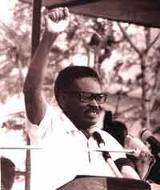
Agostinho Neto was the first president of Angola, and served from 1975 to his death in 1979. He was born in a Methodist family (his father was a Methodist pastor), attended high school in Luanda, and studied medicine in Lisbon (specializing in gynecology). In Lisbon, he befriended future political leaders such as Amilcar Cabral (Guinea Bissau and Cape Verde) and Marcelino dos Santos (Mozambique). He combined his academic life with covert political activities.
In 1948 he published his first volume of poetry and was arrested for the first time. There followed a series of arrests and detention, which interrupted his studies. He joined the Movimento Popular da Libertação de Angola (MPLA, People’s Movement for the Liberation of Angola) when it formed in 1956. He was released from detention and allowed to complete his studies in 1958, retuning shortly afterwards to Angola (1959), where he set up a private medical practice.
Flag of Angola
On 6 June 1960, Agostinho Neto was arrested at his practice as a result of his campaigning against the Portuguese colonial administration of Angola. When patients, friends, and supporters marched in demonstration for his release, the police opened fire and 30 were killed, 200 more injured. This became known as the Massacre de Icolo e Bengo (his birthplace). Neto was exiled to and held in captivity initially in Cape Verde and then in Portugal, where he wrote his second volume of poetry. After international pressures, the Portuguese government put him under house arrest, where he escaped to Morocco and later to Zaire (Congo).
He became president of the MPLA in 1962, and looked for support in the American government against Portugal, but was turned down. He received the support of Cuba and the Soviet Union for the fight for the freedom of the people of Angola from Portuguese imperialism.
After the Revolução dos Cravos (Carnation Revolution) in 1974 in Portugal, which took down the government by a military coup, Portugal’s foreign policy changed in its African colonies. On 11 November 1975, Angola became independent, and Neto was proclaimed president on that day. The country was effectively held under the rule of three independence movements, with the MPLA holding the central section and the capital.
Agostinho Neto & Jose Eduardo dos Santos
Neto’s rule was marked by armed conflict with Holden Roberto’s FNLA (supported by Mobutu of Zaire, and the US) and Jonas Savimbi‘s UNITA which had military support from South Africa. While Neto enjoyed the help and support of the Soviet Union and Cuba, he still encouraged Western investment in the country – especially in oil production. He died of cancer on September 10th, 1979 in Moscow. After his death, the civil war in Angola lasted for over a quarter of a century opposing Jose Eduardo dos Santos (his successor) and Jonas Savimbi.
Agostinho Neto was not only Angola’s first president, he was also a medical doctor, and a poet; he is actually one of Angola’s most acclaimed writer and poet. Please check out the website of the Fundação António Agostinho Neto, which has done a brilliant work in presenting Neto’s writings, debates, and comments by other leaders on Neto. Now I leave you with his great saying: “A luta Continua … A Vitória é certa!”
Amilcar Cabral was not only an agronomic engineer, or a freedom fighter, or the father of Bissau and Cape-Verde independence, but he was also a poet… like Che Guevarra or Sankara… he was a visionary with a poetic mind. In the following lines, you will read the poem ‘Regresso‘ also known as ‘Mamãi Velha‘ which was sung by the Cape-Verde singers Cesaria Evora (appeared in album Sao Vicente di Longe (2001)), and Isa Pereira.
Regresso
Old mama, come and let’s listen
To the beat of the rain against the door
It’s a friendly beat
That pounds in my heart
The rain, our friend, old mama
The rain that hasn’t been falling this way
In a long time I heard that Cidade Velha
The entire island becomes a garden
In just a few days
I heard that the country is covered in green
The most beautiful colour
The colour of hope
That now, the soil really looks like Cape Verde
Peace has now replaced the storm
Come old mama, come
Regain your strengths and come to the door
The rain, our friend, sends its salvation
And can beat in my heart
—-
Regresso
Mamãi Velha, venha ouvir comigo
o bater da chuva lá no seu portão.
É um bater de amigo
que vibra dentro do meu coração.
A chuva amiga, Mamãi Velha, a chuva
que há tanto tempo não batia assim…
Ouvi dizer que a Cidade Velha,
– a Ilha toda –
em poucos dias já virou jardim…
Dizem que o campo se cobriu de verde,
da côr mais bela, porque é a côr da esp’rança.
Que a terra, agora, é mesmo Cabo Verde,
– É tempestade que virou bonança…
Venha comigo, Mamãi Velha, venha
recobre a força e chegue-se ao portão.
A chuva amiga já falou mantenha
e bate dentro de meu coração.
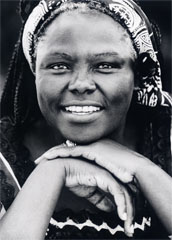
Maryse Condé is a Guadelopean/ French writer. She was married to a Guinean actor, and as such has always kept the patronym ‘Condé’ which hails from Guinea. She is a strong writer, and in my opinion, one of the best female writers of African descent. Her writing is deep, and encompasses a mixture of creole ancestry, and African culture. She has had a distinguished career as a writer and has taught at several prestigious universities in the US and France: Columbia University, University of California Berkeley, Harvard University, UCLA, University of Maryland, University of Virginia, Sorbonne, and Nanterre.
She tends to write historic fiction where she focuses on racial, gender, and cultural issues. I am an avid reader of Condé’s books. In I, Tituba: Black Witch of Salem [Moi, Tituba Sorciere] she explores slavery, and black presence during the Salem witch trials (until I read this book, it had never crossed my mind that there could be Blacks in Salem at that time).
‘Segu’ by Maryse Conde
One of the best novels ever written on an African kingdom was that of the capital of the Bambara EmpireSegu [Ségou] by Maryse Condé, which is deep and resurrects a very well-known kingdom in Mali, as well as slavery at that time, tribal warfare, the advance of islam in West Africa, the clash of cultures between muslims and animists, as well as muslims and Christians later on, and finally the presence of the white colons and the start of European imperialism in Africa. Through her novel, one finds strong historical facts, such as the battle between Fanti and Ashanti people in Ghana divided between French and English (An African version of the French-Indian war), the presence of Yoruba people in Sierra Leone, the presence of slave communities of Yoruba descent in Brazil and Jamaica, the different historic places such as the Gold coast, the Slave coast, the Grain coast, the weakening of the Bambara by the Islamic conquest which left them vulnerable to any advance by the French colonizers, etc… The depth of this book makes it one of the best African epic novel. For anybody craving for a history of Africa in the 18th/19thcentury, Segu is the best out there!
Moi, Tituba Sorciere
Asked about the meaning of her writing, Condé says: Je ne suis pas un ‘écrivain à message.’ J’écris d’abord pour moi, pour m’aider à comprendre et supporter la vie. En racontant des histoires que j’espère signifiantes, je souhaite aussi aider les autres, ceux de mon peuple en particulier, à comprendre et à la supporter à leur tour. [I am not a ‘writer of messages’. I write first for myself, to help me understand and bare life. By telling stories that I deem meaningful, I hope to help others also, particularly my people, to understand and bare life as well.]
Condé has received several awards, including the Prix Liberatur (Germany) for Segu, the Grand Prix Littéraire de la Femme for I, Tituba, Black Witch of Salem, the Prix Carbet de la Caraïbe for Desirada, the Prix Marguerite Yourcenar for Le Coeur À Rire et À Pleurer (1999, Tales from the Heart: True Stories from my Childhood), and Le Grand Prix du roman métis for En Attendant la Montée desEaux (2010). In 2001 she was ordained Commandeur dans l’Ordre des Arts et des Lettres de la France and in 2004 she was made Chevalier de la Légion d’Honneur. Please help me acclaim one of the greatest writers of African descent!!! Enjoy this interview given by Maryse Conde to Elizabeth Nunez on Grioo.com The website “ile-en-ile” provides a complete bibliography of her work. You will find a detailed biography of Condé on Kirjasto, and this interview of Maryse Conde where she discusses her book Victoire: My Mother’s Mother, about her grandmother.
This article by Alexander Cockburn is on the Pambazuka website.
———-
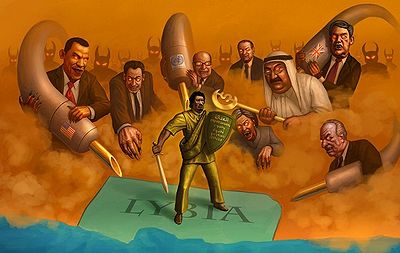
After three and a half months of bombing and arms supply to various rebel factions, NATO’s (North Atlantic Treaty Organisation) failure in its efforts to promote ‘regime change’ in Libya is now glaring. Obviously NATO’s commanders are still hoping that a lucky bomb may kill Gaddafi, but to date the staying power has been with the Libyan leader, whereas it is the relevant NATO powers who are fighting among themselves.
The reports from Istanbul of the deliberations of NATO’s contact group have a surreal quality as Secretary of State Hillary Clinton and British Foreign Minister William Hague gravely re-emphasise their commitment to regime change and the strengthening of ties to the Transitional Council in Benghazi, while the humiliation of the entire NATO expedition is entering the history books as an advertisement of the dangers of political fantasy in the service of ‘humanitarian interventionism’, appalling intelligence work, illusions about bombing and air power and some of the worst press coverage in living memory.
[….] Cameron, like Sarkozy, Clinton and Barack Obama presumably had intelligence assessments of the situation in Libya. Did any of them say that Gaddafi might be a tougher nut to crack than the presidents of Tunisia or Egypt, might even command some popular support in Tripoli and western Libya, historically at odds with Benghazi and the eastern region? If they did, did they pay any attention?
The Western press, along with al-Jazeera, was no help. The early charges of Gaddafi committing ‘genocide’ against his own people or ordering mass rapes were based on unverified rumour or propaganda bulletins from Benghazi and have now been decisively discredited by reputable organisations such as Amnesty International and Human Rights Watch. Any pretensions the International Criminal Court (ICC) might have had to judicial impartiality have been undermined by the ICC’s role as NATO’s creature, rushing out indictments of Gaddafi and his closest associates whenever NATO’s propaganda agenda has demanded it. […]
All history shows that the dropping of thousands of bombs and missiles, with whatever supposed standards of ‘pin point accuracy’, never elicits the enthusiastic support of civilians on the receiving end, even if a certificate of humanitarian assistance and merciful intent is stamped on every projectile. Recent pro-government rallies in Tripoli have been vast. Libya has a population of about 6 million, with 4 million in Tripoli. Gaddafi barrels around the city in an open jeep. Large amounts of AK-47s have been distributed to civilian defence committees. Were they all compelled to demonstrate by Gaddafi’s enforcers? It seems unlikely. […]
In early March, Sarkozy, languishing in the polls, believed the counsel of ‘new philosopher’ Bernard-Henri Lévy, after the latter’s 6 March excursion to Benghazi, that Libya and its oil were up for grabs. On 11 March Sarkozy took the precipitate step of recognising the Benghazi gang as the legitimate government of Libya and awaited Gaddafi’s collapse with a confident heart. In a hilarious inside account of the NATO debacle, Vincent Jauvert of Le Nouvel Observateur has recently disclosed that French intelligence services assured Sarkozy and Foreign Minister Alain Juppé ‘from the first [air] strike, thousands of soldiers would defect from Gaddafi’. They also predicted that the rebels would move quickly to Sirte, the hometown of Gaddafi and force him to flee the country. This was triumphantly and erroneously trumpeted by the NATO powers, which even proclaimed that he had flown to Venezuela. By all means opt for the ‘big lie’ as a propaganda ploy, but not if it is inevitably going to be discredited 24 hours later.
‘We underestimated al-Gaddafi,’ one French officer told Jauvert. ‘He was preparing for forty-one years for an invasion. We did not imagine he would adapt as quickly. No one expects, for example, to transport its troops and missile batteries, Gaddafi will go out and buy hundreds of Toyota pick-up in Niger and Mali. It is a stroke of genius: the trucks are identical to those used by the rebels. NATO is paralysed. It delays its strikes. Before bombing the vehicles, drivers need to be sure they are whose forces are Gaddafi’s. “We asked the rebels to a particular signal on the roof of their pick-up truck,” said a soldier, “but we were never sure. They are so disorganised…?”’
It is extremely hot today! When I think that temperatures could go up to 40C… I have a shiver or rather a sweat. This makes me think of having ice cream, African ice cream. Today I am introducing you to a small trade in Cameroon… that of selling ice cream… When we were growing up, we used to call them ‘lapon‘… How did you call them in your country? Enjoy! and cool down!
Aujourd’hui, il fait très chaud! Quand je pense que les temperatures pourraient avoisinner les 40C… je grelotte… oh pardon, je transpire! Mais cela me donne envie d’une bonne glace rafraîchissante, une glace africaine. Aujourd’hui, je vous introduit à un petit métier au Cameroun, celui de vendre de la glace (vente ambulante)… Quand nous étions petits, nous les appellions ‘lapon‘… comment les appelliez-vous chez vous? Savourez! et rafraîchissez-vous!