Dear All, I was so surprised when I learned that Alexandre Dumas, yes… the writer of the “Three Musketeers” was just recently (2002) inducted into the Pantheon of Paris, you know… the place where the remains of the most famous/distinguished French citizens are buried. I wondered why?… because the Three Musketeers is the most acclaimed French book adapted to screen, movies, and theater. I wondered why?… because The Three Musketeers and The Count of Monte Cristo are among the most read books by a French author in the world… why only in 2002, 132 years after his death? when Victor Hugo had been indicted in 1885? why since Rousseau, Voltaire, Emile Zola, had all been indicted, while the most read French author, Alexandre Dumas’ remains were not? Well… you’ve guessed it right: Alexandre Dumas was Black! Yes… the great French writer was just like the Russian Father of modern literature Alexander Pushkin: Black! Yes… you can paint it all you want… he was of African descent: he was Black! Just look at his hair! He was actually Haitian, the grandson of a French nobleman and a Haitian slave. See… they hide this to you in the classroom.
The Three Musketeers, by Alexandre Dumas
Alexandre Dumas was born in 1802 in Picardy, France. His paternal grandparents were Marquis Alexandre-Antoine Davy de la Pailleterie, a French nobleman and Général commissaire in the Artillery in the colony of Saint Domingue (Haiti), and Marie-Cesette Dumas, an Afro-Carribean creole of mixed African and French ancestry. His father Thomas-Alexandre Dumas served in Napoleon’s army as general, and later fell out of favor. By the time Alexandre was born, his family was very poor. His being of mixed race affected him all his life. He once said to someone who had insulted his mixed-race background: “My father was a mulatto, my grandfather was a Negro, and my great-grandfather a monkey. You see, Sir, my family starts where yours ends.”
The Count of Monte Cristo, by Alexandre Dumas
In 2002, then French president Jacques Chirac had him exhumed from his original burial place and transported to the Pantheon of Paris. Chirac said: “With you, we were D’Artagnan, Monte Cristo, or Balsamo, riding along the roads of France, touring battlefields, visiting palaces and castles—with you, we dream.” Chirac acknowledged the racism and injustice that had been done to one of the greatest French writers of all time. Imagine that, Dumas’ works have been translated into over 100 languages, and have inspired over 200 motion pictures.
Alexandre Dumas
Please check out some of these websites which give a detailed biography of Alexandre Dumas: the Alexandre Dumas pere website, and The Literature Network. In 2005, a lost novel by Dumas was found: it is titled The Chevalier de Sainte Hermine (The Knight of Sainte Hermine), was first serialized by Dumas in a French newspaper in 1869 but was never finished by the time of his passing a year later. Imagine if I had known in high school that Alexandre Dumas, the author of the Three Musketeers was black… Imagine how I would have delved further into his writings! Goodness Gracious… Goodness Gracious! As Dumas would say himself, “One for all, all for one!“
The symbol of my secondary school in Douala, Cameroon, was the Baobab tree. In the old days, there were baobab trees everywhere in the school yard… by the time I arrived, there were only two left, and by the time I graduated, only one could be seen among all the mango trees that filled the school’s playground. Found in African savannahs, the baobab is a tree which can grow as tall as 30 m, have a diameter as large as 15 m, and live for over several thousand years. I believe the ones in my school were at least a thousand years old. It is leafless during the dry season. A common description of the baobab is that it looks like it has been pulled from the ground, and re-planted upside down. It actually looks like this for a good reason: during the rainy season (wet months), the water is stored in the thick, corky, fire-resistant trunk to last throughout the dry and harsh season. The baobab flowers are white and luminous, and bloom for only a few hours, after which they fall to the ground leaving pods which are feasted on by baboons, monkeys, antelopes, and elephants. There is a tale about the rabbit and the baobab… which is very funny.
Fruit from baobab tree (source: Wikipedia)
The baobab’s leaves, bark, fruits, and trunk, are all very useful. The bark is used for clothes (just like the obom tree) and ropes, the leaves as seasoning in food or medicine, while the fruit (also known as “monkey’s bread“) is eaten directly or in porridge, or sold in some parts of Africa in a sugary mix as a snack; It is very rich in vitamin C and its fruit pulp is used to make juice. Its trunk will provide shelter for people as well as animals.
Baobab forest in Madagascar
In parts of Zambia and Zimbabwe, local traditions state that God was so displeased with the taste of the fruit of the baobab that it turned it upside down such that its roots were on top. I am not sure if I believe this, but in Cameroon, the baobab is a symbol of strength, power, grace, and presence! No wonder the Disney’s Lion King used the baobab as the tree of life… it is what it is: the tree of life, older than Christ and maybe even older or as old as the Egyptian pyramids! I think my school really embodied just that, it was the oldest secondary public school in the city of Douala, with the strongest records!
The video below is about the alley of baobabs in Madagascar: Enjoy!!!
Il était une fois une araignée qui s’appelait Kakou Ananzè. Il habitait dans un village complètement ruiné par la sécheresse qui sévissait dans le pays. La famine était atroce et les gens mouraient comme des mouches.
Kakou à moitié mort de faim, décide de se traîner jusqu’à la rivière pour pecher. Il n’y avait plus qu’un petit filet d’eau. Araignée s’assied sur une grosse pierre et surveille sa ligne. Le flotteur ne bouge pas. Les heures passent sans qu’il attrape le moindre petit poisson. La faim le dechire. Il va abandonner cette vaine recherche de nourriture quand tout d’un coup, la ligne bouge, le flotter s’enfonce. Fort ! Kakou Ananzè d’un coup sec, tire et sort de l’eau un petit silure gros comme le doigt d’un nouveau-né. Au moment ou il allait l’avaler tout cru, le poisson se, met à parler : Compère Araignée, laisse-moi la vie sauve ! aie pitié de, moi ! si tu à l’eau, je te donnerai un bon conseil et tu ne te repentiras pas de m’avoir écouté.
Araignée hésite. Mais le silure est si petit qu’il n’apaisera pas sa faim. Alors il le libère et le remet à l’eau. Avant de s’en aller en frétillant, le silure remercie Kakou Ananzè en ces termes : Grand merci, comprend Araignée ! Maintenant, grimpe jusqu’à la troisième branche de ce gros fromager. Quand tu seras là haut, ferme les yeux et saute. Tu verras que tu ne regretteras pas de m’avoir obéi.
Poisson-Silure
Kakou fait tout ce que le silure lui a conseillé. Une fois sur la branche, il ferme les yeux et saute dans le vide. Quand il touche le sol, il regarde vite autour de lui et sa surprise est grande. Il se trouve dans une ville magnifique aux maisons luxueuses, aux jardins pleins de fleurs et de fruits. Les habitants, qui sont tous riches l’emmènent au palais de la reine de ce pays magique qui lui dit alors : Ici tu peux faire tout ce que tu veux et vivre comme tu l’entends. Une seule chose t’est interdite. Ne te regarde pas dans le miroir qui est accroché à ce mur. Si tu respectes cet ordre ; tu seras désormais des nôtres.
Kakou Ananzè obéit pendant plusieurs mois et vit heureux dans le luxe et l’abondance. Cependant la curiosité le tenaille et il pense toujours au miroir. Pourrquoi ne puis-je me contempler dans cette glace, se dit-il. Pourquoi me le défend-on ? Je voudrais bien essayer, une fois seulement pour savoir.
Un beau jour, il n’y tient plus. Il va dans la grande salle, s’approche du mur ou est accroché le miroir et lève les yeux. Frrrt ! Il se retrouve aussitôt sur les bords de la rivière de son pays natal, exactement à l’endroit ou il avait péché le petit silure. Alors, dans son chagrin, il appelle : Poisson ! compère Poisson ! Reviens ! cher petit Silure ! aide-moi !
L’eau frémit et la tête du petit silure apparaît. Il ouvre la bouche et lui dit : Je veux bien t’aider, araignée ! Alors kakou Ananzè se précipite vers le fromager, grimpe jusqu’à la troisième branche, ferme les yeux et sans hésiter une seconde, saute … Et son corps s’écrase sur le sol au pied de l’arbre.
C’est pourquoi l’on dit chez nous qu’il ne faut pas être curieux car la curiosité est souvent punie.
Conte tiré de “Contes des Lagunes et Savanes,” Collection ‘Fleuve et Flamme,’ édition Edicef, 1975
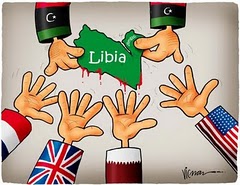
With yet another lie today (the presumed death of colonel Mouammar Kadhafi… buried in the desert), I thought about recapitulating all the lies we’ve been served by western media since the attack of NATO on Libya:
21/02/2011 : The British minister of foreign affairs, William Hague, announced that Mouammar Kadhafi with his wife and daughter, had left the Libyan territory, and were in Venezuela (Lie!!!)
21/02/2011 : Saif Al Islam Kadhafi had been wounded in a fight with rebels (Lie!!!)
23/02/2011 : Aïcha Kadhafi had ran away to Malta (Lie!!!)
20/03/2011 : Khamis Kadhafi died in Brega in a plane crash (Lie!!!)
10/08/2011 or 05/08/2011? : Khamis Kadhafi died in Zliten, after a NATO raid (Lie!!!).
22/08/2011 : Saif Al Islam was captured by rebels, and his brother Mohamed had surrendered. Obama even came out of vacation to confirm in a speech… the next day, guess who was free? Saif!!! Never captured, etc…
27/08/2011 : Mouammar Kadhafi had ran to Algeria (Lie!!!)
29/08/2011 : Khamis Kadhafi had died in Tarhuna after intense combats, and was burried in Zliten… officially listed on the Wikipedia page. (Lie!)
29/09/2011: Mouammar Kadhafi was hiding near Algeria (Lie ?)
Libyan flag
Last week: Moutassim Kadhafi had died (another Lie!!!)
Kadhafi is in Niger (Lie!!!) – Kadhafi is sick and will be transported to Saudi Arabia (Lie!!!) – Kadhafi is in the south of Libya (Lie!!!) – Kadhafi has been cornered in his campground (Lie!!!) – and the biggest of all, the start of it all, Kadhafi has killed 6000 of his own people (or was it 10,000?) (Lie!!!)
The list is so long… How many times has Khamis died again? 8 times! and how many times was Saif captured? at least twice! How many times did Kadhafi run away? Did we ever see OBL’s body after his supposed death in May? No wait… it was disposed off at sea! Now Kadhafi’s body has been disposed of in the desert! I guess one lie couldn’t fly twice. Well… my friends, the message is simple: stop being gullible… open your eyes and learn. Read Mathaba!
This poem by David Mandessi Diop was my favorite. By the time I was 9 years old, I knew it by heart… I loved it so much! It symbolizes so much about Africa, and the love we, all African children, should have for her. Oh how I wish David Diop had lived longer to see the effect of his ‘ode to Africa‘ on other generations. Enjoy!!!
Afrique mon Afrique Afrique des fiers guerriers dans les savanes ancestrales Afrique que me chantait ma grand-mère Au bord de son fleuve lointain Je ne t’ai jamais connue Mais mon regard est plein de ton sang Ton beau sang noir à travers les champs répandu Le sang de ta sueur La sueur de ton travail Le travail de l’esclavage L’esclavage de tes enfants Afrique dis-moi Afrique Est-ce donc toi ce dos qui se courbe Et se couche sous le poids de l’humilité Ce dos tremblant à zébrures rouges
Qui dit oui au fouet sur les routes de midi Alors gravement une voix me répondit Fils impétueux cet arbre robuste et jeune Cet arbre là -bas Splendidement seul au milieu de fleurs blanches et fanées C’est l’Afrique ton Afrique qui repousse Qui repousse patiemment obstinément Et dont les fruits ont peu à peu L’amère saveur de la liberté.
Africa my Africa Africa of proud warriors in ancestral savannahs Africa of whom my grandmother sings On the banks of the distant river I have never known you But your blood flows in my veins Your beautiful black blood that irrigates the fields The blood of your sweat The sweat of your work The work of your slavery The slavery of your children
Africa, tell me Africa Is this your back that is unbent This back that never breaks under the weight of humiliation This back trembling with red scars And saying no to the whip under the midday sun But a grave voice answers me Impetuous child that tree, young and strong That tree over there Splendidly alone amidst white and faded flowers That is your Africa springing up anew Springing up patiently, obstinately Whose fruit bit by bit acquires The bitter taste of liberty.
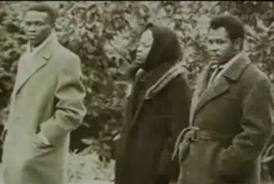
UPC Leaders (L. to R.) front row: Castor Osende Afana, Abel Kingué, Ruben Um Nyobé, Felix Moumié, and Ernest Ouandié
After my article on one of Africa’s greatest freedom fighter, the Cameroonian leader, Ruben Um Nyobé, I thought that this small rare video with pictures of Um Nyobé would be very fit to add to our knowledge. Ruben Um Nyobé with the UPC in 1948 were the first in Africa to ask for the independence of their country, Cameroon. He was murdered by the French colonial administration, and his story was totally buried for many years: it was as if he had had no impact on the lives of Cameroonians, and Africans as a whole. It is just amazing to realize that, 50 years later, he had spoken at the United Nations tribune three times for the independence and reunification of Cameroon in 1952, 1953, and 1954. It is amazing to think that in Cameroon, there was someone of the caliber of N’Krumah, Lumumba, and Nyerere… Yes… Ruben Um Nyobé’s place should be at the Pantheon (if it existed) of African legends. Enjoy!!!
With presidential elections taking place this Sunday October 9th in Cameroon, with its plethora of opposition candidates, and no real organization, I thought that a trip down memory lane to the time of the 1940s-1960s when there was a real opposition in Cameroon will be very appropriate. I would like to talk about one of Cameroon’s greatest opposition fighters and freedom fighters: Ruben Um Nyobé, the real father of Cameroon’s independence.
Ruben Um Nyobé was a Cameroonian freedom fighter, and an anti-imperialist leader. Born in Song Mpeck in 1913, Um Nyobé was a stellar student raised in a modest family of farmers. Initiated to the culture of the Bassa by his father who was well-versed, Um noticed early all the crimes committed by the colonial administration on the indigenous people, crimes such as indentured servitude, forced labor, dehumanization, spanking, beating etc… This made him later write: “la colonisation, c’est l’esclavage ; c’est l’asservissement des peuples par un groupe d’individus dont le rôle consiste à exploiter les richesses et les hommes des peuples asservis“( “Colonization is slavery; it is an enslavement of the populations by a group of individuals whose role is to exploit the riches and the men of the enslaved populations.”)
Flag of the UPC
On April 10th, 1948, the Union des Populations du Cameroon (Cameroon People’s Union or UPC) was founded and was first led by Leornard Bouli, and later Um Nyobé was elected general secretary. The main goal of the party was the independence and reunification of both (British and French) Cameroons. Its symbols were a red flag with a black crab on it: red for the blood of patriots who lost their lives, the crab as a reference to the reunification of Kamerun, and black to symbolize the color of the Black continent, Africa, the cradle of humanity.
The party was at first the Cameroonian branch of the RDA, of which Um Nyobé became one of its vice presidents in 1949. However, the RDA of Houphouet-Boigny choose to cooperate with the French colonial administration, while UPC of Um Nyobé refused to join in this treason and choose to continue the fight for the immediate recognition of the nation of Cameroon (independence), and its reunification. Um Nyobé, the leader of UPC, was particularly charismatic, courageous, and a very good orator. For the Cameroonian intellectual youth of those days, he was without any doubt the leader which embodies Cameroonian patriotism, and for the masses, he was the hero who will bring a new dawn. His aura was such that his name travelled into the country in rural areas. He was affectuously known as “Mpodol” or “celui qui porte la voix ou qui défend la cause“, “the one who carries the demands.” He was particularly active, wrote political articles, held meetings where as much as tens of thousands could be seen, met the masses, and moved across the country.
Ruben Um Nyobé with his family
As the charismatic leader of the UPC, Ruben Um Nyobé (1913-1958), defended three times (1952, 1953, and 1954) the cause of Cameroon at the United Nations tribune in New York. On 22 April 1955, the UPC published the “Proclamation commune” (Common proclamation), which was considered as a unilateral declaration of independence and a provocation by the French authorities. On 19 May, Um Nyobé went underground and on 22 May, the French gendarmes dispersed UPC meetings and the party announced it would no longer recognize French authority. Following violent riots, the UPC and its branches were banned by the French authorities on 13 July 1955. Since the UPC was then the main political party in Cameroon, the French authorities decided to support other, less provocative parties, to try to divide-and-conquer. In December 1956, the UPC which was banned from participating in the general elections, set up an armed branch called the “Comité National d’Organisation” (Organization National Committe or CNO) and started an armed struggle. A pacification campaign was performed by the French army which was actually a genocide perpetrated on the people of Cameroon, and culminated with the assassination of Um Nyobé on 13 September 1958. He was murdered by the French army, near his natal village of Boumnyebel, in the department of Nyong-et-Kéllé in the maquis Bassa. Um Nyobé ‘s death set in motion events that totally decapitated the UPC (even to this date) as the strongest opposition party of Cameroon. In essence, his murder allowed the French to set a neo-colonial state in Cameroon, which today still lives as a puppet state serving Western interests. At the time, however, his fierce fight forced the French colonial power to abuse of its powers, commit a genocide (still not well-documented almost 50 years later) in the Western highlands, and Bassa maquis, and finally forcing them to award independence to Cameroon.
L-R: Ernest Ouandié, Marthe Moumié, and Abel Kingue in Geneva after Felix Moumié's death
The independence of Cameroon, under complete French control, was proclaimed on 01 January 1960 and some leaders of the “legal UPC” rallied President Ahidjo. However, others in the UPC continued with the struggle within the country and abroad. Félix Moumié, Um Nyobé ’s successor, was poisoned with thallium on 3 November 1960 in Geneva by a French secret agent (William Bechtel). Abel Kingue died in Algeria in 1964, while Osende Afana was arrested and decapitated in 1966. A post-colonial struggle by UPC rebels opposing the new Cameroon army (trained and armed by France) continued until August 1970 when the last battalion of the UPC, commanded by Ernest Ouandié, was arrested. Ouandié was sentenced to death and was shot by a death squad in a market on 15 January 1971, in Bafoussam. The civil war, resulting in the destruction of villages and use of napalm is estimated to have resulted in at least 30,000 to 500,000 deaths. It has been conveniently removed from official history, both in Cameroon and in France.
In his book, Richard A. Joseph says: “He [Ruben Um Nyobé ] was undoubtedly one of the most brilliant political thinkers and organizers to emerge after the Second World War in Africa. Had he survived to lead his country to independence, he would most certainly be ranked today on the same level as Julius Nyerere, and the late Kwame Nkrumah and Patrice Lumumba.”
'Remember Ruben' by Mongo Béti
Check out the website Grioo.com where there is a good biography on Ruben Um Nyobe’s life. Don’t forget to check out the website of Dibussi Tande. The great Cameroonian writer Mongo Béti wrote the book Main basse sur le Cameroun, autopsie d’une décolonisation (about the Cameroonian resistance led by the UPC) which was banned in France in the 70s, which led to him to write Remember Ruben in honor of Ruben’s memory. As leader of the UPC, Um Nyobé made several trips to the United Nations headquarters in New York where he spoke in favor of an independent Cameroon. I leave you here with the rare footage, the only footage of Um Nyobé speaking at the UN tribune. This is the only audio and visual record of Um Nyobé found to date. Enjoy hearing Mpodol speak!!! It is a real treasure!!!
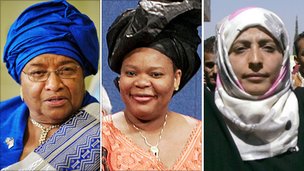
Nobel Peace Prize winners (L to R): Ellen Johnson-Sirleaf, Leymah Gbowee, and Tawakkul Karman (source: BBC)
Wow… such was my surprise and joy when I woke up this morning to find out that Madam President, Mrs. Ellen Johnson-Sirleaf had won the Nobel peace prize this year with another fellow Liberian lady Leymah Gbowee, and a lady from Yemen Tawakkul Karman. I just thought that you would want to re-read the post I wrote almost two years ago on this proud African Iron Lady, and watch the video on her first 52 weeks in power. Enjoy!!! (Just a spin: why is it that for women they had to put all three of them together? couldn’t the Nobel committee have acknowledged Madam president this year, and then the other two next year? or Madam president and the fellow Liberian lady this year, and the other one next year?So sad that when it comes to women, the world, even the Nobel committee is still sexist!)
Autrefois, au plus profond d’une profonde forêt, se trouvait un gros village appelé Ganda. Le chef de ce village s’appelait Kanomba et son épouse Okorou. Ils avaient un fils nommé Aba-soko.
Le chef tenait à avoir une bonne réputation. Quand il avait trois cauris, il en donnait un à sa femme et un à son fils. Il gardait le troisième pour lui. Il voulait se faire passer pour un homme généreux, mais c’était le roi des avares. Aucune richesse, aucun pagne, aucune pièce d’or, aucun grain de riz ne sortait de chez lui pour aider un pauvre ou un orphelin.
Le chef parlait toujours de son courage et donnait des leçons à tous de son courage et donnait des leçons à tous sur la façon de se battre, de se comporter en brave. Mais jamais il n’avait cherché l’occasion de montrer son courage. Quand l’occasion se présentait, il était malheureusement malade. Or ce chef n’était qu’un poltron, et voilà comment on l’a appris.
Régime de banane plantain
Un soir, Kanomba revient de son champ plus tard que d’habitude. Marche courbé en boitant. Son œil gauche est jonglé et à moitié fermé. Il paraît très fatigué. Tous les villageois qui le rencontrent l’interrogent, mais il répond en bredouillant : Je suis tombé d’un arbre, ou je me suis cogné à une branche ou des guêpes m’ont piqué. Il ment certainement! Que s’est-il donc passé? Quand il arrive chez lui, le chef Kanomba se laisse tomber sur un tabouret bas et fait appeler sa voisine: Gbré! Gbré! vient vite, le chef veut te parler !
Voila donc la femme qui abandonne sa marmite et qui se présente devant le chef. Celui –ci lui dit : Gbré, j’ai décidé de te récompenser. Demain tu iras dans ma plantation et tu pourras couper le plus gros régime de banane plantain que tu trouveras, je te le donne. N’oublie pas de prendre ta meilleure machette et de l’aiguiser soigneusement. Continue reading “Le Chef Poltron”→
As a follow up to my previous article on the static shoemaker, today I will be discussing the work of the mobile shoemaker. Have you ever found yourself with a fallen shoe sole, or heel, on your way to work or home, with no idea how to walk home since one of the heels on your shoe has fallen out? or have you ever found yourself with a torn shoe due to some sudden movement? What do you do in such cases? Well, in Africa, and particularly in Cameroon, people call a mobile shoemaker. A mobile shoemaker is a shoemaker who has a toolbox strapped to his shoulder (like a purse), and walks around the neighborhoods with his tools in a rectangular wooden box about 50 cm long, and perhaps 20 cm wide. In his toolbox can be found: needlles of different sizes, a small hammer, some shoe soles, different kinds of strong glue, threads, pieces of leather, a sharp knife, pieces of rubber, a brush, a sponge, small nails with magnet, and shoe polish of different colors (red, brown, black, neutral). His small hammer will not only be used to repair shoes, but also to knock on his toolbox hitting a particular note/rhythm making it resound such as to announce his presence to the entire neighborhood. No need to shout: this way of hitting the box announces his arrival. Any passerby could stop him; sometimes, inhabitants of neighborhoods can be seen rushing outside their homes looking for the one they just heard afar. Once stopped, he will either sew the shoe, or stitch/ glue the sole to the shoe itself. He works quite fast, and moves to the next neighborhood or house block. This is very similar to the work of a shoe shiner, where the work is well-done but in an expedited manner. The mobile shoemaker is particularly special to people’s heart because it’s like having a personal shoemaker who comes to your house to beautify your shoes. It is beautiful to watch them at work. It is really an art! Enjoy this video about the mobile shoemaker dealing with a customer in the streets of Douala, the economic capital of Cameroon.
Douala
En suite à mon article antécédent sur le cordonnier statique, aujourd’hui je vais vous parler du travail du cordonnier ambulant. Avez-vous jamais perdu la semelle de votre chaussure, ou un talon, quand vous rentriez du travail ou alliez au travail ? Vous êtes-vous jamais retrouvés avec une chaussure déchirée à cause d’une course folle ou d’un mouvement brusque ? Que faites-vous dans ces cas ? En Afrique, et en particulier au Cameroun, on appelle un cordonnier ambulant. Un cordonnier ambulant est un cordonnier qui possède une boîte à outil accrochée en bandoulière à son épaule, et se déplace à travers les quartiers de la ville avec tous ses outils contenus dans une boîte rectangulaire en bois d’environ 50 cm de longueur et à peu près 20 cm de largeur. Dans sa boîte à outils, on peut y trouver : des aiguilles de différentes tailles, un petit marteau, quelques semelles, différentes qualités de colle forte, du fil, des morceaux de cuir, un couteau très tranchant, quelques pièces de caoutchouc, une brosse, une éponge, des petits clous armés d’aimant, et du cirage de différentes couleurs (rouge, marron, noir, neutre). Son marteau ne lui sert pas seulement à arranger les chaussures, mais aussi à battre en cadence sa boîte à outil, la faisant résonner de manière à annoncer son arrivée dans tout le voisinage. Nul besoin de crier, cette façon de frapper sa boîte annonce son arrivée. N’importe quel passant peut l’appeler ; il arrive de voir des habitants du quartier ouvrir leur portail et se ruer vers l’extérieur à la recherche du cordonnier qu’ils ont entendu au loin. Une fois arrêté, il coudra la semelle ou la collera à la chaussure ; dans certains cas, il devra raccommoder la chaussure. Il travaille très vite, et ainsi peut aller chercher sa clientèle ailleurs. C’est très similaire au travail du cireur, dont le travail est bien fait, et exécuté rapidement. Le cordonnier ambulant occupe une place très spéciale dans le coeur des gens, car c’est comme si on avait son cordonnier personnel appelé à faire resplendir nos chaussures. C’est vraiment beau de les voir travailler. C’est tout un art ! Amusez-vous à regarder cette vidéo sur un cordonnier ambulant et son client dans les rues de Douala, la capitale économique du Cameroun.