Gerard Sekoto: the Father of Urban Black Painting

Gerard Sekoto (Source: Africansuccess.org)

Today, I will be talking about the late South African painter Gerard Sekoto.  Gerard Sekoto is known today as the father of urban black art and social realism.  Born in 1913, Gerard Sekoto grew up in South Africa at a time of apartheid.  His entire art has been influenced by his life experience.  He held exhibition in Johannesburg and Cape Town.  His painting was actually the first painting by a Black artist to be exposed at the Johannesburg Art Gallery.  He was a big fan of oil painting.

Gerard Sekoto's depiction of Steve Biko's death
Gerard Sekoto’s depiction of Steve Biko’s death

In 1947, he exiled himself to Paris.  His first two years were quite depressing and hard; they actually had nothing to do with painting.  He played in French nightclubs as a pianist, and composed over 25 songs whose main themes were the loneliness of exile, and the courage of an immigrant trying to survive in a foreign country.  Quite a global theme these days, in this global world!

In 1966, he visited Senegal, and was actually a guest of President Léopold Sédar Senghor.  He visited Dakar for a year, and this visit reignited his passion for painting.  Armed with his brushes, he fully immersed himself into the ‘Dakarois’ environment, and once again started painting African scenes.

Prisoners laboring hard in South Africa - by Gerard Sekoto
Prisoners laboring hard in South Africa – by Gerard Sekoto

In the 1970s, he started expressing his opposition to the apartheid system back in his homeland, and started painting about it.  One of his famous paintings is poignant depiction of Steve Biko‘s death, with Biko’s tearful mother at the center of the painting, Biko to the right of her, and a white policeman to the left.  It is very sorrowful and vivid depiction… and to think of Biko’s mother! Most often, people paint the victim, and forget those they’ve left behind.

Sekoto never had a chance to return to South Africa, not even for his mother’s funeral. He ended his days in a retirement home for artists on the outskirts of Paris in 1993.

Please check out the website of the Gerard Sekoto Foundation, the Gerard Sekoto Webpages, and this photo-journal by the BBC.  Don’t forget to read about how Sekoto used to capture his subjects on AfricanColours.com.

The Jackal and the Wolf

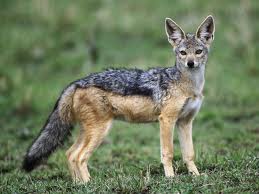
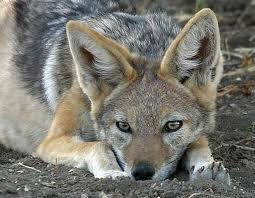
Jackal
Jackal

ONCE upon a time Jackal, who lived on the borders of the colony, saw a wagon returning from the seaside laden with fish; he tried to get into the wagon from behind, but he could not; he then ran on before and lay in the road as if dead.  The wagon came up to him, and the leader cried to the driver, “Here is a fine kaross for your wife!
Throw it into the wagon,” said the driver, and Jackal was thrown in.

The wagon traveled on, through a moonlight night, and all the while Jackal was throwing out the flsh into the road; he then jumped out himself and secured a great prize.  But stupid old Wolf (hyena), coming by, ate more than his share, for which Jackal owed him a grudge, and he said to him, ” You can get plenty of fish, too, if you lie in the way of a wagon as I did, and keep quite still whatever happens.

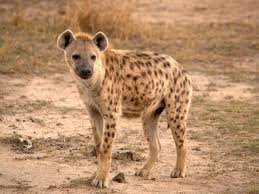
Hyena
Hyena (Wolf)

So!” mumbled Wolf.
Accordingly, when the next wagon came from the sea, Wolf stretched himself out in the road.

What ugly thing is this?” cried the leader, and kicked Wolf.  He then took a stick and thrashed him within an inch of his life.  Wolf, according to the directions of Jackal, lay quiet as long as he could; he then got up and bobbled off to tell his misfortune to Jackal, who pretended to comfort him.
What a pity,” said Wolf, “I have not got such a handsome skin as you have!

South African Folk Tales, by James A. Honey, 1910, Baker & Taylor Company.

The Danger of a Single Story

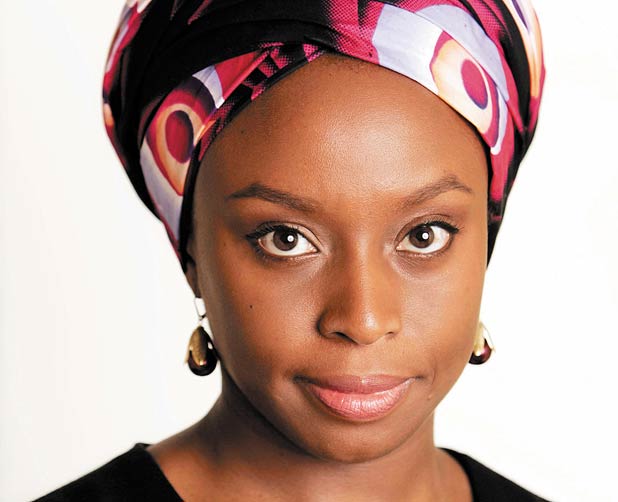
Chimamanda Adichie (Source: interviewmagazine.com)

Today, we will examine ‘The Danger of a Single Story,’ a speech given by the Nigerian author Chimamanda Ngozi Adichie at a TED (Technology, Entertainment, Design) conference.  Like Adichie, I have always felt annoyed by people referring to Africa as a country.  I have also been annoyed by people’s ‘single story’ of Africans.  Just like the author I was guilty of some stereotypes myself.  Growing up in Africa, we often watched documentaries about life in America, and how there was a gun shot death every 13 seconds in the streets of America.  I used to think, “how on earth could people live in a country where there were so many gunshot deaths, drugs, and gangs?” Until I realized that, that was a single story of America, and there were other stories like those of scientific achievements, of Ivy league schools, etc.  So why can’t they, Americans, and others, learn to have other stories of Africa?

This blog is about offering other stories of Africa other than ‘the single story.’  What kind of ‘single stories’ of Africa have you heard?  What stories of Africa would you like to hear?

Why the name: Nairobi?

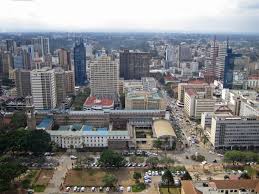
Nairobi in 2010
Nairobi in 2010

Have you ever fallen in love with a name? with a place? well… that is the feeling… when you hear the name Nairobi (the capital of Kenya) for the first time, it is like some beautiful girl you were always attracted to but could never get.  Well, the name Nairobi is quite far from that: it comes from the Maasai Enkare Nyrobi which means the place of cool waters, which is also the name for the Nairobi River which lent its name to the city.  Today, it is popularly known as the Green city in the sun… probably because of its lush-ness.

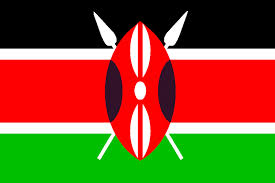
Flag of Kenya
Flag of Kenya

Nairobi hosts a natural reserve protected, the Nairobi National Park, within its borders.  It is also the capital hosting the most species of birds in the world.  Nairobi was originally built at the beginning of the 1900s as a railway link between Mombasa (on the coast of Kenya) and Kampala (Uganda) by the rail company Kenya Uganda Railway.  It was completely rebuilt in the early 1900s after an outbreak of plague and the burning of the original town.  Its location was chosen because of its central position between Mombasa and Kampala; it was also chosen because its network of rivers which could supply the British camp with water and its elevation which would make it cool for the British residential purposes.

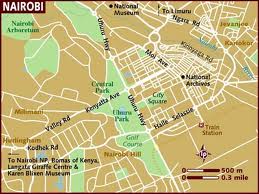
Map of Nairobi
Map of Nairobi
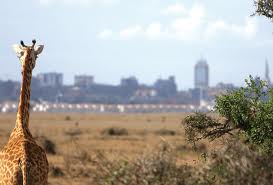
Nairobi from Nairobi National Park
A girafe looking onto Nairobi, from Nairobi National Park

In 1905, Nairobi replaced Mombasa as capital of the British protectorate, and from then on grew tremendously around tourism, administration, and big game hunting.  Britons came to live in Nairobi for for game hunting.  In those times, the city quickly became the commercial centre for the colony’s coffee, tea, and sisal industry. Today, Nairobi is one of the most populous cities in Africa known for its beauty, for its versatility, and also for its slum Kibera.  The city of Nairobi is located on the eastern edge of the Rift valley, with the Ngong Hills located to the west of the city, and Africa’s two tallest mountains, Mount Kenya and Mount Kilimanjaro are located to the north and towards the southeast, respectively.  It was also the birthplace of Kenya’s first president, Jomo Kenyatta.

Enjoy the great Congolese singer M’Bilia Bel (she is also a beauty) singing about the beautiful Nairobi, Nakei Nairobi, a song written and composed by Tabu Ley Rochereau.

Have you ever been to Nairobi? What were your impressions?

The African Origin of Extradition

Ramesses II
Pharaoh Ramesses II

I just learned today that the first ever written extradition agreement – and peace treaty- was written in Egypt centuries ago by Pharaoh Ramesses II (The Great) between the Egyptians and the neighboring Hittites in 1259 BC.  It is the world’s oldest and first extradition treaty.  Mostly known as the Treaty of Kadesh, after the battle of Kadesh fought 16 years earlier, the agreement bound both sides to repatriate criminals and political refugees from the other side.  It was concluded between Egyptian Pharaoh Ramesses II, and Hittite King Hattusili III.  The purpose of the treaty was to establish and maintain peaceful relations between the parties.

The Treaty of Kadesh (the Hittite version) engraved on baked plates and currently housed in Istanbul

In Egypt it was inscribed on the walls of temples in hieroglyphics, while in the Hittite capital of Hattusa (in present day Turkey) it was preserved on baked clay tablets.  Archaeological excavations at the Hittite royal palace uncovered it among the palace’s sizable archives.  The Egyptian version of the peace treaty was engraved on the walls of Pharaoh Ramesses II’s mortuary temple in Thebes.  Translation of the text revealed that this engraving was originally translated from the silver tablet given to Ramesses II, but had since been lost to contemporary historians. The scribes who engraved the Egyptian version of the treaty included descriptions of the figures and seals that were on the tablet that the Hittites delivered.  A complete version of the Hittite text is currently housed within Istanbul‘s Ancient Orient section of its Archaeological Museums.

Think about it, our ancestors the Egyptians were quite ahead of time… they even thought of extradition.  As the likes of Julian Assange or Edward Snowden run around the world in search of a place with no extradition, it is good to know that ancient Egyptians were men of honor, and light who had thought about such a law centuries ago.


Petits Métiers: Vendeur de Soya / Small Trades: Soya Seller

Soya (viande rotie a la Camerounaise)

Avez-vous deja goûté au soya? de la viande rôtie à la camerounaise?  Le soya est vraiment différent du kebab turque ou maroccain, et est définitivement différent du barbecue sucré américain.  Le soya est spécial.  Il est pimenté, d’un piment épicé, aux épices du Cameroun.  Au Cameroun, la cuisson du soya est génèralement tenu par les maguidas ou vendeurs de soya, qui sont des habitants de la partie septentrionale du pays, et qui ont toujours été de grands éleveurs de boeufs depuis des siècles.  La viande de boeuf est donc découpée en quartiers et tranches et arrosés d’un bon piment qui fait du soya ‘un mets digne de la table des dieux’ comme le dit si bien l’écrivain camerounais Sévérin Cécile Abega.  Abega dit si bien dans sa nouvelle Au ministère du soya dans son livre Les Bimanes: [le soya est] “cet Everest de l’art culinaire qu’est la viande en tranches ou en brochettes grillées au feu…“… “Nul autre qu’un maguida ne peut, avec la même virtuosité, avec le même bonheur, réussir cette alchimie.  Souriant, chantant, plaisantant, semblant ignorer eux-mêmes l’immense portée … les créateurs de la huitième et la plus quotidienne, la plus appétissante aussi des merveilles du monde, chaque soir, transforment la plus banale des viandes, celle du boeuf, en soya.”

Allez-y savourer le soya… ce met digne de la table des dieux made in Cameroun.

========================

Soya sellers at the entrance of Douala (in Bonaberi)

Have you ever tasted soya?  roasted meat à la Camerounaise?  I don’t mean meat broiled or barbecued meat with some sweet American sauce, or the Moroccan or Turkish kebab.  The soya is special.  It is spiced with chilis, and spices from Cameroon.  In Cameroon, the cooking of soya is generally led by the maguidas or soya seller, who are inhabitants of the northern part of the country, and who have always been great cattle rearers for centuries.  The beef meat is cut in quarters and slices, and basted with some good chili which make soya ‘a dish worthy to be served at the table of the gods’ like the Cameroonian author Sévérin Cécile Abega said.  Abega tells it so well in his novella At the ministry of soya: [the soya is] “this Everest of the culinary art which is meat in slices or in grilled skewers on the fire…” … “None other than a maguida can, with the same virtuosity, with the same happiness, succeed in this alchemy.  Smiling, singing, joking, seeming to ignore themselves its immense scope… the creators of the eighth and daily, most delicious of the world’s wonders, every evening, transform the most common of meats, that of beef, into soya.”

Enjoy the soya … this dish worthy of the table of the gods, made in Cameroon.

‘Asimbonanga’ by Johnny Clegg

Johnny Clegg & Savuka

Since we are on the subject of Soweto 1976, and since last week Madiba (Nelson Mandela) gave us a scare, I decided to publish the song ‘Asimbonanga’ by Johnny Clegg.  ‘Asimbonanga‘ or ‘We have not seen him’ was released by Johnny Clegg and Savuka, in the album Third World Child in 1987, and called for the release of Nelson Mandela, and also gave homage to three martyrs of the anti-apartheid struggle: Steve Biko, Victoria Mxenge, and Neil Aggett.  I have posted the song with lyrics below (translation of the Zulu words to English is in italics).  Enjoy, and don’t forget to visit Johnny Clegg’s website: johnnyclegg.com.

'Asimbonanga' by Johnny Clegg & Savuka
‘Asimbonanga’ by Johnny Clegg & Savuka

Soweto 1976 and Marikana 2012: any similarities?

Marikana, 16 August 2012

With the cleansing ceremony for the Marikana massacre taking place today, I couldn’t help but think about similarities, if any, between the Soweto uprisings of 1976, and the Marikana miners’ strike of 2012.

First of all, the Soweto uprising on June 16, 1976, was a movement of school children protesting against the use of Afrikaans as a medium in school and the fact that this was essentially limiting their career opportunities leading them to mostly menial jobs later in life; besides Afrikaans was the language of the oppressor, and in itself a symbol of oppression.  The school children were reprimanded in blood by police from the apartheid government of John Vorster.  It was a brutal repression.  The pictures, particularly, that of Hector Pieterson‘s dead body being carried away by another student alongside his sister, were just heart-wrenching.

Soweto uprising 16 June 1976

Over 30 years later, Marikana happened, albeit not on the same giant scale.  Miners protesting for wages were repressed in blood by the police on 16 August 2012; this time under the free government of the rainbow nation led by Jacob Zuma.  The violence used by the police was just as shocking, and has been compared by the media to the Sharpeville massacre.

Hector Pieterson being carried away by Mbuyisa Makhubo, with his sister running alongside (Photo by: Sam Nzima)

The similarities are important: both events showed police brutality against unarmed school children (Soweto 1976), and unarmed miners (Marikana 2012); Note: there are some claims that one miner shot first at the police before the police opened fire at Marikana, and images show that some of the miners had machetes.  Both events showed poor judgment (more like lack of judgment) from government, and police repressive use of force.  Both events harbored bloodshed.  What Marikana 2012 showed us is that police brutality is the same decades later.  I always wondered why didn’t the police use fake bullets in both cases If the police was trying to restore order in both cases, why not use common sense and use rubber bullets instead?  They have the upper hand and the bullet proof vests (and the dogs), they should act like the adults in the play. 

Miners demonstrating at Marikana

The main difference, is that unlike Marikana, where the police was dealing with adults, the police in Soweto dealt with school children. Where is this world going when we now attack, hurt, and kill children? Has the human race descended so low?  And the apartheid government had a clear agenda against color and race, while the current government’s agenda seems to be driven by capitalism.  The children of Soweto were demonstrating for a better education, while the miners of Marikana were workers demonstrating for increased wages…

In the end, Soweto 1976 cannot be compared to Marikana 2012, where the government did not even conduct an investigation, and did not present apologies (or did they?) as they did not consider the lives of these Black children relevant in the apartheid society.  And even today, one can see the difference between both events in the length at which Marikana was covered in the South African press, and the small number of archives (accessible?) on Soweto 1976.  Besides, Soweto 1976 marked a turning point in the end of the apartheid regime.  One thing is for sure, both events should never happen in the history of a nation.

This is my two-cents on this… What do you think were the similarities between Marikana 2012 and Soweto 1976? Were there similarities in your opinion? As people protest around the world, how do you stop police brutality?  How do we ensure that lives are preserved, while populations’ protests are taken into account?

Remembrance: 16 June 1976 Soweto Massacre

Soweto3
Soweto uprising: children walking peacefully (Source: Ezakwantu.com)

The Soweto massacre or Soweto uprisings also known as June 16, were some of the biggest massacre of the apartheid regime in South Africa, mostly because it showed police repression against kids.  On June 16, 1976, Black high school children in Soweto protested against the Afrikaans medium decree of 1974 which forced the schools to use Afrikaans as one of the main languages in schools (50-50 with English): Afrikaans was to be used to teach mathematics, arithmetic, etc…  In the 1950s, 60s, and 70s, many people preferred English as the school language, the commerce language, etc, because of the violence attached with Afrikaans which was the language of the oppressor.

Soweto Uprising (Source:kilimedia.com)
Soweto Uprising: children running away (Source: kilimedia.com)

On June 16, 1976, over 20,000 school children took part in protests which left over 700 dead (the official numbers say 176, but we all know that this number could not be further from the truth).  On that bright morning, 10,000 – 20,000 black students walked from their schools to Orlando stadium for a peaceful rally against the use of Afrikaans, the oppressor’s language, in school.  The protest had been carefully planned by the Soweto Students’ Representative Council’s (SSRC) Action Committee, with support from the Black Consciousness Movement, and teachers from Soweto.  The students were marching and they found out that police had barricaded the road along the intended route.  The leader of the SSRC action committee then asked the crowd not to provoke the police, and the march went on on a different route, eventually ending up near Orlando High School.  The students were marching, singing, and waving placards with slogans such as, “Down with Afrikaans“, “Viva Azania“, and “If we must do Afrikaans, Vorster must do Zulu.”

Hector Pieterson being carried away by Mbuyisa Makhubo, with his sister running alongside (Photo by: Sam Nzima)

One officer shot and fired his gun causing panic and chaos.  Students started screaming and running, as more gunshots were being fired, and the police let out their dogs on children who responded by stoning the dogs.  The police then began to shoot directly at the children.  One of the first students to be shot dead was 13-year-old Hector Pieterson, who became the symbol of the Soweto uprisings.  The picture of his dead body being carried away by another student while his sister ran beside them in tears, was captured by news photographer Sam Nzima, and made it worldwide.  The police patrolled the streets throughout the night as the students came under intense attack.  Emergency clinics were swamped with injured and bloody children.  The police requested the hospitals to provide a list of all victims with bullet wounds, but the doctors refused to create the list, and recorded bullet wounds as abscesses.  On the 17th of June, 1,500 heavily armed police officers were deployed to Soweto carrying automatic rifles, stun guns, and carbines.  They were driving in armored vehicles with helicopters, while the South African army was ordered on standby… for repression onto school children.

In the end, the Soweto uprising established the leading role of African National Congress (ANC) against the apartheid regime; it marked the turning point in the opposition to white rule in South Africa.  Formerly, the struggle had been fought outside South Africa, in neighboring countries (Rhodesia – Zimbabwe, South-West Africa – Namibia, and Angola), but from that moment forward, the struggle became internal as well as external.

June 16th is now celebrated in South Africa as a public holiday.  Enjoy this quick collage about the events of June 16th, and please remember to commemorate the lives of innocent children killed on this day in South Africa, children whose future were ended too early.  Don’t forget to check out these articles on BBCLibcom.orgSouth Africa Info, and watch the video on Independent Lens on PBS.

The Lion, the Jackal, and the Man

Jackal
Jackal

It so happened one day that Lion and Jackal came together to converse on affairs of land and state.  Jackal, let me say, was the most important adviser to the king of the forest, and after they had spoken about these matters for quite a while, the conversation took a more personal turn.

Lion began to boast and talk big about his strength.  Jackal had, perhaps, given him cause for it, because by nature he was a flatterer.  But now that Lion began to assume so many airs, said he, “See here, Lion, I will show you an animal that is still more powerful than you are.”

They walked along, Jackal leading the way, and met first a little boy.

Is this the strong man?” asked Lion.

No,” answered Jackal, “he must still become a man, O king.”

After a while they found an old man walking with bowed head and supporting his bent figure with a stick.

Is this the wonderful strong man?” asked Lion.

Not yet, O king,” was Jackal’s answer, “he has been a man.”

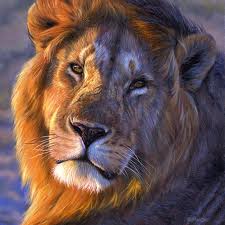
Lion
Lion

Continuing their walk a short distance farther, they came across a young hunter, in the prime of youth, and accompanied by some of his dogs.

There you have him now, O king,” said Jackal.  “Pit your strength against his, and if you win, then truly you are the strength of the earth.”

Then Jackal made tracks to one side toward a little rocky kopje from which he would be able to see the meeting.  Growling, growling, Lion strode forward to meet the man, but when he came close the dogs beset him.  He, however, paid but little attention to the dogs, pushed and separated them on all sides with a few sweeps of his front paws.  They bowled aloud, beating a hasty retreat toward the man.  Thereupon the man fired a charge of shot, biting him behind the shoulder, but even to this Lion paid but little attention.  Thereupon the hunter pulled out his steel knife, and gave him a few good jabs.  Lion retreated, followed by the flying bullets of the hunter.

Well, are you strongest now?” was Jackal’s first question when Lion arrived at his side.

No, Jackal,” answered Lion, “let that fellow there keep the name and welcome.  Such as he I have never before seen.  In the first place he had about ten of his bodyguard storm me.  I really did not bother myself much about them, but when I attempted to turn him to chaff, he spat and blew fire at me, mostly into my face, that burned just a little but not very badly.  And when I again endeavored to pull him to the ground he jerked out from his body one of his ribs with which he gave me some very ugly wounds, so bad that I had to make chips fly, and as a parting he sent some warm bullets after me.  No, Jackal, give him the name.”

South African Folk Tales, by James A. Honey, 1910, Baker & Taylor Company.