
I just wanted to follow up on the article on Kente cloth, with this great video on weaving Kente cloth. the video details the origin and the art behind Kente cloth. Enjoy!

Kente Cloth: An Ashanti Tradition dating Centuries back

Have you ever seen those beautiful bright multicolored scarves worn on graduation day by thousands of African Americans and African students across the United States? Those scarves are usually hand-woven, bright, and multicolored, worn to represent the membership to a Black sorority, fraternity, or to just an African student organization at the different colleges and universities.
Well, those scarves are made from a material commonly known as Kente cloth, which originates from the Ashanti people of Ghana and Cote d’Ivoire. The Ashanti people used to (and still do) hand weave these bright multicolored clothes for their kings and noblemen. The tradition of kente cloth is said to have been developed in the 17th century, and stems from ancient Akan weaving techniques dating as far back as the 11th century AD (this is one of Africa’s textile tradition). Kente cloth is known as nwentoma (meaning woven cloth) in Akan language, and is a type of silk, cotton, or rayon fabric made of interwoven cloth strips which is native to the Akan/Ashanti ethnic group of Southern Ghana (and also Cote d’Ivoire). It is woven on a wooden loom, which produces a band about 10 cm wide; several bands will then be sewn together to make a larger cloth. The elaborate patterns arise from the mixture of different weaving techniques applied to the same band of cloth. The quality of the fabric, and weaving indicates the rank of the person, the best being reserved for the kings. It is worn by men as a toga, and by women as upper and lower wrappers. The art of weaving kente is passed down only to males, from generation to generation. The main center of weaving kente is around the Kumasi region of Ghana.
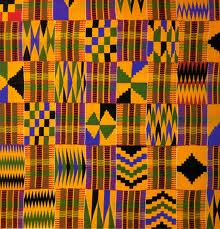
An Ashanti legend has it that two friends who had gone hunting in the forest came across a giant spider (the famous Ananzé) who was weaving her web. They were so amazed that they stayed welded in place for two days, contemplating the spider at work. When they returned from hunting, they imitated the animal and wove a cloth out of raffia. This is how was born the first kente which was offered to the king. The Asantehene (king) was so amazed by the beauty of the present, that he elevated the weavers to the rank of royalty, and they became the king’s exclusive tailors. The clothes woven for the king were each unique, and whoever tried to reproduce them was severely punished.
Kente is an Akan royal and sacred cloth worn only in times of extreme importance and is the cloth of kings and nobility, before finding its way into bags, and scarves sold around the globe nowadays. In Akan culture, the different colors and intricate patterns used in the weaving do have traditional meanings.
White: is the color of purity, innocence, spirituality, and peace (mental, collective, and interior). Very small amount are found on the kente (sometimes just the threads are white). White has a divine and sacred character;

Kumase, Ghana (Photograph by Eliot Elisofon,1970,
National Museum of African Art).
Yellow: is the color of gold, and symbolizes preciousness, royalty, wealth (financial, spiritual, intellectual, etc), and fertility. It is associated with the earth’s generosity. This color is strongly represented in the kente, because the king, who wears it during public gatherings, embodies all these virtues: gold, royalty, wealth, high status, glory, spiritual purity. Yellow, just like the sun’s rays, also reminds of divine goodness.
Black: is the color of bereavement, and darkness, but also of mystery and secrecy. It is mostly used in initiation and purification ceremonies. It is an ambivalent color representing both obscurantism, and spiritual elevation; it is thus both feared and revered. Its discrete presence in kente reminds that noblemen are first and foremost the guardians of the throne. Black also represents maturation and intensified spiritual energy;
Blue: reminds of the big spaces: the sea and the sky. It symbolizes elevation, communion, humility, patience, and wisdom. The king and noblemen have perfect control over their environment. Blue is the color of peace, harmony, and love. It is sometimes associated with yellow or white, or red, to represent wealth and power which are founded on spirituality, and which bring tranquility, and balance, and constitutes a strong guarantee of stability for all powers;
Green: is the symbol of life, growth and harmony. Green reminds of the forest, the trees, birth, and youth. It is also linked to vegetation, planting, harvesting, growth, and spiritual renewal. Joined with blue and yellow on a kente, it completes the meaning of the clothing which expresses wealth and nobility founded on humility, humanism, and balance.
Other less common colors are:

Grey: healing and cleansing rituals, and is associated with ashes;
Brown: is the color of mother earth, and is associated with healing;
Pink: mostly worn by women, is associated with the female essence of life: sweetness, tenderness, calmness, pleasantness;
Purple: is associated with feminine aspects of life, and is mostly worn by women;
Red: political and spiritual moods, bloodshed, sacrificial rites, and death;
Silver: serenity, purity, joy, and is associated with the moon;
Continue reading “Kente Cloth: An Ashanti Tradition dating Centuries back”
Share this:

Freedom at last? 12 high political figures freed in Côte d’Ivoire
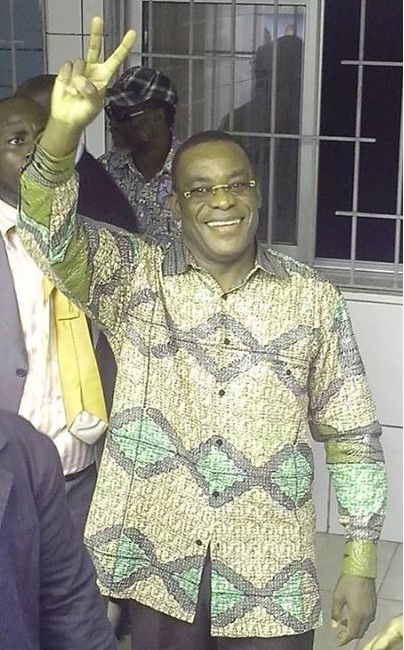
Freedom at last for 12 high political figures in Côte d’Ivoire. These were members of the FPI, Laurent Gbagbo‘s who had been detained without any hearing for the past 2 years. This is a sign that truth and justice always wins. I have translated here a speech by Pascal Affi N’Guessan, one of the detainees and once prime minister of Côte d’Ivoire. This was published on the website of Le Nouveau Courrier. For the audio and integral text, go to Le Nouveau Courrier. Thank goodness for this… and let us keep fighting for freedom and true democracy (not the one manufactured by the IMF, in Europe or the US, but what will work for us).
=========
I would like to, before giving any speech, first greet you and thank you wholeheartedly. If we can stand here today in front of you, don’t be fooled. There are no three explanations. There are no two explanations. There is only one explanation. It’s your engagement, it is your determination, your strength, it is your rejection of an unfair situation that was made in Côte d’Ivoire which explains why we can stand before you today. This explains why yesterday other comrades were released. This explains why yesterday Bê Diabaté and other comrades […] have been released. And it is this mobilization which will explain tomorrow’s normalization in Côte d’Ivoire, the release of all our comrades who are still detained, the return from exile of all our comrades who were forced to flee their own country, and the return to us of President Laurent Gbagbo.
… The original project [Ouattara regime] is not to let the FPI exists as a political party. The ambition nurtured by those who came to power under the conditions that we know is not to reinstate democracy. It is not to let a party as powerful as the Ivorian Popular Front party exist. (…)
Dear Comrades, you defeated the odds. You have proven that the Ivorian Popular Front (FPI) was intractable. You have proven that the Ivorian Popular Front was a spirit. You have proven that the people of Côte d’Ivoire did not want to backtrack. And its course is determined to be democracy, to be progress, to be freedom. And it is because our opponents have realized this fact, because we have imposed this reality, that we stand here today in front of you.
Today is a day of rejoicing. A day to celebrate this milestone in our struggle. That is why it may be too risky to go further. But know that we do not have three programs, we do not have two programs, we have one program. And this program is the program of the people of Côte d’Ivoire. And this program are the aspirations of the people of Côte d’Ivoire. And this program is to resolve all the problems that prevent this country from becoming a modern and prosperous country. This is our program!
We’re here to straighten out. As the old of Ménékré says it, “twisted politics”, we are here to rectify. Continue reading “Freedom at last? 12 high political figures freed in Côte d’Ivoire”
Share this:

Why the name: Lusaka?

Today, I will be talking about Lusaka, the capital of Zambia and its largest city. The actual location of the city of Lusaka corresponds to that of a village which was named after its chief Lusaaka, and which was located at Manda Hill, near the current site of the Zambian National Assembly building. In the Nyanja language, Manda means graveyard.
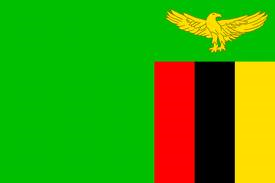
The area was expanded by British settlers in 1905 with the building a the railway. Due to its central location and its position on the railway at the crossroads between the Great North Road and Great East Road, Lusaka is chosen to replace Livingstone as the capital of the British colony of Northern Rhodesia (Southern Rhodesia being today’s Zimbabwe) in 1935. With the fusion of the Northern Rhodesia (Zambia) with Southern Rhodesia (Zimbabwe) and Nyasaland (Malawi) in 1953, Lusaka became the center of independentist movements amongst the educated elite, which eventually led to the creation of the Republic of Zambia. In 1964, Lusaka became the capital of the newly independent country Zambia, with the country’s first president being Kenneth Kaunda.
Lusaka is not only the capital of the country, but also the capital of the province of Lusaka, which is the smallest and the second most populated of the nine provinces of Zambia.

Today, Lusaka is one of the fastest-developing cities in Southern Africa. It is the centre of both commerce and government in Zambia and connects to the country’s four main highways heading north, south, east and west, including the famous Cairo Road which is a section of the Great North Road and was so named because it is a link in Cecil Rhodes‘ then dream of a Cape to Cairo Road through British colonies in Africa. The city is also located at an altitude of 1300 m above sea level. English is the official language of the city, but Nyanja, and Bemba are commonly used as well.
In recent years, Lusaka has become a popular urban settlement for Zambians and tourists alike. Check out the map of city of Lusaka, or the newspaper Lusaka Times to get more news about this great city whose name hails from that of a local king. Enjoy the video below about the city of Lusaka.
Share this:

When Lion could Fly

LION, it is said, used once to fly, and at that time nothing could live before him. As he was unwilling that the bones of what he caught should be broken into pieces, he made a pair of White Crows watch the bones, leaving them behind at the kraal whilst he went a-hunting.
But one day Great Frog came there, broke the bones in pieces, and said, “Why can men and animals live no longer?” And he added these words, “When he comes, tell him that I live at yonder pool; if he wishes to see me, he must come there.”
Lion, lying in wait (for game), wanted to fly up, but found he could not fly. Then he got angry, thinking that at the kraal something was wrong, and returned home. When he arrived, he asked, “What have you done that I cannot fly?” Then they answered and said, “Someone came here, broke the bones into pieces, and said, ‘If he want me, he may look for me at yonder pool!”‘ Lion went, and arrived while Frog was sitting at the water’s edge, and he tried to creep stealthily upon him. When he was about to get hold of him, Frog said, “Ho!” and, diving, went to the other side of the pool, and sat there. Lion pursued him; but as he could not catch him he returned home.
From that day, it is said, Lion walked on his feet, and also began to creep upon (big game); and the White Crows became entirely dumb since the day that they said, “Nothing can be said of that matter.”
South African Folk Tales, by James A. Honey, 1910, Baker & Taylor Company.
Share this:

Cameroun: Autopsie d’une Pseudo-Independance
Pour continuer sur la même lancée, je voudrais vous faire part de cette vidéo: “Cameroun: Autopsie d’une pseudo-indépendence” par Gaëlle Le Roy et Valérie Osouf. Cette vidéo porte sur les années noires du Cameroun, les années de repression, les années du maquis, les années du génocide en pays Bamiléké, et les techniques utilisées par Roland Pré, alors Haut-commissaire muté au Cameroun en 1954. Pour en savoir un peu plus, visiter le site: Kamerun-leSite qui fait état de cette guerre cachée qui sévira au Cameroun pendant plus de 20 ans et qui fera plus de 300,000 morts.
Share this:
The Principal Reasons why Osende Afana was defeated
Castor Osendé Afana‘s maquis suffered a major defeat, and a final blow with the murder and decapitation of its leader on 15 March 1966. Here are some of the principal reasons of the defeat of the Boumba-Ngoko maquis in the south east corner of Cameroon. These reasons had been identified by Osendé Afana himself before his death, and by his some of his followers later on.
1 – The Boumba-Ngoko region (or Moloundou region) had not been exposed to any revolutionary movement, or any influx of political ideas about the liberation of Cameroon since the end of the second world war, like the populations of the West, Littoral, Center or Southern provinces. The populations there being mostly Bakas pygmies and poor Bantous peasants and illiterate had almost never led major economic or political struggles against the exploitation and domination of the colonial and neocolonial forces. Their political awareness was quite low, and they had very little experience fighting.
2 – The region was sparsely populated, which forced the guerilleros, who were supposed to move around the people as fish in the sea, to fight practically in the open against a very powerful enemy.
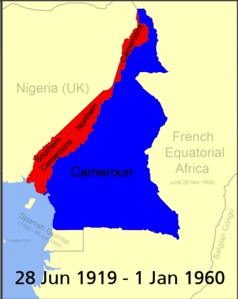
3 – The low number in Afana’s group which kept decreasing due to several desertions. It was also very difficult to recruit among the local people.
4 – No members of the initial group were originally from that region, and thus had little knowledge of the field, the language, and customs of the local populations.
5 – The maquis’ entrance from Congo-Brazzaville had happened without much discretion, and all their subsequent movements in the region did not go unnoticed. This made it easy for the colonial forces to trace them.
6 – No prior ground study had been done.
7 – The government of Congo, while giving their support to Afana, were opposed to any military action on their borders.
8 – Several tactical differences persisted within the group, with Osendé Afana, being more political and anxious of respecting the Congolese wishes, and with Fosso Francois, who was more military-centered.
9 – No prior contact/communication had been established with the Western maquis led by Ernest Ouandié. This could have ensure some help.
10 – An incorrect assessment of the colonial forces, their tactics, their capacity of enrolment, and the political activity of the masses on the national scale.
11 – Lastly, too big a reliance on external help.
For more information, visit afrohistorama.com to learn more about these critical events in the history of Cameroon.
Share this:

Castor Osendé Afana: A Cameroonian National Hero
Brilliant economist, Castor Osendé Afana is considered a national hero in Cameroon, however he is not as well-known as Ruben Um Nyobé, or Felix-Roland Moumié, or even his alter ego on the western front of Cameroon, Ernest Ouandié. Like those three, he was also assassinated, and paid with his life for his passion for the freedom of Cameroon, and Africa from colonialism. So who was Castor Osendé Afana?
Well, Castor Osendé Afana was born in 1930 in Ngoksa near Sa’a, in the Centre Region of Cameroon. In 1948 he was admitted to the seminary at Mvolyé, in Yaoundé, where he became a strong friend of Albert Ndongmo, the future Bishop of Nkongsamba. He was excluded from the seminary in 1950 because of his critical and rebellious character. It is as a ‘candidat libre’ that he successfully passed the first part of the Baccalauréat. He then started in philosophy at the Lycée Leclerc where he headed student manifestations demonstrating against the poor food service there. He nonetheless went on to successfully pass the 2nd part of the baccalauréat in 1952.
Later, Osendé Afana obtained a full scholarship to study Economics in Toulouse, France. By 1956, he was a vice-president of the Black African Students Federation in France (Fédération des étudiants d’Afrique noire en France – FEANF), and was managing director of the FEANF organ L’Etudiant d’Afrique noire. As a UPC militant he ensured that the issues of Cameroon were well-covered in the magazine. In 1958, Osendé Afana was named General Treasurer of FEANF, as well as being responsible for the UPC in France.

After the French government dissolved the UPC by decree on 13 July 1955, most of the UPC leaders moved to Kumba in the British-administered Southern Cameroons to avoid being jailed by the colonial power. In July 1957, under pressure from the French, the British authorities in western Cameroon deported the leaders of the UPC to Khartoum, Sudan. They moved in turn to Cairo, Egypt, to Conakry, Guinea and finally to Accra, Ghana, where they were hosted by President Nkrumah. In 1958, after Ruben Um Nyobé’s death, Osendé Afana decided to abandon his thesis and rejoin the leadership of the UPC, proposing himself as a candidate for the new Secretary General. Nyobé’s successor, Félix-Roland Moumié, told him “There is no longer a Secretary General. There was one, he is dead, that is it.” However, Osendé Afana was designated UPC representative at the Afro-Asian People’s Solidarity Conference in Cairo in December 1957 – January 1958. After Cameroon’s independence in 1960, the UPC continued to fight the government of President Ahmadou Ahidjo whom they considered a puppet of the French colonial power. Continue reading “Castor Osendé Afana: A Cameroonian National Hero”
Share this:

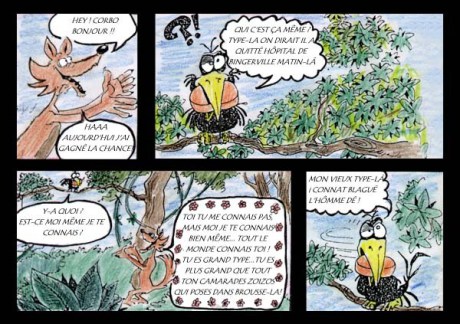
‘Le Corbeau et le Renard’ version ivoirienne
J’ai trouve cette belle illustration de la fable de Jean de La Fontaine ‘Le Corbeau et le Renard.’ C’est une fable que nous avions l’habitude de reciter au cours moyen 1 (CM1), quand nous etions petits. Vous reconnaitrez l’accent ivoirien dans les dessins (texte et dessins de LaCombe)… Alors regalez-vous bien!
| Le Corbeau et le Renard
Maître Corbeau, sur un arbre perché, |
The Crow and the Fox
Master Crow perched on a tree, |



Share this:

Analysis on Obama’s 2013 Visit to Africa

I would like to share the following article on Pambazuka by Antoine Roger Lokongo, summarizing and identifying key questions for Obama’s last visit in Africa. Like he points out so well, Obama’s visit was a tour to counter China’s influence in Africa. Make up your own opinions, and please think: what should be the future of African relations with the United States, Europe, China, and others? What will be fair for African countries? How do Africans impose themselves at the bargaining table?
=======
[…] There is a Chinese proverb which says that, ‘When the water subsides the rocks emerge’. Now that the ‘Obama fever’ has evaporated, all that remains is a stark reality that we are faced with: Barack Obama is the President of the United States of America who went to Africa to defend and promote America’s strategic interests, perceived as being threatened by China’s strong presence in the continent. … Obama’s African tour was about countering China’s influence in Africa. Despite his charm offensive to woo Africa, depicting it as a ‘hopeful continent on the rise and with which America can partner and do business on an equal footing and ‘win-win’ basis’, perhaps taking a leaf from the Chinese ‘win-win’ international relations lexicon, Africans should treat him as such: A US president who went to Africa to build strategic military and business ties with Africa in the face of China’s surge in the continent.
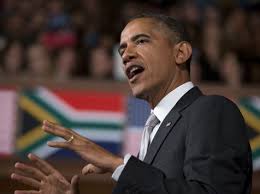
[…] In his speech at the University of Cape Town, South Africa, President Obama rebuffed the criticism often coming out of Africa according to which democracy and transparency, those values which America holds dearly, are somehow Western exports and that it is intrusive and meddlesome of America to impose them on Africa. … he pointed out that ‘those in power in Africa who make those arguments are usually trying to distract people from their own abuses. Sometimes, they are the same people who behind closed doors are willing to sell out their own country’s resource to foreign interests, just so long as they get a cut’. It is hard to argue against that. The question, however, is, what if those foreign interests are American?
It is hard to believe that America does not tell African people who their leaders should be, but stand up with those who support the principles that lead to a better life. The list of African leaders who were assassinated by the CIA because they put the interests of their people first and refused to blindly serve American interests is very long. The list of leaders (living and dead) who were hoisted to power to serve America’s strategic interests and heaped with praises they do not deserve from the White House is also very long. In Congo, Patrice Lumumba was assassinated and Mobutu Sese Seko was hoisted to power. As far as we know, there are no strong institutions, such as independent judiciaries that can enforce the rule of law; honest police forces that can protect the peoples’ interests instead of their own; an open government that can bring transparency and accountability in Rwanda and Uganda today. But there are two strongmen who are supported and protected by Britain and America so long as they serve as proxy forces in Congo. They are presidents Yoweri Museveni and Paul Kagame!

In fact, today, apart from the Chinese mining contracts in which the Congolese state (DRC) retains at least 32% of stakes, the stakes of the Congolese state in all other mining contracts the government has signed with Western mining companies do not go beyond 20%! So, Western powers still enjoy the lion’s share in Congo. In Zimbabwe, the government retains 51% stakes in each mining contract, not like in the DRC. That is what should be emulated by all other countries throughout Africa. The Chinese respect our laws and rules of the game and are massively investing in Zimbabwe under those rules, but Western countries see a problem with that policy in Zimbabwe where the economy is recovering without Western financial help and despite Western sanctions (so Mugabe is not pocketing all the money). Without African countries drawing their own rules and laying them on the table for their external partners to follow and not the other way round, African independence will remain meaningless and Africa will totally be owned by the outside world, in other words, by people who come and loot Africa’s wealth through predatory wars and then return to Africa as investors! Continue reading “Analysis on Obama’s 2013 Visit to Africa”

 African Heritage