Last night, the Pharaohs of Egypt took a stroll in the savanna and were eaten by the Indomitable Lions of Cameroon. Oh yes… the Egyptians, 7th time African champions, finally bowed down to the Cameroonians, who last night became 5th time African champions. The Cameroonian team broke the curse to defeat the Egyptians… who on all previous meets had always beaten Cameroon.
Flag of Cameroon
So last night, Cameroon won its 5th African Cup of Nations to become, after Egypt, the most titled African country in soccer. Needless to say that this relatively young Cameroonian squad surprised everybody to first make it through the qualifying turn, and then defeat countries such as Senegal in quarter-finals, and Ghana in semi-finals, to make it into the final against Egypt.
Stylized face of Shesepamuntayesher depicted on her coffin (Source: National Geographic)Flag of Egypt
The final score of the Cameroon-Egypt game was 2-1 in favor of Cameroon, even though the Egyptians were ahead 1-0 at the end of the first half, they could not stop the Cameroonian turbo machine, which came back to win 2-1. I raise a special hat to the Indomitable Lions’ goalkeeper Fabrice Ondoa, who to me, is truly the reason Cameroon made it that far in the competition. And to think that he doesn’t even have an official club, shows how determined and hard-working this young player is. At the end of the game, the players all wore the number 17, in honor of Marc-Vivien Foé, who had passed on on the field several years back. The last time Cameroon had won the African Cup of Nations was in 2002. Special salutes to this young squad of Cameroon, and our wishes is that they truly work hard to make it further, and always make us proud, and make it back as a great nation of soccer.
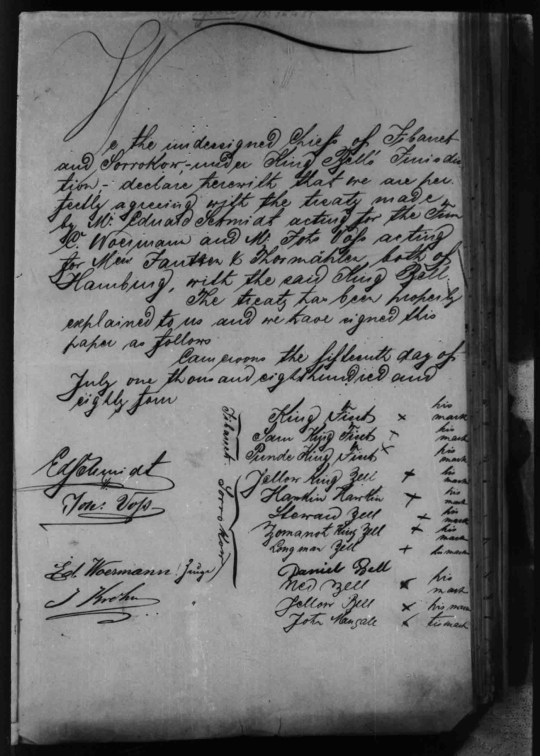
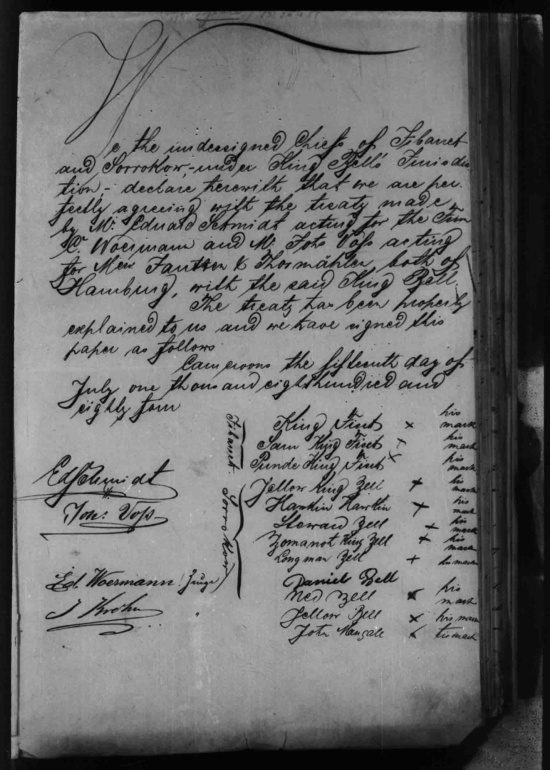
Here is the text of the 15 July 1884 treaty signed between the Chiefs of Jibarret (Djebale) and Sorrokow (Sodiko) and the German merchants of the Adolph Woermann and Jantzen & Thormählen firms in Cameroons. It basically does not show the entire text, but rather cites the treaty signed on 12 July 1884 between Kings Bell and Akwa and the Germans. It is pictured here:
“We the undersigned chiefs of Jibarret and Sorrokow, under King Bell’s juridiction declare herewith that we are perfectly agreeing with the treaty made by Mr. Edouard Schmidt acting for the company C. Woermann and Mr. John VoK acting for Misters Jantzen & Thormählen both of Hamburg, with the said King Bell.
The treaty has been properly explained to us and we have signed this paper as follows.
Cameroons the fifteenth day of July one thousand eight hundred and eighty four.”
Source:Abretungs-Urkunde Jibarret und Sorrokow, 15-7-1884 DZA-potsdam 4204 f.192.
15 July 1884 treaty between the Chiefs of Jibarret (Djebale) and Sorrokow (Sodiko), and the German merchants
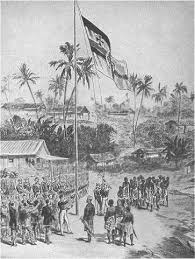
German flag on the Joss plateau in Cameroons Town (Douala) on 14 July 1884
Here is the text to the Pre-treaty approved by King Ndumbé Lobé Bell and King Akwa of Cameroons River (Wouri River, Douala) before agreeing to signing the 12th July 1884 Germano-Duala treaty. It is called the “Wünsche der Kamerun” (or the Cameroonians’ wishes) and was signed by the German consul. Note that only the German consul signed to engage his country into this pre-treaty; and no Cameroonian party signed it. It is only once this was done, that the Kings Bell, and Akwa signed the treaty of sovereignty. Here is the text of the pre-treaty.
“Cameroons River, July 12th, 1884
Our wish is that white men should not go up and trade with the Bushmen, nothing to do with our markets; they must stay here in this River, and then give us trust so that we will trade with our Bushmen.
We need no protection; we should like our country to annex with the government of any European Power.
We need no alteration about our marriages, we shall marry as we are doing now.
Our cultivated ground must not be taken from us, for we are not able to buy and sell as other countries.
We need no Duty or Custom House in our country.
We shall keep bullocks, pigs, goats, fowls as it is now and also no duty on them.
No man should take another man’s wife by force or else a heavy fine.
We need no fighting and beating without fault and no imprisonment on paying the trust without notice and no man should be put to Iron for the trust.
We are the Chiefs of Cameroons.
The Imperial German Consul
Emil Schulze“
Source:L’Afrique s’annonce au rendez-vous, la tête haute! Du Pr. Kum’a Ndumbe III, P. 145-146, Ed. AfricAvenir/Exchange & Dialogue 2012
A few years back, I met some German colleagues who did not know that Germany had African colonies. I was astounded, especially given that some of these colonies (territories, people, cultures) were broken into two as a result of Germany’s loss of World War I: Great Britain and France divided Kamerun (Cameroons) and Togoland. Belgium gained Ruanda-Urundi (Rwanda and Burundi) in northwestern German East Africa, while Great Britain obtained the greater land mass of German East Africa (Tanzania), Portugal received the Kionga Triangle, a sliver of German East Africa, and South Africa gained German South-West Africa (Namibia). It is like getting punished for someone else’s sins: Africans had no say in it! Here is one of those treacherous colonial treaties Africans had to sign, and then overnight became a ‘COLONY‘, in this case a German colony. On 12 July 1884, King Ndumbé Lobé Bell and King Akwa of Cameroons River (Wouri River, Douala) signed a treaty in which they assigned sovereign rights, legislation and administration of their country in full to the German firms of Adolph Woermann and Jantzen & Thormählen. The treaty included conditions that existing contracts and property rights be maintained, existing customs respected and the German administration continue to make “comey”, or trading tax, payments to the kings as before.
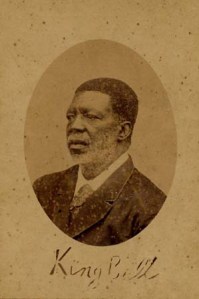
King Bell in later life
Prior to signing this ‘famous’ Germano-Duala treaty of 12th July 1884, the Duala kings had the German consul sign a pre-treaty in which their rights were preserved. Little did they know that none of these clauses will be respected by the German party afterwards. The original text is found below; for more information, check out the amazing work of the Pr. Kum’a Ndumbe III of the Afric’Avenir foundation, who has done a marvelous job researching these German treaties and impact in Cameroon.
“We, the undersigned independent Kings and Chiefs of the country called Cameroons situated on the Cameroons River, between the River Bimbia on the North Side, the River Qua-Qua on the South Side and up to 4°10’ North Lat. have in a meeting held today in the German factory on King Aqua’s Beach, voluntarily concluded as follows:
We give this day our rights of Sovereignty, the Legislation and Management of this our country entirely to Mr. Edouard Schmidt acting for the C. Woermann and Mr. Johannes Voss acting for Misters Jantzen & Thormahlen, both in Hamburg, and for many years trading in this River.
We have conveyed our rights of Sovereignty, the Legislation and Management of this our country to the firms mentioned under the following reservation:
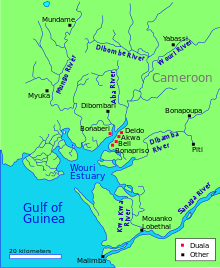
Wouri estuary in 1850s
Under reservation of rights of third persons
Reserving that all friendship and commercial treaties made before with other foreign governments shall have full power
That the land cultivated by us now and the places, the towns are built on shall be property of present owners and their successors
That the Coumie shall be paid annually as it has been paid to the Kings and Chiefs before
That during the first time of establishing an administration here, our country fashions will be respected.
Cameroons the twelfth day of July thousand eight hundred and eighty four.
Source: L’Afrique s’annonce au rendez-vous, la tête haute! Du Pr. Kum’a Ndumbe III, P. 147-148, Ed. AfricAvenir/Exchange & Dialogue 2012
Pictured here is the treaty signed on 15 July 1884 by the chiefs of Jibarret (Djebale) and Sorrokow (Sodiko), Cameroons
Deux hommes discutent dans un bar.
– T’es né où toi ?
– A Paris
– C’est marrant ça ! Moi aussi, et en quelle année ?
– En 1973
– C’est drôle ça ! Moi aussi, et quel mois ?
– Janvier
– Ça alors ! Moi aussi, et quel jour ?
– Le 28
– INCROYABLE ! Moi aussi !!...
Et là, un troisième homme entre dans le bar et s’adresse au patron
– Salut patron, quoi de neuf ?
– Oh pas grand chose, juste les jumeaux qui sont encore bourrés…
=========
Two men are talking at a bar.
– Where were you born?
– Paris
– That’s funny! Me too, and what year?
– In 1973
– That’s funny! Me too, and what month?
– January
– Wow! Me too, and what day?
– The 28th
– Unbelievable! Me too!! …
A third man then enters a bar and talks to the owner,
Many years ago, there lived a young married couple in a small village in Africa. In the beginning, the husband and the wife were very happy in their marriage and loved spending time with each other. However, of late, things had changed a lot. The husband started staying a little unhappy and never returned home on time, unlike before. The wife loved her husband very much and thought that he was the most wonderful man in the world, but of late, the husband’s behavior made the wife really sad and miserable.
One day, she decided to visit a wise old man in the village, to get some advice about her marriage. The old man had got this couple married just a few years back and had thought that it would last forever. He was very sad to hear that they were unhappy in their marriage.
The old man said that he could end their marriage, but he asked the wife for one last time, if she really wanted to end this marriage and marry someone else.
Lion
“I want my husband to be loving and caring like before and even I want to be like that,” the wife replied sadly. The old man replied, “If that is what you really want then I think I can help you. I can make a secret potion. Once your husband has the potion, he will turn into a very loving and caring man.” “Really?” the wife exclaimed. “Then please prepare it and give it to me at once,” she said impatiently.
“I can make the potion but you have to get me a very special ingredient for it,” the old man said to the wife. “I will get you whatever you want,” the wife said. “Alright then, please get me a single whisker from the body of a living lion.” The wife was shocked to hear about the ingredient. But she wanted to save her marriage so badly that she promised the old man that she would get the whisker.
The next day, the wife bought a huge chunk of meat and waited near the river where the lions often came to drink water. As she saw a lion approaching from a distance, she dropped the meat on the ground and hid behind a tree. The lion saw the meat on the ground and finished it in one single bite. The lion knew that the wife was there. She was shivering with fear, waiting for the lion to leave.
After a while, the lion left quietly.
The next day the wife did the same thing. Only this time the lion came quickly to eat the meat. This continued for about a month and every day the woman kept moving closer and closer to the lion. After a month, the wife decided to move really close to the lion and one day, she actually went and sat beside the lion while he was eating the piece of meat. Shaking with fear the wife slowly pulled out a whisker from the lion’s chin. The lion turned its huge head and took a look at her. She almost froze with fear. But the lion turned back its head and continued to eat.
The wife waited for the lion to leave and then ran to the old man with the lion’s whisker. The old man was awestruck to hear the story of the wife. He said, “It requires immense courage, patience and perseverance to accomplish a task like that. If you can show even half the amount of patience and courage in your marriage, I am sure you can change your husband with that.”
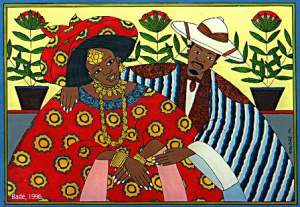
African couple (Wikimedia Commons)
“What about the potion?” The wife asked eagerly. The old man replied, “I can certainly make the potion. But that wouldn’t last forever. But if you try, you can change your husband into a loving man with the help of your love, understanding and patience. Make him feel loved and wanted and share all his problems. I am sure he will change into a better man.”
The wife followed the advice of the old man and within a month the husband’s behavior changed towards her. He became more caring and loving and was never late from work. Thus, they lived a happily married life forever.
In my series on Reclaiming African History, I came across this article by Ama Biney on Pambazuka about reparations for slavery, which I found very pertinent. I decided to share parts of it. I particularly liked the ending paragraph, “… in addressing the issue of reparations, we must also address transforming the system of capitalism which slavery gave birth to. A rupture with this unequal and exploitative system is fundamental in eliminating oppression that remains with us in the twenty-first century in reconfigured forms“. For the full article, go to Pambazuka.
=============
… what should reparations entail?
… Acknowledging the atrocity and enormity of this experience is necessary in an official apology. Commentators have observed how the Maoris received an apology from the British Queen in 1995. [2] In 2008 the Australian Prime Minister Kevin Rudd apologized in parliament to all Aborigines for laws and policies that “inflicted profound grief, suffering and loss”. [3] It appears when it comes to Africans our lives, bodies and history do not matter. Racism will find various rationalizations (or excuses) to deny that enslavement of Africans merits an apology and reparations. Yet, we cannot erase the collective historical memory and experiences of enslavement that was wrought on people of African descent and continues with the covert and overt forms of racial discrimination that they still experience in the 21st century. …
Slave ships
Whilst it is the case that no amount of financial compensation can address the psychological and emotional scars of enslavement of people of African descent, nor the horrors of the Middle Passage, nor those who remain buried in the Atlantic Ocean as a consequence of suicide, nor the 132 Africans deliberately thrown overboard in 1786 on the slave ship Zong — in order that the ship owners could claim the insurance — a comprehensive economic package needs to address the fact that the current economic and technological underdevelopment of Africa and the Caribbean is symptomatic of the impact of 400 years of enslavement. This enslavement was followed by the brief but no less damaging interlude of colonialism and must be recognized as central to any form of reparations.
… There are those who refuse to accept the fact that the economic wealth of Europe was built on the sweat, blood and toil of African people to the detriment of Africa. Yet, let us be clear that the trans-Atlantic slave trade was not a “trade.” The meaning of “trade” supposes equal benefit to both parties. It was not “trade” but the looting of Africa in which Europe benefited at the expense of Africa as Walter Rodney graphically illustrates in his acclaimed book, “How Europe Underdeveloped Africa.” The consequence for Africa was and remains that “the African economy taken as a whole was diverted away from its previous line of development and became distorted.” [4]
Slaves on board a ship
Reparations is therefore a quest to repair the economic damage of underdevelopment wrought by the process of enslavement and colonialism. This economic redress will be symbolic for it may run into trillions of dollars, for one can never place an economic value on the millions of Africans whose lives were lost in the slave raids, or as they died in the long march to the forts on the coast. How many died on such journeys? Can we account for those enslaved women who secretly aborted or killed their child to prevent them from experiencing slavery? And should we not include the medical experimentations carried out on the bodies of enslaved African women graphically documented in the books From Midwives to Medicine and Medical Apartheid? [5]
… Also, it is important for us to remember that on the ending of slavery in the British colonies, the British government were able to compensate the slave owners £20 million (£20 billion in today’s money). There was no compensation for the former enslaved African men and women. In the USA there were pledges to the freed men and women of “forty acres and a mule” that never materialized across the board. [6]
… What should reparations for slavery entail? It should address the following:
First, an apology to all continental Africans and people of African descent for the immorality of slavery, for merely stating “regret” — as the former British Prime Minister Tony Blair did in 2007 — is mere cant. [7] …
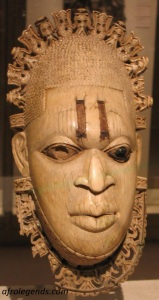
Pendant Ivory mask representing Queen Idia, Iyoba of Benin City (16th Century)
Second, we must demand that all Western governments instruct Western museums and citizens to hand over to African countries illicitly acquired African artifacts languishing both publicly and privately in their hidden vaults. They must also provide the training and facilities for African countries to host, display and conserve these returned items. This includes thousands of artifacts, among them being the more famous and well known 400 Ethiopian treasures looted by British soldiers during the 1868 Magdala expedition. [9] There are also the Benin bronzes looted in the British invasion of the Nigerian kingdom of Benin in 1896. [10] …
Third, as mentioned above, the brain drain of African and African Caribbean professionals should be halted by offering these professionals the same salaries to voluntarily return to Africa and the Caribbean in order to assist in the building of new schools, universities, hospitals and clinics that would be set up and financed by a comprehensive reparations economic program.
Debt cancellation would free up these critical funds to address the real needs of African citizens.
Fourth, cancellation of all debt incurred by the Caribbean and African nations on the grounds that they are odious and were not incurred by the ordinary citizens of Africa and the Caribbean but rather their ruling classes. … In short, aid is simply a paltry and ineffective band aid that keeps African economies in a continued process of economic subordination to neoliberal capitalism under the illusion that there will be “trickle down growth.” …
… Ultimately, in addressing the issue of reparations, we must also address transforming the system of capitalism which slavery gave birth to. A rupture with this unequal and exploitative system is fundamental in eliminating oppression that remains with us in the twenty-first century in reconfigured forms.

 Le fond de la pirogue ne dit pas ce qu’il y a au fond de l’eau (Proverbe Douala – Cameroun). – Ne racontez pas les secrets de vos amis.








 Two men are talking at a bar.







 Fourth, cancellation of all debt incurred by the Caribbean and African nations on the grounds that
 African Heritage