Happy international Women’s Day. I am so proud to celebrate the achievements and milestones of women. I decided to reblog Dr. Maya Angelou’s poem: ‘Phenomenal Woman’.
In celebration of the Women International Day on March 8th, I decided to post this poem by the great African American poet, Maya Angelou. It is dedicated to all the women of the world, the gorgeous, natural, and phenomenal women who make up our lives. Enjoy Phenomenal Woman.
Pretty women wonder where my secret lies. I’m not cute or built to suit a fashion model’s size But when I start to tell them, They think I’m telling lies. I say, It’s in the reach of my arms The span of my hips, The stride of my step, The curl of my lips. I’m a woman Phenomenally. Phenomenal woman, That’s me.
I walk into a room Just as cool as you please, And to a man, The fellows stand or Fall down on their knees. Then they swarm around me, A hive of honey bees. I…
Yesterday, just as I published my article “Why the name: Zanzibar?” the BBC published a photo-journal on “ Saving Zanzibar’s Heritage.” This made for a happy surprise, and showed the effort taken by locals to save and restore Stone Town (Mji Mkongwe in Swahili)’s architecture. So please check out the article on BBC HERE. Enjoy!
Sultan Palace in Old Stone Town in Zanzibar (1871 – 1875)
The name Zanzibarcomes from the ArabicZanjibār(زنجبار), which in turn comes from the PersianZang-bār (زنگبار), a compound of Zang (زنگ, “Black“) + bār(بار, “coast, land, country“), name given by Persian navigators when they visited the area in the middle ages. So, in essence, Zanzibarmeans the “land of the Blacks” or “the land of the Blackpeople,” or “the coast where Black people live.”
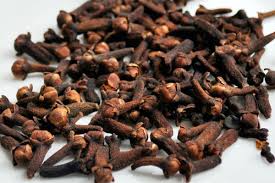
Cloves
Traders from the Arabian Peninsula, the Persian Gulf region of modern-day Iran (especially Shiraz), and west India probably visited Zanzibar as early as the 1st century. Zanzibar was used as a base for voyages between the Middle East, India, and Africa. In the olden days, the archipelago was known as Spice islands, and was world famous for its cloves (see the article I wrote So much for that clove in your food!) and other spices.
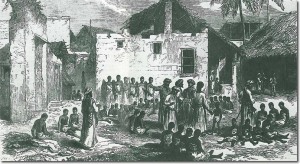
Malindi in Zanzibar City was the Swahili Coast’s main port for the slave trade with the Middle East. In the mid-19th century, as many as 50,000 slaves passed annually through the port. Many became rich through the slave trade, such as the notorious Arab slave trader and ivory merchant, Tippu Tib. Today, there are still vestiges of old slave forts in Stone Town.
Until around 1890, the sultans of Zanzibar controlled a substantial portion of the Swahili Coast, known as Zanj, which included Mombasa and Dar es Salaam. Beginning in 1886, Great Britain and Germany plotted to obtain parts of the Zanzibar sultanate for their own empires. Over the next few years, however, almost all of these mainland possessions were lost to European imperial powers.
Sultan Sayyid Abd Allah ibn Khalifa
In 1890 Zanzibar became a protectorate (not a colony) of Britain. This status meant it continued to be under the sovereignty of the Sultan of Zanzibar. From 1890 to 1913, traditional viziers were in charge; they were supervised by advisors appointed by the Colonial Office. However, in 1913 a switch was made to a system of direct rule through British governors. The death of the pro-British SultanHamad bin Thuwaini on 25 August 1896 and the succession of Sultan Khalid bin Barghash, whom the British did not approve of, led to the Anglo-Zanzibar War, known as the shortest war in history lasting 38 minutes.
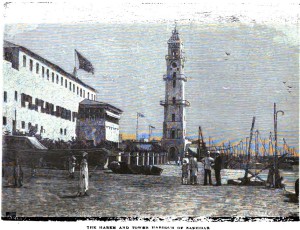
The Harem and tower harbor of Zanzibar ca 1890
On 10 December 1963, the Protectorate that had existed over Zanzibar since 1890 was terminated by the United Kingdom. The United Kingdom did not grant Zanzibar independence, as such, because the UK had never had sovereignty over Zanzibar. Rather, by the Zanzibar Act 1963 of the United Kingdom, the UK ended the Protectorate and made provision for full self-government in Zanzibar as an independent country within the Commonwealth. Upon the Protectorate being abolished, Zanzibar became a constitutional monarchy under the Sultan. However, just a month later, on 12 January 1964 Sultan Jamshid bin Abdullah was deposed during the Zanzibar Revolution. The Sultan fled into exile, and the Sultanate was replaced by the People’s Republic of Zanzibar and Pemba. In April 1964, the republic merged with mainland Tanganyika. This United Republic of Tanganyika and Zanzibar was soon renamed, blending the two names, as the United Republic of Tanzania, within which Zanzibar remains a semi-autonomous region.
Beach of Zanzibar (Zanzibar.net)
Today, Zanzibar is world-renowned for its great tourism, with Stone town showing remnants of the ancient Swahili kingdom, and the melting pot of cultures (Persian, Arabic, Bantus, European), and its cloves. Enjoy the video below, and whenever you visit Zanzibar, remember that it is the Land of the Black people!
Quand on se promène avec un écureuil, on apprend à grimper à l’arbre mais aussi à voler(Proverbe Solongo – Angola). – Mauvaise compagnie.
When walking with a squirrel, you learn to climb a tree, but also to steal(Solongo Proverb – Angola). – Poor company.
Quando se anda por aí com um esquilo, você aprende a subir na árvore, mas também para voar (provérbio Solongo – Angola). – Diz-me com quem andas dir-te-ei quem és.
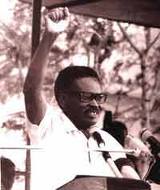
Today, I would like to share a poem by one of Angola’s most prolific writer and its first president, Agostinho Neto. This poem, “Havemos de Voltar” / “We Shall Return“, speaks to all people, and all times.
Back when this was written from his prison cell in Lisbon, the poem symbolized the return of lost sons, of exiles, of freedom fighters, and the return to their homeland, their loved ones, and the re-attribution of their resources back to them. Today, the message means pretty much the same: a return to liberty (African countries’ freedom from the oppressors), economic freedom (FCFA, the slave currency), and even freedom to all immigrants around the globe who run away from their country because of poverty, war, etc. So to all those seeking a return to peace, to love, a return home, here is Agostinho Neto‘s message.
Havemos de voltar
Às casas, às nossas lavras às praias, aos nossos campos havemos de voltar
ÀS nossas terras vermelhas do café brancas de algodão verdes dos milharais havemos de voltar
Às nossas minas de diamantes ouro, cobre, de petróleo havemos de voltar
Aos nossos rios, nossos lagos às montanhas, às florestas havemos de voltar
À frescura da mulemba às nossas tradições aos ritmos e às fogueiras havemos de voltar
À marimba e ao quissange ao nosso carnaval havemos de voltar
À bela pátria angolana nossa terra, nossa mãe havemos de voltar
Havemos de voltar À Angola libertada Angola independente
We shall return
To the houses, to our crops, to the beaches, to our fields we shall return
To our lands Red with coffee White with cotton Green with maize fields we shall return
To our mines of diamonds Gold, copper, oil we shall return
To our rivers, our lakes our mountains, our forests we will return
To the shade of the mulemba To our traditions To the rhythms and bonfires we shall return
To the marimba and the quissange to our carnival we shall return
To our beautiful Angolan homeland our land, our mother we shall return
We shall return to liberated Angola independent Angola.
From Sacred Hope – Poems by Agostinho Neto, published by the Angolan Writers Union, 1986, sponsored by the National Bank of Angola. Translated to English by Marga Holness.
In memory of one of Africa’s great women writer, I would like to share a post I wrote a few years back dedicated entirely to her work. Buchi Emecheta was a strong woman, a strong writer, and she used her writing to get out of a difficult situation (violent marriage, divorce, single-handedly raising 5 children, work). Above all, she believed in what she was doing, and gave us some of the first feminist books in Africa
Today I would like to talk about a strong woman… a determined woman… an independent African female writer: Buchi Emecheta. Dr.Buchi Emechetais an established Nigerian author who has published over 20 books. She wrote such books asSlave Girl, The Joys of Motherhood, Second Class Citizen, The Bride Price, and more recentlyKehinde. Her themes have always revolved around motherhood, child slavery, and women independence. Buchi got married at the tender age of 16, and by the age of 22 was the mother of five children (they had moved to London after the birth of the first child for her husband to pursue higher education). Her marriage was unhappy and oftentimes violent. She used writing as an escape, to keep her sanity.The day her husband burnt her first manuscript marked Buchi’s rebirth. As she watched him burn her novel…
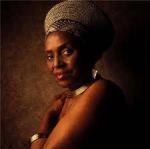
Who has not heard of the famous African love song ‘Malaika?’ The best known version of this song is the one sung by Mama Africa, Miriam Makeba. It is a Swahili song written by Tanzanian Adam Salim in 1945, who composed “Malaika” for his very beautiful girlfriend Halima Ramadhani Maruwa. Their parents disapproved of their relationship, and Halima was forced by her parents to marry an Asian tajir (wealthy man). The song is sung by a poor young man who wishes to marry his beloved ″Angel″ or ″Little bird″ but is defeated by the bride price.
A true African beauty: Mama Africa, Miriam Makeba
This song is the most famous of all Swahili love songs in Tanzania, Kenya and the entire East Africa, as well as being one of the most widely known of all Swahili songs in the world; again, it was made popular around the globe by Miriam Makeba. Malaikameans “angel” in Swahili, and this word has always been used by the Swahili speakers to refer to a beautiful girl.So this is to all the angels out there for this Valentine day.
Malaika
Malaika, nakupenda Malaika
Malaika, nakupenda Malaika
Nami nifanyeje, kijana mwenzio
Nashindwa na mali sina, we,
Ningekuoa Malaika
Nashindwa na mali sina, we, Ningekuoa Malaika
Kidege, hukuwaza kidege
Kidege, hukuwaza kidege
Nami nifanyeje, kijana mwenzio
Nashindwa na mali sina, we,
Ningekuoa Malaika
Nashindwa na mali sina, we, Ningekuoa Malaika
Pesa zasumbua roho yangu
Pesa zasumbua roho yangu
Nami nifanyeje, kijana mwenzio
Ningekuoa Malaika
Nashindwa na mali sina, we, Ningekuoa Malaika
Angel
Angel, I love you angel
Angel, I love you angel
and I, what should I do, your young friend
I am defeated by the bride price that I don’t have
I would marry you, angel
I am defeated by the bride price that I don’t have I would marry you, angel
Little bird, I think of you little bird
Little bird, I think of you little bird
and I, what should I do, your young friend
I am defeated by the bride price that I don’t have
I would marry you, angel I am defeated by the bride price that I don’t have I would marry you, angel
The money (which I do not have) depresses my soul The money (which I do not have) depresses my soul and I, what should I do, your young friend
I would marry you, angel
I am defeated by the bride price that I don’t have I would marry you, angel


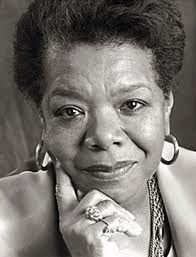 Maya Angelou





 Back when this was written from his prison cell in Lisbon,
 Ce que Imana (Dieu) te donne, le vent ne peut pas l’emporter

 Le chemin qui conduit vers des êtres chers, n’a pas d’épines


 African Heritage