Africa’s Second Female Head of State: Meet Joyce Banda of Malawi

Malawi
Malawi
President Joyce Banda

Malawi has a new president: it is her excellency Joyce Hilda Mtila Banda. The passing of president Bingu wa Mutharika of Malawi was announced last Saturday. As written in the constitution, the vice president stepped in as head of state. On Saturday, April 7th 2012, Joyce Banda became Malawi’s first female president, and Africa’s second female head of state after Ellen Johnson Sirleaf of Liberia. Immediately after being invested, Banda called on the nation to mourn Mutharika with dignity and she thanked Malawians for staying calm during the power transition period. She said she was accepting the presidency with total humility and that she would strive to serve the nation earnestly.

President Bingu wa Mutharika

Joyce Banda is stepping into the shoes of Bingu wa Mutharika who had recently been disavowed by the ‘international community’, and Malawi was put under embargo from UK, US, and EU. I wonder which way she will go: restore and do the good will of the international community, or try to restore Malawians’s rights to happiness (could the two be linked?)… Tough choice isn’t it? Only time will tell which way the balance will tip!

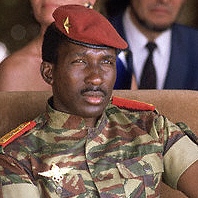
Témoignage sur les derniers jours de Thomas Sankara? Boukary Kaboré, le lion, raconte.

Thomas Sankara
Thomas Sankara à Ouagadougou

Le lion du BoulkiemdéBoukary Kaboré raconte ses derniers jours avec le capitaine, Président du Faso, le Che Africain, Thomas Sankara, et la largesse d’esprit de ce grand homme.  Proche de Thomas Sankara durant la révolution, le capitaine Boukary Kaboré dirigeait une des 4 regions militaires.

Dans les jours qui suivirent l’assassinat de Thomas Sankara, il refusa de faire allégeance à Blaise Compaoré.  Il refusa d’organiser une montée sur Ouagadougou arguant du fait qu’il ne voyait pas qui pouvait diriger le pays.  Ce sont finalement des militaires proches de Blaise Compaoré qui vont assaillir la ville de Koudougou procédant à un véritable massacre des militaires restés fidèles au Lion.  Il réussira à s’enfuir de justesse pour se réfugier au Ghana.

Boukary Kabore
Boukary Kaboré

Il revient longuement sur tous ces évènements.  ll raconte aussi combien il a tenté vainement de protéger Thomas Sankara qui ne voulait pas de protection (il dit si bien en parlant de Thomas: ‘comment protéger un président qui aime se déplacer à vélo?‘), les tentatives pour le convaincre de démissionner afin d’éclaircir la situation politique, comment était organisée la sécurité de la présidence, comment on a acheté un des fidèles, etc…

Regardez, écoutez, et que ceci vous apporte un élément de clarté sur la mort de notre héros, et grand ‘Che’ africain, Thomas Sankara.

Celebrating a Strong Writer: Buchi Emecheta or the Joys of Motherhood

Buchi Emecheta
Buchi Emecheta

Today I would like to talk about a strong woman… a determined woman… an independent African female writer: Buchi Emecheta.  Dr. Buchi Emecheta is an established Nigerian author who has published over 20 books.  She wrote such books as Slave Girl, The Joys of Motherhood, Second Class Citizen, The Bride Price, and more recently KehindeHer themes have always revolved around motherhood, child slavery, and women independenceBuchi got married at the tender age of 16, and by the age of 22 was the mother of five children (they had moved to London after the birth of the first child for her husband to pursue higher education).  Her marriage was unhappy and oftentimes violent.  She used writing as an escape, to keep her sanity.  The day her husband burnt her first manuscript marked Buchi’s rebirth.  As she watched him burn her novel, she said ‘I am going to leave this marriage‘ and the man replied ‘what for? that stupid book?‘, and she told him, ‘I just feel you just burn my child.‘ (Source: Buchi Emecheta BBC).  That was really her turning point.  At the age of 22, she left her husband, raised her 5 children by herself, got a degree in sociology studying at night, and wrote 4 novels in the space of 5 years.  She would often rise at dawn to pursue her dream of becoming a writer.  She wore several hats: mother, student, writer, and worker.

The Joys of Motherhood
'The Joys of Motherhood' by Buchi Emecheta

Like her Nigerian ancestors, she uses storytelling to teach morals, to entertain and to instruct.  She brings to her writing the Igbo qualities of vividness, economy and directness.  She speaks for the marginalized woman.  Some of her first novels, such as In the Ditch and Second Class Citizen, were quite autobiographical.  She views her writing as the “release for all my anger, all my bitterness, my disappointments, my questions and my joy.” Please help me acclaim Buchi Emecheta, a powerful woman, a powerful writer, and a proud daughter of Africa. In her own words, Buchi advises ‘whatever you want to do with your life. “Just keep trying and trying. If you have the determination and commitment you will succeed.” (Source: ‘Just’ an Igbo Woman Interview by Julie Holmes in The Voice July 9, 1996.) Check out some of Buchi’s quotes on GoodReads.com.

Celebrating the Life of a Great Economist: Paul-Antoine Bohoun Bouabré

Paul-Antoine Bohoun Bouabré (Source Abidjan.net)

On January 12, 2012, Paul-Antoine Bohoun Bouabré left us. Who was Paul-Antoine? and why should we care?

Well, Paul-Antoine Bohoun Bouabré was a great economist from Côte d’Ivoire.  His genius successfully protected his country from bankruptcy during the years when Côte d’Ivoire was under siege by France (i.e. 2000 – 2011).  Educated in the great schools of his country and in France, he earned a PhD in economics with a specialty in development in 1985.  He then returned to his country where he taught economics at the Universities of Cocody, and Bouaké, and at the Côte d’Ivoire National School of Administration.  In 2000, he joined the government of Laurent Gbagbo, for whom he had great respect, as the minister of Economy and Finances.  After the chaotic military transition of the years 2000 (from Gueï’s coup on 24 December 1999 to the elections of 2000) he single-handedly created a ‘secured budget’ to face all the financial problems of the state of Côte d’Ivoire, as the foreign investors and donors were no longer investing in the country.  His motto was “live within your means and don’t borrow from the outside.”  He did just that: the ‘secured budget’ was founded entirely on internal revenues of the state which increased due to the financial reforms put in place.  He managed to keep Côte d’Ivoire afloat.  After the rebellion of 2002, which totally destabilized the country by splitting it into two, thus depriving the state of more than half of its revenues and territory, Paul-Antoine created the ‘backup budget’ or the ‘safeguard budget’ or ‘the protection budget’ through which he managed to pay all the salaries, and all the state charges for the entire country! All this was done, under the eyes of the rebellion and its foreign allies who gave Gbagbo and his government no less than 3 months to survive; they survived over 8 years in this state of asphyxiation, thanks in part to his efforts!

Flag of Côte d'Ivoire

It just pains me to see how a bright son of Africa has been depicted and demonized in the foreign press.  This great man, and economist kept an entire country afloat through all the foreign pressures.  Imagine for a single moment, a country asphyxiated by all (France, E.U., USA, IMF, World Bank, etc…), and beleaguered from all sides, trying to stay afloat, to pay salaries, and keep the state from sinking….  Imagine the livelihood of millions of people depending on these external forces, forces which do not accept the people’s vote, but prefer their own jockey…  Imagine providing for millions of  men and women, and their children!  Truly, this man, and his entire team, deeply loved their country.  Any man in their right mind would have quit such a job, or would have accused others for their downfall… but Bohoun Bouabré, like so many, stayed in place, and steered the ship in the right direction.  Many may disagree, but Bohoun Bouabré did what the Greek minister of finances could not do when faced with a financial crisis, he did what the Irish could not do, or what the Portuguese cannot do while being faced with a crisis.  All these European countries benefit from the support of their counterparts (E.U.), the US, the IMF, and the World bank, and yet… they cannot and have not been able to keep their ships afloat.  Today, some people want us to believe lies about him, but the truth will always be that Bohoun Bouabré was a great economist, who managed to keep a country like Côte d’Ivoire besieged from all sides, with a population (of 20 millions) bigger than Portugal (10 millions), Greece (10 millions) and Ireland (6 millions) afloat. Yes… this man was a true giant No offense to the Irish, Portuguese, and Greeks, but their finance ministers should take example on Paul-Antoine Bohoun Bouabré, a proud son of Côte d’Ivoire!

Cheikh Anta Diop and the African Origin of Civilization

Cheikh Anta Diop
Cheikh Anta Diop

Cheikh Anta Diop was a great Senegalese historian, anthropologist, philosopher, physicist and politician.  He should be considered as one of the greatest scientists after Darwin, as he demonstrated that Africa was the cradle of humanity; that everything started in Africa, and that Egypt and modern day Africans descended from the same ancestors, in other words, were the same people.  Before Cheikh Anta Diop, the world, and Africans in particular, had been taught that Africa was nothing, and that Egypt and Egyptians were not Africans… that the great Egyptian civilization which gave so much to the world, could not have come from the dark brown Africans.  Europeans refused to admit that although in Africa, Egyptians could be Africans i.e. Black, or rather believed that Blacks were so backwards that their ancestors could not have possibly made the great pyramids of Giza or the great sphinx.  Well Cheikh Anta Diop proved them all wrong!

Cheikh Anta Diop in the laboratory

As a physicist, I was amazed to learn that Cheikh Anta Diop was a PhD student of Frédéric Joliot-Curie, the 1935 physics nobel laureate, and Marie Curie‘s son-in-law (first woman to receive a Nobel in Physics, and first to have two nobel prizes). So Diop’s pedigree, in physics terms, was quite impressive!  Moreover, he had earned two PhDs: one in history and the other in nuclear physics.  He was also the only African student of his generation to have received a training in egyptology. He was well-versed in prehistoric archaeology, and linguistics.  It took him almost a decade to have his doctorate degree granted: he submitted a thesis in 1951 which was based on the premise that the Egypt of the great pharaohs and pyramids was an African civilization– it was rejected.  He then published it in 1955, as Nations Nègres et Culture, and received world-wide acclaim.  Two additional attempts at submitting it were rejected, until 1960 when he finally managed to convince a room full of physicists, sociologists, anthropologists, egyptologists, and historians.  Having gone through the hurdle of submitting and defending a doctoral dissertation, I truly raise my hat to someone like Diop who had so much stamina and endurance, and could endure a decade of rejection like that; he was truly destined for greatness!

'Nations Negres et Culture' de Cheikh Anta Diop

In 1974, Diop managed to prove beyond a shadow of a doubt, that Egyptians were Black people.  He obtained pigment from Egyptian mummies and tested for their melanin content.  He was able to determine their melanin content accurately, and later published his technique and methodology for the melanin dosage test in scholarly journals.  This technique is used today by Forensic investigators around the world, to determine the “racial identity” of badly burnt accident victims.

He was affectionately known as the Pharaoh of knowledge, and the Université Cheikh Anta Diop (UCAD) of Dakar was re-named after him.  Check out CheikhAntaDiop.net a website dedicated to this great man, Wikipedia, Cheikh Anta Diop: The Pharaoh of Knowledge, and Africawithin.com.  Don’t forget to read his books: Nations Nègres et Cultures: de l’Antiquité Nègre Egyptienne aux Problèmes Culturels de l’Afrique Noire d’Aujourd’hui, The African Origin of Civilization: Myth or Reality, Precolonial Black Africa, Civilization or Barbarism: An Authentic Anthropology [Civilisation ou Barbarie: Anthropology sans Complaisance], and many others.

'The African Origin of Civilization' by Cheikh Anta Diop

Please watch one of the greatest African thinkers of the 20th century, and above all one of Africa’s greatest sons (… and renowned physicist). I salute this great soul who made us proud of being Africans, who re-define history or rather wrote History the way it should have been, with Africa in its right place, as the origin of civilization. If there was an African Pantheon for great minds, Cheikh Anta Diop’s remains should be in it!

Amilcar Cabral – Tell no lies, claim no easy victories

Amilcar Cabral
Amilcar Cabral

January 20th marks the anniversary of the death of Amilcar Cabral, the father of the independence of Guinea Bissau and Cape Verde. As such, I just thought about leaving you with some of his most famous quotes. Enjoy!

A people who free themselves from foreign domination will be free culturally only if, without complexes and without underestimating the importance of positive accretions from the oppressor and other cultures, they return to the upward paths of their own culture, which is nourished by the living reality of its environment, and which negates both harmful influences and any kind of subjection to foreign culture. Thus, it may be seen that if imperialist domination has the vital need to practice cultural oppression, national liberation is necessarily an act of culture.”  Amilcar Cabral, “National Liberation and Culture” Lecture delivered on February 20 at Syracuse University as part of the Eduardo Mondlane Memorial Lecture Series. Eduardo Mondlane was the first President of the Mozambique Liberation Front (FRELIMO) who was assassinated by Portuguese agents on Feb. 3, 1960. historyisaweapon.com

Map of Guinea Bissau

We must practice revolutionary democracy in every aspect of our Party life. Every responsible member must have the courage of his responsibilities, exacting from others a proper respect for his work and properly respecting the work of others. Hide nothing from the masses of our people. Tell no lies. Expose lies whenever they are told. Mask no difficulties, mistakes, failures.  Claim no easy victories…Amilcar Cabral: tell no lies, claim no easy victories

Educate ourselves; educate other people, the population in general, to fight fear and ignorance, to eliminate little by little the subjection to nature and natural forces which our economy has not yet mastered. Convince little by little, in particular the militants of the Party, that we shall end by con­quering the fear of nature, and that man is the strongest force in nature.Amilcar Cabral: Tell no lies, claim no easy victories

Continue reading “Amilcar Cabral – Tell no lies, claim no easy victories”

Cesaria Evora: the Barefoot Diva– the Love of Cape Verde

Cesaria Evora
Cesaria Evora

I was quite shocked to learn of the ‘passing’ of Cesaria Evora… It hurts… the barefoot diva, the lady who sang ‘sodade‘ and ‘Angola‘, is no longer. The lady who started singing in her later days, and gained stardomship at the age of 50+, the lady who always performed barefoot on stage is no longer. She exemplified endurance and perseverance. Someone else could have given up… someone else could have said ‘there is no point singing, if I can barely make a living’. She knew all of that, but she also knew that she had a gift for singing and bringing the morna (Cape Verde music) to the international scene. She sang, and went on worldwide tours in her late 60s… giving concerts, etc… at an age when most people would have retired. She was truly an example of strength, confidence, endurance and perseverance. Her life was really all about endurance!

The album titled 'Cesaria Evora'

She lost her dad at the age of 7, and was placed in an orphanage at the age of 10 by her mother who could not raise all her 6 children.  She started singing at the age of 16 in a sailors’ tavern. She won international acclaim for her album ‘La Diva aux Pieds Nus‘ in 1988, and the album ‘Miss Perfumado‘ released in 1992 sealed her international aura.  In 1997, she won the Kora All African Music Awards for best Artist of West Africa, Best Album, and Merit of Jury.  In 2004, came the Grammy in the world category (such a silly category… mixing musicians from Europe, Africa, Asia, and Latin America in one pot… unthinkable) for her album ‘Voz D’Amor‘. Keep singing, and check out her website Cesaria Evora, a video biography on BBC, An article by the Guardian newspaper, USA Today, NY Times, LA Times, So long Cesaria, we will keep singing ‘sodade‘ and dancing the morna, praising ‘Angola‘ and ‘Cabo Verde.’

Fire and Rhythm (Fogo e ritmo) by Agostinho Neto

Agostinho Neto
Agostinho Neto

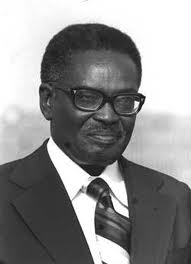
Agostinho Neto was the a medical doctor, a poet, and most importantly the first president of Angola. Today, I would like you to sit back and enjoy a poem written by this great African leader

Fogo e ritmo

Sons de grilhetas nas estradas

cantos de pássaros

sob a verdura úmida das florestas

frescura na sinfonia adocicada

dos coqueirais

fogo

fogo no capim

fogo sobre o quente das chapas do Cayatte.

Caminhos largos

cheios de gente cheios de gente

em êxodo de toda a parte

caminhos largos para os horizontes fechados

mas caminhos

caminhos abertos por cima

da impossibilidade dos braços.

Fogueiras

dança

tamtam

ritmo

Ritmo na luz

ritmo na cor

ritmo no movimento

ritmo nas gretas sangrentas dos pés descalços

ritmo nas unhas descarnadas

Mas ritmo

ritmo.

Ó vozes dolorosas de África!


Fire and rhythm

The sound of chains on the roads

the songs of birds

under the humid greenery of the forest

freshness in the smooth symphony

of the palm trees

fire

fire on the grass

fire on the heat of the Cayatte plains

Wide paths

full of people full of people

an exodus from everywhere

wide paths to closed horizons

but paths

paths open atop

the impossibility of arm

fire

dance

tum tum

rhythm

Rhythm in light

rhythm in color

rhythm in movement

rhythm in the bloody

cracks of bare feet

rhythm on torn nails

yet rhythm

rhythm

Oh painful African voices


.

Alexandre Dumas: Greatest French writer was of… African descent

Alexandre Dumas (source: Wikipedia)

Dear All, I was so surprised when I learned that Alexandre Dumas, yes… the writer of the “Three Musketeers” was just recently (2002) inducted into the Pantheon of Paris, you know… the place where the remains of the most famous/distinguished French citizens are buried. I wondered why?… because the Three Musketeers is the most acclaimed French book adapted to screen, movies, and theater. I wondered why?… because The Three Musketeers and The Count of Monte Cristo are among the most read books by a French author in the world… why only in 2002, 132 years after his death? when Victor Hugo had been indicted in 1885? why since Rousseau, Voltaire, Emile Zola, had all been indicted, while the most read French author, Alexandre Dumas’ remains were not? Well… you’ve guessed it right: Alexandre Dumas was Black! Yes… the great French writer was just like the Russian Father of modern literature Alexander Pushkin: Black! Yes… you can paint it all you want… he was of African descent: he was Black! Just look at his hair! He was actually Haitian, the grandson of a French nobleman and a Haitian slave. See… they hide this to you in the classroom.

The Three Musketeers, by Alexandre Dumas

Alexandre Dumas was born in 1802 in Picardy, France. His paternal grandparents were Marquis Alexandre-Antoine Davy de la Pailleterie, a French nobleman and Général commissaire in the Artillery in the colony of Saint Domingue (Haiti), and Marie-Cesette Dumas, an Afro-Carribean creole of mixed African and French ancestry. His father Thomas-Alexandre Dumas served in Napoleon’s army as general, and later fell out of favor. By the time Alexandre was born, his family was very poor.  His being of mixed race affected him all his life.  He once said to someone who had insulted his mixed-race background: “My father was a mulatto, my grandfather was a Negro, and my great-grandfather a monkey.  You see, Sir, my family starts where yours ends.

The Count of Monte Cristo, by Alexandre Dumas

In 2002, then French president Jacques Chirac had him exhumed from his original burial place and transported to the Pantheon of Paris. Chirac said: “With you, we were D’Artagnan, Monte Cristo, or Balsamo, riding along the roads of France, touring battlefields, visiting palaces and castles—with you, we dream.”  Chirac acknowledged the racism and injustice that had been done to one of the greatest French writers of all time. Imagine that, Dumas’ works have been translated into over 100 languages, and have inspired over 200 motion pictures.

Alexandre Dumas
Alexandre Dumas

Please check out some of these websites which give a detailed biography of Alexandre Dumas: the Alexandre Dumas pere website, and The Literature Network. In 2005, a lost novel by Dumas was found: it is titled The Chevalier de Sainte Hermine (The Knight of Sainte Hermine), was first serialized by Dumas in a French newspaper in 1869 but was never finished by the time of his passing a year later. Imagine if I had known in high school that Alexandre Dumas, the author of the Three Musketeers was black… Imagine how I would have delved further into his writings! Goodness Gracious…  Goodness Gracious! As Dumas would say himself, “One for all, all for one!

Remember Ruben: A Rare Video Biography of Ruben Um Nyobé

UPC Leaders (L. to R.) front row: Castor Osende Afana, Abel Kingué, Ruben Um Nyobé, Felix Moumié, and Ernest Ouandié

After my article on one of Africa’s greatest freedom fighter, the Cameroonian leader, Ruben Um Nyobé, I thought that this small rare video with pictures of Um Nyobé would be very fit to add to our knowledge.  Ruben Um Nyobé with the UPC in 1948 were the first in Africa to ask for the independence of their country, Cameroon.  He was murdered by the French colonial administration, and his story was totally buried for many years: it was as if he had had no impact on the lives of Cameroonians, and Africans as a whole.  It is just amazing to realize that, 50 years later, he had spoken at the United Nations tribune three times for the independence and reunification of Cameroon in 1952, 1953, and 1954.  It is amazing to think that in Cameroon, there was someone of the caliber of N’Krumah, Lumumba, and Nyerere… Yes… Ruben Um Nyobé’s place should be at the Pantheon (if it existed) of African legends.  Enjoy!!!