17 September marks National Heroes’ Day in Angola, in memory of its first president Agostinho Neto‘s whose birthday was on that day in Kaxicane. To join in the celebration, I publish here one of his poems, ‘Western Civilization‘. Sad how these words still ring true to factory workers, plantation workers, miners, sweatshop workers, etc, around the world to this day. Enjoy ‘Civilização Ocidental‘ by Agostinho Neto!
Civilização ocidental
Latas pregadas em paus fixados na terra fazem a casa
Os farrapos completam a paisagem íntima
O sol atravessando as frestas acorda o seu habitante
Depois as doze horas de trabalho Escravo
Britar pedra acarretar pedra britar pedra acarretar pedra ao sol à chuva britar pedra acarretar pedra
A velhice vem cedo Uma esteira nas noites escuras
basta para ele morrer grato e de fome.
Western Civilization
Sheets of tin nailed to posts driven in the ground make up the house.
Some rags complete the intimate landscape.
The sun slanting through cracks welcomes the owner
after twelve hours of slave labour.
breaking rock shifting rock breaking rock shifting rock fair weather wet weather breaking rock shifting rock
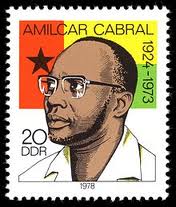
Amilcar Cabral on a stamp with the flag of Guinea Bissau
“A people who free themselves from foreign domination will be free culturally only if, without complexes and without underestimating the importance of positive accretions from the oppressor and other cultures, they return to the upward paths of their own culture, which is nourished by the living reality of its environment, and which negates both harmful influences and any kind of subjection to foreign culture. Thus, it may be seen that if imperialist domination has the vital need to practice cultural oppression, national liberation is necessarily an act of culture.”
The value of culture as an element of resistanceto foreign domination lies in the fact that culture is the vigorous manifestation on the ideological or idealist plane of the physical and historical reality of the society that is dominated or to be dominated.Culture is simultaneously the fruit of a people’s history and a determinant of history, by the positive or negative influence which it exerts on the evolution of relationships between man and his environment, among men or groups of men within a society, as well as among different societies.
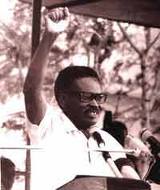
To celebrate Amilcar Cabral, the Father of Cape-Verdean and Bissau-Guinean independence, birthday (12 September), I decided to share this beautiful video of Amilcar Cabral with El Commandante, Fidel Castro. Enjoy!
This is old news, but I am still in awe with this kid and had to share it with you. Meet then 15 years-old Sierra Leone boy, Kelvin Doe, who wowed MIT! Enjoy! He is very creative: he created his own battery because of electricity shortage, he made his own radio because he wanted to broadcast to people in his neighborhood, he made his own generator because he needed it. He works by reverse engineering. Enjoy!
“There is no easy walk to freedom anywhere, and many of us will have to pass through the valley of the shadow of death again and again before we reach the mountaintop of our desires.” Long walk to freedom by Nelson Mandela, 1994
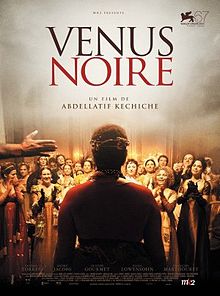
I had to share the trailer for the movie on Sarah Baartman, Black Venus, which starred Yahima Torres and was released in 2010. The film was nominated for the Golden Lion at the 67th Venice International Film Festival, where [for what it is worth] it was awarded the Equal Opportunity Award. Here are articles from the BBC about Sarah Baartman The significance of Sarah Baartman, SA History – Sarah Baartman, and this article by Brand South Africa. As stated in this New York Times article, “[the story of Sarah Baartman] is “a symbol of the alienation and degradation of colonization, lost children, exile, the expropriation of female labor and the sexual and economic exploitation of black women by men, white and black.””
Caricature of Sarah Baartman from the 19th century
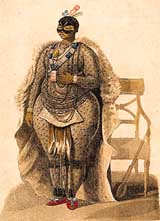
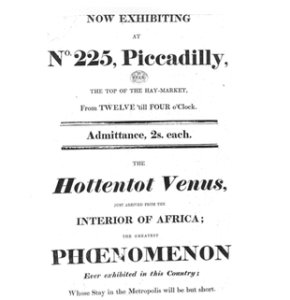
I have long wanted to talk about Sarah Baartman, known as the Hottentot Venus or the Black Venus. This Black woman was promised a life of fortune, taken to Europe as a slave to be exhibited naked to men and women around Europe just because of her physique, the physique of a Black woman. Her life was that of humiliation, prostitution, and slavery of another name. Her story is a very hard one to hear when you are a Black woman, when you love Black women, or when you love women in general.Her life was not that of a Venus, but rather that of a sex slave and zoo animal being exposed naked all the time, and raped by men who dreamt of “trying” this Black Venus. She was displayed as a freak because of her unusual physical features, studied, dissected after death and will only finally be put to rest 187 years after her death.
Saartje
Sawtche, from her real name, was born in 1789 in the Eastern Cape, of modern-day South Africa. Her father was from the Khoikhoi tribe, and her mother came from the Bushmen or San tribe, the oldest tribe in Southern Africa. Women from that tribe are known to have a lighter skin tone, with very developed hips. In the Khoi tribe, it is a sign of beauty, but to Europeans who had never seen it, it was considered a physical deformation or a sign of racial inferiority (not sure how having a flat bum-bum can attest of a race superiority). As a teen, Sawtche was a typical Khoi woman of medium build and light skin tone, and as will be said today, with a big bootie. Even if she was beautiful, no one in her tribe was shocked by her physique given that thousands of women were just as Sawtche.
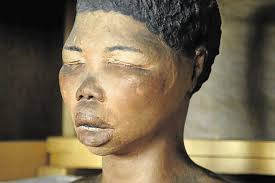
Exposed face of Sarah Baartman from the French Museum
She was captured and moved to the Gamtoos River as the slave of a rich Afrikaner farmer for whom she worked several months. A Dutch doctor working for the Royal Navy, William Dunlop, met the farmer, and noticed Sawtche and was not indifferent to her physique. She seemed to meet all his sexual fantasies, and so he decided to buy her. He made her his slave and sexual servant, and took her back to Cape Town, and from there taken onboard a boat to London where he gave her the name Sarah or Saartjie (little Sarah in dutch).
La Belle Hottentot on display, French print, 19th century
In 1810 in London, Sarah was only 16, and Dunlop was very manipulative. He constantly had sexual relations with her, and the young woman thought he loved her. He made her believe that in London, and throughout Europe, she could become rich just by exposing her body. He told her that white women didn’t have the same physique and will be willing to see her in exchange for some money. White Men will be crazy to touch and get the power to touch a Black woman, object of their wildest most secret fantasies, in exchange for money.
Sarah accepted without hesitation, and was quickly exposed in cities in England and in the Netherlands, exhibiting her body under all orders given her. As an animal, she walked, stood up or sat obediently. The public was mixed with astonishment, amusement, disgust, and stupefaction. Those men and women who wanted to approach her, those who wanted to touch her did. People told her all sorts of words, sweet as well as disdainful. Doctors and scientists came up with all sorts of theories to explain her anatomy. It was clear to them that Sarah was the proof of the Black race’s inferiority! To them, she was victim of a sickness that was the lot of all people of her race. Her sickness was called steatopygy, and since her sexual organs were abnormally developed she was said to be suffering from macronymphy (even though this is a normal characteristic found only in Black women).
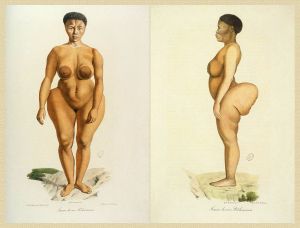
Illustration of Sarah Baartman from Illutrations Histoire Naturelle des mammiferes (History of Natural studies of mammals)
A young Jamaican, Robert Wedderburn, activist against racism and slavery watched those disgusting scenes and decided to act. He formed a support group for Sarah and started a series of judiciary pressures against the British government to stop this sort of horrible spectacles. Because of all these pressures, Sarah was taken to Paris, where she was exposed publicly between two circus spectacles, in music halls, and in the halls of the Haute Bourgeoisie. They called her the Hottentot Venus. She ended up being forced to prostitute herself at private soirees where she became a true sex object, believing that in due time she will be given the money she had made up to then.
It is at that time that she became the subject of studies by zoologist and surgeon Georges Cuvier, generalist, and surgeon of Napoleon Bonaparte. For him, Sarah was the missing link between the animal and man. The zoology professor and administrator of the National museum of Natural History of France, Etienne Geoffroy de Saint Hilaire, asked for the official authorization to “profit from the circumstances given them to have a Bushman woman in Paris to study, with more precision, the distinct characteristics of a peculiar race.” [« profiter de la circonstance offerte par la présence à Paris d’une femme bochimane pour donner avec plus de précision qu’on ne l’a fait jusqu’à ce jour, les caractères distinctifs de cette race curieuse. » ] de Saint Hilaire concluded his studies by comparing the face of Sarah with that of an orang-utang and her buttocks to those of female mandrills!
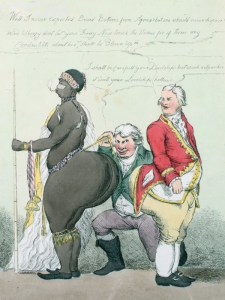
1810 caricature of Sarah Baartman by William Heath
Later, the writer Victor Hugo made reference to Sarah in his work “Les Misérables” in 1862, describing the activities of the city of Paris: “Paris is like a good child. He royally accepts everything: it is not difficult in fact of a Venus; Her callipyge is Hottentot; provided he laughs, he amnesties ; ugliness cheers him, difformity delights him, vice distracts him […]: « Paris est bon enfant. Il accepte royalement tout ; il n’est pas difficile en fait de Vénus ; sa callipyge est hottentote ; pourvu qu’il rie, il amnistie ; la laideur l’égaye, la difformité le désopile, le vice le distrait […] »
Sarah died in Paris on 29 December 1815 at the age of 26. She died poor, she who was made to think that she could become rich by exposing her body as an art object.
After her death, Georges Cuvier dissected her body, and displayed her remains. He gathered her brains and genital organs which he conserved in formol. He extracted her skeleton and continued his studies about the missing link between humans and monkey. In 1817, he presented his work at the Academy of Medicine, and concluded, “the races [the niggers] are condemned to eternal inferiority.” [« Les races à crâne déprimé et comprimé [les “ nègres ”] sont condamnées à une éternelle infériorité. »]
Advertisement for Sarah’s exposition
Her genitals, skeleton, brain, and a plaster cast of her body were exposed for over 150 years in Paris until 1975. In 1994, when Nelson Mandela became president of South Africa, the Khoi people’s first request was for the return of Sarah’s remains. But the French government refused stating that they wanted to conserve their “national collections.” However, after several discussions, on 9 August 2002, Sarah was inhumed near the village of Hankey in Eastern Cape in a ceremony presided by President Thabo Mbeki, several ministers, and traditional chiefs Khoi.
Weird how today, most women around the world wish for a nice bum-bum, and some are willing to pay thousands to have it protruding, while the beautiful Sarah was exploited, humiliated, raped, for simply being beautiful, the way her Creator had made her.
Nelson Rohlilahla Mandela
There’s more to the story: Sarah would have been considered highly attractive and desirable to her people. The Dutch told Sarah if she came with them to Paris they would make her a celebrity and she would be treated like a queen. Her humiliation was even greater because she was deceived. If only Sarah had known that nearly 50 years after her death she would inspire the fashion of the times. Women wanted to resemble her shape so they began wearing corsets and ridiculous layers of clothes with a back bump. Her shape became the most coveted and white women would risk death wearing constricting corsets. In fact, many white women died from having their ribs crushed and internal organs like kidneys and the stomach moved up and out of place. Instead Sarah died of shame and disease. At last, in 2002, she was laid back into dignity at home among her ancestors!
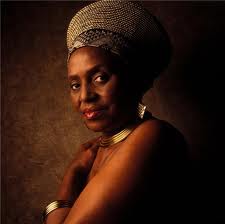
“I look at an ant and I see myself: a native South African, endowed by nature with a strength much greater than my size so I might cope with the weight of a racism that crushes my spirit.” Miriam Makeba
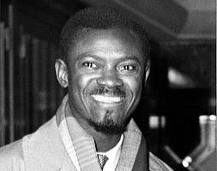
The 30 June 1960 marks the independence of the then Congo-Belge (Democratic Republic of the Congo (DRC)) from Belgium. We will celebrate DRC’s independence today with a poem by one of Congo’s proud sons, none other than its first democratically elected Prime Minister Patrice Lumumba, “Pleure, Ô Noir Frère bien-aimé (Weep, beloved black brother)”. This poem was published in the journal INDEPENDANCE, organe du M.N.C., en septembre 1959 (Cf. La pensée politique de Patrice LUMUMBA, textes et documents recueillis par Jean VAN LIERDE, Présence Africaine, 1963, p. 69-70). Translated to English by Lillian Lowenfels and Nan Apotheker.
Pleure, O Noir Frère bien-aimé
O Noir, bétail humain depuis des millénaires Tes cendres s’éparpillent à tous les vents du ciel Et tu bâtis jadis les temples funéraires Où dorment les bourreaux d’un sommeil éternel. Poursuivi et traqué, chassé de tes villages, Vaincu en des batailles où la loi du plus fort, En ces siècles barbares de rapt et de carnage, Signifiait pour toi l’esclavage ou la mort, Tu t’étais réfugié en ces forêts profondes Où l’autre mort guettait sous son masque fiévreux Sous la dent du félin, ou dans l’étreinte immonde Et froide du serpent, t’écrasant peu à peu. Et puis s’en vint le Blanc, plus sournois, plus rusé et rapace Qui échangeait ton or pour de la pacotille, Violentant tes femmes, enivrant tes guerriers, Parquant en ses vaisseaux tes garçons et tes filles. Le tam-tam bourdonnait de village en village Portant au loin le deuil, semant le désarroi, Disant le grand départ pour les lointains rivages Où le coton est Dieu et le dollar Roi Condamné au travail forcé, tel une bête de somme De l’aube au crépuscule sous un soleil de feu Pour te faire oublier que tu étais un homme On t’apprit à chanter les louanges de Dieu. Et ces divers cantiques, en rythmant ton calvaire Te donnaient l’espoir en un monde meilleur… Mais en ton cœur de créature humaine, tu ne demandais guère Que ton droit à la vie et ta part de bonheur. Assis autour du feu, les yeux pleins de rêve et d’angoisse Chantant des mélopées qui disaient ton cafard Parfois joyeux aussi, lorsque montait la sève Tu dansais, éperdu, dans la moiteur du soir. Et c’est là que jaillit, magnifique, Sensuelle et virile comme une voix d’airain Issue de ta douleur, ta puissante musique, Le jazz, aujourd’hui admiré dans le monde En forçant le respect de l’homme blanc, En lui disant tout haut que dorénavant, Ce pays n’est plus le sien comme aux vieux temps. Tu as permis ainsi à tes frères de race De relever la tête et de regarder en face L’avenir heureux que promet la délivrance. Les rives du grand fleuve, pleines de promesses Sont désormais tiennes. Cette terre et toutes ses richesses Sont désormais tiennes. Et là haut, le soleil de feu dans un ciel sans couleur, De sa chaleur étouffera ta douleur Ses rayons brûlants sécheront pour toujours La larme qu’ont coulée tes ancêtres, Martyrisés par leurs tyranniques maîtres, Sur ce sol que tu chéris toujours. Et tu feras du Congo, une nation libre et heureuse, Au centre de cette gigantesque Afrique Noire.
Weep, Beloved Black Brother
O black man, beast of burden through the centuries, Your ashes scattered to the winds of heaven, There was a time when you built burial temples In which your murderers sleep their final sleep. Hunted down and tracked, driven from your homes. Beaten in battles where brute force prevailed. Barbaric centuries of rape and carnage That offered you the choice of death or slavery. You went for refuge to the forest depths, And other deaths waylaid you, burning fevers, Jaws of wild beasts, the cold, unholy coils Of snakes who crushed you gradually to death. Then came the white man, more clever, tricky, cruel, He took your gold in trade for shoddy stuff, He raped your women, made your warriors drunk, Penned up you sons and daughters on his ships. The tom-toms hummed through all the villages, Spreading afar the mourning, the wild grief At news of exile to a distant land Where cotton is God and the dollar King. Condemned to enforced labor, beasts of burden, Under a burning sun from dawn to dusk, So that you might forget you are a man They taught your to sing the praises of their God, And these hosannas, tuned in to your sorrows, Gave you the hope of a better world to come. But in your human heart you only asked The right to live, your share of happiness. Beside your fire, your eyes reflect your dreams and suffering, You sang the chants that gave voice to your blues. And sometimes to your joys, when sap rose in the trees And you danced wildly in the damp of evening. And out of this sprang forth, magnificent, Alive and virile, like a bell of brass Sounding your sorrow, that powerful music, Jazz, now loved, admired throughout the world, Compelling the white man to respect, Announcing in clear loud tones from this time on This country no longer belongs to him. And thus you made the brothers of your race Lift up their heads to see clear, straight ahead The happy future bearing deliverance. The banks of a great river in flower with hope Are yours from this time onward. The earth and all its riches Are yours from this time onward. The blazing sun in the colorless sky Dissolves our sorrow in a wave of warmth. Its burning rays will help to dry forever The flood of tears shed by our ancestors, Martyrs of the tyranny of the masters. And on this earth which you will always love You will make the Congo a nation, happy and free, In the very heart of vast Black Africa.
Ghanaian inventor, Asidu Abudu, fabricates things to make every day chores easier and faster. Imagine helping women who just finished a whole day in the fields, and who have to come back and pound eba to feed the entire family? Now you have a machine which pounds it for you, and gives you a break, all compliments of this brilliant inventor!















 African Heritage