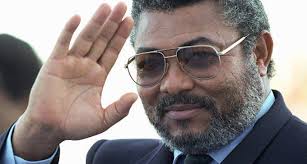
President Jerry Rawlings of Ghana (Source: thecable.ng)
In the video below, you will hear J.J. Rawlings talk about the issues I always talk about on this blog: the loss of the African soul to westernization, the danger of traitors within our ranks, and more importantly the dangers of globalization. I think people should really pay attention to all he has to say about betrayal, African identity, and also about the manipulations of the people by the triumvirate that is the multinationals, the media, and the intelligence.
Kwame Nkrumah, First President of Ghana
On betrayal, Jerry Rawlings said, “Something that is worse than an enemy is a traitor.” This is very reminiscent of the speech Amilcar Cabral gave at the funeral of Ghana’s first president Kwame Nkrumah on May 13, 1972, which I translated to English here on Afrolegends, “The Cancer of Betrayal” by Amilcar Cabral. J.J. adds, “As bad as an enemy can be, … something worse than an enemy is a traitor.”
On African identity, Rawlings affirmed, “In the process of trying to modernize, we [Africans] have ended up being westernized. … When I wanted to even name my children African names, heroic names, … the catholic church said no…they will have to be catholic names … [which] are European names.“… “I have a right to my identity, don’t take away my identity!”
“Christianize me if you may, but don’t westernize me!” He talks about the issues of African identity, which is powerfully shown in the poem ‘My Name’ by Magoleng wa Selepe.
On globalization, “The world is manipulated by the multinational corporations, the media, and the intelligence apparatus, … they work as a triumvirate and they are neatly sandwiched… in between the governed people and the governors… the sooner we begin to return, restore, some sense of morality in business ethics, in politics, in the media, intelligence apparatus, …” apply the same morality to all, especially when talking about globalization, applying the same moral standards to all.
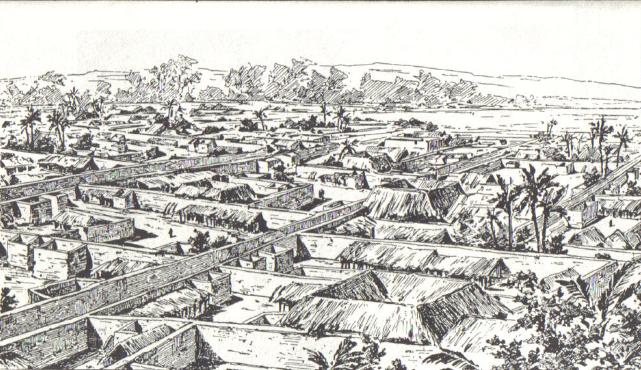
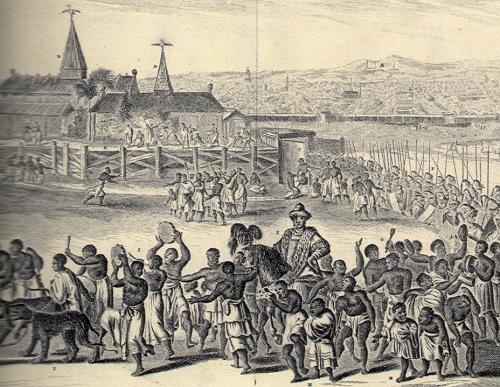
In the 15th century, a Dutch traveler visited the great Benin City, in West Africa, located in modern-day Nigeria, in Edo State. This man was visibly stunned by the beauty and the discipline of the people he met. The city he talks about, Benin City, was so much bigger than Amsterdam, the Dutch capital… and so much cleaner… As you read, please note the wealth of the Benin Kingdom, the well-ordered hierarchy, and lastly note the pride and discipline of the people of Benin City. Also note the mention of the great renowned Benin bronzed sculpting on the pillars. No wonder the British could not help but loot the city [Benin City: the Majestic City the British burnt to the ground] because greed and jealousy had the better of them. Below is his account:
=====
“The town seems to be very great. When you enter into it, you go into a great broad street, not paved, which seems to be seven or eight times broader than the Warmoes street in Amsterdam….
Benin City around 1600
The king’s palace is a collection of buildings which occupy as much space as the town of Harlem, and which is enclosed with walls. There are numerous apartments for the Prince’s ministers and fine galleries, most of which are as big as those on the Exchange at Amsterdam. They are supported by wooden pillars encased with copper, where their victories are depicted, and which are carefully kept very clean.
The town is composed of thirty main streets, very straight and 120 feet wide, apart from an infinity of small intersecting streets. The houses are close to one another, arranged in good order. These people are in no way inferior to the Dutch as regards cleanliness; they wash and scrub their houses so well that they are polished and shining like a looking-glass.”
Source: “How Europe under-developed Africa,” by Walter Rodney, Howard Univ. Press, 1981, p. 69
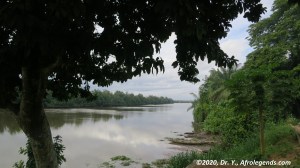
Wouri river and the Djebale island seen on the other side
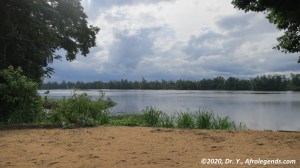
I share here a poem by the Cameroonian poet Elolongue Epanya Yondo about his beautiful native island of Jebale, Cameroon. Note that Elolongue Epanya is the uncle of another great Senegalese-Cameroonian poet David M. Diop known for his amazing poem “Afrique / Africa“. Jebale (Jébalè or Djebale) is an island on the Wouri River, in Douala, Cameroon. It is also one of the places whose kings signed on 15 July 1884, a treaty of protectorate with German merchants from the firm Jantzen & Thormählen, thereby agreeing to the infamous Germano – Duala Treaty signed 3 days earlier on 12 July 1884 by King Bell and others. In 1884, Jebalewas then known as Jibarret.
View of Jebale and the Wouri river, Douala, Cameroon
As you read Yondo’s words, you can imagine the beauty of his homeland, this island, Jebale, on the Wouri river. Jebale is known as the “emerald island, flamboyant jewel” on the Wouri estuary, on the coast of Cameroon. The author cites well-known coastal rivers of Cameroon, the Bimbia creek, the Sanaga River, the Dibamba river, the Kwa-Kwa river, and also notes other islands of the Littoral, Malimba and Suellaba. In this poem, the author anchors his words in the rich tradition of the coastal Sawa people as he cites the Miengu and the Mbeatoe, those big shrimps known as Camarões which led to the name of the country Cameroun via the Wouri River – Rio dos Camarões. For those who have visited Jebale, it is indeed an emerald island, mostly known as a small fishing village; however in the eye of Elolongue Epanya Yondo, it is his love, the one he cannot wait to come back to, from exile. Enjoy!
This poem was published in Paris on February 25th 1972, in revue Présence Africaine, numéro 84 (4e trimestre 1972), re-published in Anthologie Africaine: Poésie Vol2, Jacques Chevrier, Collection Monde Noir Poche, 1988, and translated to English by Dr. Y.Afrolegends.com .
Have you ever had your car stolen? Have you had to file a police report about it? or just spent days looking everywhere for it, scanning every car in the streets in hope of finding your car? Talk of sleepless nights, and endless talks with the insurance company? Now, imagine having the opportunity to track your car, and immobilize it while the thief is driving it away? Wouldn’t that be great? No more need to deal with busy police, or endless talk with insurance… Hooray to peace of mind!
Well, Zuo Bruno, a Cameroonian entrepreneur has created a car security solution just for you: his mobile application, Zoomed, enables people to track their vehicles and immobilize them if they are stolen, with or without internet. Remember that in many places in Africa, internet is a luxury, or is sketchy, … or like in the case of Zuo, the government had shutdown the internet to his province for over 90 days. His application also enables to track the car’s fuel consumption, which is very helpful if you are the owner of a fleet of vehicles, such as taxis. Enjoy this quick video, and salute the ingenuity of a brother!
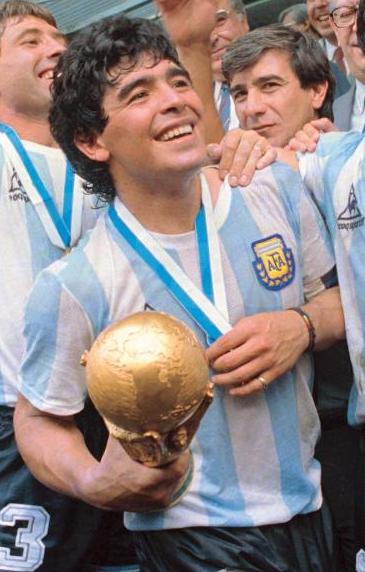
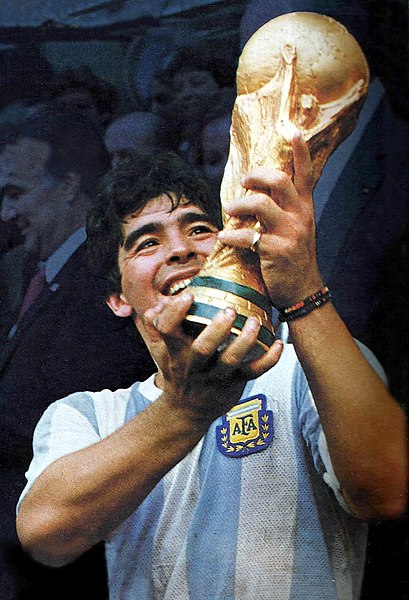
As a kid growing up on the African continent, football is everything… For many it is almost a religion! Which kid has not felt or touched a football? Which one has not been in awe of a football game? My two best football players of all times are Pelé and Maradona. Now Maradona has changed dimensions. I loved Maradona because he was just pure genius, and he had insane dribbling skills. He entered the annals of history for his impressive talent and charisma, for the famous “La Mano de Dios” in 1986, and more importantly for his dribbling from the 60 m line past 5 players to score the goal which was voted “Goal of the Century” by FIFA.com voters in 2002. He possessed an amazing ability, dexterity, and passion for the game on the field. I have viewed countless footings of him as he raised the cup in 1986, just as I watched as he cried for the second place in 1990. Learning to play football meant that you had to watch the maestro, the great Maradona. I have loved every play of this man. The man was a pure genius, an explosion of talent, a force of nature… no wonder that he was nicknamed “El Pibe de Oro” (the golden boy) as a young boy. Maradona was truly a golden boy… He has inspired so many. We all loved to wear the number 10 of Maradona, but very few have been found worthy of it. Just the other day, I found a small statue effigy of Maradona on my colleague’s table… yes So long El Pibe, you have touched all our hearts forever.
Below I share the words of a few famous African players; I have added words by my other all-time player, Pelé, at the end. Cameroon played against Argentina in 1990 and defeated Maradona’s Albiceleste in the opening game, and then went on to be the first African team to advance all the way to the quaterfinals in FIFA World Cup history, so this is special.
Didier Drogba of Ivory Coast said, “RIP Diego Armando Maradona, my first ever football shirt, the man behind my love for football.”
Roger Milla, the great Cameroonian player, a contemporary of Maradona, said, “My great friend Diego Maradona … Rest In Peace LEGEND.”
Diego Maradona lifting the World Cup for Argentina, 1986
“We have lost a legend and an icon,” former Liberia international and 1995 Ballon d’Or winner and now president of Liberia, George Weah tweeted. He added, “… His extraordinary story as a kid who unshackled himself from the yoke of poverty and used his mastery of football to bring joy, inspired millions. May his soul rest in perpetual peace.”
Samuel Eto’o of Cameroon, who like Maradona starred for Barcelona, also reserved special praise for the football icon. “… Maradona will always be with us. He was the idol for a whole generation, and for future generations, for what he did in football. He was from another planet. Diego, you’re god, you’ll always be alive in our hearts,” the former Cameroon international said as quoted by AS.
The other legend, the Brazilian Pelé, had this to say, “… I’ve lost a great friend and the world has lost a legend. One day, I hope we can play ball together in the sky.“
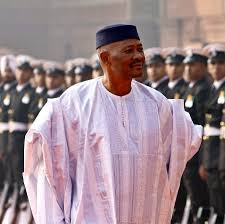
It is sadness that I learned of the passing of Amadou Toumani Touré, one of the former presidents of Mali. Affectionately known by his initials, A.T.T. has been deemed the “soldier of democracy” when after taking power, he handed over the power to the elected president Alpha Oumar Konaré.
ATT was born in 1948 in Mopti, a city which lies west of the Dogon Plateau and northwest of the famous Bandiagara region and north-northeast of the legendary Djenné. He later went to Bamako, and joined the Parachute Corps in the army, where he rose to be the commander of the parachute commandos in 1984. ATT was head of President Moussa Traoré‘s personal guard (and parachute regiment). In March 1991, after the violent suppression of anti-government demonstrations, Conférence Nationale Souveraine movements that shook multiple countries in Africa, turned into a popular revolution, the armed forces refused to fire any longer on the Malian people and Touré arrested President Moussa Traoré. He presided over a year-long military-civilian transition process that led to a new Constitution and multiparty elections, and then handed the power over to Mali’s first democratically-elected president, Alpha Oumar Konaré, on 6 June 1992. Konaré promoted Touré to the rank of General. It is after this that people started affectionately calling him the “soldier of the democracy.”
Map of Mali with its capital Bamako
Ten years later, after an early retirement from the army, Touré entered politics as a civilian and won the 2002 presidential election with a broad coalition of support. He was easily re-elected in 2007 to a second and final term. His presidency was non-conventional as he belonged to no political party, and his government always included people from all parties. On 22 March 2012, shortly before the end of his mandate, disgruntled soldiers initiated a coup d’état that forced him into hiding. These soldiers were mad about the government’s inability to stop the fighting in the north of the country by jihadists (2012 insurgency in northern Mali). As part of the agreement to restore constitutional order to Mali, Touré resigned from the presidency on 8 April 2012 and eleven days later he went into exile.
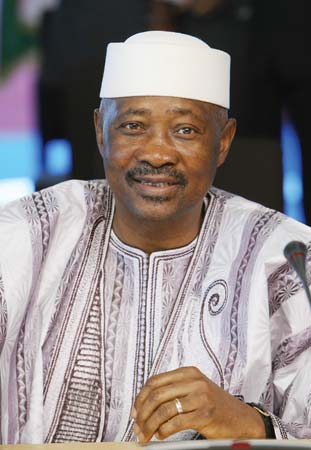
Amadou Toumani Toure – ATT (Souce: Blackfacts.com)
As you can see, this was a man of integrity! When then president Traoré asked the army to keep firing at the Malian people, he stood up and said ‘NO’. He took power, and steered the country towards its first democratic elections. Then he stepped down. Later, he won the presidential election with a coalition, and served 2 mandates. When in 2012 there was a coup against him, he resigned, and left the office. It will be good if the leaders in some of our banana republics (PB, SN, FG, ID, ADO, AC, AB, …) could do this; and more importantly if France could just leave these places!!! But like Thomas Sankara said, «… l’esclave qui n’est pas capable d’assumer sa révolte ne mérite pas que l’on s’apitoie sur son sort. Cet esclave répondra seul de son malheur s’il se fait des illusions sur la condescendance suspecte d’un maître qui prétend l’affranchir.Seule la lutte libère… » [“…the slave who is not capable of assuming his rebellion does not deserve that we feel sorry for himself. This slave will respond only to his misfortune if he is deluding himself about the suspect condescension of a master who claims to free him. Only struggle liberates … “]
President Jerry Rawlings of Ghana (Source: citizen.co.za)
I found this tribute to J.J. Rawlings, and there are many out there, but I particularly liked this one. Excerpts below are from GNN Liberia. For the full article, please visit GNN Liberia. I also added below the short video made by Al-Jazeera.
=====
Not even his harshest critics would begrudge Flt. Lt. John Jerry Rawlings – the late Ghanaian President his place in history as an influential, courageous, tough-talking, bold, impactful leader and charismatic Statesman who left deep impressions on the political landscapes of his country and, indeed, Africa.
J.J. or ‘Junior Jesus” as his admirers fondly called him, exuded great energy and revolutionary ideas. He and his colleagues were unhappy with the inequalities, corruption, and mismanagement that characterised the government of post-independent Ghana and decided to ‘remedy’ the situation in their own way.
… After the May 1979 failed coup, Rawlings was again in the limelight on 4 June 1979, when junior officers broke jail to set him free. But he never allowed the government of his Armed Forces Revolutionary Council (AFRC) to overstay its welcome. By September 1979, Rawlings had handed over power to the elected government of President Hilla Limann. …
Map and Flag of Ghana
Notorious for his very short fuse, J.J. quickly lost patience with Limann’s government, sacking it in another military coup in December1981 military, thus, returning to power as head of the Provisional National Defence Council (PNDC). The Council tried to transform Ghana into a Marxist State and so turned to the Soviet Union for support. But the Communist system was abandoned two years later, with J.J. reluctantly embracing the Western free-market system followed by the devaluation of Cedi – the local currency.
J.J. gained popularity with the free-market reforms, turning economic austerity into a stable economy in the early 1990s, which coincided with the advent of pluralistic democracy in Africa. Moving with the global tide, he won the first democratic presidential election in 1992 and boosted Ghana’s international profile by contributing troops to the regional ECOWAS Ceasefire Monitoring Group (ECOMOG) and the U.N. peacekeeping operations in Liberia, Sierra Leone, Lebanon, and Iraq, among others.
… Rawlings will be remembered for speaking his mind on issues, especially on governance in Africa.
… Butlike every human or any coin, there are at least two sides to Rawlings’ legacy. After all, one man’s terrorist, they say, is another’s freedom fighter!
President J.J. Rawlings of Ghana (Source: thecable.ng)
Today, we will talk about the former president of Ghana, Jerry John Rawlings, affectionately called J.J. Rawlings, who passed away last week. Jerry Rawlings is known as the president of Ghana who ushered in a new era of change and economic prosperity in Ghana. Just like the Ghana of today owes a lot to Kwame Nkrumah the father of its independence, the Ghana of today owes a lot to J.J. Rawlings, the father of its economic stability and face-lift.
J.J. Rawlings (source: citizen.co.za)
Born on 22 June 1947 in Accra, Ghana, to a Ghanaian mother and a Scottish father who refused to recognize him, Rawlings grew up in Ghana and was a proud son of the land. He attended the notorious Achimota School, and later on enlisted as a Flight Cadet in the Ghana Air Force in 1967. He was later selected for officer cadet training at the Ghana Military Academy and Training school. In 1969, he became commissioned Pilot officer, and then won the coveted “Speed Bird Trophy” as the best cadet in flying and airmanship.
He said that it was during his military service in the Ghana Air Force, that he witnessed the deterioration of discipline and morale, and the high level of corruption that had engulfed the army and Ghana as a whole. He also became aware of the immense social injustices prevalent in the country. He then vowed to change that.
Jerry Rawlings during his time in the Ghana air force (Source: ab-tc.com)
On 15 May 1979, five weeks prior to civilian elections, Rawlings and six other soldiers staged a coup against the government of General Fred Akuffo, but failed and were arrested by the military. He was arrested and sentenced to death in a general court martial, but his statements on the social injustices that motivated his action won him popular support. While awaiting execution, he was freed by a group of soldiers. Claiming that the government was corrupt beyond recognition, he led a group in a successful coup against president Akuffo. What has remained engraved in many Ghanaians’ psyche, and has been seen as the real turning point in the history of the country, is when Rawlings with the 15-memberArmed Forces Revolutionary Council (AFRC), primarily composed of junior officers, ruled for 112 days and arranged the execution by firing squad of 8 senior military officers, and 3 former presidents. This was seen as an unconditional message against corruption, injustices at the hand of a few, and a vindication of the people. Elections were then held, and the AFRC peacefully handed the power to the civilian President Hilla Limann, whose People’s National Party (PNP) had the support of Kwame Nkrumah’s followers. Two years later, Rawlings led another coup which ousted Limann. To those in the west who complained and called him on human abuses, he said that he “was representing the conscience of the armed forces, … and the conscience of the nation.” The nation was suffering from so much corruption, and injustices, at the hand of a few who chose to serve the colonial forces at the detriment of their own people, and Rawlings heard their cry. What do you do when you are faced with gangrene? Do you try to clean and patch it or do you amputate it? I do not condone this, and he himself acknowledged that there were regrettable events, but we need to recognize his great work for his country.
Rawlings ruled Ghana longer than any other president, almost 2 decades, winning 2 elections as a civilian. His rule has been hailed as the start of a new beginning, or rather the rebirth of Ghana, and he should be recognized for his impact on Ghana, and also on Africa.
Thomas Sankara, president of the Faso
The charismatic J.J. Rawlings was a great friend of Thomas Sankara, and worked to perpetuate his legacy and revolutionary ideas. When Sankara was assassinated in 1987, Sankara’s wife first found refuge in the Ghana of J.J.. Decades later, when the neighboring country of Cote d’Ivoire and its president Gbagbo were being bombed by foreign forces, Rawlings spoke against it [President J.J. Rawlings denounces the Transfer of President Gbagbo to the Hague tribunal]. He was one of the few African leaders who spoke against the FCFA [The 11 Components of the French Colonial Tax in Africa] and more recently against the ECO [Is France Trying to (re) Colonize Africa?]. His legacy is his pan-Africanism and passion for the continent. This was a man of the people, and it is with great sadness that Ghana mourns the passing of one its great sons, who is celebrated for Ghana’s economic stability.
President J. J. Rawlings of Ghana
On 12 November 2020, J.J. Rawlings passed away at Korle-Bu Teaching Hospital in Accra, just nearly two months after his mother, Victoria Agbotui, in September. The current president, Nana Akufo-Addo has declared a seven-day period of mourning in his honor and flags flown at half-mast. So long comrade… you will be remembered for your hard work and love for your country, and above all for ushering in a new erain Ghana’s history.
On October 4th, 1984, Thomas Sankara addressed the General Assembly of the United Nations. It was a historical speech, as only he, the great orator, could speak. It was moving, it was strong, and it was good. Below is an extract of his speech. For the whole speech, go to thomassankara.net. Enjoy!!!
============
“I speak on behalf of the millions of human beings … thrown out of work by a system that is structurally unjust and periodically unhinged, who are reduced to only glimpsing in life a reflection of the lives of the affluent. I speak on behalf of women the world over, who suffer from a male-imposed system of exploitation. … Women who struggle and who proclaim with us that the slave who is not able to take charge of his own revolt deserves no pity for his lot. This harbors…
I recently watched a documentary made by René Vautier, Afrique 50. This documentary is the first French anti-colonization movie ever made. Vautier was assigned to French West Africa to make an educational film, but upon arrival he witnessed the appalling conditions of the Africans and the crimes committed against them by the French troops. The result was Afrique 50. For making this documentary, he was thrown in jail, and the documentary was banned for 40 years.
I loved Afrique 50 because it showed West Africa in 1950, a different side of it, and the African society with some of its strong culture and identity. It was a society of togetherness. Vautier tried to show different aspects of a normal day: artisans, farmers, weavers, women cooking, a hairdressing for both boys and girls, men called for prayers, fishermen, boat makers, herders, just normal life under the African sun.
He also showed colonization and its nefarious effects on African cultures and the fact that colonization did not help, but rather empoverished the Africans. He says, “a school is opened when the big companies need an accountant” (On ouvre une école quand les grosses companies ont besoin de comptables), or “a doctor is sent, when the big colonial companies risk running out of manpower” (on envoie un médécin quand les grosses compagnies coloniales risquent de manquer de main d’oeuvre).
Afrique 50 by Rene Vautier – The Empire Awaits you, Join the colonial
In his documentary, Vautier shows how the French destroyed entire villages, killed people, women, kids, pregnant women, etc, because the people were not able to bring in a quota of bananas, or cocoa, or rubber, i.e. to pay the tax which was the penny sum of 3700F.
Vautier says, “colonization is the reign of the vultures,” and these vultures are the big multinationals. He cites, Société Commerciale de l’Ouest Africain (650 millions F of profit in 1949), Compagnie française de l’Afrique occidentale (actuelle CFAO) (365 millions of profit in 1949), Dabom (180 millions of profit), L’Africaine Française, le Niger Français, La Compagnie Française de la Côte d’Ivoire, Unilever who made 11 billions 500 millions of profit in a year / 40 millions a day. Not much has changed today!
It also shows why Africa always looks underdeveloped. Isn’t it surprising to notice that today, lots of large-scale agriculture is not industrialized in sub-saharan Africa? Well because it costs less to these multinationals to have Africans labor fields with hoes, machetes, and more, than buying and maintaining turbines, or tractors. This is cheap labor!
Vautier says “A machine will do the job of 20 Blacks of course, but 20 blacks for 50F a day cost less to the company than the machine, so let’s use the Black” (Une machine ferait le travail de 20 noirs bien sûr, mais 20 noirs à 50F par jour reviennent moins cher qu’une machine, alors usons le noir).
Banana plantation in Cameroon
To this day, 70 years later, not much has changed in the rubber plantations of Liberia, or the cocoa plantations of Côte d’Ivoire, or the banana plantations of Cameroon, or in the forests of Gabon.
Africans are still asking for their lands which were taken by the multinationals (Did You Know about the 999-year Lease granted to Europeans in Kenya ?), and to this day the reply is always brutal and violent; when in the past they had the French administrator and police burn down villages, today they have their puppet governments installed everywhere on the continent crushing the people.
La grande mosquee de Djenne (Mali – heritage du grand empire du Mali)
What I also liked in Afrique 50, was that in 1950, the architecture in Africa was still that of our ancestors. One can see Séguéla, Dimbokro, Kétékre, Daloa, Bouaflé, Palaka, etc… it still looks like the great architecture of Timbuktu and Djenné, sublime, and upstanding. The French came, destroyed, and burnt down those villages, and kingdoms. In the Bamiléké highlands of Cameroon, some kingdoms have no real palaces anymore, or the king’s house is made of zinc roofing, because the colonizers had them burnt down (such as the Bazou royal palace) in the 1950s during the maquis years (French President Acknowledges French Genocide in Cameroon) and before. The mud huts seen today across Africa are a result of years of being crushed and under constant attack by foreigners. When you are constantly attacked, you barely have time to rebuild the old ways, and also with time those with the architectural know-how pass away without passing on their knowledge, and more, we are told that building like the Europeans is sign of modernism even if it not adapted to our environment!
Please enjoy this documentary… It is a real eye-opener! Very little has changed in 70 years, the name has morphed from colonization to neo-colonization, to globalization, to cheap labor, and more!