As South Africa‘s President Jacob Zuma opened an exhibition about the life of the country’s first black leader, Nelson Mandela, in Johannesburg yesterday, I thought it befitting to remind you of this great speech by Nelson Mandela where he was prepared to give his life for South Africa, and for his cause. Enjoy! The integral speech can be found here: Nelson Mandela 1964 speech_I am prepared to die.
========
“I am the First Accused.
… At the outset, I want to say that the suggestion made by the State in its opening that the struggle in South Africa is under the influence of foreigners or communists is wholly incorrect. I have done whatever I did, both as an individual and as a leader of my people, because of my experience in South Africa and my own proudly felt African background, and not because of what any outsider might have said….
Nelson Mandela
Our fight is against real, and not imaginary, hardships … Basically, we fight against two features which are the hallmarks of African life in South Africa and which are entrenched by legislation which we seek to have repealed. These features are poverty and lack of human dignity, and we do not need communists or so-called ‘agitators’ to teach us about these things. …
… This struggle is a truly national one. It is a struggle of the African people, inspired by their own suffering and their own experience. It is a struggle for the right to live.
Nelson Mandela clothed in a Pathe’O shirt
During my lifetime I have dedicated myself to this struggle of the African people.I have fought against white domination, and I have fought against black domination.I have cherished the ideal of a democratic and free society in which all persons live together in harmony and with equal opportunities. It is an ideal which I hope to live for and to achieve. But if needs be, it is an ideal for which I am prepared to die.”
The group “Y’en a Marre” with their shirts “Faux pas Force”
Today, I would like to talk about the “Y’en a Marre” (“Fed Up“), a Senegalese group which influenced change in the presidential election of 2012 in Senegal, by forcing President Abdoulaye Wade (and his son, Karim Wade) out of office. Y’en a Marre decided to stop complaining and to start acting, to make the changes they wanted implemented. It is a group of Senegalese rappers and journalists, created in January 2011, to protest ineffective government and register youth to vote. They are credited with helping to mobilize Senegal’s youth vote and oust incumbent President Abdoulaye Wade, though the group claims no affiliation with Macky Sall, Senegal’s current president, or with any political party.
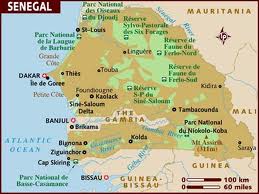
Map of Senegal
The group was founded by rappers Fou Malade (“Crazy Sick Guy“, real name: Malal Talla), Thiat (“Junior“, real name: Cheikh Oumar Cyrille Touré), Kilifeu (both from celebrated rap crew “Keur Gui of Kaolack“) and journalists Sheikh Fadel Barro, Aliou Sane and Denise Sow. The movement was originally started in reaction to Dakar‘s frequent power cuts, but the group quickly concluded that they were “fed up” with an array of problems in Senegalese society. “One day, there was 20 hours of cuts,” said Fadel Barro, whose dimly lit apartment served as the place where the movement took shape. “I said: ‘Guys, everyone knows you. But you’re not doing anything to change the country.’ ”[from NYT interview – see link below]. Those words energized the musicians.
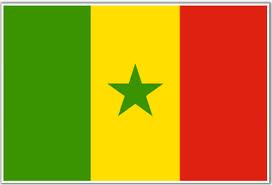
Flag of Senegal
Their goal was to incite Senegalese to vote, to renew the political personnel, to fight against corruption and to promote a sense of civic responsibility. Their most famous quote is: « L’heure n’est plus aux lamentations de salon et aux complaintes fatalistes face aux coupures d’électricité. Nous refusons le rationnement systématique imposé à nos foyers dans l’alimentation en électricité. La coupe est pleine. » [The hour is no longer to ballroom lamentations and fatalistic complaints in the face of power cuts. We refuse the systematic rationing imposed on our homes in the power supply. Our cup is full to the rim.]
Through recordings, rallies and a network of regional affiliates, called “the spirit of Y’en a Marre“, the group advocates for youth to embrace a new type of thinking and living termed “The New Type of Senegalese” or NTS. In late 2011, the collective released a compilation titled “Y’en A Marre“, from which the single “Faux! Pas Forcé” (“Don’t force it”) emerged as a rallying cry for youth frustrated with President Wade and his son and presumed successor. They followed with a single, “Doggali” (“Let’s finish”), which advocated for cleansing the country of Wade and son.
“Y’en a Marre” at a public demonstration in 2012
From April to August 2011, the group and their members campaigned door to door to register young Senegalese to vote at the Presidential election of 2012, and they claimed more than 300,000voters registered. During 2011, they organized manifestations, called “foires aux problèmes” (“problem fairs”), and sit-ins in Dakar’s Obelisk Square. On 15 February 2012, these manifestations were prohibited by Wade’s government, leading to 3 members of Y’en a Marre’s arrest on the 16th. This did not stop the group which continued manifesting until the election of Macky Sall as President. Today, even though Macky Sall has been elected president, Y’en a Marre remains active, hosting meetings, and shows, urging the new government to implement all the promised reforms.
So we can all choose to be the change we want to see, stop complaining, and start acting like Y’en a Marre. If there is anything wrong bothering you in your community, it is possible to work at it, to act upon it, and change it the way you want it to be. Our countries all need it, our continent needs it. Read the article the New York Times did on Y’en a Marre, as well as the UNRIC, and the article on NPR. So let’s us be “fed up” like the Y’en a Marre, and let us act and be the change we want to see.
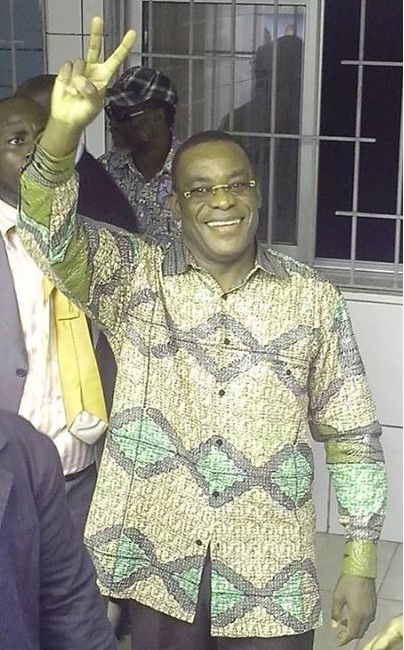
Freedom at last for 12 high political figures in Côte d’Ivoire. These were members of the FPI, Laurent Gbagbo‘s who had been detained without any hearing for the past 2 years. This is a sign that truth and justice always wins. I have translated here a speech by Pascal Affi N’Guessan, one of the detainees and once prime minister of Côte d’Ivoire. This was published on the website of Le Nouveau Courrier. For the audio and integral text, go to Le Nouveau Courrier. Thank goodness for this… and let us keep fighting for freedom and true democracy (not the one manufactured by the IMF, in Europe or the US, but what will work for us).
=========
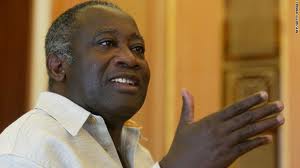
Président Laurent GBAGBO
I would like to, before giving any speech, first greet you and thank you wholeheartedly. If we can stand here today in front of you, don’t be fooled. There are no three explanations. There are no two explanations. There is only one explanation. It’s your engagement, it is your determination, your strength, it is your rejection of an unfair situation that was made in Côte d’Ivoire which explains why we can stand before you today. This explains why yesterday other comrades were released. This explains why yesterday Bê Diabaté and other comrades […] have been released. And it is this mobilization which will explain tomorrow’s normalization in Côte d’Ivoire, the release of all our comrades who are still detained, the return from exile of all our comrades who were forced to flee their own country, and the return to us of President Laurent Gbagbo.
… The original project [Ouattara regime] is not to let the FPI exists as a political party. The ambition nurtured by those who came to power under the conditions that we know is not to reinstate democracy. It is not to let a party as powerful as the Ivorian Popular Front party exist. (…)
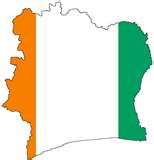
Cote d’Ivoire
Dear Comrades, you defeated the odds. You have proven that the Ivorian Popular Front (FPI) was intractable. You have proven that the Ivorian Popular Front was a spirit. You have proven that the people of Côte d’Ivoire did not want to backtrack. And its course is determined to be democracy, to be progress, to be freedom. And it is because our opponents have realized this fact, because we have imposed this reality, that we stand here today in front of you.
Today is a day of rejoicing. A day to celebrate this milestone in our struggle. That is why it may be too risky to go further. But know that we do not have three programs, we do not have two programs, we have one program. And this program is the program of the people of Côte d’Ivoire. And this program are the aspirations of the people of Côte d’Ivoire. And this program is to resolve all the problems that prevent this country from becoming a modern and prosperous country. This is our program!
Pour continuer sur la même lancée, je voudrais vous faire part de cette vidéo: “Cameroun: Autopsie d’une pseudo-indépendence” par Gaëlle Le Roy et Valérie Osouf. Cette vidéo porte sur les années noires du Cameroun, les années de repression, les années du maquis, les années du génocide en pays Bamiléké, et les techniques utilisées par Roland Pré, alors Haut-commissaire muté au Cameroun en 1954. Pour en savoir un peu plus, visiter le site: Kamerun-leSite qui fait état de cette guerre cachée qui sévira au Cameroun pendant plus de 20 ans et qui fera plus de 300,000 morts.
Castor Osendé Afana‘s maquis suffered a major defeat, and a final blow with the murder and decapitation of its leader on 15 March 1966. Here are some of the principal reasons of the defeat of the Boumba-Ngoko maquis in the south east corner of Cameroon. These reasons had been identified by Osendé Afana himself before his death, and by his some of his followers later on.
1 – The Boumba-Ngoko region (or Moloundou region) had not been exposed to any revolutionary movement, or any influx of political ideas about the liberation of Cameroon since the end of the second world war, like the populations of the West, Littoral, Center or Southern provinces. The populations there being mostly Bakaspygmies and poor Bantous peasants and illiterate had almost never led major economic or political struggles against the exploitation and domination of the colonial and neocolonial forces. Their political awareness was quite low, and they had very little experience fighting.
2 – The region was sparsely populated, which forced the guerilleros, who were supposed to move around the people as fish in the sea, to fight practically in the open against a very powerful enemy.
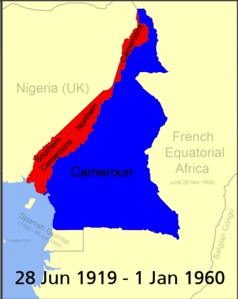
Map of Cameroon from 1919 to 1960, including both Cameroons (French in Blue, and British in red)
3 – The low number in Afana’s group which kept decreasing due to several desertions. It was also very difficult to recruit among the local people.
4 – No members of the initial group were originally from that region, and thus had little knowledge of the field, the language, and customs of the local populations.
5 – The maquis’ entrance from Congo-Brazzaville had happened without much discretion, and all their subsequent movements in the region did not go unnoticed. This made it easy for the colonial forces to trace them.
6 – No prior ground study had been done.
7 – The government of Congo, while giving their support to Afana, were opposed to any military action on their borders.
8 – Several tactical differences persisted within the group, with Osendé Afana, being more political and anxious of respecting the Congolese wishes, and with Fosso Francois, who was more military-centered.
9 – No prior contact/communication had been established with the Western maquis led by Ernest Ouandié. This could have ensure some help.
10 – An incorrect assessment of the colonial forces, their tactics, their capacity of enrolment, and the political activity of the masses on the national scale.
11 – Lastly, too big a reliance on external help.
For more information, visit afrohistorama.com to learn more about these critical events in the history of Cameroon.
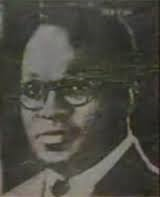
Brilliant economist, Castor Osendé Afana is considered a national hero in Cameroon, however he is not as well-known as Ruben Um Nyobé, or Felix-Roland Moumié, or even his alter ego on the western front of Cameroon, Ernest Ouandié. Like those three, he was also assassinated, and paid with his life for his passion for the freedom of Cameroon, and Africa from colonialism. So who was Castor Osendé Afana?
Well, Castor Osendé Afana was born in 1930 in Ngoksa near Sa’a, in the Centre Region of Cameroon. In 1948 he was admitted to the seminary at Mvolyé, in Yaoundé, where he became a strong friend of Albert Ndongmo, the future Bishop of Nkongsamba. He was excluded from the seminary in 1950 because of his critical and rebellious character. It is as a ‘candidat libre’ that he successfully passed the first part of the Baccalauréat. He then started in philosophy at the Lycée Leclerc where he headed student manifestations demonstrating against the poor food service there. He nonetheless went on to successfully pass the 2nd part of the baccalauréat in 1952.
Later, Osendé Afana obtained a full scholarship to study Economics in Toulouse, France. By 1956, he was a vice-president of the Black African Students Federation in France (Fédération des étudiants d’Afrique noire en France – FEANF), and was managing director of the FEANF organ L’Etudiant d’Afrique noire.As a UPC militant he ensured that the issues of Cameroon were well-covered in the magazine.In 1958, Osendé Afana was named General Treasurer of FEANF, as well as being responsible for the UPC in France.
UPC Leaders (L. to R.) front row: Castor Osende Afana, Abel Kingué, Ruben Um Nyobé, Felix Moumié, and Ernest Ouandié
After the French government dissolved the UPC by decree on 13 July 1955, most of the UPC leaders moved to Kumba in the British-administered Southern Cameroons to avoid being jailed by the colonial power. In July 1957, under pressure from the French, the British authorities in western Cameroon deported the leaders of the UPC to Khartoum, Sudan. They moved in turn to Cairo, Egypt, to Conakry, Guinea and finally to Accra, Ghana, where they were hosted by President Nkrumah. In 1958, after Ruben Um Nyobé’s death, Osendé Afana decided to abandon his thesis and rejoin the leadership of the UPC, proposing himself as a candidate for the new Secretary General. Nyobé’s successor, Félix-Roland Moumié, told him “There is no longer a Secretary General. There was one, he is dead, that is it.” However, Osendé Afana was designated UPC representative at the Afro-Asian People’s Solidarity Conference in Cairo in December 1957 – January 1958. After Cameroon’s independence in 1960, the UPC continued to fight the government of President Ahmadou Ahidjo whom they considered a puppet of the French colonial power. Continue reading “Castor Osendé Afana: A Cameroonian National Hero”→
President Barack Obama with President Macky Sall of Senegal
I would like to share the following article on Pambazuka by Antoine Roger Lokongo, summarizing and identifying key questions for Obama’s last visit in Africa. Like he points out so well, Obama’s visit was a tour to counter China’s influence in Africa. Make up your own opinions, and please think: what should be the future of African relations with the United States, Europe, China, and others? What will be fair for African countries? How do Africans impose themselves at the bargaining table?
=======
[…] There is a Chinese proverb which says that, ‘When the water subsides the rocks emerge’. Now that the ‘Obama fever’ has evaporated, all that remains is a stark reality that we are faced with: Barack Obama is the President of the United States of America who went to Africa to defend and promote America’s strategic interests, perceived as being threatened by China’s strong presence in the continent. … Obama’s African tour was about countering China’s influence in Africa. Despite his charm offensive to woo Africa, depicting it as a ‘hopeful continent on the rise and with which America can partner and do business on an equal footing and ‘win-win’ basis’, perhaps taking a leaf from the Chinese ‘win-win’ international relations lexicon, Africans should treat him as such: A US president who went to Africa to build strategic military and business ties with Africa in the face of China’s surge in the continent.
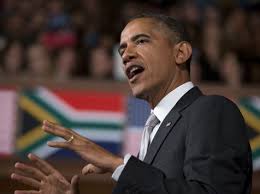
President Obama in South Africa
[…] In his speech at the University of Cape Town, South Africa, President Obama rebuffed the criticism often coming out of Africa according to which democracy and transparency, those values which America holds dearly, are somehow Western exports and that it is intrusive and meddlesome of America to impose them on Africa. … he pointed out that ‘those in power in Africa who make those arguments are usually trying to distract people from their own abuses. Sometimes, they are the same people who behind closed doors are willing to sell out their own country’s resource to foreign interests, just so long as they get a cut’. It is hard to argue against that. The question, however, is, what if those foreign interests are American?
It is hard to believe that America does not tell African people who their leaders should be, but stand up with those who support the principles that lead to a better life. The list of African leaders who were assassinated by the CIA because they put the interests of their people first and refused to blindly serve American interests is very long. The list of leaders (living and dead) who were hoisted to power to serve America’s strategic interests and heaped with praises they do not deserve from the White House is also very long. In Congo, Patrice Lumumba was assassinated and Mobutu Sese Seko was hoisted to power. As far as we know, there are no strong institutions, such as independent judiciaries that can enforce the rule of law; honest police forces that can protect the peoples’ interests instead of their own; an open government that can bring transparency and accountability in Rwanda and Uganda today. But there are two strongmen who are supported and protected by Britain and America so long as they serve as proxy forces in Congo. They are presidents Yoweri Museveni and Paul Kagame!
China’s presence in Africa
In fact, today, apart from the Chinese mining contracts in whichthe Congolese state (DRC) retains at least 32% of stakes, the stakes of the Congolese state in all other mining contracts the government has signed with Western mining companies do not go beyond 20%! So, Western powers still enjoy the lion’s share in Congo. In Zimbabwe, the government retains 51% stakes in each mining contract, not like in the DRC. That is what should be emulated by all other countries throughout Africa. The Chinese respect our laws and rules of the game and are massively investing in Zimbabwe under those rules, but Western countries see a problem with that policy in Zimbabwe where the economy is recovering without Western financial help and despite Western sanctions (so Mugabe is not pocketing all the money). Without African countries drawing their own rules and laying them on the table for their external partners to follow and not the other way round, African independence will remain meaningless and Africa will totally be owned by the outside world, in other words, by people who come and loot Africa’s wealth through predatory wars and then return to Africa as investors! Continue reading “Analysis on Obama’s 2013 Visit to Africa”→
Since we are on the subject of Soweto 1976, and since last week Madiba (Nelson Mandela) gave us a scare, I decided to publish the song ‘Asimbonanga’ by Johnny Clegg. ‘Asimbonanga‘ or ‘We have not seen him’ was released by Johnny Clegg and Savuka, in the album Third World Childin 1987, and called for the release of Nelson Mandela, and also gave homage to three martyrs of the anti-apartheid struggle: Steve Biko, Victoria Mxenge, and Neil Aggett. I have posted the song with lyrics below (translation of the Zulu words to English is in italics). Enjoy, and don’t forget to visit Johnny Clegg’s website: johnnyclegg.com.
With the cleansing ceremony for the Marikana massacre taking place today, I couldn’t help but think about similarities, if any, between the Soweto uprisings of 1976, and the Marikana miners’ strike of 2012.
First of all, the Soweto uprising on June 16, 1976, was a movement of school children protesting against the use of Afrikaans as a medium in school and the fact that this was essentially limiting their career opportunities leading them to mostly menial jobs later in life; besides Afrikaans was the language of the oppressor, and in itself a symbol of oppression. The school children were reprimanded in blood by police from the apartheid government of John Vorster. It was a brutal repression. The pictures, particularly, that of Hector Pieterson‘s dead body being carried away by another student alongside his sister, were just heart-wrenching.
Soweto uprising 16 June 1976
Over 30 years later, Marikana happened, albeit not on the same giant scale. Miners protesting for wages were repressed in blood by the police on 16 August 2012; this time under the free government of the rainbow nation led by Jacob Zuma. The violence used by the police was just as shocking, and has been compared by the media to the Sharpeville massacre.
Hector Pieterson being carried away by Mbuyisa Makhubo, with his sister running alongside (Photo by: Sam Nzima)
The similarities are important: both events showed police brutality against unarmed school children (Soweto 1976), and unarmed miners (Marikana 2012); Note: there are some claims that one miner shot first at the police before the police opened fire at Marikana, and images show that some of the miners had machetes. Both events showed poor judgment (more like lack of judgment) from government, and police repressive use of force. Both events harbored bloodshed. What Marikana 2012 showed us is that police brutality is the same decades later. I always wondered why didn’t the police use fake bullets in both cases? If the police was trying to restore order in both cases, why not use common sense and use rubber bullets instead? They have the upper hand and the bullet proof vests (and the dogs), they should act like the adults in the play.
Miners demonstrating at Marikana
The main difference, is that unlike Marikana, where the police was dealing with adults, the police in Soweto dealt with school children. Where is this world going when we now attack, hurt, and kill children?Has the human race descended so low? And the apartheid government had a clear agenda against color and race, while the current government’s agenda seems to be driven by capitalism. The children of Soweto were demonstrating for a better education, while the miners of Marikana were workers demonstrating for increased wages…
In the end, Soweto 1976 cannot be compared to Marikana 2012, where the government did not even conduct an investigation, and did not present apologies (or did they?) as they did not consider the lives of these Black children relevant in the apartheid society. And even today, one can see the difference between both events in the length at which Marikana was covered in the South African press, and the small number of archives (accessible?) on Soweto 1976. Besides, Soweto 1976 marked a turning point in the end of the apartheid regime. One thing is for sure, both events should never happen in the history of a nation.
This is my two-cents on this… What do you think were the similarities between Marikana 2012 and Soweto 1976? Were there similarities in your opinion? As people protest around the world, how do you stop police brutality? How do we ensure that lives are preserved, while populations’ protests are taken into account?
Soweto uprising: children walking peacefully (Source: Ezakwantu.com)
The Soweto massacre or Soweto uprisings also known as June 16, were some of the biggest massacre of the apartheid regime in South Africa, mostly because it showed police repression against kids. On June 16, 1976, Black high school children in Soweto protested against the Afrikaans medium decreeof 1974 which forced the schools to use Afrikaans as one of the main languages in schools (50-50 with English): Afrikaans was to be used to teach mathematics, arithmetic, etc… In the 1950s, 60s, and 70s, many people preferred English as the school language, the commerce language, etc, because of the violence attached with Afrikaans which was the language of the oppressor.
Soweto Uprising: children running away (Source: kilimedia.com)
On June 16, 1976, over 20,000 school children took part in protests which left over 700 dead (the official numbers say 176, but we all know that this number could not be further from the truth). On that bright morning, 10,000 – 20,000 black students walked from their schools to Orlando stadium for a peaceful rally against the use of Afrikaans, the oppressor’s language, in school. The protest had been carefully planned by the Soweto Students’ Representative Council’s (SSRC) Action Committee, with support from the Black Consciousness Movement, and teachers from Soweto. The students were marching and they found out that police had barricaded the road along the intended route. The leader of the SSRC action committee then asked the crowd not to provoke the police, and the march went on on a different route, eventually ending up near Orlando High School. The students were marching, singing, and waving placards with slogans such as, “Down with Afrikaans“, “Viva Azania“, and “If we must do Afrikaans, Vorster must do Zulu.”
Hector Pieterson being carried away by Mbuyisa Makhubo, with his sister running alongside (Photo by: Sam Nzima)
One officer shot and fired his gun causing panic and chaos. Students started screaming and running, as more gunshots were being fired, and the police let out their dogs on children who responded by stoning the dogs. The police then began to shoot directly at the children. One of the first students to be shot dead was 13-year-oldHector Pieterson, who became the symbol of the Soweto uprisings. The picture of his dead body being carried away by another student while his sister ran beside them in tears, was captured by news photographer Sam Nzima, and made it worldwide. The police patrolled the streets throughout the night as the students came under intense attack. Emergency clinics were swamped with injured and bloody children. The police requested the hospitals to provide a list of all victims with bullet wounds, but the doctors refused to create the list, and recorded bullet wounds as abscesses. On the 17th of June, 1,500 heavily armed police officers were deployed to Soweto carrying automatic rifles, stun guns, and carbines. They were driving in armored vehicles with helicopters, while the South African army was ordered on standby… for repression onto school children.
In the end, the Soweto uprising established the leading role of African National Congress (ANC) against the apartheid regime; it marked the turning point in the opposition to white rule in South Africa. Formerly, the struggle had been fought outside South Africa, in neighboring countries (Rhodesia – Zimbabwe, South-West Africa – Namibia, and Angola), but from that moment forward, the struggle became internal as well as external.
June 16th is now celebrated in South Africa as a public holiday. Enjoy this quick collage about the events of June 16th, and please remember to commemorate the lives of innocent children killed on this day in South Africa, children whose future were ended too early. Don’t forget to check out these articles on BBC, Libcom.org, South Africa Info, and watch the video on Independent Lens on PBS.