African Athletes to Watch for at the 2012 London Olympics

2012 London Olympics

With the start of the 2012 London Olympics, I thought about giving you a hint as to who to look out for, and who are those brilliant athletes representing the continent at the Olympics.  Here is a list of some of the outstanding ones… There is no particular order.  If I have missed a big one, please send me his/her name.


Athletes Country Discipline Achievements
Kenenisa Bekele Ethiopia 5,000m & 10,000m Reigning world and Olympic champion (male)
Tirunesh Dibaba Ethiopia 5,000m & 10,000m Reigning world and Olympic champion (female)
Cameron van der Burgh South Africa Swimming Gold medalist 100 m breaststroke 2012 olympics
Amantle Montsho Botswana 400 m & 800 m track & field African champion
Jonathan Akinyemi Nigeria Canoe-Kayak
Blessing Okagbare Nigeria 100 m, long and triple jump 2008 Olympics Bronze medalist long jump
Caster Semenya South Africa 800 m, 1500 m 2011 World Champion Silver medal (800m)
Vivian Cheruiyot Kenya 5000 m 2009 world champion
Silas Kiplagat Kenya 1500 m 2010 Commonwealth gold champion
Tosin Oke Nigeria Triple jump 2011 All-African Games gold medalist
Ruddy Zang Milama Gabon 100 m 2012 African champion
Taoufik Makhloufi Algeria 800 m, 1500 m 2012 African champion (800 m)
Alaaedin Abouelkassem Egypt Men’s Fencing 2010 World Junior champion
Ndiss Kaba Badji Senegal Long jump 2012 African champion
Pamela Jelimo Kenya 800 m 2008 Olympic Gold medalist
Kirsty Coventry Zimbabwe Swimming Olympic Gold medalist 2004, 2008 (2 gold, 4 silver, & 1 bronze olympic medals)
Khotso Mokoena South Africa Long jumper 2008 Olympic silver medalist
Antonia de Fatima Faia Angola Judo Bronze medalist World champion
Zersenay Tadese Erithrea 10,000 m 2004 Olympic bronze medalist
Wilson Kipsang Kenya Marathon 2012 London Marathon winner
Mary Keitany Kenya Marathon 2012 London Marathon winner
Amaechi Morton Nigeria 400 m hurdles 2012 African championship gold medalist
Oscar Pistorius South Africa 100m, 200m, 400 m 2004, 2008 paralympic gold medalist
Samuel Kamau Wanjiru Kenya Marathon 2008 Olympic gold medalist
Chad le Clos South Africa Swimming (200 m butterfly) Commonwealth gold medalist
Benjamin Boukpeti Togo Canoe (K-1 Kayak single) 2008 Olympic bronze medalist
Oussama Mellouli Tunisia 1500 m freestyle swimming 2008 olympic Gold medalist

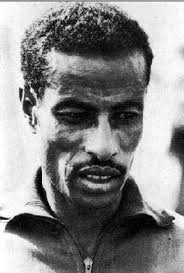
Abebe Bikila: Emperor of the Distance and Running Barefoot

Abebe Bikila
Abebe Bikila

Today I would like to talk about Abebe Bikila, one of Africa’s finest athletes, who marked the entire continent by his strength, endurance, and love of his country, and continent.  Abebe Bikila was an Ethiopian athlete and the very first African to win an Olympic gold medal in 1964 (remember that previous winners like Alain Mimoun from Algeria competed for France, since Algeria was still a French colony).

Coincidentally born on the day of the 1932 Los Angeles Olympics, Abebe Bikila opened his eyes to the world in the small village of Jato, near the town of Mendida in Ethiopia.  As a young adult, one could already sense his determination, as he decided to join the imperial guard, and walked the distance of 130 km separating him from Addis Ababa.  Thereafter he started as a private guard.  Soon after, he was spotted by Onni Niskanen, a Swede, who had been hired by the government to train athletes.

Abebe Bikila on the podium in 1960 Olympics in Rome
Abebe Bikila on the podium during the 1960 Olympics in Rome, after winning the gold medal in the marathon, and surrounded by Rhadi Ben Abdesselam of Morocco (silver) and Barry Magee of New Zealand (Bronze)

He made it to the 1960 Rome Olympics as a replacement to Wami Biratu who had just injured himself.  At the shoe-trial, Adidas, the Olympics sponsor, had very few shoes left, and none of them were comfortable to Bikila.  In the end, Abebe Bikila ran the marathon barefoot in Rome’s cobblestone streets.  He won the marathon in a record time of 2:15:16.2 improving the previous record by 8 min, thus giving Africa its very first gold Olympic medal. When asked why he ran barefoot, he said: “I wanted the world to know that my country, Ethiopia, has always won with determination and heroism.” The symbolic was huge, since there on the track course was the Axum Obelisk, which Mussolini had plundered away from Ethiopia… and 24 years later, Abebe Bikila, a small Ethiopian, from the imperial guard of Emperor Haile Selassie, marched over Rome and conquered!

40 days prior to the 1964 Tokyo Olympics, Abebe was operated for an appendicitis.  His sense of determination was so strong that he would train at night in the hospital courtyard, during the recovery.  Once in Tokyo, Abebe Bikila set a new world record, 2:12:11:2, and won the race far ahead of the pack, and still full of energy. The police estimated that 1 million people lined up the streets to cheer Abebe Bikila. He was the first person in history to win a gold medal for the marathon back-to-back.  Back home, Bikila was given a hero’s return by Emperor Haile Selassie and all of Ethiopia.

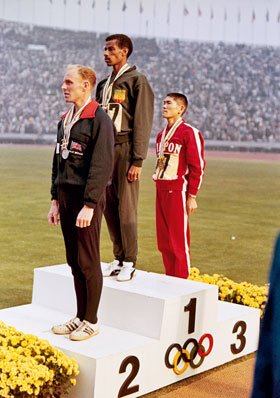
Abebe Bikila on the podium of the 1964 Tokyo Olympics
Abebe Bikila on the podium of the 1964 Tokyo Olympics, after winning gold in the marathon, and surrounded by Basil Heatley of Great Britain (Silver) and Kokichi Tsuburaya of Japan (Bronze)

At the 1968 Mexico City Olympics, Abebe Bikila tried to repeat his win, but had to surrender after 17 km due to a severe injury to his knee. He told his teammate Mamo Wolde, as he was living the race: “The responsibility of winning a gold medal for Ethiopia is in your shoulder.

It pains me to know that this great Olympian finished his life on a wheelchair.  During the civil unrest of 1969, trying to avoid a crowd, he lost control of his car, and landed in a ditch.  He was left paralyzed by the accident, as a quadriplegic.  After several operations, his condition improved to the point where he was a paraplegic.  While in wheels, Abebe’s competitive spirit and desire to see his country’s flag hoisted high and proud helped him compete and win several more races.  In 1970, he participated in a 25 km cross-country sledge competition in Norway where he won the gold medal. Again, in the same tournament, he won a similar 10 km race where he was awarded a special plaque.

Abebe Bikila died in 1973 from complications from his accident, 4 years earlier.  His funeral was attended by more than 75,000 people, and emperor Haile Selassie proclaimed a national day of mourning for Ethiopia’s national hero.  Newspapers throughout Africa eulogized him as an inspiration to their athletes and youths, some of whom won gold medals in future Olympics.  A stadium in Addis Ababa was named in his honor.

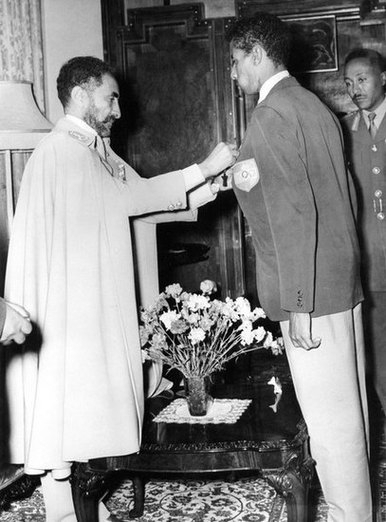
Abebe Bikila honored by Emperor Haile Selassie
Abebe Bikila honored by Emperor Haile Selassie I

Please check out the website dedicated to Abebe Bikila, and this great article on Abebe Bikila on Ethiopians.com,  and enjoy the poem written in praise of Bikila’s great heroism.  The lines I liked were: Abebe Bikila, With you, Our dreams  Never broken … The foot soldier Of forty years Led Ethiopians to run… And this said he in silence: We are the Ethiopians Whose lions made to sleep Need to run twice as fast!” … Running for Victory With that Abe’s Legacy.  Yahoo had a really good article on him, while the The Guardian had a really good photojournal to honor Bikila’s life and legacy.  Lastly, click on this Facebook page and check out the movie Abebe Bikila made in his honor.  Throughout his illustrious athletic career, Bikila had competed in more than 26 major marathon races.  The world championships he won in 1960 and 1962 deserve special recognition, as well as the Osaka marathon of 1961Bikila became the first runner ever to win two Olympic marathon gold medals, and the first African ever to win double gold at the Olympics.  As the olympics approach, please remember this great African athlete who inspired so many, and was so determined that even as a paraplegic he still won gold medals.

Amilcar Cabral and Cape Verdeans in the USA

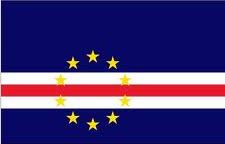
Flag of Cape Verde
Flag of Cape Verde

Over a year ago, I was contacted by Mike Costa, a gentleman who was making a documentary on Cape Verdeans in California, and their history in relation to their homeland.  The gentleman really liked my article on Amilcar Cabral and wanted my contribution.  I was delighted to help in any way possible.  Two months ago, I received an e-mail with a link to the trailer to the documentary which was coming out in the US.  I must admit that this made me extremely proud to have helped (in any way) in his project, and most importantly to see the final product which is truly a praise of Cape Verdeans in the bay area, and Cape Verdeans in general.  Enjoy the trailer… and if you have a chance, leave a comment on his website ProudTobeCapeVerdean.com or under his YouTube video or buy the DVD to show your support of his great work.  This is a non-profit endeavor that shines a well-deserved light on the California Cape Verdean community.  Like he says on his website: ” If we don’t tell our story, who would?”

Frankie Fredericks: Sprinting to the Finish for Namibia

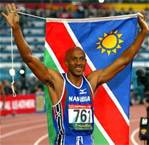
Frankie Fredericks raising the flag of Namibia

The athlete of the week is Frankie Fredericks: the handsome, good-looking, strong, fast, and powerful brother from Namibia.  Yep that’s right, Frankie Fredericks is one of those athletes I loved watching in the 1990s.  Always consistent, always strong, and everpresent, Frankie Fredericks was a force to reckon with.  How many silver medals has he gotten while contending the 100 m and 200 m at the Olympics?  4 Silver medals!  That’s right, an African with 4 silver olympic medals!  He has also won several gold medals at the World Championships, World Indoor Championships, All-Africa Games, and Commonwealth Games.  He is thus far Namibia’s only olympic medalist.

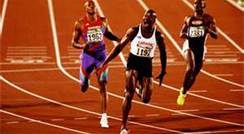
Frankie Fredericks coming 2nd to Donovan Bailey during the 100 m finale at the 1996 Atlanta Olympics

Born in Windhoek, Namibia’s capital, Frankie began running at the age of 13, and particularly loved football (soccer for Americans).  However, when he was awarded a scholarship to attend Brigham Young University, in the USA in 1987, he quickly moved his passion to track and field.  In 1991, as Namibia gained independence from South Africa, Frankie started officially compete for his country.  At the Barcelona Olympics in 1992, Frankie Fredericks won 2 silver medals in 100 m and 200m, giving Namibia its very first olympic medal.  In 1996 at the Atlanta Olympics, Frankie again won 2 silver medals coming 2nd to Donovan Bailey in the 100m, and 2nd to Michael Johnson in the 200 m.  Due to injuries, Frankie was absent at Sydney Olympics in 2000, and Namibia dearly missed him there.  He raced the 200m at the Athens Olympics in 2004, and came out 4th, and finally retired at the end of that year at the age of 37 (Imagine a 37 year-old sprinter coming 4th at the olympics, running against young folks like Shawn Crawford, Justin Gatlin, and Bernard Williams).  At the beginning of that run in Athens, Frankie was given a standing ovation that lasted few minutes, and at the end, he said “It is quite emotional, … I always wanted to go out with a medal, but sometimes in life you don’t get everything you want.” Frankie has run the 100 m under 10 s more consistently than most athletes (he is ranked 4th behind Ato Boldon of Trinidad & TobagoMaurice Greene of the US, and Asafa Powell of Jamaica).

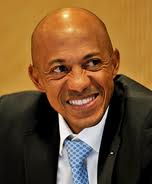
Frankie Fredericks
Frankie Fredericks

Off track, Frankie has a computer science degree and a masters of business administration, and he has created the Frank Fredericks Foundation to foster young Namibian athletes. In 2004, he was  elected by fellow athletes to serve on the board of the International Olympic Committee. Please check out the tribute to Frankie Fredericks given by International Association of Athletics Federations IAAF athletics.

The personable and wildly popular Fredericks spent the greater part of a decade-and-a-half at the pinnacle of his craft, a record for longevity nearly unprecedented in the sprints.  What was always fun about watching Frankie run was his consistency: Frankie was constant on the distance, and a very reliable athlete, training hard to represent his country and continent at the highest level.  I am sure most people had never heard of the country Namibia, but when Frankie was running, the whole world could hear and feel Namibia rising!

Mozambique’s First Gold Medal, and World Greatest 800m Runner: Maria Mutola

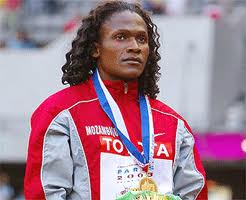
Maria Mutola winning gold in Sydney

With the olympics fast approaching, I have decided to feature one African athlete per week to keep us in Olympics mood. Today, I would like to talk about an athlete hailing from Mozambique: Maria Mutola.

Maria de Lurdes Mutola was born in Maputo, the capital of Mozambique, and was running so fast that she was nicknamed ‘The Maputo Express’.  She specialized in 800 m, and is the 4th athlete to have competed in 6 olympic games (imagine that: the olympic games happen every 4 years… thus it took a total of 24 years of intense competition at the highest level, as a world class athlete).  As a young girl, she excelled in football(soccer), and played with boys.  Later on, she was encouraged by the great

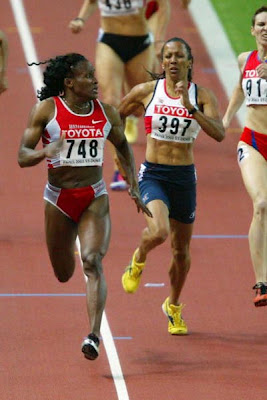
Maria Mutola defeating Kelly Holmes at World Championships

Mozambican writer Jose Craveirinha to pursue track and field.  Her very first olympic was in 1988 at the Seoul Games, at the age of 15.  She finished last, but this made her even stronger.  After that, she dominated the 800 m distance, winning the gold medal at the IAAF World Indoor Championships in 1993 and 1995, and the Stuttgart 1993 IAAF World Championships.  She won the bronze medal in 1996 at the Atlanta Olympic games, and finally won a sweet Gold medal at the Sydney Olympic Games in 2000.  Mutola retired from track and field at the 2008 Beijing Olympics where she sadly finished 5th, after being in contention for a medal.  Mutola is often ranked as the greatest female 800 m runner of all time, since her consistency, her record at major championships and her ability to compete at the highest levels of the sport for well over a decade are unmatched.

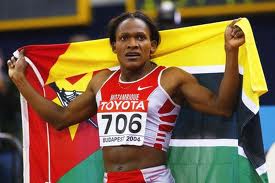
Maria Mutola raising the flag of Mozambique

As a sports fan, I watched Maria at the 1995 World indoor games in Barcelona.  The year 2000 was so special, as we all saw Maria finally lift the Olympic gold medal for Mozambique, at the Sydney games.  In 2003, she became the sole winner of the IAAF $1million Golden league title, for being undefeated throughout that year at all major competitions.  I have always been a big fan of hers, even though I always thought that she had too much of a ‘male’ physique.  With that physique, she ran with power and grace, and raised the flag of Mozambique with pride.  Greatness to you Maria, you’ve made us proud!

La Dernière Lettre de Patrice Lumumba / Patrice Lumumba’s Last Letter

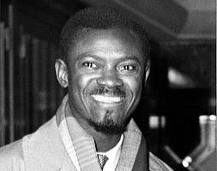
Patrice Emery Lumumba

Avec la commémoration de l’indépendance du Congo Démocratique acquise le 1er Juillet 1960, j’ai trouvé bon de poster cette si belle lettre de Patrice Lumumba à Pauline, sa femme (c’est d’ailleurs sa dernière lettre) était très appropriée, car bien que triste, elle est pleine d’espoir à la pensée qu’un jour le Congo sera libre, à la pensée que les enfants congolais doivent tous s’unir pour re-bâtir le Congo!

Ma compagne chérie, Je t’écris ces mots sans savoir s’ils te parviendront, quand ils te parviendront et si je serai en vie lorsque tu les liras.  Tout au long de ma lutte pour l’indépendance de mon pays, je n’ai jamais douté un seul instant du triomphe final de la cause sacrée à laquelle mes compagnons et moi avons consacré toute notre vie.  Mais ce que nous voulions pour notre pays, son droit à une vie honorable, à une dignité sans tache, à une indépendance sans restrictions, le colonialisme et ses alliés occidentaux—qui ont trouvé des soutiens directs et indirects, délibérés et non délibérés, parmi certains hauts fonctionnaires des Nations, cet organisme en qui nous avons placé toute notre confiance lorsque nous avons fait appel à son assistance—ne l’ont jamais voulu.

Ils ont corrompu certains de nos compatriotes. Ils ont contribué à déformer la vérité et à souiller notre indépendance.  Que pourrai je dire d’autre ? 

Que mort, vivant, libre ou en prison sur ordre des colonialistes, ce n’est pas ma personne qui compte.  C’est le Congo, c’est notre pauvre peuple dont on a transformé l’indépendance en une cage d’où l’on nous regarde du dehors, tantôt avec cette compassion bénévole, tantôt avec joie et plaisir.  Mais ma foi restera inébranlable.  Je sais et je sens au fond de moi même que tôt ou tard mon peuple se débarrassera de tous ses ennemis intérieurs et extérieurs, qu’il se lèvera comme un seul homme pour dire non au capitalisme dégradant et honteux, et pour reprendre sa dignité sous un soleil pur.

Nous ne sommes pas seuls.  L’Afrique, l’Asie et les peuples libres et libérés de tous les coins du monde se trouveront toujours aux côtés de millions de congolais qui n’abandonneront la lutte que le jour où il n’y aura plus de colonisateurs et leurs mercenaires dans notre pays.  A mes enfants que je laisse, et que peut-être je ne reverrai plus, je veux qu’on dise que l’avenir du Congo est beau et qu’il attend d’eux, comme il attend de chaque Congolais, d’accomplir la tâche sacrée de la reconstruction de notre indépendance et de notre souveraineté, car sans dignité il n’y a pas de liberté, sans justice il n’y a pas de dignité, et sans indépendance il n’y a pas d’hommes libres.

Ni brutalités, ni sévices, ni tortures ne m’ont jamais amené à demander la grâce, car je préfère mourir la tête haute, la foi inébranlable et la confiance profonde dans la destinée de mon pays, plutôt que vivre dans la soumission et le mépris des principes sacrés.  L’histoire dira un jour son mot, mais ce ne sera pas l’histoire qu’on enseignera à Bruxelles, Washington, Paris ou aux Nations Unies, mais celle qu’on enseignera dans les pays affranchis du colonialisme et de ses fantoches.  L’Afrique écrira sa propre histoire et elle sera au nord et au sud du Sahara une histoire de gloire et de dignité.

Ne me pleure pas, ma compagne.  Moi je sais que mon pays, qui souffre tant, saura défendre son indépendance et sa liberté.

Vive le Congo !  Vive l’Afrique !

Patrice Lumumba

My beloved companion, I am writing these words not knowing whether they will reach you, when they will reach you, and whether I shall still be alive when you read them.  All through my struggle for the independence of my country, I have never doubted for a single instant the final triumph of the sacred cause to which my companions and I have devoted all our lives.  But what we wished for our country, its right to an honourable life, to unstained dignity, to independence without restrictions, was never desired by the Belgian imperialists and their Western allies, who found direct and indirect support, both deliberate and unintentional, amongst certain high officials of the United Nations, that organization in which we placed all our trust when we called on its assistance.

They have corrupted some of our compatriots and bribed others.  They have helped to distort the truth and bring our independence into dishonour.  How could I speak otherwise? 

Dead or alive, free or in prison by order of the imperialists, it is not myself who counts.  It is the Congo, it is our poor people for whom independence has been transformed into a cage from whose confines the outside world looks on us, sometimes with kindly sympathy, but at other times with joy and pleasure But my faith will remain unshakeable.  I know and I feel in my heart that sooner or later my people will rid themselves of all their enemies, both internal and external, and that they will rise as one man to say No to the degradation and shame of colonialism, and regain their dignity in the clear light of the sun.

We are not alone.  Africa, Asia and the free liberated people from all corners of the world will always be found at the side of the millions of Congolese who will not abandon the struggle until the day when there are no longer any colonialists and their mercenaries in our country.  As to my children whom I leave and whom I may never see again, to be told that the future of the Congo is beautiful and that their country expects them, as it expects every Congolese, to fulfill the sacred task of rebuilding our independence, our sovereignty; for without justice there is no dignity and without independence there are no free men.

Neither brutality, nor cruelty nor torture will ever bring me to ask for mercy, for I prefer to die with my head unbowed, my faith unshakable and with profound trust in the destiny of my country, rather than live under subjection and disregarding sacred principles.  History will one day have its say, but it will not be the history that is taught in Brussels, Paris, Washington or in the United Nations, but the history which will be taught in the countries freed from imperialism and its puppets.  Africa will write its own history, and to the north and south of the Sahara, it will be a glorious and dignified history.

Do not weep for me, my dear wife.  I know that my country, which is suffering so much, will know how to defend its independence and its liberty.

Long live the Congo!  Long live Africa!

Patrice Lumumba

Nkosi Sikelel’ iAfrika – God Bless Africa

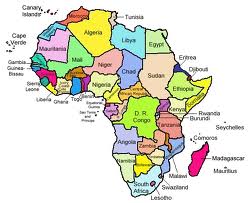
Africa
Africa

Today I would like to talk about the great ode to Africa, ‘Nkosi Sikelel’ iAfrika‘ or ‘God Bless Africa‘ which used to be the national anthem of five African countries.  Little did Enoch Sontonga, a simple school teacher in Johannesburg, know that his hymn praising his love for his country and land of ancestors would become one of the most known African national anthems when he wrote it in 1897, in his mother tongue Xhosa.  This song became a pan-African anthem to the countries of Zambia, South Africa, ZimbabweNamibia and Tanzania … Zimbabwe and Namibia have since then adopted new anthems.  At its creation, it was sung to the 1879 tune ‘Aberystwyth‘ by Joseph Parry.  In 1927, seven more Xhosa stanzas were added by poet Samuel Mqhayi.  In 1996, under President Nelson Mandela, a shortened version of ‘Nkosi Sikelel’ iAfrika‘ was added to the national anthem of South Africa, and Sontonga’s grave was dedicated as a national monument.  In Zimbabwe, after independence in 1980, it was sung in Shona language as ‘Ishe Komborera Africa‘; in Tanzania, it is still the national anthem and is sung in Kiswahili as ‘Mungu ibariki Afrika‘.  In Zambia, it is ‘Stand and Sing of Zambia, Proud and Free‘ or ‘Lumbanyeni Zambia‘.  Enjoy… sing… and feel it… as God blesses Africa.  Watch Miriam Makeba, Hugh MasekelaLadysmith Black Mambazo, and Paul Simon sing it… and reap the blessings.

Nkosi Sikeleli Africa
Malup hakanyiswu phando lwayo
Yiswa imithanda zo yethu
Nkosi Sikelela
Thina lusapo lwayo

Nkosi Sikeleli Africa
Malup hakanyiswu phando lwayo
Yiswa imithanda zo yethu
Nkosi Sikelela
Thina lusapo lwayo

Woza Moya (Woza, Woza)
Woza Moya oyingcwele
Nkosi Sikelela
Thina lusapo lwayo

Morena boloka sechaba sa heso (sa heso)
O fedise dintwa le matswenyeho
Morena boloka sechaba sa heso
O fedise dintwa le matswenyeho
O seboloke (O se boloke)
O seboloke morena
O seboloke sechaba, Sechaba sa Heso
Sechaba sa Africa

God bless Africa
May her glory be lifted high
Hear thou our prayers
God bless us
Us Your children

God bless Africa
May her glory be lifted high
Hear thou our prayers
God bless us
Us Your children

Come Spirit
Come Spirit
Come Spirit Holy
God bless us
Us Your children

Lord, we ask you to protect our nation
Intervene and end all conflicts
Lord, we ask you to protect our nation
Intervene and end all conflicts
Protect us
Protect us Lord
Protect us, Protect our nation
Protect Africa


Libreville: Why the Name?

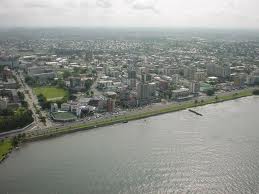
Libreville today
Libreville today, 2012

Two capitals in Africa share the same name: Freetown in Sierra Leone, and Libreville in Gabon; one in English, the other in French.  I always knew that Freetown was named the way it was because it was a city founded in 1792 by freed African American Slaves also called Nova Scotian who had fought on the side of the British during the American Revolutionary war.  The land was named Freetown as a land for freed slaves.

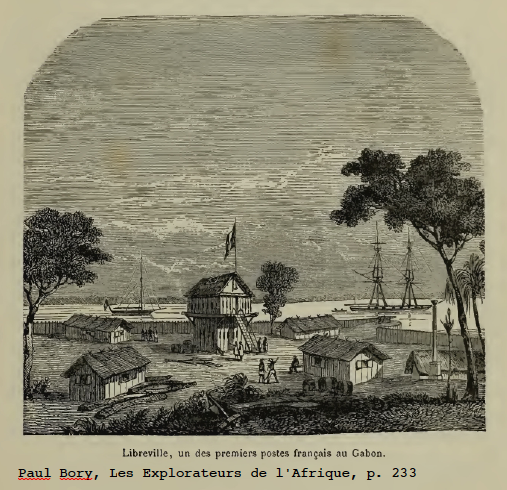
Libreville in 1846
Libreville in 1846

But why on earth is Libreville named free town?  Since, there were apparently no freed slaves returning from the colonies, or running away from slavery?  I recently found out that the story of Libreville is very similar to that of Freetown, as it does involve slaves!  Yes… that’s right!  In the old days, i.e. prior to French occupation (the French acquired land there in 1839), the area that is today Libreville was inhabited by the Mpongwé people since the 11th century.  In 1846, l’Elizia, a slave ship en route for Brazil, carrying slaves for sale was captured by the French navy near Loango, offshore from the Mbongwé’s kingdom.  260 negroes were thus freed and taken to the Island of Gorée in Senegal in 1846.  After an intervention from Paris, 30 – 50 of these slaves will return to Gabon, where the French governor Bouët-Willaumez will take advantage of this, and found Libreville (French for ‘free town’ or ‘free city’) in 1849, in close proximity to Fort d’Aumale, where the French navy was installed to “fight” against slavery.  The small town, Libreville, was then organized as a “French christian village” around 5 places: the Mpongwé’s place, the freedom place, the Bakélé place, the Pahué place, and the Bulu place, after the main tribes in the area at the time.

Francafrique: Raison d’Etat

After the joke of elections held in Egypt this past month, and with all the turmoil in Libya, Mali, and Côte d’Ivoire, I thought it will be best to watch this great documentary by Patrick Benquet which stirred thoughts across French Africa since December 16, 2010, date of its official diffusion.  It tells you all about the tricks, and machiavelism of France (Africa’s policeman) in Africa, and of course the effect of the cold war on African leaders and countries. Enjoy the first part titled the Francafrique Reason of State (Raison d’Etat) and share with others! It is important to know!

La Charte du Mandé: Première déclaration de droits de l’Homme au Monde?

L'Empire du Mali a son apogee (1230 - 1545)
L’Empire du Mali à son apogée (1230 – 1545)

J’ai été admirablement surprise de lire la charte du Manden (Mandé), qui semble être la première déclaration des droits de l’homme au monde.  Elle fut prononcée lors de l’intronisation de Soundiata Keïta comme empereur du Mali en 1222.  Imaginez-vous ma joie: première declaration des droits de l’homme au monde, érigée en Afrique? en 1222? plusieurs siècles (7 siècles) avant la fameuse déclaration des droits de l’homme de l’ONU? Waou…! Et après on vous dira qu’il n’ya jamais rien eu en Afrique. Lisez, et rejouissez-vous, car au Mali, du temps de l’empereur Soundiata Keïta, il y avait le concept du droit de l’homme et l’amour de l’être humain.

===========

La Charte du Manden (Mandé)

Soundiata Keita a l'Assemblée constitutive de l'empire du Mandé avec les chefs de guerre (Source: Wikipedia.fr)
Soundiata Keïta a l’Assemblée constitutive de l’empire du Mandé avec les chefs de guerre (Source: Wikipedia.fr)

1. Les chasseurs déclarent :

Toute vie (humaine) est une vie.

Il est vrai qu’une vie apparaît à l’existence avant une autre vie,

Mais une vie n’est pas plus “ancienne“, plus respectable qu’une autre vie,

De même qu’une vie n’est pas supérieure à une autre vie.

2. Les chasseurs déclarent :

Toute vie étant une vie,

Tout tort causé à une vie exige réparation.

Par conséquent,

Que nul ne s’en prenne gratuitement à son voisin,

Que nul ne cause du tort à son prochain,

Que nul ne martyrise son semblable.

Assemblée constitutive de l'empire du Mandé (Source: Wikipedia)
Assemblée constitutive de l’empire du Mandé (Source: Wikipedia)

3. Les chasseurs déclarent :

Que chacun veille sur son prochain,

Que chacun vénère ses géniteurs,

Que chacun éduque comme il se doit ses enfants,

Que chacun “entretienne”, pourvoie aux besoins des membres de sa famille.

4. Les chasseurs déclarent :

Que chacun veille sur le pays de ses pères.

Par pays ou patrie, faso,

Il faut entendre aussi et surtout les hommes ;

Car “tout pays, toute terre qui verrait les hommes disparaître de sa surface

Deviendrait aussitôt nostalgique.”

Assemblée constitutive de l'empire du Mandé (Source: Wikipedia.fr)
Assemblée constitutive de l’empire du Mandé (Source: Wikipedia.fr)

5. Les chasseurs déclarent :

La faim n’est pas une bonne chose,

L’esclavage n’est pas non plus une bonne chose ;

Il n’y a pas pire calamité que ces choses-là,

Dans ce bas monde.

Tant que nous détiendrons le carquois et l’arc,

La faim ne tuera plus personne au Manden,

Si d’aventure la famine venait à sévir ;

La guerre ne détruira plus jamais de village

Pour y prélever des esclaves ;

C’est dire que nul ne placera désormais le mors dans la bouche de son semblable

Pour allez le vendre ;

Personne ne sera non plus battu,

A fortiori mis à mort,

Parce qu’il est fils d’esclave.

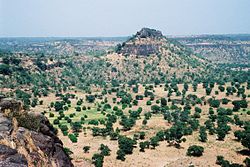
le Manding, berceau de l'empire du Mali (photo: Olivier Epron)
le Manding, berceau de l’empire du Mali (photo: Olivier Epron)

6. Les chasseurs déclarent :

L’essence de l’esclavage est éteinte ce jour,

“D’un mur à l’autre”, d’une frontière à l’autre du Manden ;

La razzia est bannie à compter de ce jour au Manden ;

Les tourments nés de ces horreurs sont finis à partir de ce jour au Manden.

Quelle épreuve que le tourment !

Surtout lorsque l’opprimé ne dispose d’aucun recours.

L’esclave ne jouit d’aucune considération,

Nulle part dans le monde.

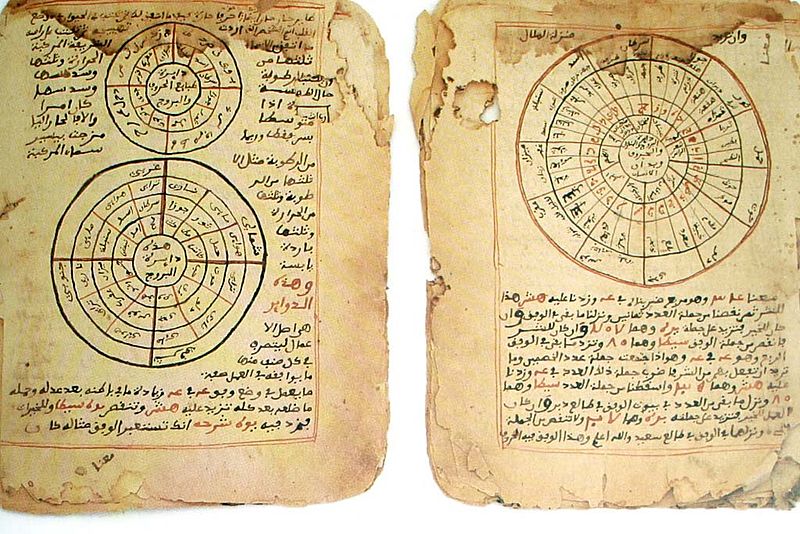
Manuscripts a Tombouctou (Mali) montrant de l'astronomie et mathematique
Manuscripts à Tombouctou (Mali) montrant de l’astronomie et mathématique

7. Les gens d’autrefois nous disent :

“L’homme en tant qu’individu

Fait d’os et de chair,

De moelle et de nerfs,

De peau recouverte de poils et de cheveux,

Se nourrit d’aliments et de boissons ;

Mais son “âme”, son esprit vit de trois choses :

Voir qui il a envie de voir,

Dire ce qu’il a envie de dire

Et faire ce qu’il a envie de faire ;

Si une seule de ces choses venait à manquer à l’âme humaine,

Elle en souffrirait

Et s’étiolerait sûrement.”

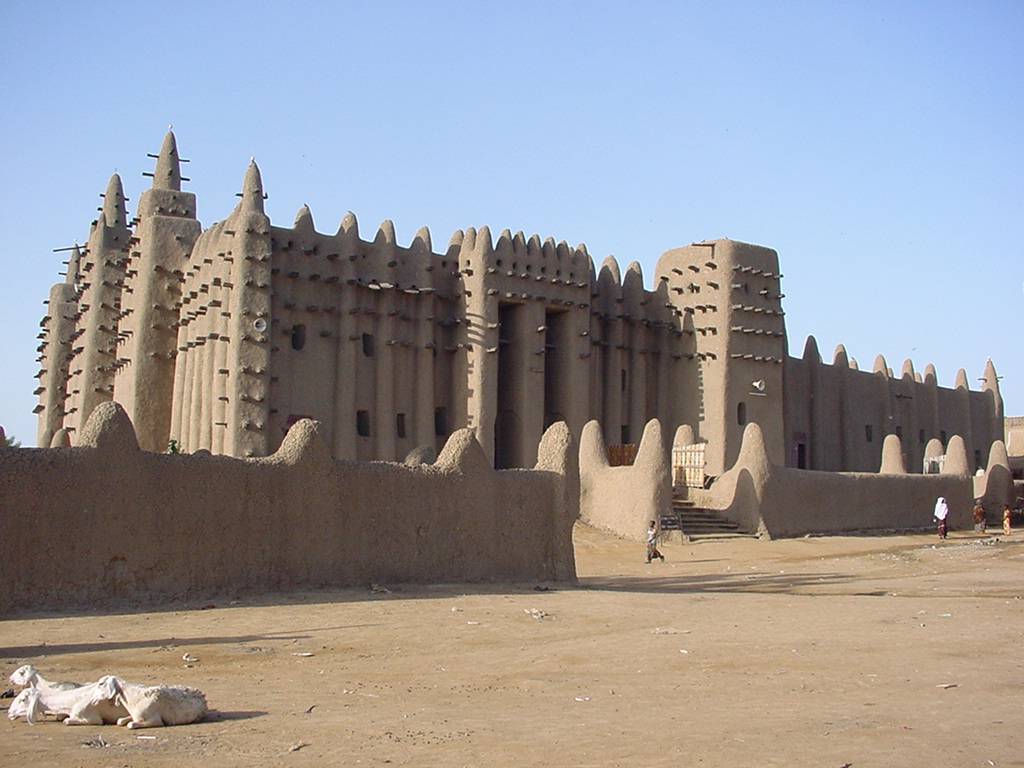
La grande mosquee de Djenne (Mali - heritage du grand empire du Mali)
La grande mosquée de Djenné (Mali – héritage du grand empire du Mali)

En conséquence, les chasseurs déclarent :

Chacun dispose désormais de sa personne,

Chacun est libre de ses actes,

Chacun dispose désormais des fruits de son travail.

Tel est le serment du Manden

A l’adresse des oreilles du monde tout entier.

Youssouf Tata Cissé

Texte réécrit par Youssouf Tata Cissé dans “Soundjata, la Gloire du Mali”, éd. Karthala, ARSAN, 1991