There will be some Brazzaville–Kinshasa rivalry as the two Congos are set to face each other in the first quarter final on Saturday, while the host Equatorial Guinea will take on Tunisia. Ghana and Guinea will face each other in the third quarter final, while Côte d’Ivoire will meet Algeria in the last one.
African Cup of Nations’ Trophy
In soccer, all teams have the same chances, but very often, experience and/or good discipline/organization always pays. Algeria, as Africa’s top team in the FIFA world ranking, is a big name this year; even though they did not perform so well in the first round, they are expected to do better. However the Elephants of Cote d’Ivoire have the most experience at this stage of the competition. That will be a good game to watch. The same story applies between Ghana and Guinea: Ghana has been the better of the two teams and also has a more experienced squad with Asamoah Gyan at their helm. Between the two Congos, a slight edge is given to DRC with their secret weapon in the person of Yannick Bolasie. Between Equatorial Guinea and Tunisia, any guess is a good one, even though having the host nation advance further in a competition is always a good thing. With this said, which team do you think will advance to the semi-finals, and which team will lift this year’s African Cup of Nations’ trophy?
I had to share with you this Feb. 16, 1959 Time Magazine gem of an article on President Sekou Toure of Guinea, the first country to say ‘NO’ to France. As you will see, even the so-called ‘dictators’ of the world have graced the cover of Time Magazine when they were still ‘deemed’ good. Some of the article is a bit a mockery of Africans for wanting independence from their colonial masters, as it is referred to as ‘haste’ in the article (could you really have faulted Africans for wanting freedom?). Enjoy! The full article can be found at: WebGuinee.net. Below are a few words.
==============
Finally, Sékou Touré, 37 President of the new Republic of Guinea, a trim figure in a European busine suit, rose and raised his arm. “Vive l’indépendance!” he shouted, and three times the crowd roared back, “Vive l’indépendance!” “Vive l’Afrique!”he shrieked in a voice close to frenzy. Once again, the cry was three times repeated. There was no reason for Touré to do more. The crowd had seen and heard him, and that was enough.
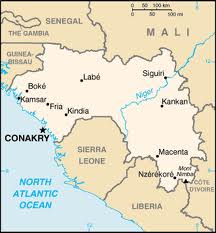
Guinea-Conakry
Broad-shouldered and handsome. Sékou Touré is as dynamic a platform performer as any in all Black Africa. He is the idol of his 2,500.000 people, and the shadow he casts over Africa stretches far beyond the borders of his Oregon-sized country. As the head of the only French territory to vote against De Gaulle‘s constitution and thus to choose complete independence, he has been suddenly catapulted into the forefront of the African scene. ….
Part dedicated idealist and part ruthless organizer-perhaps the best in Black Africa-Guinea’s Touré should have problems enough just coping with the disruption that inevitably came with independence. But he, too, has dreams as wide as a continent. “All Africa,” says he, “is my problem.”
Samori Toure holding the Coran
In a sense, he was born in the right place and with the right ancestry to favor a big role. Though Africa was, until the Europeans came, the continent that could not write, it had known its times of glory. Guinea was once part of the powerful Mali Empire that stretched from the French Sudan, on the upper reaches of the Niger, to just short of West Africa’s Atlantic Coast. When its 14th century ruler, the Mansa (Sultan) Musa, made his pilgrimage to Mecca, he traveled with a caravan of 60,000 men, and among his camels were 80 that each bore 300 lbs. of gold. … he turned the fabled city of Timbuktu into a trading center and a refuge for scholars. … But the legend lived on of the warrior Samory, whom Sékou Touré claims as his grandfather.
Sekou Toure, one of Samori Toure’s grandson
When De Gaulle stopped off at Conakry on his swift tour of Africa before the referendum, Touré thundered in his presence: “We prefer poverty in liberty to riches in slavery.” Angrily, De Gaulle canceled a diner in time he was to have had with Touré, and the split was final. A few weeks later, 95% of the people of Guinea voted no to the De Gaulle constitution.
We feared for our beloved Africa Cup of Nations (CAN) when Morocco, the host declined to host! It was like, what? Why wouldn’t you want to host an event you signed up to host years ago? Thankfully, Equatorial Guinea stepped in to host the 30th edition, CAN 2015, 2 months to the event. We raise our hats to the host country, Equatorial Guinea, because it is a real feat to organize such a continental event in such short notice. So, for the next month, we will all be vibrating to the rhythm of the African Cup of Nations. We will watch some of Africa’s most renowned teams, and some not so well-known, and some of the continent’s best players display their greatness. We hope that every game will be amazingly good, and that every single player on the field will give their very best for their country. Yes… the African Cup of Nations is truly an African event to showcase the grace, endurance, and play of Africans on their continent. What more to applaud?
The Cape Coast Castle is one of the 30 slave forts of Ghana. In 2009, the US president Barack Obama and his family, made a point to visit the Cape Coast Castle. So why should you learn about it?
Well, it took 50 years to build the three-story building that forms today’s Cape Coast Castle. It was originally built by the Swedes (the Swedish Africa Company), starting in 1653 (it was then known as Fort Carlsborg or Carolusborg) for timber and mineral exportation, and then taken over by the Dutch before the British wrestled it away. The original cannons, cannon balls, and mortars used to defend the fort can still be seen today, facing the Atlantic Ocean.
Cape Coast Castle in 1682
The brick courtyard of the castle, which Ghanaians commonly refer to as Cape Coast Dungeon, has two 18-foot water wells and four graves. The first grave is for the Rev. Phillip Quarcoo, the first black Anglican pastor in the area. Beside him lies C.B. Whitehead, 38-year old British soldier who was killed by a Dutch soldier in the courtyard. Besides them are the graves of Letitia Elizabeth Landon, and her husband George MacLean, the British governor of Cape Coast from 1830 to 1844. I am not sure how a woman could possibly live next to such atrocities; maybe by rationalizing that the people being imprisoned, were not human beings?
The open auditorium on the top floor of the former administration building now hosts an exhibit chronicling the history of slavery on Ghanaian shores.
Cape Coast Castle in 1890 (National Archives UK – Wikimedia)
During the 17th and 18th centuries, the Cape Coast slave fort imprisoned about 1000 men and 300 women for any given 3 months period, before they were crammed into ships bound for a life of slavery in the Americas. Its corridors are full of dungeons where only dim light coming from tiny windows let the light and air in. 200 males will be kept in space meant for 50 people or less, where they will spend over 23h a day for three months, and will only be brought briefly out to eat. Ironically, Christian services were held in the fort while these poor souls were screaming for their lives underneath.The majority of captives ranged between 15 and 35 years of age.
Women were locked in 2 similar dungeons, 150 of them per chamber. They will be raped daily by the British soldiers, who would come into the cells and select the ones to spend the night with. Any slave who challenged the authorities was thrown into the condemned cell, which held 30 – 50 in a room no bigger than most walk-in closets. There, they would die deprived of food, water, light, and oxygen, clawing the brick walls and floors as they suffocated.
Cape Coast Castle (WZM – Wikipedia)
To descend into the exposed brick castle feels like entering the depth of the underworld (I can only imagine how those captives felt going through there). There are five dungeon chambers for men. The strongest ones were separated during branding, when hot iron rods were used to mark their chests, and then chained and shackled together in the first chamber. The last cell has a hole in the wall, which leads into a deep dark tunnel which was used to take slaves underneath the castle’s courtyard, leading them to the “door of no return.” Cape Coast Castle was once the most active slave trading hub in West Africa.
Slavery was not just a European affair, but an African one as well, since many African chiefs traded slaves (rarely their own people – but people from other nations) to the Europeans in exchange for goods. Thus, the Ghana House of Chiefs – a body comprising all the country’s traditional kings and chiefs- has placed a plaque on one of Cape Coast castle’s walls, asking for forgiveness to the souls of those who were sold. When will European nations also ask for forgiveness?
Precious readers, may the year 2015 be the year of all great conquests, achievements, success, and greatness. I would like to express my sincere gratitude to all those who visited my blog, and to all future visitors. 2014 was a beautiful year: the number of subscribers on Afrolegends.com has tripled, the number of visitors on the blog has doubled, the article Burkina Faso was cited by TIME Magazine online, while the article La SAPE was cited by The Guardian, and many articles were reblogged on multiple sites. For 2015, I wish you wonders without borders, peace, grace, and love.
Happy 2015 (Illustration by Osee Tueam, for Dr. Y, Afrolegends.com)
Here were the top posts of 2014. Keep trusting, reading, sharing, and liking.
Like every year, I have to tell you about the good things that happen in Africa, and all the things we celebrated. Here are 10 of them.
1. I have to say it again: Blaise Compaore’s demotion. Blaise Compaoré was booted out of office in 2014. Thomas Sankara‘s murderer taught that he will be eternal in power, and on October 30th 2014, the people of Burkina Faso said ENOUGH!
2. Presidential Elections finally took place in Tunisia, 3 years after Ben Ali‘s toppling at the beginning of the ‘Arab Spring’, and the election of the people’s choice as president: Beji Caid Essebsi. We are glad the people of Tunisia’s choice was respected.
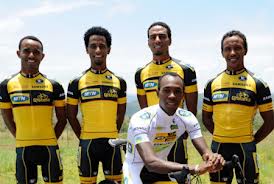
Some members of the South African Team – MTN Qhubeka(Source: bicycling.co.za)
3. Mrs Catherine Samba-Panza was sworn in as interim president of the Central African Republic on 23 January 2014. She was chosen as a neutral person to lead the country of the conflict that rages in the area; she is the first woman appointed in such a position in the history of the country.
4. For the first time in the history of Cycling, there was an African team competing in a great race. 6 Africans (two Erithreans and 4 South Africans) ran in Spain for the South African team, MTN-Qhubeka.
5. Two African teams advancing into the last round of 16 at the Brazil 2014 FIFA World Cup for the first time in the history of the FIFA World Cup: namely, Nigeria and Algeria. Even though both teams were eliminated in the last round of 16, Algeria particularly put up a good fight against Germany (who went on to win the World Cup) and made us proud.
6. The African version of Robocop designed by two female engineers in the Democratic Republic of Congo, one of them being Thérèse Inza. This is a traffic cop who regulates the traffic, and even gives tickets to the cab drivers, and those who do not want to follow the code of the road.
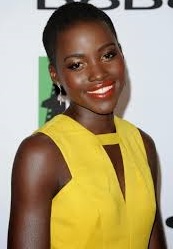
Lupita Nyong’o
7. There were 3 Africans nominated at the Oscars in main categories this year: Chiwetel Ejiofor(Nigeria) in the ‘Best Actor’ category, Barkhad Abdi (Somalia) in the ‘Best Actor in a Supporting role’ category and Lupita Nyong’o (Kenya) in the ‘Best Actress in a Supporting role’ category. Lupita made us proud by winning the Academy Award for ‘Best Actress in a Supporting role’ for her role in 12 Years a Slave. She was also named the ‘Most beautiful Woman’ by People magazine (I never really understood that People Magazine award: as if they had searched through the 3.5Billion women in the world before giving this award!) and ‘Woman of the Year’ in Glamour, and was announced as the ‘New Face’ of Lancôme, a first for a Black woman.
8. Nigeria became Africa’s # 1 economy after rebasing its Gross Domestic Product (GDP) from 1990 to 2010 constant prices. Nigeria just surpassed South Africa as Africa’s top economy, and the world’s 26th largest economy.
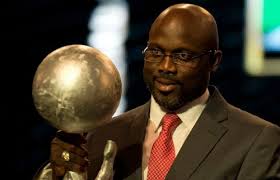
10. George Weah, the only African to have won a FIFA World Player of the Year (in 1995) and won Ballon d’Or, won a senate seat in Liberia yesterday Dec. 29th. The 2005 presidential contender (he had won the first round of the elections then) of Mrs. Johnson-Sirleaf won the senate elections against Robert Sirleaf (President Johnson-Sirleaf’s son). This was a landslide victory; it is a step forward, and progress is always to be acclaimed!
I have to do a recap of the year 2014. You already know that the number one person we said goodbye to was the dictator and murderer Blaise Compaoré, who was booted out of office the tail between his legs.
1. Blaise Compaoré, booted out of office in 2014. Thomas Sankara‘s murderer taught that he will be eternal in power, and on October 30th 2014, the people of Burkina Faso said ENOUGH!
2. Michael Sata, the President of Zambia, passed on in office on October 28, 2014. He was replaced by Guy Scott, the first white president (albeit interim president) of Zambia since independence.
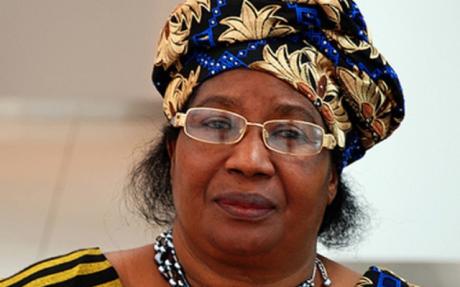
President Joyce Banda
3. Joyce Banda, President of Malawi, who lost the elections this year. She became president of Malawi after Bingu wa Mutharika passed away in 2012. She is succeeded in office by Peter Mutharika. She had been Africa’s second female Head of State.
4. Nadine Gordimer, South Africa’s first Nobel prize of literature, passed away at the age of 90, on 13 July 2014. She was called the one of the great “guerilla of imagination” by poet Seamus Heaney.
Lapiro de Mbanga
5. Lapiro de Mbanga, the voice of the voiceless, the great Cameroonian musician, and activist, left us this year, in March. Lapiro sang for the people, talked about the youth’s shattered dreams, the division, the tribalism, the corruption, the decadence, and the ills of the country. So long Ndinga Man!
6. Abel Eyinga and Charles Ateba Eyene, both of Cameroon, passed away. These were strong outspoken voices of Cameroon, and will forever be remembered.
7. King Kester Emeneya, the king ofla Rumba, passed away on 13 February 2014. I had just recently gotten reacquainted with his music, and danced to Nzinziagain. So long King.
8. Mama Gbagbo, the mother of Laurent Gbagbo, passed away this year. Gbagbo who is currently detained by the CPI at the Hague was refused the opportunity to bury his mother. She was over 90 years old.
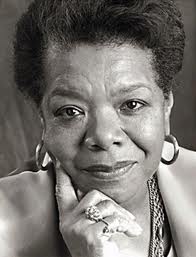
Maya Angelou
9. The world said goodbye to Maya Angelou in May of this year. Dr. Maya Angelou was one of the world’s best poets. My two favorite poems by Dr. Angelou are ‘Phenomenal Woman‘ and ‘Still I Rise.’ Her African roots are very deep as she was a journalist in Egypt and Ghana. Her life was an embodiment of Truth, and passion.
10. More than 160 immigrants were feared dead after a boat carrying about 200 African immigrants sank off the coast of Libya. How many Lampedusa shipwrecks are we going to have until the world realizes that feeding and destabilizing countries does not help global equilibrium?
Elmina Castle (Source: Ghana.nl)Inner courtyard at Elmina Castle (Source: Ghana.nl)
The Elmina Castle is one of the 30 slave forts along the coasts of Ghana. It was built in 1482 by Portuguese traders on the site of a town called Amankwaor Amankwakurom. It was the first European slave-trading post in all of sub-saharan Africa. The Portuguese gave it the name of São Jorge da Mina, or St. George’s of the mine, or simply “Elmina” (the mine). At four storeys high, it was one of the most imposing coastal forts, and for many years the largest one. It was originally build by the Portuguese as a warehouse to protect the gold trade, but later it became the center of the Dutch slave trade, after its capture by the Dutch in 1637. The British attacked the city in 1782, but it remained in Dutch hands until 1872, when the Dutch Gold Coast was sold to the British.
16th Century map of West Africa with Fort Elmina
Slaves were typically captured inland, and then brought to the fort on an arduous journey that often lasted many days. Half of all captives did not even make it to the coast. Once at the fort, the slaves would wait, often for a long period of time ranging from 3-9 months, until a ship arrived. Imagine waiting in crammed conditions, packed in cells like sardines for 3 or more months!
Painting of Elmina Castle in 1668; notice the ships and sea in the front
Elmina, like other West African slave fortresses, housed luxury suites for the Europeans in the upper levels. The slaves were kept in cramped and filthy cells below, each cell often housing as many as 200-600 people at a time, without enough space to even lie down. Staircases led directly from the spacious governor’s chambers on the third level to the women’s cells below, making it easy for him to select personal concubines from amongst the women to “service him” every night.
There was also a discipline cell for “freedom fighters” : those who disobeyed were shut in this cell until they suffocated or starved to death. Ironically, Elmina also held Christian church services for the Europeans, on the second floor of the castle.
Slave holding cell in Elmina (Wikimedia Commons – KD)
On the seaboard side of the castle was the Door of No Return, the infamous portal through which slaves boarded the ships that would take them on the treacherous journey across the Atlantic ocean known as the Middle Passage. At Elmina, the door of no return was a child-size window that slaves squeezed through to board the ship.
British bombing of Elmina – 13 June 1873
By the 18th century, at least 30,000 slaves on their way to the Americas had passed through Elmina each year. That is 30,000 slaves each year for at least 250 years: about 7.5 millions! Appalling!!
Today, Elmina’s economy is sustained by tourism and fishing. Elmina Castle is preserved as a Ghanaian national museum and the monument was designated as a World Heritage Monument under UNESCO in 1979. It is a place of pilgrimage for many African Americans seeking to connect with their long lost heritage. Enjoy the video below which is very educational!
I am going to start a series on reclaiming our history. I will be talking about slave forts across Africa. There were over 30 slave forts in Ghana only. How many in other countries?We will find out through this exercise. These fortified trading posts were built between 1482 and early 1800s by Portuguese, British, Swedish, English, Danish, Dutch, and French traders that plied the African coast. Initially, they had come in search of gold (in Ghana), ivory (in Ivory Coast), pepper (along the Pepper Coast) and then later, they discovered cheap labor: thus was born the slave trade. There was intense rivalry between those European powers for the control of the West African coast from Senegal, to as far south as Angola.
Slaves marching after capture
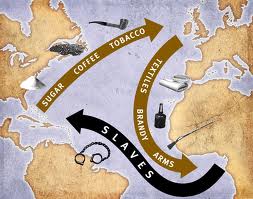
It is estimated that over 20 million Africans were sold into slavery during the Atlantic slave trade; this does not account for those who died during the trip aboard the ship (about 1/3), and those who were killed during the capture. Slaves were taken to North America, the Caribbeans, and Brazil. Moreover, this is an estimate for the transatlantic slave trade only, but did you know that slaves were also taken by Arabic sailors from the East Coast of Africa, to places like Saudi Arabia and as far as India?
The Transatlantic slave trade
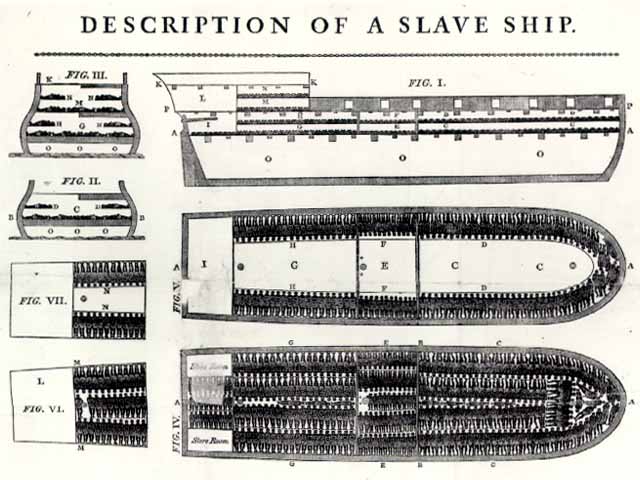
The Portuguese began dealing in black slaves from Africa in the 15th century. Initially, they purchased slaves from Islamic traders, who had established inland trading routes to the sub-Sahara region. Later, as the Portuguese explored the coast of Africa, they came upon the Senegal River, and found that they could purchase slaves directly from Africans. The European slave trading activity moved south along the African coast over time, as far south as Angola. On the east coast of Africa and in the Indian Ocean region, slaves were also taken from Mozambique, Zanzibar and Madagascar. Many of the slaves were from the interior of Africa, having been taken captive as a result of tribal wars, or else having been kidnapped by black slave traders engaged in the business of trading slaves for European goods. These slaves would be marched to the coast to be sold, sometimes traveling hundreds of miles. Many perished along the way. The captured Africans were held in forts or slave castles along the coast. They remained there for months crammed in horrible conditions inside dungeons for months before being shipped on board European merchant ships chained at the wrists and legs with irons, to North America, Brazil, and the West Indies.
Slaves on board a ship
Some African rulers were instrumental in the slave trade, as they exchanged prisoners of war (rarely their own people) for firearms which in turn allowed them to expand their territories. The slave trade had a profound effect on the economy and politics of Africa, leading in many cases to an increase in tension and violence, as many kingdoms were expanding.
Inspection of slave for sale
The slave trade was responsible for major disruption to the people of Africa. Women and men were taken young, in their most productive years, thus damaging African economies. The physical experience of slavery was painful, traumatic and long-lasting. We know this from the written evidence of several freed slaves. Captivity marked the beginning of a dehumanizing process that affected European attitudes towards African people. Can you imagine losing 1/3 or more of your active population? It is hard to fathom what crippling effect that will have on any country’s progress. That is why, in upcoming months, I will be talking and trying to identify slave forts in Africa, in an attempt to reclaim our history. I know this is a touchy subject, but it is history: the bad, the ugly, the beautiful, the joyous. It is important to know history in order to be able to claim the future fully, without any baggage.
15 jours et 27 ans, après avoir fait assassiner Thomas Sankara, Blaise Compaoré est à son tour forcé ou plutot jeté dehors. En effet, c’était le 15 Octobre 1987 que Thomas Sankara était assassiné par des hommes de Compaoré. Donc le fameux Compaoré est tombé le 30 Octobre 2014. Comme on le dit si bien, quiconque se sert de l’épée perira par l’épée. Maintenant, notre voeu le plus cher est que cette révolution populaire ne soit pas confisquée par l’armée qui est constituée d’hommes de Compaoré, et des bras de la France. Bye Bye Compaoré.
==========
Flag of Burkina Faso
15 days and 27 years, after having murdered Thomas Sankara, Blaise Compaoré is in his turn forced to resign or rather booted out of office. On 15 Octobre 1987 that Thomas Sankara was murdered by men of Compaoré. Now, Compaoré himself fell on 30 October 2014. As it so well said, anyone who uses the sword, will die by the sword. Now, our hope is that the people’s revolution will not be hijacked by the army who are Compaoré’s men and France’s men. Bye Bye Compaoré.

 Now that the first round of the African Cup of Nations has gone through, several countries have qualified for the next stage: Congo and Equatorial Guinea qualified in Group A, Tunisia and the Democratic Republic of Congo (DRC) in Group B, Ghana and Algeria in Group C, and Cote d’Ivoire and Guinea in Group D.