Analysis on Obama’s 2013 Visit to Africa

President Barack Obama with President Macky Sall of Senegal

I would like to share the following article on Pambazuka by Antoine Roger Lokongo, summarizing and identifying key questions for Obama’s last visit in Africa.  Like he points out so well, Obama’s visit was a tour to counter China’s influence in Africa.  Make up your own opinions, and please think: what should be the future of African relations with the United States, Europe, China, and others? What will be fair for African countries? How do Africans impose themselves at the bargaining table?

=======

[…]  There is a Chinese proverb which says that, ‘When the water subsides the rocks emerge’. Now that the ‘Obama fever’ has evaporated, all that remains is a stark reality that we are faced with: Barack Obama is the President of the United States of America who went to Africa to defend and promote America’s strategic interests, perceived as being threatened by China’s strong presence in the continent. Obama’s African tour was about countering China’s influence in Africa. Despite his charm offensive to woo Africa, depicting it as a ‘hopeful continent on the rise and with which America can partner and do business on an equal footing and ‘win-win’ basis’, perhaps taking a leaf from the Chinese ‘win-win’ international relations lexicon, Africans should treat him as such: A US president who went to Africa to build strategic military and business ties with Africa in the face of China’s surge in the continent.

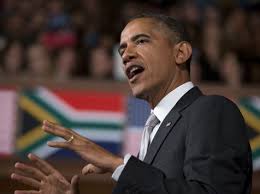
President Obama in South Africa

[…] In his speech at the University of Cape Town, South Africa, President Obama rebuffed the criticism often coming out of Africa according to which democracy and transparency, those values which America holds dearly, are somehow Western exports and that it is intrusive and meddlesome of America to impose them on Africa. … he pointed out that ‘those in power in Africa who make those arguments are usually trying to distract people from their own abuses. Sometimes, they are the same people who behind closed doors are willing to sell out their own country’s resource to foreign interests, just so long as they get a cut’. It is hard to argue against that. The question, however, is, what if those foreign interests are American?

It is hard to believe that America does not tell African people who their leaders should be, but stand up with those who support the principles that lead to a better life. The list of African leaders who were assassinated by the CIA because they put the interests of their people first and refused to blindly serve American interests is very long. The list of leaders (living and dead) who were hoisted to power to serve America’s strategic interests and heaped with praises they do not deserve from the White House is also very long. In Congo, Patrice Lumumba was assassinated and Mobutu Sese Seko was hoisted to power. As far as we know, there are no strong institutions, such as independent judiciaries that can enforce the rule of law; honest police forces that can protect the peoples’ interests instead of their own; an open government that can bring transparency and accountability in Rwanda and Uganda today. But there are two strongmen who are supported and protected by Britain and America so long as they serve as proxy forces in Congo. They are presidents Yoweri Museveni and Paul Kagame!

China's presence in Africa
China’s presence in Africa

In fact, today, apart from the Chinese mining contracts in which the Congolese state (DRC) retains at least 32% of stakes, the stakes of the Congolese state in all other mining contracts the government has signed with Western mining companies do not go beyond 20%! So, Western powers still enjoy the lion’s share in Congo. In Zimbabwe, the government retains 51% stakes in each mining contract, not like in the DRC. That is what should be emulated by all other countries throughout Africa. The Chinese respect our laws and rules of the game and are massively investing in Zimbabwe under those rules, but Western countries see a problem with that policy in Zimbabwe where the economy is recovering without Western financial help and despite Western sanctions (so Mugabe is not pocketing all the money). Without African countries drawing their own rules and laying them on the table for their external partners to follow and not the other way round, African independence will remain meaningless and Africa will totally be owned by the outside world, in other words, by people who come and loot Africa’s wealth through predatory wars and then return to Africa as investors! Continue reading “Analysis on Obama’s 2013 Visit to Africa”

‘Asimbonanga’ by Johnny Clegg

Johnny Clegg & Savuka

Since we are on the subject of Soweto 1976, and since last week Madiba (Nelson Mandela) gave us a scare, I decided to publish the song ‘Asimbonanga’ by Johnny Clegg.  ‘Asimbonanga‘ or ‘We have not seen him’ was released by Johnny Clegg and Savuka, in the album Third World Child in 1987, and called for the release of Nelson Mandela, and also gave homage to three martyrs of the anti-apartheid struggle: Steve Biko, Victoria Mxenge, and Neil Aggett.  I have posted the song with lyrics below (translation of the Zulu words to English is in italics).  Enjoy, and don’t forget to visit Johnny Clegg’s website: johnnyclegg.com.

'Asimbonanga' by Johnny Clegg & Savuka
‘Asimbonanga’ by Johnny Clegg & Savuka

Soweto 1976 and Marikana 2012: any similarities?

Marikana, 16 August 2012

With the cleansing ceremony for the Marikana massacre taking place today, I couldn’t help but think about similarities, if any, between the Soweto uprisings of 1976, and the Marikana miners’ strike of 2012.

First of all, the Soweto uprising on June 16, 1976, was a movement of school children protesting against the use of Afrikaans as a medium in school and the fact that this was essentially limiting their career opportunities leading them to mostly menial jobs later in life; besides Afrikaans was the language of the oppressor, and in itself a symbol of oppression.  The school children were reprimanded in blood by police from the apartheid government of John Vorster.  It was a brutal repression.  The pictures, particularly, that of Hector Pieterson‘s dead body being carried away by another student alongside his sister, were just heart-wrenching.

Soweto uprising 16 June 1976

Over 30 years later, Marikana happened, albeit not on the same giant scale.  Miners protesting for wages were repressed in blood by the police on 16 August 2012; this time under the free government of the rainbow nation led by Jacob Zuma.  The violence used by the police was just as shocking, and has been compared by the media to the Sharpeville massacre.

Hector Pieterson being carried away by Mbuyisa Makhubo, with his sister running alongside (Photo by: Sam Nzima)

The similarities are important: both events showed police brutality against unarmed school children (Soweto 1976), and unarmed miners (Marikana 2012); Note: there are some claims that one miner shot first at the police before the police opened fire at Marikana, and images show that some of the miners had machetes.  Both events showed poor judgment (more like lack of judgment) from government, and police repressive use of force.  Both events harbored bloodshed.  What Marikana 2012 showed us is that police brutality is the same decades later.  I always wondered why didn’t the police use fake bullets in both cases If the police was trying to restore order in both cases, why not use common sense and use rubber bullets instead?  They have the upper hand and the bullet proof vests (and the dogs), they should act like the adults in the play. 

Miners demonstrating at Marikana

The main difference, is that unlike Marikana, where the police was dealing with adults, the police in Soweto dealt with school children. Where is this world going when we now attack, hurt, and kill children? Has the human race descended so low?  And the apartheid government had a clear agenda against color and race, while the current government’s agenda seems to be driven by capitalism.  The children of Soweto were demonstrating for a better education, while the miners of Marikana were workers demonstrating for increased wages…

In the end, Soweto 1976 cannot be compared to Marikana 2012, where the government did not even conduct an investigation, and did not present apologies (or did they?) as they did not consider the lives of these Black children relevant in the apartheid society.  And even today, one can see the difference between both events in the length at which Marikana was covered in the South African press, and the small number of archives (accessible?) on Soweto 1976.  Besides, Soweto 1976 marked a turning point in the end of the apartheid regime.  One thing is for sure, both events should never happen in the history of a nation.

This is my two-cents on this… What do you think were the similarities between Marikana 2012 and Soweto 1976? Were there similarities in your opinion? As people protest around the world, how do you stop police brutality?  How do we ensure that lives are preserved, while populations’ protests are taken into account?

Remembrance: 16 June 1976 Soweto Massacre

Soweto3
Soweto uprising: children walking peacefully (Source: Ezakwantu.com)

The Soweto massacre or Soweto uprisings also known as June 16, were some of the biggest massacre of the apartheid regime in South Africa, mostly because it showed police repression against kids.  On June 16, 1976, Black high school children in Soweto protested against the Afrikaans medium decree of 1974 which forced the schools to use Afrikaans as one of the main languages in schools (50-50 with English): Afrikaans was to be used to teach mathematics, arithmetic, etc…  In the 1950s, 60s, and 70s, many people preferred English as the school language, the commerce language, etc, because of the violence attached with Afrikaans which was the language of the oppressor.

Soweto Uprising (Source:kilimedia.com)
Soweto Uprising: children running away (Source: kilimedia.com)

On June 16, 1976, over 20,000 school children took part in protests which left over 700 dead (the official numbers say 176, but we all know that this number could not be further from the truth).  On that bright morning, 10,000 – 20,000 black students walked from their schools to Orlando stadium for a peaceful rally against the use of Afrikaans, the oppressor’s language, in school.  The protest had been carefully planned by the Soweto Students’ Representative Council’s (SSRC) Action Committee, with support from the Black Consciousness Movement, and teachers from Soweto.  The students were marching and they found out that police had barricaded the road along the intended route.  The leader of the SSRC action committee then asked the crowd not to provoke the police, and the march went on on a different route, eventually ending up near Orlando High School.  The students were marching, singing, and waving placards with slogans such as, “Down with Afrikaans“, “Viva Azania“, and “If we must do Afrikaans, Vorster must do Zulu.”

Hector Pieterson being carried away by Mbuyisa Makhubo, with his sister running alongside (Photo by: Sam Nzima)

One officer shot and fired his gun causing panic and chaos.  Students started screaming and running, as more gunshots were being fired, and the police let out their dogs on children who responded by stoning the dogs.  The police then began to shoot directly at the children.  One of the first students to be shot dead was 13-year-old Hector Pieterson, who became the symbol of the Soweto uprisings.  The picture of his dead body being carried away by another student while his sister ran beside them in tears, was captured by news photographer Sam Nzima, and made it worldwide.  The police patrolled the streets throughout the night as the students came under intense attack.  Emergency clinics were swamped with injured and bloody children.  The police requested the hospitals to provide a list of all victims with bullet wounds, but the doctors refused to create the list, and recorded bullet wounds as abscesses.  On the 17th of June, 1,500 heavily armed police officers were deployed to Soweto carrying automatic rifles, stun guns, and carbines.  They were driving in armored vehicles with helicopters, while the South African army was ordered on standby… for repression onto school children.

In the end, the Soweto uprising established the leading role of African National Congress (ANC) against the apartheid regime; it marked the turning point in the opposition to white rule in South Africa.  Formerly, the struggle had been fought outside South Africa, in neighboring countries (Rhodesia – Zimbabwe, South-West Africa – Namibia, and Angola), but from that moment forward, the struggle became internal as well as external.

June 16th is now celebrated in South Africa as a public holiday.  Enjoy this quick collage about the events of June 16th, and please remember to commemorate the lives of innocent children killed on this day in South Africa, children whose future were ended too early.  Don’t forget to check out these articles on BBCLibcom.orgSouth Africa Info, and watch the video on Independent Lens on PBS.

The British Government apologizes for Mau Mau atrocities

In a prison camp during the Mau Mau rebellion (Source:The Guardian)
In a prison camp in Kenya during the Mau Mau rebellion (Source:The Guardian)

The British government finally recognized its wrong-doings in Kenya, during the Mau Mau uprising, and publicly apologized for it.  The British colonial forces thoroughly tortured and murdered thousands of people during the Mau Mau revolt against British rule in Kenya in the 1950s.  The British foreign secretary admitted last Thursday (06/06/2013) that: … ” on behalf of Her Majesty’s government, that we [the British government] understand the pain and grievance felt by those who were involved in the events of the emergency in Kenya.”… “The British government recognizes that Kenyans were subject to torture and other forms of ill-treatment at the hands of the colonial administrationThe British government sincerely regrets that these abuses took place and that they marred Kenya’s progress towards independence.”

Under British guns, during the Mau Mau rebellion in Kenya
Under British guns, during the Mau Mau rebellion in Kenya in the 1950s

So today’s surviving victims, 5228 people will receive a payment of £19.9m for compensation.  The compensation amounts to about £3,000 per victim and applies only to the living survivors of the abuses that took place.  As I read this… first I was happy that after so many years (over 60 years), the British government could finally acknowledge their atrocities in Kenya, and I think this opens the door for other colonial powers to openly recognize atrocities they perpetrated in their colonies: such as the massacre and genocides perpetrated by the French in Cameroon, Algeria, and Madagascar during the colonial era and after independence.  However, when I read the amount given to every victim, I gasped in shock: 3000 pounds per person? what is that? Is that a joke? What would £3,000 do to somebody who has been tortured, raped, and beaten to death? Would it erase the debilitating pain, and all those years spent fighting for the British to acknowledge their wrongdoings? Finally what is money compared to the pain? What is the British government doing to ensure that no such thing would ever happen again? As we know, paying quickly so that nobody bothers you is easy, but has anything been put in place for this never to occur again? Or would other citizens of the world have to fight 50 or 100 years from now for yet another apology?

Enjoy the documentary below on the Mau Mau rebellion… no amount of money can erase this! The case in court used some of the work by Harvard professor Caroline Elkins.

May 3rd: World Press Day – Norbert Zongo

Norbert Zongo
Norbert Zongo

May 3rd marks the World Press Freedom Day, or simply World Press Day.  This day is to raise awareness of the importance of the freedom of the press and remind governments across the world to respect the right to freedom of expression.  Today I would like to commemorate the life of an African journalist hailing from Burkina Faso, Norbert Zongo, who just like the great Cameroonian journalist Pius Njawe, stood for justice and fought injustice.

Norbert Zongo was the publisher and editor of Burkina Faso newspaper L’Independant.  On 13 December 1998, Norbert Zongo was assassinated after his newspaper investigated the murder of a driver (David Ouédraogo) who had worked for the brother of the president Blaise Compaoré, François Compaoré.  Zongo’s burned body was found along with the bodies of three other people: his brother Ernest Zongo, his chauffeur Ablasse Nikiema, and Blaise Ilboudo, in a vehicle near Sapouy, 100 km from the capital Ouagadougou.  An investigation showed that Zongo was killed for political reasons.  His murder rocked Burkina Faso, and manifestations arose within the country, and neighboring countries.  The most violent manifestations took place in the city of Koudougou, Zongo’s birthplace, and government supporters organized a militia armed with clubs engaged to hunt protesters in many cities of the country.

Burkina Faso
Burkina Faso

Bowing to popular discontent, President Blaise Compaoré, had to open a judicial investigation where his brother was charged for murder and harboring the body of the victim in connection with the death of David Ouédraogo who died of torture.  The charges were later dropped by a military tribunal.  In August 2000, five members of the presidential guard were charged for the murder of Ouédraogo, were convicted and sentenced to lengthy prison terms, but all were later freed.  In seven years of trial, one suspect, a member of the presidential guard was charged, but the accusing witness later recanted.  The Zongo trial ended in July of 2006 with a non-place which caused an international outcry.

Norbert Zongo is also the writer of the book, The Parachute Drop (Le Parachutage), which was translated to English and published in 2004.  Many of his articles can be found in the review Mobutuization of Burkina Faso.

Today, Norbert Zongo is celebrated as a martyr, one who stood for truth, in a country where not many dared to talk.  This is why he should be the man of the day, for a day like World Press Day: He dared to talk, he expressed the truth to enlighten others, and sought justice for another man.  In 2003, a documentary was made to talk about his murder: Borry Bana, the fatal destiny of Norbert Zongo.  In 2012, a memorial was erected at the Highway N6 (Ouagadougou – Léo) near Sapouy, exactly where Zongo was murdered.  Please watch this video of Norbert Zongo talking to African youths.  His message is that of maintaining intrinsic values of principle, of growth, of conscience.

“My name is Nigeria, I need Re-building, not Re-branding!” by Onyema Uche

Flag and map of Nigeria

I came across this article on Nigeria, which can be applied to many countries in Africa.  This is more of a wake up call, rather than just a critic.  This expresses a need for re-building the minds, the brains, and the experiences of Africans.  This is very close to the poem ‘No More‘ by Kelvin Karani.  You can read the entire article on African Spotlight.  So, after reading this article, I would like to you to answer these questions: Do African countries need re-branding or re-building?  How do we stop importing and start producing ourselves?  Since we have all that is needed to feed ourselves, how do we get to the level where every child is well-fed? How do we improve our infrastructures, etc…?  Thomas Sankara managed, in less than 4 years as president, to bring his country to the level of food self-sufficiency. How do we get rid of our debts? How do we create jobs for our youths? What is needed to come out of this inferno cycle? While you are at it, please watch Thomas Sankara’s speech on eliminating the debt.

============

Few days ago, I spent 10 billion Naira to celebrate my 52nd birthday! I am Nigeria!!!.

I am divided into 36 unequal states, plus my capital territory, christened ABUJA . I have millions of acres of arable land and billions of cubic litres of water, but I cannot feed myself. So I spend $1 billion to import rice and another $2 billion to import milk. I produce rice, but don’t eat it. I have 60 million cattle but no milk. I have the capacity to feed the whole of Africa but I import most food instead. I am hungry, please help and re-build me. […]
I wanted change so I stood all day long to cast my vote. But even before I could vote, the results had been announced. When I dared to speak out, silence was enthroned by bullets. My rulers are my oppressors, and my policemen are my terrors. I am ruled by men in mufti, but I am not a democracy. I have no verve, no vote, no voice, please re-build me.
I have over 50 million youths with no jobs, no present and no future. So my sons in the North have become street urchins and their brothers in the South have become militants. My nephews die of thirst in the Sahara and their cousins drown in the waters of the Mediterranean.  My daughters walk the streets of Lagos, Abuja and Port Harcourt , while their sisters parade the streets of Rome and Amsterdam. I am inconsolable, please re-build me.
Bend Skin
Bend Skin in Cameroon (known as Okada in Nigeria)
My people cannot sleep at night and cannot relax by day.  They cannot use ATM machines, nor use cheques. My children sleep through the staccato of AK 47′s, see through the mist of tear gas, while we all inhale Carbon Monoxide, poisonous CO-2 from popular ‘I better pass my neighbour’ (portable generators) and ‘Okada’ (motorbike taxis) The leaders have looted everything on ground and below. They walk the land with haughty strides and fly the skies with private jets (28 of which were bought in the last 12 months). They have stolen the future of generations yet unborn and have money they cannot spend in several lifetimes, but their brothers die of hunger. I want justice, please re-build me.
I can produce anything, but import everything. So my toothpick is made in China; my toothpaste is made in South Africa; my salt is made in Ghana; my butter is made in Ireland; my milk is made in Holland; my shoe is made in Italy; my vegetable oil is made in Malaysia; my biscuit is made in Indonesia; my chocolate is made in Turkey and my table water made in France. My taste is far-flung and foreign. I no longer cook at home but take pride in eating at take-away outlets fashioned after the Western style of living. Anything made in my land is inferior; I prefer those made in England, America or Europe . To crown it all, items made in my land but specifically sent abroad with made in England labels are brought back from ‘Oyinbo’ land at 5 times the original price it would have gone for had it been sold as home made, please re-brand me. […]
 … I have four (4) refineries, but prefer to import fuel, so I waste more billions to import petrol and diesel. I have no security in my country, but would rather send troops to keep the peace in another man’s land. I have 160 dams, but cannot get water to drink, so I buy ‘pure’ water that broils my inwards. I have a million children waiting to enter universities, but my ivory dungeons can only take a tenth (10 %).  I have no power (electricity), but choose to flare gas, and vote billion of dollars every year to generate electricity but not a single watt has come from it. So, my people have learnt to see in the dark and stare at the glare of naked flares. I have no direction, please re-build me.
Children begging
Children begging
My people pray to God every morning and every night, but commit every crime known to man because re-branded identities will never alter the tunes of inbred rhythms. Just as the drums of heritage heralds the frenzied jingles, remember – the Nigerian soul can only be Nigerianfighting free from the cold embrace of a government that has no spring, no sense, no shame. So we watch the possessed, frenzied dance, drenched in silent tears as freedom is locked up in democracy’s empty cellars. I need guidance, please re-build me.
But then, why can I not simply be me, without being re-branded? Or does my complexion cloud the colour of my character? Does my location limit the lengths of my liberty? Does the spirit of my conviction shackle my soul? Does my mien maim the mine of my mind? And is this life worth re-branding? Is it re-branding that I need or complete re-building?…
To re-build a wobbling structure, there is need for dismantling of existing one (remember, if the foundation can be destroyed, what can the righteous do?).. Shall I then consider the idea muted by some of my own who have fled abroad? Some call for ‘Separation for Co-operation’ , others call for true Federalism – while others are yet asking for the return to Parliamentary system. Which way do I go? on October 1, 2009, I celebrated my 50th birthday and my 52nd was just celebrated. I do not want to carry on in my golden age without direction, … so, please, help me God. Re-mould and Re-Build me.
PLEASE PRAY PERSISTENTLY FOR NIGERIA!
By Onyema Uche

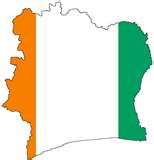
Commemoration: 11 April 2011, the day Côte d’Ivoire was defaced!

Cote d'Ivoire
Cote d’Ivoire

It was on 11 April 2011, exactly 2 years ago, that Côte d’Ivoire, the land of the elephants, was defaced!  Yes…  I remember the tears streaming down my cheeks as I watched an African country being bombed by a foreign country (France) for … frauds during elections.  Before then, I had heard the term ‘francafrique‘, but always thought that it belonged to the past, and never for once thought that in this day and age, after African nations had just celebrated “50 years of independence”, we could be bombed.   See the irony of everything?  How could our people celebrate 50 years of independence in 2010, and then be bombed in 2011, because of internal affairs?  Whether anybody likes it or not, what happened in Côte d’Ivoire was an internal affair: fraud during elections, and international observers sent in to monitor elections all said that there were frauds in the northern part perpetrated by the armed rebels of Alassane Dramane Ouattara (ADO).  Since Gbagbo was the man to take down, we then heard that the ‘international community’ was summoning Gbagbo to step down.  Who remembers this nice ‘international community’ summoning Bush to let Al Gore take power after election fraud in the US in 2000?

And ever since, France and the ‘developed’ nations have not stopped bombing us: they even ganged up to bomb Libya, now Mali, Central African Republic, … it’s like “who is going to be next?”  Yes… centuries and years before, Africa was raped… but it never just stared you in the face like this… or rather they did not openly bomb us?  Is it true?  the Napalm bombs dropped in Cameroon during the independence war, or the bombs used in Algeria during the Algerian war, or in Madagascar claim otherwise. …  I guess in 50 years of independence, our history books had always been written by others, and we willingly let ourselves be brainwashed.

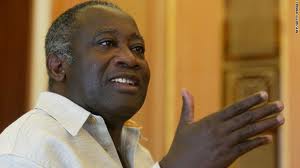
Laurent Gbagbo
Laurent Gbagbo

Some may ask “why are you writing this now? what good will it do? ADO is in power, Gbagbo is in prison, so there is nothing else to do.” Well…  my friends, you sound like losers.  We owe it to future generations to write “our” story ourselves, tell “our” side of history.  Everybody, or at least … nobody should spend 50 years thinking that they were independent like we did for the past 50.  We all need to know that Gbagbo stood for a higher fight, and bravely stood for his country.  Because of him we all openly saw what happened in Côte d’Ivoire: how the head of the electoral commission was ‘bribed’ by the French and American ambassadors in Côte d’Ivoire, how Africa was bribed with stupid temporary seats on the UN security council (South Africa, Nigeria and Gabon), how the Nigerian president was called 11 times in a day by the French one (Sarkozy) to force the CEDEAO and ECOMOG to military intervene in Côte d’Ivoire, how Jacob Zuma (the president of South Africa) abandoned Gbagbo (like he later did with Kadhafi, in a 360-degree turn), how the African Union was full of stupid cowards who all sided with the European union, how the international community declared an embargo on medicine (drugs), and refused to deliver any drugs as the country was being bombed, how they blocked cocoa from Côte d’Ivoire (the number one producer of Cocoa in the world) until after ADO took over, how the African intelligentsia just crucified Gbagbo and 50% of Ivorians in a go (without ever voicing a word of reason), how Gbagbo was betrayed by his main generals (Mangou and Kassaraté), and finally how France bombed the presidency of Côte d’Ivoire, murdering thousands on its way.  The list is so long… and Yes… we all saw it… and today some are silent… we have to write… it is our duty to our children.

Our celebrated writer, Chinua Achebe said:  “There is that great proverb — that until the lions have their own historians, the history of the hunt will always glorify the hunter.” …  “It’s not one man’s job.  It’s not one person’s job.  But it is something we have to do, so that the story of the hunt will also reflect the agony, the travail — the bravery, even, of the lions.”

Elections in Kenya: a Great Win for Democracy on the Continent

Uhuru Kenyatta, Kenya's fourth president
Uhuru Kenyatta, Kenya’s new president

I had to talk about the recent elections (last week) in Kenya.  They were peaceful, classy, and above all democratic (i.e. the choice was made by the people, for the people).  In only one round, Uhuru Kenyatta defeated the ‘machine’-chosen guy, i.e. Raila Odinga (Obama’s cousin).  It was such an important victory for Kenya.  Kenyans actually worked very hard not to have a repeat of 2007-2008 violence, and succeeded.  It was a true example of perseverance on the part of Kenyans who realized that they were making their choice, not the west… and it did not matter that their chosen candidate had been summoned to the International Criminal Court (ICC) in the Hague, because they had chosen him.  I am proud of the Kenyans for showing such class in the election of Kenyatta.  As usual, the poor loser Odinga wants to take Kenya to brink of demolition (as in 2007-2008, by making it about tribes) by filing at the Supreme court, but it would not matter, because the people have spoken! Long live Kenya!

He said “Today, we celebrate the triumph of democracy, the triumph of peace, the triumph of nationhood. Despite the misgivings of many in the world, we demonstrated a level of political maturity that surpassed expectations.”

Check out the Daily Nation, Standard Media, The Star on the victory of Uhuru Kenyatta and the road ahead.

Love for Hugo Chavez’ legacy

Hugo Chavez
Hugo Chavez
Venezuelans accompanying Chavez' procession in Caracas
Venezuelans accompanying Chavez’ procession through the streets of Caracas

I was immensely touched by the outpouring of love for Chavez coming from all corners of the world.  Tell me: how many leaders of this world, have had this great show of love?  How many can boast the millions of Venezuelans who have been mourning for Chavez?  How many can boast popular support in their respective countries like Chavez did?  Remember, he won a third term in office.

Over 55 foreign delegations with 32 head of states were present in Caracas (the capital of Venezuela) to give a last hommage to the great Comandante.  Even Spain sent in the crown prince.  An immense crowd was there to salute Hugo Rafael Chávez Frías.  Chavez’ passing has shown to the world what a true leader is.  Besides his Venezuelan funerals, 55 countries across the globe have declared a national day of mourning.  Argentina declared 5 days of national mourning, Brazil 2, Bolivia 5, Nigeria and Benin 7, and so on and so forth.  Imagine that: 55 countries declaring national days of mourning for the president of another country!  Who can boast better? Can you believe it? Praise be given to the great Comandante, the man who gave us hope, love, courage, and resilience.  Find below videos showing Hugo Chavez’s great work… and love, applaud, and be proud to have lived in a time when a great man gave love and freedom to his people, and the world.