To celebrate all the mothers out there in the world, I thought of sharing this beautiful song by the Burundian singer Khadja Nin, “Mama,” from her widely acclaimed 1996 album Sambolera. Her song Mama is sung in both Kiswahili and Kirundi (for the chorus). It is very soulful, and deep. The song starts with Pygmees’ calls, which reminds us so much of the great Gabonese singer Pierre Akendengué, with whom Nin collaborated on the album. As she sings the chorus, one can imagine being transported on wings of birds, or taken off by the wind on a beach. Such a great reminder that in Africa, language can never be a barrier to stop Beautiful African Music. I dedicate it to all the mothers out there, and future mothers. Enjoy!
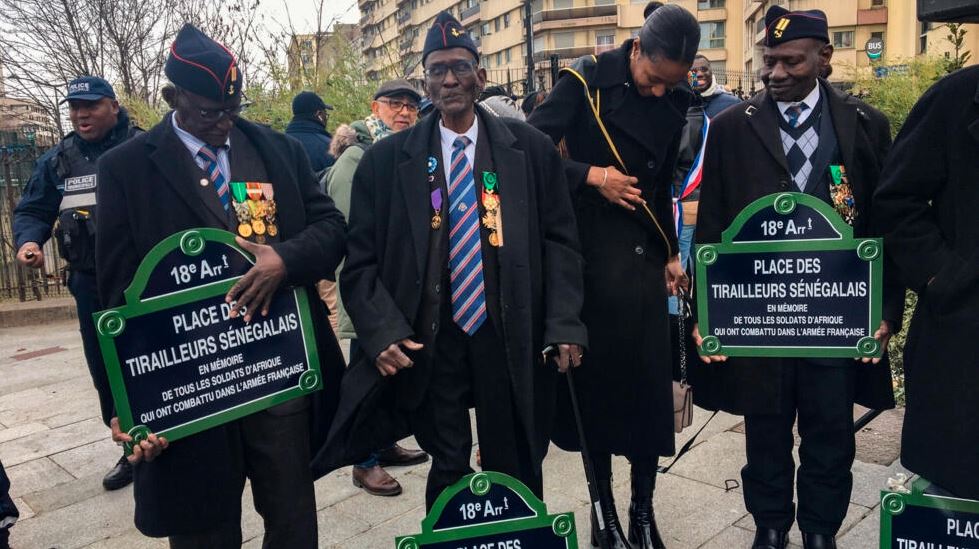
Inauguration of the Place des Tirailleurs-Sénégalais with Tirailleurs aged over 90-years-old on 10 March 2023 (Source: Sylvie Koffi, RFI)
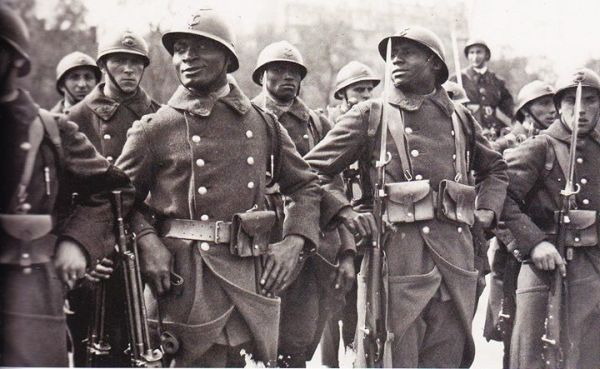
Nine Senegalese tirailleurs, men who served for France for its liberation during the wars, have now won the right to receive their pension while living in Senegal. These men, aged 85 to 96 years, have served in the French army during the wars of Indochina and Algeria, and were forced to live in France at least 6 months per year to get their retirement pension! This meant that in essence, most of them just stayed in France, unable to afford the trips back home to Senegal. For those who do not know, the term “tirailleur” was the name given by the French Army to indigenous infantry recruited in the various French colonies of Africa. They were not all Senegalese, even though the name always said “tirailleur sénégalais,” but rather came from all over Africa. They served France in a number of wars, including World War I, World War II, Indochina, Algeria, and several others. The name “Tirailleur” is a link of two words “tir ailleurs” to laugh and denigrate the African troops by saying that the soldiers were not capable to shoot on target, more to mean “shoot off target”; it could be translated as skirmisher. Although these soldiers fought to help free France, most of them were never recognized, and instead were insulted, laughed at, and sometimes even abused or more. Find here an article on The Conversation, and more importantly on the video of the Massacre of Thiaroye [Thiaroye: A French Massacre in Senegal, ‘Thiaroye Massacre’ by Ousmane Sembene] showing the poor treatment and sometimes massacre of these tirailleurs by the French, when they returned home after serving France.
Senegalese Tirailleurs serving in France in 1940
So, after most of them have died, these remaining 9 Senegalese tirailleurs had to reside in France for at least 6 months every year to receive their due pension!!! Unbelievable! Who knows the atrocities they witnessed in the name of France? Who knows the blood, sweat, and trauma they lived through? Now that only 9 are remaining, France cannot even pay them their pension of 950 Euros per month! 950 Euros per month for 9 people? How difficult can it be for France who gets 500 billion Euros every year from Africa [The 11 Components of the French Colonial Tax in Africa, Africa is funding Europe!, FCFA: France’s Colonial Tax on Africa, Is France Trying to (re) Colonize Africa?]? And these men, tirailleurs Senegalais in their advanced age, had to live in France to even see a money that is due them? And people actually had to fight, and write petitions for the French government to finally agree to pay them in Senegal. See… they always wait for everybody to die, before even acknowledging them [The British Government apologizes for Mau Mau atrocities].
It is a trip they almost stopped dreaming of. Nine Senegalese veterans, aged 85 to 96, who fought for France during the XXth century, will join their families in Senegal.
After years and sometimes decades of living thousands of miles from their relatives so they could claim their French army pension, the soldiers were moved on their way to the airport Friday (Apr.28).
A few days before the journey home, AFP met with Yoro Diao [head medic during the war in Indochina, Vietnam, in charge of the stretcher bearers, carrying the wounded under enemy fire], a veteran aged 95….
“It’s a victory,” the decorated veteran said on Wednesday (Apr.26) as he prepared his flight.
“I’m going to live and eat well. I’ll walk around the village. It’s paradise over there,” he added, a smile lighting up his thin face.
Hundreds of thousands of African soldiers fought for their colonial master France in the two world wars and against independence movements in Indochina and Algeria. But until this year, surviving veterans among the so-called “Senegalese Infantrymen” had to live in France for half the year or lose their pension. In January, the French state dropped the condition, saying they could return home for good and continue receiving their monthly allowance of 950 euros ($1,000). It would also pay for the flight and move of any veterans wishing to leave.
… Their pensions were increased to adjust for inflation for the first time in almost five decades in 2006.
“I was shocked that all these old men who had contributed to our freedom couldn’t even become French,” said [Aissata Seck, Head of the Association for the Memory and History of Senegalese Infantrymen].
… Diao said the French government’s waiver has been a long time coming — too late for some veterans who are now too frail to make the journey home. But for those who still can, “it’s better late than never,” he said.
Amidst the news of chaos in Sudan, it is easy to forget other news happening at the same time across the continent. When it comes to Africa, the Western media have a chic to make us focus only on the worst things on the continent, and rarely the good. After all, if anybody watches the news, they would not think that there is joy and happiness, prosperity, and abundance in Africa; not everything is as portrayed in the news. This week, Japan’s Prime Minister, Fumio Kishida, is touring Africa. The tour started last Sunday in Egypt, followed by Ghana, then Kenya, and Mozambique (Japanese banks are among the international banks financing the multi-billion dollar deal involving the French firm Total in Mozambique (Who/What did we say goodbye to in Africa in 2020?)). In this tour, Japan has vowed to give 500 million dollars in financial support to Africa over the next three years to promote stability and peace on the continent. The New Scramble for Africa is on… are Africans awake? Excerpts below are from AfricaNews.
====
Flag of Egypt
Japan’s Prime minister is on an African tour. He arrived Monday (May. 1st) in Ghana, the day before he was in Egypt. He is set to visit Kenya and Mozambique.
The Prime Minister of Japan arrived at the Kotoka International Airport in Accra, Ghana and is expected to hold a bilateral discussion with President Nana Akufo-Addo.
After a meeting with the Secretary-General of the Arab League at the institution’s headquarters in Cairo, Kishida held talks with Egypt ‘s leader.
Map and Flag of Ghana
Al Sissi detailed the topics per the agenda during a press conference.
“We reviewed the challenges the international arena is witnessing today, in particular the massive economic repercussions left by the Ukrainian crisis on developing countries that exceeded what the coronavirus pandemic caused in terms of a rise in inflation rates, energy and food prices, and expectations of a decline in the growth rate.”
The discussions came as Japan is to host the G7 Summit scheduled on 19-25 May.
“We discussed many regional issues of common concern, especially the Palestinian issue and the situation in Libya. Developments in Sudan occupied an important aspect of the talks“.
A few weeks ago, we talked about The New Scramble for Africa. Our hearts go out to our brothers and sisters in Sudan as unrest rises in the country. Those who think that this is a “simple” feud between two generals, or two “brothers” as portrayed in the news, must look deeper. Why are US troops getting deployed there? In the early 2000s, people around the globe were bombarded non-stop with information about the genocide in Darfur and “slavery” in Sudan; we were all told that Northern Sudanese were “white” who treated poorly their Southern Sudanese brothers who were “Black” which is a very simplistic and exaggerated way of looking at Sudan (remember Libya and Slavery: Sheep without a Shepherd in recent years?). Hollywood stars such as George Clooney came out in numbers claiming to care about the plight of the Black man, and saying that the Black people of DarfurSudan were enslaved by their lighter skinned Sudanese brothers.To all who know the tactic of divide-and-conquer, and know social conflicts in Africa, we are always manipulated into thinking that every conflict in Africa is about this tribe vs. that tribe, this group vs. group; thus neighbors become enemies, when in reality, it is a diamond mine or oil field coveted by external forces which is at the core of the issue (Northern Mozambique today). The conflict in Sudan led to the split of Sudan, which was then Africa’s largest country, into Sudan with capital in Khartoum, and South Sudan with capital in Juba. Many forget that the southern part of then-Sudan was rich in oil fields, and that this split diminished Sudan’s oil output to the detriment of the newly created South Sudan (in passing, wasn’t the Pope in South Sudan in February? The Pope Visits the Democratic Republic of Congo and South Sudan), thus putting a big dint on Sudan’s partnerships with China (Sudan was providing more than 10% of China’s oil needs and a Chinese presence on the horn of Africa). After the split, the world’s attention which was on Darfur moved on, Darfur which was supposedly the goal of Western interventions was never resolved, but South Sudan with the oil fields was detached from Sudan.
The New Scramble for Africa (Source: Source: Dr Jack & Curtis for City Press, National Institute African Studies (NIAS))
The cold war between the West and the East took place mostly in other countries like Angola, Mozambique, Congo, Afghanistan, Nicaragua in Africa, Asia, Latin America with many coups d’état and conflicts around the globe. Similarly today, the new kind of war has started yet again, but this time, it is on African soil with The New Scramble for Africa as the world moves toward energy-“conscious” policies.
How do we, Africans, stop from having our lands be a theater for others’ wars? How can we independently make learned decisions for our people without being dragged in others’ conflict?
Very often, our differences are emphasized, rather than our similarities. For instance, our different religions, different political views, different races, different tribes, countries, etc, more emphasis is placed on what divides us, rather than on what unites us: humanity! We are all humans and neighbors on this big planet that is called Earth. In Senegal, Christians and Muslims reinforce their unity and solidarity during the Christian holiday of Easter with the “Ngalakh” dessert. In a country that is mostly Muslim (over 95%), the people of Christian faith share Ngalakh dessert for “Good Friday” with the rest of their community. The dessert has come to symbolize unity and solidarity between Muslims and Christians in Senegal; just like during Eid al-Adha or Ramadan, Muslim families share meat and couscous with their Christian neighbors. Enjoy and learn more about ways that unite us, rather than divide us. Excerpts below are fromAfricaNews.
====
Flag of Senegal
… In Senegal, where approximately 4 percent of the population is Christian, the feverish preparation that started before Easter to be celebrated on 9 April continues unabated. Christian families prepare a special dessert for “Good Friday”, which represents the end of the Great Lent (Careme) fast that the Christian community keeps during the Easter period and coincides with the Friday before Easter Sunday.
Ngalakh, the first flavour that comes to mind when Easter is mentioned in Senegal, is prepared with “thiakry”, a type of semolina commonly used in West Africa, baobab tree fruit, nutmeg, milk, sugar and peanut cream. Christian families gather early on Friday at the home of a family elder and cook enough Ngalakh for almost the entire neighbourhood. Ngalakh has a liquid consistency and is served with grated coconut, banana slices and raisins.
The young people of the house make a list of Muslim neighbours and acquaintances and distribute most of the dessert to them until Friday afternoon.
Ngalakh, an Easter tradition, is considered one of the symbols of unity and solidarity between Muslims and Christians in Senegal today.
… “This solidarity is unique to Senegal”
… Coly [Adama Manga] said, “In Senegal, everyone respects each other’s religion, no one is in a competition of ‘my belief is superior to yours’. This is a secular country. We live here peacefully together with Christians as well as many sects.“
A few years ago when we published Dum Diversas or The Vatican’s Authorization of Slavery, many were surprised if not astounded to know that the Catholic Church had authorized and condoned the enslavement of people around the world, the conquest of their lands, the placement of indigenous populations into perpetual servitude, and the genocidal eradication of non Christian populations around the globe. There are still many Catholics today who do not know this! We received quite a few harsh inbox messages about the veracity of our work. Imagine the confirmation we got when last Thursday, March 30, 2023, after decades of indigenous calls, the Vatican itself repudiated the ‘Doctrine of Discovery’ which justified colonialism. A Vatican statement said the papal bulls, or decrees, “did not adequately reflect the equal dignity and rights of Indigenous peoples” and “therefore [the Vatican] repudiates those concepts that fail to recognize the inherent human rights of Indigenous peoples, including what has become known as the legal and political ‘doctrine of discovery.'”
It is not clear what to make out of this “rejection of the ‘Doctrine of Discovery'” by the Vatican. Are we supposed to clap? After centuries of killings, conquistadors killings of indigenous people of Americas, eradication of entire populations, enslavement of African people, land grabs across the globe, resources grab, enrichment, etc. We all know the coffers of the Vatican and European nations are filled with the spoils of these conquests and that their cities and countries were built on the back of all these. We ask again, what are we supposed to do with this “rejection”? Is the Vatican giving back what they took? Will the lands be returned? Words again and again and again… no actions!
The New Scramble for Africa (Source: Source: Dr Jack & Curtis for City Press, National Institute African Studies (NIAS))
As said before, there are no coincidences. There is no coincidence that this comes less than 2 months after the Pope’s visit to Africa, which is said to be the future of the Catholic Church. It is no coincidence that it comes just a few days before the very important Christian celebration of Easter. Could this be linked to the New Scramble for Africa? This New Scramble for Africa needs to be done as before, under the veil of good intentions, purity, and supposed forgiveness; while the impoverished people get ‘honeyed’ out with the ‘rejection’ (just words), the resources get pumped out. Some also think that it is no coincidence that it comes under history’s first Latin American Pope. And You, what do you make of this ‘rejection of the Doctrine of Discovery’ by the Vatican?Excerpts below are from Common Dreams. Please also check out the article in Al Jazeera.
=====
In a historic shift long sought by Indigenous-led activists, the Holy See on Thursday formally repudiated the doctrine of discovery, a dubious legal theory born from a series of 15th-century papal decrees used by colonizers including the United States to legally justify the genocidal conquest of non-Christian peoples and their land.
In a joint statement, the Vatican’s departments of culture and education declared that “the church acknowledges that these papal bulls did not adequately reflectthe equal dignity and rights of Indigenous peoples” and “therefore repudiates those concepts that fail to recognize the inherent human rights of Indigenous peoples, including what has become known as the legal and political ‘doctrine of discovery.'”
Slaves on board a ship
“The church is also aware that the contents of these documents were manipulated for political purposes by competing colonial powers in order to justify immoral acts against Indigenous peoples that were carried out, at times, without opposition from ecclesiastical authorities,” the statement added. “It is only just to recognize these errors, acknowledge the terrible effects of the assimilation policies and the pain experienced by Indigenous peoples, and ask for pardon.”
Indigenous leaders—who for decades demanded the Vatican rescind the discovery doctrine—welcomed the move, while expressing hope that it brings real change.
“On the surface it sounds good, it looks good… but there has to be a fundamental change in attitudes, behavior, laws, and policies from that statement,” Ernie Daniels, the former chief of Long Plain First Nation in Manitoba, Canada, toldCBC Thursday.
“There’s still a mentality out there—they want to assimilate, decimate, terminate, eradicate Indigenous people,” added Daniels, who was part of a delegation that met with Pope Francis last year in Rome and Canada.
… Discovery doctrine is rooted in a trio of papal decrees issued in the second half of the 15th century authorizing the Portuguese and Spanish monarchies to conquer land and enslave people in Africa and the Americas if they were non-Christians and dividing the Americas between the two burgeoning empires.
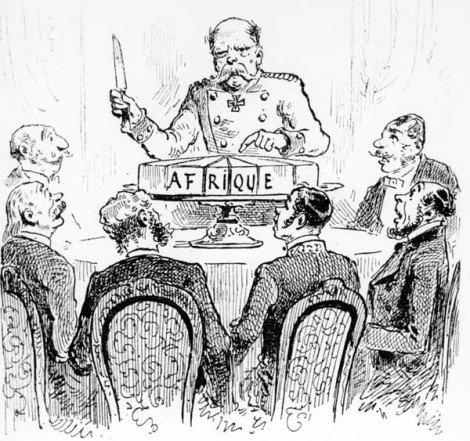
Le partage de l’Afrique à la Conférence de Berlin de 1884
As we talk about neo-colonialism, and the new scramble for Africa, I thought about sharing this poem ‘They Came‘ by Cameroonian writer François Sengat-Kuo published in Fleurs de Latérite, Heures Rouges Éditions Clé, 1971. I had previously shared this poem here. In the poem, Sengat-Kuo talks about colonization and how Africans were fooled by European missionaries who were always preceding European explorers and armies. I particularly like the sentence: “they came, … bible on hand, guns behind.” Jomo Kenyatta, first president of Kenya, said it slightly differently, “When the missionaries came to Africa they had the Bible and we had the land. They said ‘Let us pray.’ We closed our eyes. When we opened them we had the Bible and they had the land.” (Nobel Peace prize Laureate, Desmond Tutu, of South Africa, is said to have popularized the quote). How true! In the days of colonization, Europeans claimed to be bringing civilization and Christianity to pagans across the globe. Today, they bring development, globalization, and democracy… same ol’ thing → submission and slavery to the people. Enjoy!
Recently, I was having a conversation with a friend about leadership in Africa: the endless complaints about our poor leadership, or the killing of our good leaders, and then my friend said talking about Mali, “I wish we had more Assimi Goïta, Choguel Maïga, Abdoulaye Maïga, … on the continent.” Although my heart warmed at this statement, it reminded me that the fight starts at the bottom with each of us. We have to be the leader we want to see; we have to be the Assimi we want to have as a leader. Leadership starts with us, at the individual level. We cannot leave all the task to Assimi or whoever is at the head, we have to do our part; that is the only way to move forward. Otherwise, if something happens to the leader, what will become of our cause? In the article “How do We Continue the Fight when the Head has been Cut Off?”, I wrote, “the prize of freedom is too great to lay on the shoulders of one man, one leader, or a few… we do not follow men, we follow ideas… we are not fighting for men, we are fighting for our right to dignity, our right to humanity, our liberty.“
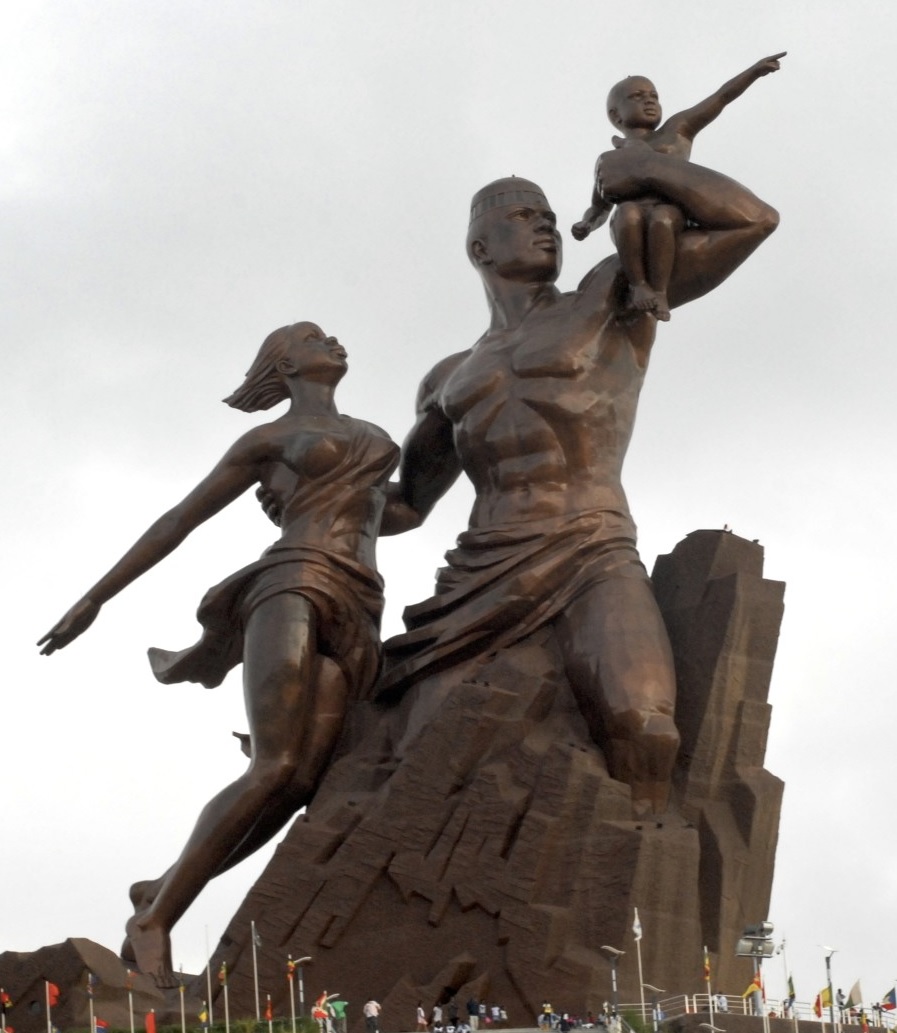
African Renaissance Monument in Dakar (Wikipedia)
Very often it is said among Africans, that we have the leaders we have because that is, at the root, who we are. When you have watched Thomas Sankara, Amilcar Cabral, Patrice Lumumba, Samora Machel, Modibo Keita, Kwame Nkrumah, Ruben Um Nyobe, Felix Moumie, Sylvanus Olympio, Ernest Ouandie, Barthelemy Boganda, Mehdi Ben Barka, Muammar Kadhafi, and many others get assassinated by or in conjunction with foreign forces because of their vision for their countries, it is easy to cower away, and just bend the heads and accept whatever comes in silence. However, cowering in silence, perpetuates the problem endlessly. People often say, we all come on earth and will have to leave at some point, why not leave with dignity? Why cower away? If we start at our level, getting involved in our communities, doing our part (whatever our talents are), being there for each other, do you really think corruption will persist? Let us not wait for Messiahs (and we know how rare those are), but let us start laying the bricks to the foundation of the home we want to live in. If you are an educator, make sure to lay the foundation for the best education possible; if you are a brick layer, do your work with integrity; if you are an okada driver, drive with integrity; if you are a housewife, raise the next leader; if you are a business man, make sure honesty is at the core of your business; if you are a student, arm yourself to be the next leader; … If you want to be led by honest people, then deal with honesty in your daily encounters; if you want to have a transparent government, start with transparency at your level, etc. As my favorite quote by Dr. Martin Luther King Jr goes, “If you are called to be a street sweeper, sweep streets even as Michelangelo painted, or Beethoven composed music or Shakespeare wrote poetry. Sweep streets so well that all hosts of heaven and earth will pause to say, “Here lived a great sweeper who did his job well.” ” We all play a part in this whole that is our homeland, and each one of us is needed!
Thomas Sankara once said in one of his interviews, “if you kill Sankara, you will have a million Sankaras.” Let’s have a million Assimi Goïta, a million Choguel Maïga! Let us have millions of African leaders! Let us have a billion exemplary leaders and more!
The New Scramble for Africa (Source: Source: Dr Jack & Curtis for City Press, National Institute African Studies (NIAS))
American Vice President Kamala Harris is travelling to Africa this week. Her visit comes on the heels of French president Macron’s tour of Africa (Gabon, Angola, DRC, and RC) at the beginning of March, Pope Francis’ visits to the Democratic Republic of Congo and South Sudan at the end of January and February. Less than 2 weeks ago, U.S. Secretary of State Antony Blinkenannounced—during his visit to Niger—that the United States government will provide $150 million in aid to the Sahel region of Africa. Is it a surprise that this aid is going to Niger, country which borders Mali and Burkina Faso? Jill Biden was in Namibia and Kenya in February; and there were many more American envoys crisscrossing the continent. Is it a surprise that the US is increasing the number of its AFRICOM bases in Africa? Just northeast of Niger’s capital Niamey, near the city of Agadez, is Air Base 201, with one of the world’s largest drone bases that is home to several armed MQ-9 Reapers.
Le partage de l’Afrique a la Conference de Berlin de 1884
This sudden open frenzy for Africa reminds us too much of the Scramble for Africa, after the Berlin Conference when Africa was partitioned and shared among European countries. After all, Africa holds over 50% of some of the most valuable minerals in the world, the largest youthful population on earth, and still has the largest mass of arable lands on earth. Truly Africa is the future, and just like during the cold war era when African soil was the theater of the fight between the east and the west, Africa is now once again at the heart of fight for resources. What this does today with Russia, France, the US, China, and all the other nations courting Africa is give Africans more opportunities for better partnerships, or at least deals that actually benefit their populations and not like what France used to do and still does in Africa, exploiting resources for free, not paying taxes to the locals, and not building any schools, hospitals, or even roads. Can Africans unite, and look out for Africa this time around? These promise to be turbulent times, but Africans have to rise up and stand for Africa’s gains, not signing up deals that line up the pockets of only a few, but truly look for the future and the best of our continent. Below is the excerpt about the VP’s visit from the BBC. The American VP promises more investments as usual… they always give aid programs and debt while they take mines, resources, etc… Enough empty promises and paper (valueless) money for resources. Why not teach the people to fish? African people are tired of getting the fish!
====
Map and Flag of Ghana
First it was the US secretary of state who went on a trip to Africa, now it is the vice-president and later in the year the president himself is expected to come.
This flurry of visits by top figures in the US administration reflects a growing awareness that the US needs to deepen its engagement with the continent.
This all comes in the face of growing competition from other global powers, especially China and Russia.
Vice-President Kamala Harris started her nine-day trip in Ghana on Sunday, where she was greeted by drummers and dancers at Kotoko International Airport. She will later go to Tanzania and Zambia.
Ghana, with its focus on strengthening ties with the African diaspora as well as a record of several peaceful democratic transfers of power, provides an ideal launchpad for Ms Harris.
Her trip, according to an official statement, is intended to “build on” December’s US-Africa summit in Washington where President Joe Biden said the US was “all in on Africa’s future“.
But it is that future, boosted by a youthful and growing population as well as the continent’s immense natural resources, that have attracted a lot of other powerful nations vying for influence.
Flag of Ethiopia
While Secretary of State Anthony Blinken’s recent visit to Ethiopia and Niger focused on these countries’ security challenges, the vice-president’s tour will take her to nations facing serious economic problems.
… [University of Ghana Economist and professor of finance, Godfred Alufar Bokpin] told the BBC the interest the US is showing in the country and its debt crisis “is good” but he is worried about what he described as “unfavourable terms of trade” with creditor nations.
… There is a growing sentiment on the continent that Africa should have a free choice in its relationships with the rest of the world.
“Zambia sees the United States in the same way as it sees China and Russia – a friend,” Dr Sishuwa told the BBC.
“When a country turns to China, or Russia, or the US for support, this should not be seen as snubbing one major power bloc or the other.“
He said attempts to seek exclusive relationships with African countries may be counterproductive and unsustainable.
This echoed South African President Cyril Ramaphosa’s comments during a visit to Washington last year when he said: “We should not be told by anyone who we associate with.” …
FESPACO 2023 theme ‘African Cinema and Culture of Peace’
The biennial African film festival, FESPACO, took place this year from 25 February to March 4. On March 4, the winner was announced, and Tunisian Youssef Chebbi won the Golden Stallion of Yennenga (Etalon d’or de Yennenga) for his film ‘Ashkal‘ which centres on the investigation into the killing of a caretaker on a construction site at Carthage on the outskirts of his hometown. He won the first prize over Burkinabe filmwriter Apolline Traore, who picked up the Silver Stallion of Yennenga for the film ‘Sira‘, while the Bronze Stallion was awarded to Kenya’s Angela Wamai for ‘Shimoni‘.
FESPACO 2023
The Festival Panafricain du cinema et de la television de Ouagadougou (FESPACO) is the Panafrican Film and Television Festival of Ouagadougou, which happens to be the largest African film festival. It is held biennially in Ouagadougou, the capital of Burkina Faso. First established in 1969, and boasting some of Africa’s greatest writers and filmmakers (like Ousmane Sembene), the FESPACO offers a chance for African filmmakers and professionals to showcase their work, exchange ideas, and meet other filmmakers, and sponsors.
The Golden Stallion of Yennenga
There were a total of 170 entries selected for the FESPACO festival in the capital Ouagadougou, including 15 fiction feature films in contention for the Yennenga Golden Stallion award and a prize of around $30,000. A big win for women filmmakers, with the second and third prizes won by Apolline Traore and Angela Wamai respectively. Burkinabe filmmaker Apolline Traore won the Silver Stallion for Sira, about a woman kidnapped by Jihadists, and Kenyan director Angela Wamai took home the Bronze Stallion forShimoni, about a schoolteacher rebuilding his life in his remote village after a harsh stint in jail. In 2019, Burkinabe director Apolline Traore had said that any award had to be earned, not considered a token gesture; we are glad for the recognition her work and that of others is getting recognized.
The film, ‘Cuba in Africa‘ produced by Negash Abdurahman won the Thomas Sankara Prize. The film talks about the altruism of Cubans who sacrificed their sons and daughters on behalf of Africa; Cuban volunteers gave their lives to help Angola, Namibia, Guinea Bissau and Cape Verde, and others win independence, and contributed to the fall of apartheid in South Africa. It is a story all Africans should learn.
The 29th edition of Fespaco will be held from 22 February to 1 March 2025, also in Ouagadougou, Burkina Faso.