Yesterday saw new turns in the situation in Niger with the airspace closure, and the rebuffing of the west’s puppet organizations that are the AU, ECOWAS, and the UN by Niger. One thing is for sure, everyone is watching carefully, and no one wants a regional spillover; after all, there are a lot of presidents installed to serve foreign interests in many bordering African countries, and many are starting to sweat. As a side note, the U.S., along with France has about 1,500 troops in Niger and Germany with about 100 (and even Italy) use facilities in that country to “combat jihadi groups” (that the West created to destabilize the entire region). The US with Secretary of State Antony Blinken said that Wagner (and thus Russia) is misleading the people of Niger… he told the BBC’s Focus on Africa programme, “I think what happened, and what continues to happen in Niger was not instigated by Russia or by Wagner, but… they tried to take advantage of it. … Every single place that this Wagner group has gone, death, destruction and exploitation have followed,” said Mr Blinken. “Insecurity has gone up, not down“. And where the US has gone there has not been insecurity, death, or destruction? It is like the pot calling the kettle black! US Acting Deputy Secretary of State Victoria Nuland flew to Niamey on Monday but was denied permission to meet with current president Abdourahamane Tchiani, coup leader, or with former president Bazoum, who is in detention. Instead, she spoke for two hours with other army officers. “These conversations were extremely frank and at times quite difficult because, again, we’re pushing for a negotiated solution. … They are quite firm in their view of how they want to proceed, and it does not comport with the Constitution of Niger,” Nuland told reporters. So when it serves the West’s interests, the constitution of a country is a valid piece of paper, but when it does not like in Ivory Coast in 2010, it is just toilet paper?
… Despite the international pressure, [Niger] coup leaders have seemed unwilling to back down, and on Sunday night, they closed Niger’s airspace until further notice, citing the threat of military intervention.
“In the face of the threat of intervention that is becoming more apparent … Nigerien airspace is closed effective from today,” a junta representative said in a statement on national television on Sunday evening [when Africans fight for their freedoms, they are called junta; but when in other countries people fight for their people’s freedoms, they are called patriots] .
He said there had been a pre-deployment of forces in two central African countries in preparation for an intervention, but did not give details. “Niger’s armed forces and all our defence and security forces, backed by the unfailing support of our people, are ready to defend the integrity of our territory,” the representative said.
The coup leaders warned any attempt to violate Niger’s airspace would face “an energetic and instant response”.
Ecowas defence officials agreed a possible military action plan, including when and where to strike, if Bazoum was not released and reinstated by the Sunday deadline.
On Monday, an Ecowas spokesperson, Emos Lungu, said the bloc would hold an extraordinary summit to discuss Niger on Thursday at the organisation’s headquarters in Abuja.
However, the bloc’s unity has been shattered by support for the coup leaders from the ruling juntas in Mali and Burkina Faso, both [sanctioned] members of Ecowas, and a pledge to come to Niger’s defence if necessary.
Flag of Burkina Faso
The Malian army said it would send a delegation to Niamey to show solidarity and a military plane from Burkina Faso was reported to have landed in the Niger capital at about 11.20am GMT.
The coup, the seventh in west and central Africa in three years, has rocked the Sahel region, one of the poorest in the world. Given its uranium and oil riches and its pivotal role in a war with Islamist militants, Niger holds great importance for the US, Europe, China and Russia.
… Gen Dominique Trinquand, a former French military representative at the UN, said the junta was “totally isolated” [yeah right! so why is the West afraid of this seemingly “isolated” force?].
He added: “Nigeria, which supplies 70% of Niger’s electricity, has cut the supply. All aid has been cut while Niger is one of the poorest countries in the world.”
On Sunday, Paris announced it was suspending its €482m (£416m) development aid programme to neighbouring Burkina Faso, which – along with Mali – has expressed its support for the junta. [And Burkina Faso told Paris to shove it!]
Last week Niger revoked military cooperation agreements with France, which has between 1,000 and 1,500 troops in the country.
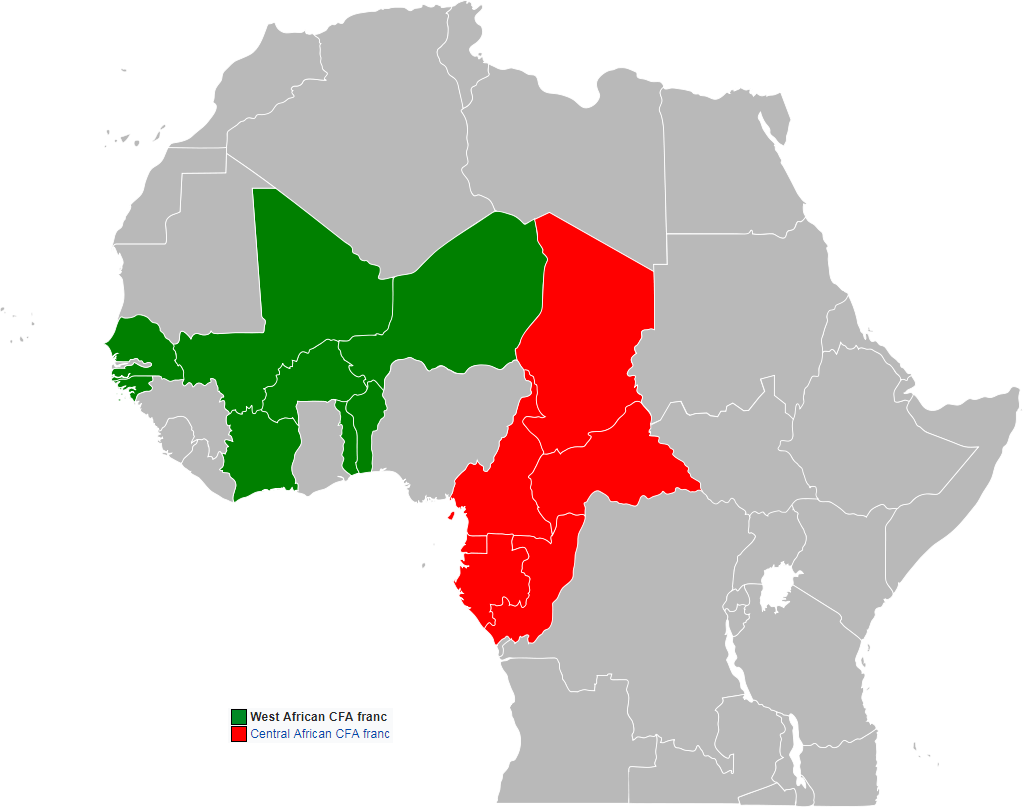
In the Lion King, the song goes as “Can you feel the love tonight?” The recent events in Niger have made us, Africans, sing, “Can you feel the wind of change tonight?” A hurricane is passing through West Africa. It has now landed in Niger! Oh yes! Niger! France is seeing red! Over 1/3 of its uranium is coming from Niger. France, the great country of nuclear energy, has been pillaging Niger, taking over the uranium without so much as building simple roads for Niger people; Niger is still the second poorest country in the world. Did you know that France’s nuclear power is funded by the uranium of Niger? and that Niger gets nothing for it? When Mamadou Tandja, one of the former presidents of Niger asked that the French nuclear company Areva start to pay something to Niger, as Areva had enjoyed a de facto four-decades monopoly in the country, he was deposed in a coup. Remember The 11 Components of the French Colonial Tax in Africa which gives France monopoly over riches, resources and mines, in 15 countries?
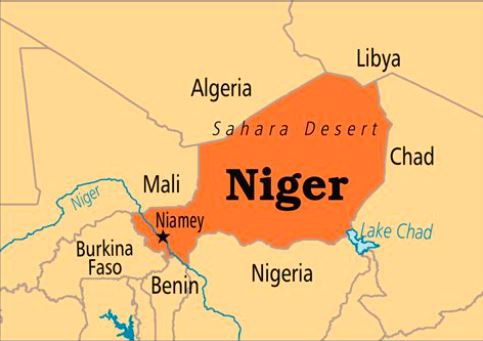
Map of Niger
The International community, France and its cronies the EU, US, etc, have all condemned the 26 July 2023 coup in Niger. They are all panicking! Let’s just say that this might be the start of a big world War reminiscent of the cold war. Why do I say that? Remember how the Cold War between the East and the West was not really played on their soils but rather on African, Latin American, and even Asian soils? This is it! The war in Ukraine is too close to Russia, and the West has put too much in trying to, unsuccessfully, asphyxiate Russia. Now their new energy routes are in jeopardy of being cut off! This is an energetic war! The great oil pipeline that was supposed to go from Nigeria all the way to Europe passes through Niger [Europe turns to Africa for Energetic Needs to Reduce Reliance on Russia].
Can you feel the wind of change? Oh yes! It is blowing through the Sahara. The West asked ECOWAS to militarily intervene in Niger, which it at first agreed to (president Tinubu of Nigeria who is presiding over ECOWAS agreed), but the Nigerian senate said that they would emphasize dialogue over military intervention. Algeria, Niger’s northern neighbor, was tapped in, but they too, prefer dialogue. Chad was called in to intervene in Niger, but Chad said “how can I fight my brother?” The military governments in Mali and Burkina Faso told ECOWAS that an armed intervention in Niger would be met with force. Guinea also sided Mali and Burkina Faso. All three countries plus Niger are suspended from ECOWAS, and form part of a military-led belt spanning Africa’s Sahel from Guinea in the west to Sudan in the east. After the destabilization of Libya by NATO (led by France of Sarkozy, and the US), the entire Sahel region has been unstable. After all, why should neighbors be asked to fight neighbors for foreign interests? We are all African brothers, the fact that we were colonized by different powers does not change the fact that we were colonized by foreigners. One colonizer is not better than another, and we cannot continue to fall over stupid divisions. We are all brothers, the enemy is the same (in the eyes of the colonizer, we are all the same anyways). We have been enslaved for far too long. How can a country like Niger with some of the world’s largest deposits of uranium be the second poorest country in the world (In 2021, Niger was the main supplier of uranium to the EU)? How can it be France’s entire backyard? How can France exploit the country, without so much as building roads, or paying for it? France who has no uranium, no gold, yet is top world producer of all these resources, and gets annually $500 billion from Africa [Africa is funding Europe!] while Africans are impoverished! As you think about it, there comes a time when Bob Marley’s prophetic words ring true “You can fool some people sometimes, but you can’t fool all the people all the time… Now [we] see the light… [we will] stand up for [our] rights!” Enough is enough! Niger O Bosso! As Agostinho Neto said, “A luta continua, e la vitoria e certa.” Brothers and sisters, let us all unite for the freedom of Niger, and Africa as a whole.
In1890, George Washington Williams wrote an open letter to King Leopold II about the atrocities being committed in his name in the Congo in the exploitation of rubber: it took the proportions of a genocide, as almost15 million peoplewere maimed or murdered at the hands of King Leopold II. To read the full letter, please consultBlackPast. Below are some excerpts from the letter.
=====
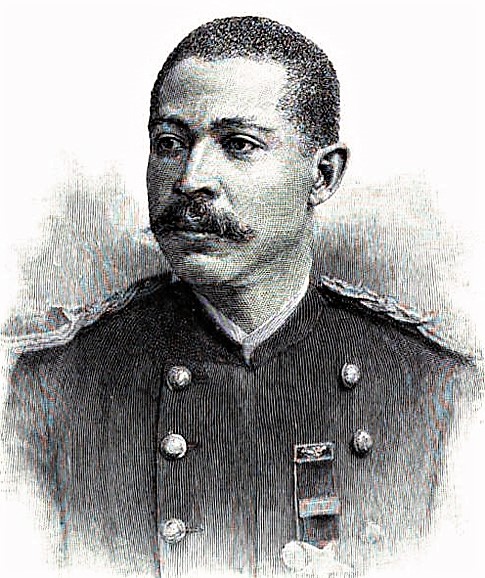
George Washington Williams, “An Open Letter to His Serene Majesty Leopold II, King of the Belgians and Sovereign of the Independent State of Congo By Colonel, The Honorable Geo. W. Williams, of the United States of America,” 1890
Good and Great Friend,
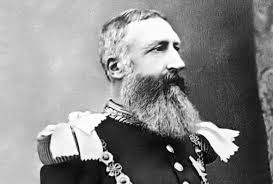
King Leopold II
I have the honour to submit for your Majesty’s consideration some reflections respecting the Independent State of Congo, based upon a careful study and inspection of the country and character of the personal Government you have established upon the African Continent.
It afforded me great pleasure to avail myself of the opportunity afforded me last year, of visiting your State in Africa; and how thoroughly I have been disenchanted, disappointed and disheartened, it is now my painful duty to make known to your Majesty in plain but respectful language. Every charge which I am about to bring against your Majesty’s personal Government in the Congo has been carefully investigated; a list of competent and veracious witnesses, documents, letters, official records and datahas been faithfully prepared, which will be deposited with Her Britannic Majesty’s Secretary of State for Foreign Affairs, until such time as an International Commission can be created with power to send for persons and papers, to administer oaths, and attest the truth or falsity of these charges.
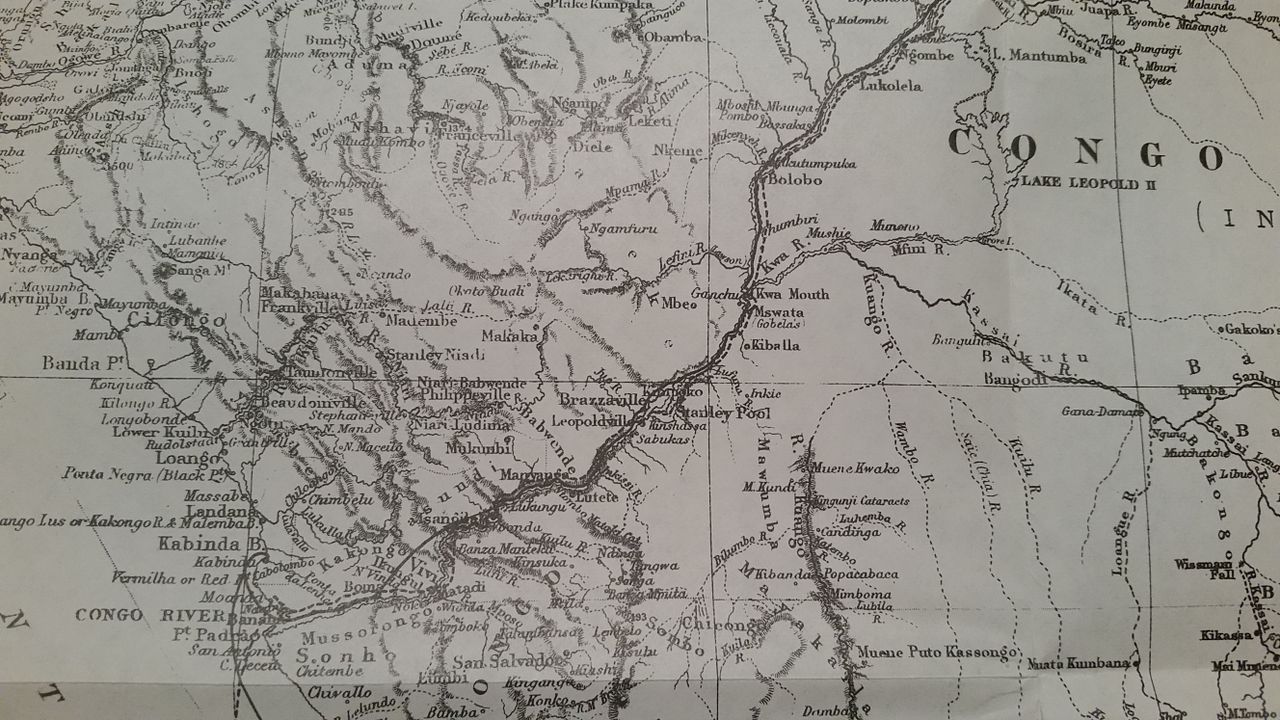
Map of Congo by Stanley
… When I arrived in the Congo, I naturally sought for the results of the brilliant programme: “fostering care”, “benevolent enterprise”, an “honest and practical effort” to increase the knowledge of the natives “and secure their welfare”. I had never been able to conceive of Europeans, establishing a government in a tropical country, without building a hospital; and yet from the mouth of the Congo River to its head-waters, here at the seventh cataract, a distance of 1,448 miles, there is not a solitary hospital for Europeans, and only three sheds for sick Africans in the service of the State, not fit to be occupied by a horse [“Afrique 50” The First French Anti-Colonization Documentary]. …
I was anxious to see to what extent the natives had “adopted the fostering care” of your Majesty’s “benevolent enterprise” (?), and I was doomed to bitter disappointment. Instead of the natives of the Congo “adopting the fostering care” of your Majesty’s Government, they everywhere complain that their land has been taken from them by force; that the Government is cruel and arbitrary, and declare that they neither love nor respect the Government and its flag. Your Majesty’s Government has sequestered their land, burned their towns, stolen their property, enslaved their women and children, and committed other crimes too numerous to mention in detail. It is natural that they everywhere shrink from “the fostering care” your Majesty’s Government so eagerly proffers them.
There has been, to my absolute knowledge, no “honest and practical effort made to increase their knowledge and secure their welfare.” Your Majesty’s Government has never spent one franc for educational purposes, nor instituted any practical system of industrialism. Indeed the most unpractical measures have been adopted against the natives in nearly every respect; and in the capital of your Majesty’s Government at Boma there is not a native employed. …
… From these general observations I wish now to pass to specific charges against your Majesty’s Government.
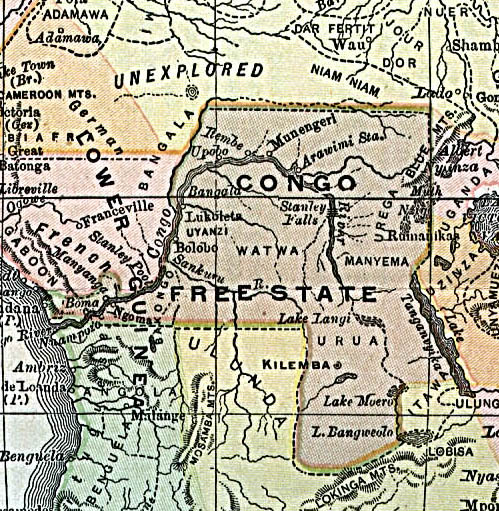
Map of the Congo Free State in 1892
FIRST.—Your Majesty’s Government is deficient in the moral military and financial strength, necessary to govern a territory of 1,508,000 square miles, 7,251 miles of navigation, and 31,694 square miles of lake surface. In the Lower Congo River there is but One post, in the cataract region one. From Leopoldville to N’Gombe, a distance of more than 300 miles, there is not a single soldier or civilian. Not one out of every twenty State-officials know the language of the natives, although they are constantly issuing laws, difficult even for Europeans, and expect the natives to comprehend and obey them. …
SECOND.—Your Majesty’s Government has established nearly fifty posts, consisting of from two to eight mercenary slave-soldiers from the East Coast. … These piratical, buccaneering posts compel the natives to furnish them with fish, goats, fowls, and vegetables at the mouths of their muskets; and whenever the natives refuse to feed these vampires, they report to the main station and white officers come with an expeditionary force and burn away the homes of the natives. These black soldiers, many of whom are slaves, exercise the power of life and death. They are ignorant and cruel, because they do not comprehend the natives; they are imposed upon them by the State. They make no report as to the number of robberies they commit, or the number of lives they take; they are only required to subsist upon the natives and thus relieve your Majesty’s Government of the cost of feeding them. They are the greatest curse the country suffers now.
THIRD.—Your Majesty’s Government is guilty of violating its contracts made with its soldiers, mechanics and workmen, many of whom are subjects of other Governments. Their letters never reach home.
FOURTH.—The Courts of your Majesty’s Government are abortive, unjust, partial and delinquent. I have personally witnessed and examined their clumsy operations. The laws printed and circulated in Europe “for the Protection of the blacks” in the Congo, are a dead letter and a fraud. …
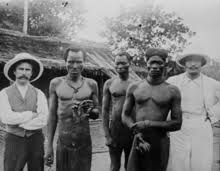
Picture of men holding cut-off hands (image by Alice S. Harris in Baringa 1904)
FIFTH—Your Majesty’s Government is excessively cruel to its prisoners, condemning them, for the slightest offences, to the chain gang, the like of which can not be seen in any other Government in the civilized or uncivilized world. … But the cruelties visited upon soldiers and workmen are not to be compared with the sufferings of the poor natives who, upon the slightest pretext, are thrust into the wretched prisons here in the Upper River. …
SIXTH.—Women are imported into your Majesty’s Government for immoral purposes. They are introduced by two methods, viz., black men are dispatched to the Portuguese coast where they engage these women as mistresses of white men, who pay to the procurer a monthly sum. The other method is by capturing native women and condemning them to seven years’ servitude for some imaginary crime against the State with which the villages of these women are charged. The State then hires these women out to the highest bidder, the officers having the first choice and then the men. Whenever children are born of such relations, the State maintains that the women being its property the child belongs to it also. …
SEVENTH.—Your Majesty’s Government is engaged in trade and commerce, competing with the organised trade companies of Belgium, England, France, Portugal and Holland. It taxes all trading companies and exempts its own goods from export-duty, and makes many of its officers ivory-traders, with the promise of a liberal commission upon all they can buy or get for the State. State soldiers patrol many villages forbidding the natives to trade with any person but a State official, and when the natives refuse to accept the price of the State, their goods are seized by the Government that promised them “protection”. When natives have persisted in trading with the trade-companies the State has punished their independence by burning the villages in the vicinity of the trading houses and driving the natives away.
EIGHTH.—Your Majesty’s Government has violated the General Act of the Conference of Berlin by firing upon native canoes; by confiscating the property of natives; by intimidating native traders, and preventing them from trading with white trading companies; by quartering troops in native villages when there is no war; … by permitting the natives to carry on the slave- trade, and by engaging in the wholesale and retail slave-trade itself.
NINTH.—-Your Majesty’s Government has been, and is now, guilty of waging unjust and cruel wars against natives, with the hope of securing slaves and women, to minister to the behests of the officers of your Government. In such slave-hunting raids one village is armed by the State against the other, and the force thus secured is incorporated with the regular troops. …
TENTH.—Your Majesty’s Government is engaged in the slave-trade, wholesale and retail. It buys and sells and steals slaves. … The labour force at the stations of your Majesty’s Government in the Upper River is composed of slaves of all ages and both sexes.
ELEVENTH.—Your Majesty’s Government has concluded a contract with the Arab Governor at this place for the establishment of a line of military posts from the Seventh Cataract to Lake Tanganyika territory to which your Majesty has no more legal claim, than I have to be Commander-in-Chief of the Belgian army. …
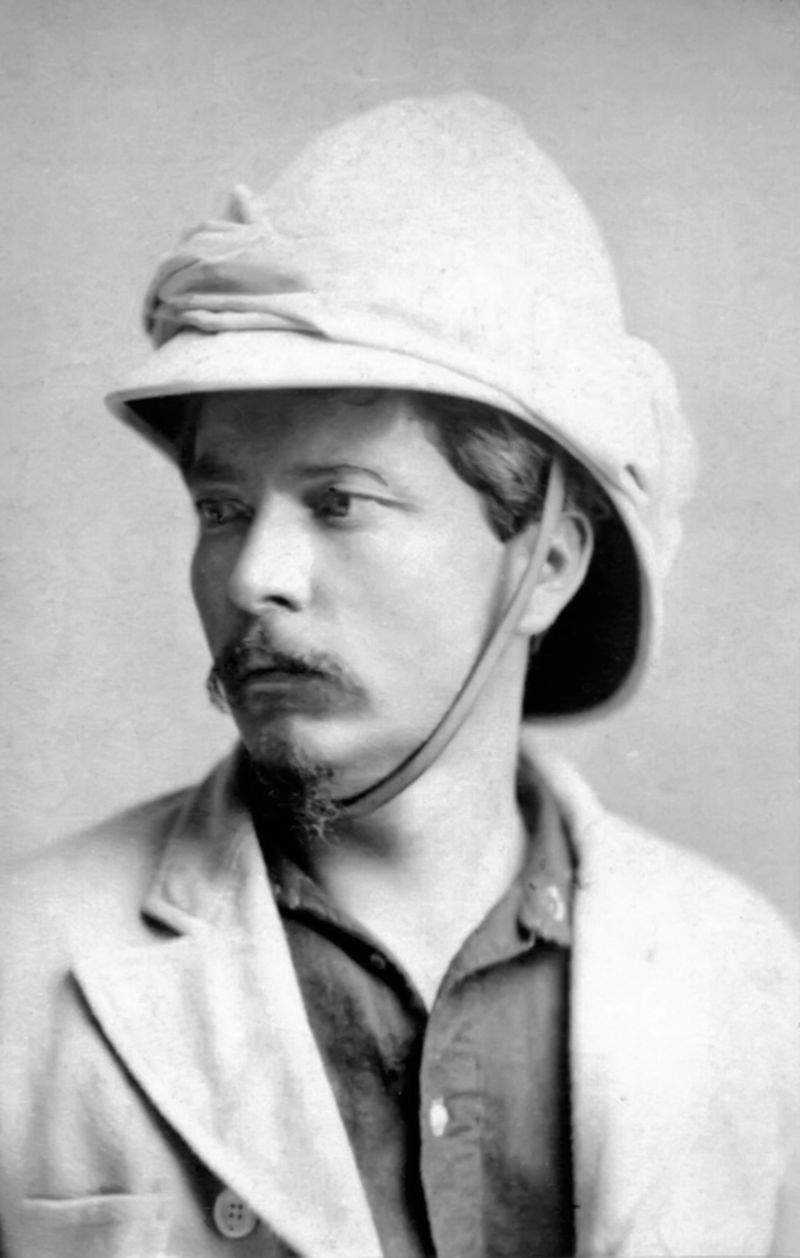
Henry Morton Stanley, whose exploration of the Congo region at Leopold’s invitation led to the establishment of the Congo Free State under personal sovereignty
TWELFTH—The agents of your Majesty’s Government have misrepresented the Congo country and the Congo railway. Mr. H. M. STANLEY, the man who was your chief agent in setting up your authority in this country, has grossly misrepresented the character of the country. Instead of it being fertile and productive it is sterile and unproductive. The natives can scarcely subsist upon the vegetable life produced in some parts of the country. … HENRY M. STANLEY’S name produces a shudder among this simple folk when mentioned; they remember his broken promises, his copious profanity, his hot temper, his heavy blows, his severe and rigorous measures, by which they were mulcted of their lands. His last appearance in the Congo produced a profound sensation among them, … the only thing they found in the wake of his march was misery. …
CONCLUSIONS Against the deceit, fraud, robberies, arson, murder, slave-raiding, and general policy of cruelty of your Majesty’s Government to the natives, stands their record of unexampled patience, long-suffering and forgiving spirit, which put the boasted civilisation and professed religion of your Majesty’s Government to the blush. …
All the crimes perpetrated in the Congo have been done in your name, and you must answer at the bar of Public Sentiment for the misgovernment of a people, whose lives and fortunes were entrusted to you by the august Conference of Berlin, 1884—1 885. I now appeal to the Powers which committed this infant State to your Majesty’s charge, and to the great States which gave it international being; and whose majestic law you have scorned and trampled upon, to call and create an International Commission to investigate the charges herein preferred in the name of Humanity, Commerce, Constitutional Government and Christian Civilisation.
I base this appeal upon the terms of Article 36 of Chapter VII of the General Act of the Conference of Berlin, in which that august assembly of Sovereign States reserved to themselves the right “to introduce into it later and by common accord the modifications or ameliorations, the utility of which may be demonstrated experience”.
Painting of George Washington Williams addressing the Ohio State Legislature. Williams was the first African-American elected to the Ohio State Legislature, serving one term 1880 to 1881 (Source: Ohio Statehouse, Wikipedia)
I appeal to the Belgian people and to their Constitutional Government, so proud of its traditions, replete with the song and story of its champions of human liberty, and so jealous of its present position in the sisterhood of European States—to cleanse itself from the imputation of the crimes with which your Majesty’s personal State of Congo is polluted.
I appeal to Anti-Slavery Societies in all parts of Christendom, to Philanthropists, Christians, Statesmen, and to the great mass of people everywhere, to call upon the Governments of Europe, to hasten the close of the tragedy your Majesty’s unlimited Monarchy is enacting in the Congo.
I appeal to our Heavenly Father, whose service is perfect love, in witness of the purity of my motives and the integrity of my aims; and to history and mankind I appeal for the demonstration and vindication of the truthfulness of the charge I have herein briefly outlined.
And all this upon the word of honour of a gentleman, I subscribe myself your Majesty’s humble and obedient servant,
It is no secret that Aimé Césaire, the father of the Négritude movement, was a prolific author and poet. He published over 100 poems, each one more unique than the other. Césaire was not only responsible for Cahier d’un retour au pays natal, a widely acclaimed masterpiece read throughout schools in Africa today, which documented the 20th-century colonial condition, but he was also an accomplished playwright. In what Césaire describes as his “triptych” of plays, La Tragédie du roi Christophe (The Tragedy of King Christophe, another one read in schools), Une Saison au Congo (A Season in the Congo, another masterpiece), and Une Tempête (The Tempest), he explores a series of related themes, especially the efforts of Blacks—whether in Africa, the United States, or the Caribbean—to resist the powers of colonial domination. Like his poetry and polemical essays, Césaire’s plays explore the paradox of Black identity under French colonial rule.
The poem below “The Woman and The Flame” by Aimé Césaire, Solar Throat Slashed: The Unexpurgated 1948 Edition, is from published by Wesleyan University Press, and translated to English by Clayton Eshleman. Enjoy!
=====
African Venus, a sculpture by Charles-Henri Joseph Cordier 1851 (Source: Walters Art Museum)
“The Woman and the Flame” by Aimé Césaire
A bit of light that descends the springhead of a gaze twin shadow of the eyelash and the rainbow on a face and round about who goes there angelically ambling Woman the current weather the current weather matters little to me my life is always ahead of a hurricane you are the morning that swoops down on the lamp a night stone between its teeth you are the passage of seabirds as well you who are the wind through the salty ipomeas of consciousness insinuating yourself from another world Woman you are a dragon whose lovely color is dispersed and darkens so as to constitute the inevitable tenor of things I am used to brush fires I am used to ashen bush rats and the bronze ibis of the flame Woman binder of the foresail gorgeous ghost helmet of algae of eucalyptus dawn isn’t it and in the abandon of the ribbands very savory swimmer
Every June30, we commemorate the “independence” of the Democratic Republic of Congo (DRC) by posting a speech or letter by its first prime minister Patrice Emery Lumumba. The word independence is placed in quotes because we know that independence cha-cha never really occurred and that many African countries including the DRC are still suffering from the sequels of neo-colonialism.
Patrice Lumumba gave the speech below on December 11, 1958 in Accra, Ghana, at a conference sponsored by Kwame Nkrumah, Ghana’s first president who also succumbed to imperialism. In his speech, all the evils that plague Congolese and African societies are cited: Western domination, external domination, balkanization of the Congolese territory (and Africa), and all the ‘ism‘ that undermine the unity of Africa. His speech is still very current today. The speech can be found in its entirety on Blackpast.org.
====
Kwame Nkrumah
On December 11, 1958, 34 year old Patrice Lumumba, president of the Congolese National Movement, spoke at the Assembly of African Peoples, an international Pan African Conference sponsored by Kwame Nkrumah, the Prime Minister of newly independent Ghana. His remarks appear below. Two years later Lumumba would become the first Prime Minister of the Congo.
…
Our Program of Action
The Congolese National Movement, which we represent at this great conference, is a political movement, founded on October 5, 1958.
This date marks a decisive step for the Congolese people as they move toward emancipation. I am happy to say that the birth of our movement was warmly received by the people for this reason.
The fundamental aim of our movement is to free the Congolese people from the colonialist regime and earn them their independence.
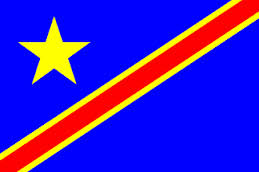
Flag of the Democratic Republic of Congo
We base our action on the Universal Declaration of the Rights of Man — rights guaranteed to each and every citizen of humanity by the United Nations Charter — and we are of the opinion that the Congo, as a human society, has the right to join the ranks of free peoples.
We wish to see a modern democratic state established in our country, which will grant its citizens freedom, justice, social peace, tolerance, well-being, and equality, with no discrimination whatsoever.
In a motion we recently transmitted to the minister of the Congo in Brussels, we clearly stipulated — as did many other compatriots of ours — that the Congo could no longer be treated as a colony to be either exploited or settled, and that its attainment of independence was the sine qua non condition of peace.
In our actions aimed at winning the independence of the Congo, we have repeatedly proclaimed that we are against no one, but rather are simply against domination, injustices and abuses, and merely want to free ourselves of the shackles of colonialism and all its consequences.
These injustices and the stupid superiority complex that the colonialists make such a display of, are the causes of the drama of the West in Africa, as is clearly evident from the disturbing reports of the other delegates.
Map of the Democratic Republic of Congo
Along with this struggle for national liberation waged with calm and dignity, our movement opposes, with every power at its command, the balkanization of national territory under any pretext whatsoever.
From all the speeches that have preceded ours, something becomes obvious that is, to say the least, odd, and that all colonized people have noticed: the proverbial patience and good-heartedness that Africans have given proof of for thousands of years, despite persecution, extortions, discrimination, segregation, and tortures of every sort.
The winds of freedom currently blowing across all of Africa have not left the Congolese people indifferent. Political awareness, which until very recently was latent, is now becoming manifest and assuming outward expression, and it will assert itself even more forcefully in the months to come. We are thus assured of the support of the masses and of the success of the efforts we are undertaking.
This historical conference, which puts us in contact with experienced political figures from all the African countries and from all over the world, reveals one thing to us: despite the boundaries that separate us, despite our ethnic differences, we have the same awareness, the same soul plunged day and night in anguish, the same anxious desire to make this African continent a free and happy continent that has rid itself of unrest and of fear and of any sort of colonialist domination.
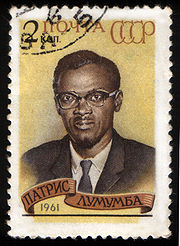
Lumumba on a USSR commemorative stamp in 1961
We are particularly happy to see that this conference has set as its objective the struggle against all the internal and external factors standing in the way of the emancipation of our respective countries and the unification of Africa.
Among these factors, the most important are colonialism, imperialism, tribalism, and religious separatism, all of which seriously hinder the flowering of a harmonious and fraternal African society.
This is why we passionately cry out with all the delegates:
Down with colonialism and imperialism!
Down with racism and tribalism!
And long live the Congolese nation, long live independent Africa!
At end of 2021, we all screamed when we heard news that the only Ugandan international airport at Entebbe was about to be seized by China to pay the country’s debt. This was avoided at the last minute. Zambia is another matter all together, when talking about Zambia these days, there is no way to avoid the Zambia Sovereign Debt Crisis: in 2020, it was the first country to declare bankruptcy as the pandemic had drawn it to its knees, and it was on the verge of a full Chinese takeover. Can you only imagine the instantaneous gray hairs a president will get after getting elected and finding that not only are the country’s coffers empty, but above all, the country is so deep in debt that it will need a miracle to come out of it? Today, President Hichilema applauded the debt deal, which is a big step forward. However, one cannot help but wonder what sort of deals were made, and how many generations of Zambians will have to pay for it (DRC and Zambia Sign Over Cobalt and Copper Resources Rights to the United States?). At this point, don’t you think former president Edgar Lungu and its cronies deserve to be prosecuted for madly borrowing away Zambians’ future? Below are excerpts from the BBC.
====
Map of Zambia
Zambia’s President Hakainde Hichilema can finally breathe a sigh of relief as the outlines of a deal aimed at lifting his country out of its debt crisis have been unveiled.
In 2020, the copper-rich country became the first African nation to default on its debt payments during the Covid pandemic. It was burdened by loans and high interest rates that severely restricted the government’s ability to invest in critical social programmes and infrastructure development, both crucial for economic growth.
Following months of talks, Zambia has now successfully agreed new repayment terms with its state creditors on up to $6.3bn (£5bn) debt, including over $4bn owed to China.
… Although the details of the deal have not yet been released [as always, populations are kept in the dark, while their future is being signed over], it appears that Zambia will be granted an extended repayment time of over 20 years, including a three-year grace period with interest-only payments.
Experts have praised the government for securing the agreement and are hopeful that this will improve Zambia’s economic situation.
Economist Isaac Mwaipopo, from the think-tank the Centre For Trade Policy and Development, believes it will help inspire investor confidence, but urges the government to follow an economic recovery plan.
“There’s a need to come up with a clear plan in terms of reconstructing the economy, especially that we will still be on an IMF programme [which developing country has ever been helped by the IMF?] for the next three years. It will be very important that sectors are identified which can be strategic for growth, boosting job creation and aiding poverty alleviation.”
… By renegotiating the debt terms, Zambia gains valuable breathing space to stabilise its economy, implement necessary reforms and pursue long-term growth. This newfound flexibility can be redirected toward investment in healthcare, education, infrastructure and social welfare.
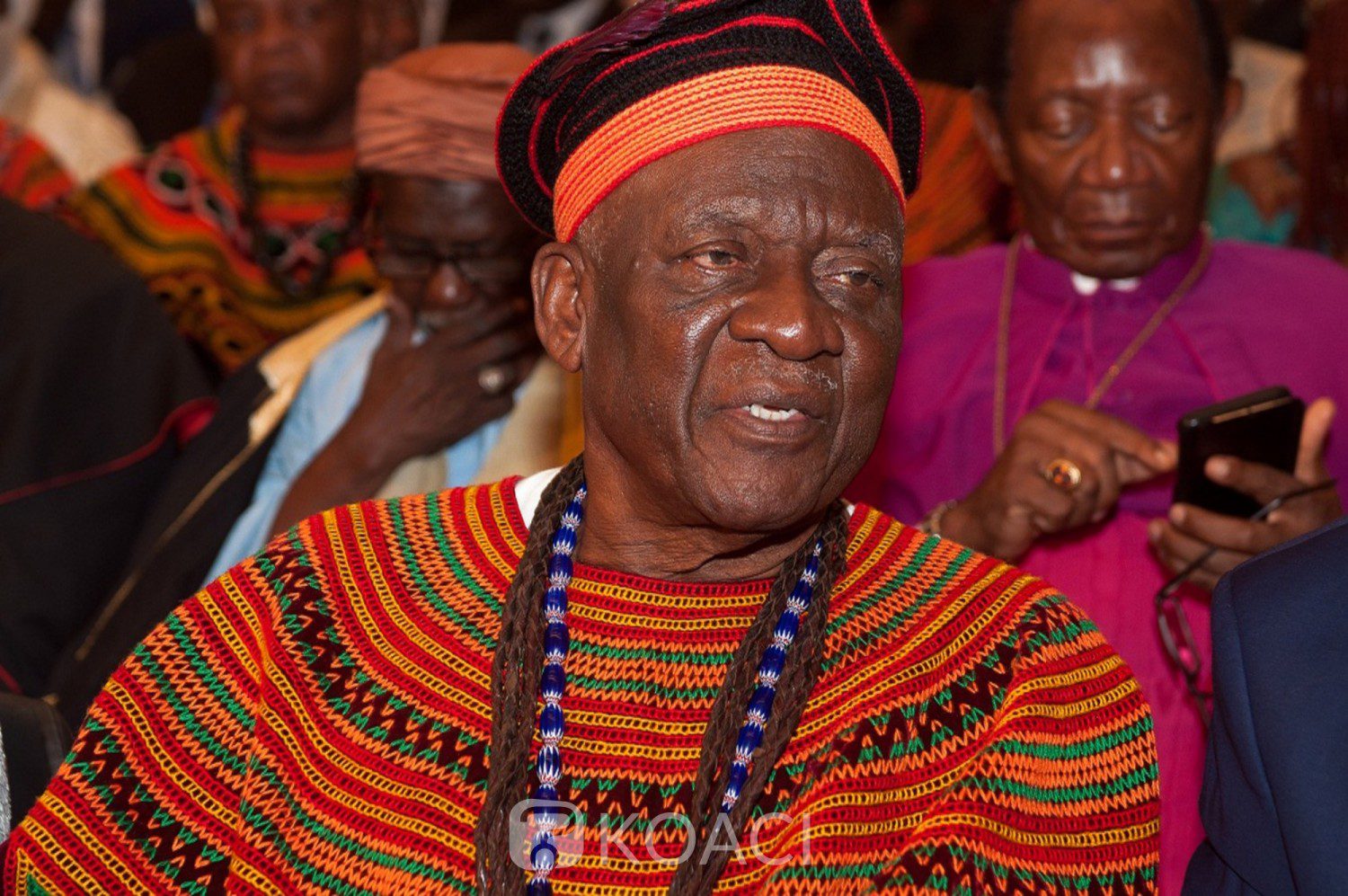
Ni John Fru Ndi, the major political opponent to the current president of Cameroon for almost 3 decades has passed away. Affectionately called “The Chairman,” John Fru Ndi came up at the twilight of the National Conference in Cameroon with the creation of the Social Democratic Front (SDF) in 1990. Over the years, his party came to symbolize hope in a place where there had been no ‘real’ leadership change in over 30 years. His party was seen as the main opposition party to the government for over 2 decades. He was unavoidable in the political arena, and ran for president several times. He came close to winning in theOctober 1992 presidential election, but through some constitutional gymnastics and some play by the Supreme court (always) his win was pulverized and given to the governing party. The Supreme Court judge who heard his petition alleging fraud, said his “hands were tied” – and let the official results granting victory to incumbent Paul Biya, with 40% of the vote, stand. This caused great upset among SDF supporters and Fru Ndi was placed under house arrest for three months in his home in Bamenda, and a state of emergency was declared in the country. Later, Fru Ndi was nonetheless invited with his wife to the inauguration of US President Bill Clinton in January 1993.
Ni John Fru Ndi (Source: Bonaberi.com)
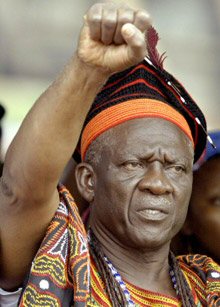
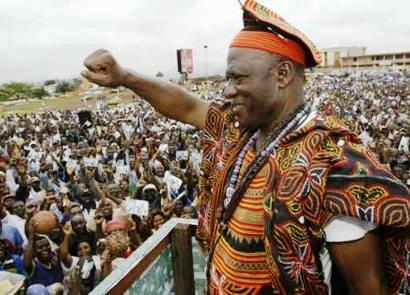
Like everyone back then, Fru Ndi began his political career in the 1980s as a member of Biya’s Cameroon People’s Democratic Movement (RDPC). Through the years, he grew frustrated with the one-party system. In 1990, during the years of the National Conference when Cameroon officially ended the one-party rule, he formed the opposition party the Social Democratic Front (SDF). Although he hailed from the Northwest province of Cameroon (English speaking area of Cameroon), he strove to represent all Cameroonians, and aspired for the unity of the entire country seeking a federally unified Cameroon. He addressed the masses in pidgin English. Soon, SDF came to stand for “Suffer don finish” – where with his arrival in power, his party would usher the end to suffering. At political rallies, he would raise his fist to shout “SDF” to the crowd, who would chant back en masse: “Power to the people!” This call and response was repeated until the third time when they would roar back: “Power to the people and equal opportunities!” The masses were galvanized; for many Cameroonians who had been muzzled for far too long under the one-party frame, this was the opportunity to exercise their civic duties and participate in the political life of their country. They saw in Fru Ndi the alternative to the stuck-up politics. Their efforts were repressed by the governing party; the early 1990s were the years of strikes, street protests, “zero-deaths,” and more.
John Fru Ndi addressing the masses in Bamenda (Source: Cameroonpostline.com)
In recent years, Fru Ndi was not a supporter of the secessionist rebellion in Anglophone Cameroon that has claimed tens of thousands of lives and displaced countless people over the last six years. He was even kidnapped twice and beaten up by militants of the secessionist group in 2019, and part of his house was burnt down. The secessionists were angered by what they saw as his betrayal for not supporting their demand for an independent state of Ambazonia, as they call Cameroon’s two English-speaking areas – the Northwest and Southwest regions. This forced him to sadly relocate from his beloved Bamenda to the capital Yaounde. He was very proud of his origins and rarely was seen wearing anything but atogho, traditional Bamileke clothing from the Northwest region, or Boubou: A Traditional African Garment.
Flag of Cameroon
Many claim that he should have united the opposition behind one leader against the government, as he had failed to get the coalition formed by the opposition to agree to field a single candidate to take on Mr Biya; or that he had been corrupted by the governing party. Fru Ndi may have made mistakes, but at some point he represented the hopes of millions, hopes for a different future, a different alternative; and he had the courage to stand up and create a party who united people from all levels of the society, ushering the era of multi-party in Cameroon which was often paved with thorns. He has left a major imprint in Cameroon’s politics.
“I salute the memory of a singular, charismatic and courageous leader,” said current opposition leader Maurice Kamto who ran for president in 2018.
“The story of the return to multi-party politics in Cameroon cannot be written without [Fru Ndi’s] name in bold gold,” said politician Akere Muna, who ran for president in 2018. “His life is a lesson to the fact that leadership is about serving and not about being served,” he said.
“Ni John Fru Ndi for the SDF (Social Democratic Front, editor’s note) was the guide, that is to say, the man who traced the furrow along which we walk, the man who against all odds imposed the return to a multi-party system in Cameroon on 26 May 1990 and with it a set of individual and collective freedoms granted to the entire Cameroonian people” Marcel Tadjeu , Chairman of the Douala 5 SDF electoral constituency told AfricaNews correspondent.
From this scene I strolled away to the northern gate, to where the dead body of the late Master of Magdala lay, on his canvas stretcher. I found a mob of officers and men, rudely jostling each other in the endeavour to get possession of a small piece of Theodore’s blood-stained shirt.
No guard was placed over the body until it was naked, nor was the slightest respect shown it. Extended on its hammock, it lay subjected to the taunts and jests of the brutal-minded. An officer, seeing it in this condition, informed Sir Robert Napier of the fact, who at once gave orders that it should be dressed and prepared for interment on the morrow.—Henry M. Stanley [Henry M. Stanley, Magdala: The Story of the Abyssinian Campaign, 1866-67. Being the Second Part of the Original Volume Entitled “Coomassie and Magdala”, Leopold Classic Library,1896, p. 156.]
Prince Alemayehu, son of Emperor Tewodros II, as photographed in 1868 by Julia Cameron
This is a heartbreaking news. Last week, Buckingham Palace, and the UK government refused to return the remains of Prince Alemayehu, son of Emperor Tewodros II, to Ethiopia. Prince Alemayehu’s remains are still in Great Britain 150 years after his death. How preposterous is this! Few years ago, when the Ethiopian government asked, the British said that they could not identify his bones (Ethiopians urge Britain to return bones of ‘stolen’ prince after 150 years). Today, Ethiopians thought that now that there is a new occupant in Buckingham Palace, King Charles III, Prince Alemayehu’s remains will finally return home. However, Buckingham Palace said that returning his remains will not be possible, as it will disturb the resting place of several others in the vicinity. From not being able to identify his bones a few years ago (when in this day and age the remains of King Richard III of England have been identified 500 years after his death), to disturbing others buried there, it makes us wonder if they ever even took the time to look. These are the same people who only returned the hair of Emperor Tewodros II only in 2019. It is so painful to hear… it feels like part of Emperor Tewodros II is still stuck in England. As one looks at pictures of the young orphaned prince who arrived in the UK at the age of 7, and who died at the age of 18, there is so much pain in his face.
Below are snippets of the article; for the full version, go to the BBC.
=====
Emperor Tewodros II
Buckingham Palace has declined a request to return the remains of an Ethiopian prince who came to be buried at Windsor Castle in the 19th Century.
Prince Alemayehu was taken to the UK aged just seven and arrived an orphan after his mother died on the journey. Queen Victoria then took an interest in him and arranged for his education – and ultimately his burial when he died aged just 18.
But his family wants his remains to be sent back to Ethiopia. “We want his remains back as a family and as Ethiopians because that is not the country he was born in,” one of the royal descendants Fasil Minas told the BBC. “It was not right” for him to be buried in the UK, he added.
… in a statement sent to the BBC, a Buckingham Palace spokesperson said removing his remains could affect others buried in the catacombs of St George’s Chapel in Windsor Castle. “It is very unlikely that it would be possible to exhume the remains without disturbing the resting place of a substantial number of others in the vicinity,” the palace said. The statement added that the authorities at the chapel were sensitive to the need to honour Prince Alemayehu’s memory, but that they also had “the responsibility to preserve the dignity of the departed“.
How Prince Alemayehu ended up in the UK at such a young age was the result of imperial action and the failure of diplomacy. In 1862, in an effort to strengthen his empire, the prince’s father Emperor Tewodros II sought an alliance with the UK, but his letters making his case did not get a response from Queen Victoria. Angered by the silence and taking matters into his own hands, the emperor held some Europeans, among them the British consul, hostage. This precipitated a huge military expedition, involving some 13,000 British and Indian troops, to rescue them [no diplomacy, always force and violence].
British Camp at Zoola, Abyssinia expedition 1868-9 (Source: Victoria and Albert Museum, London)
The force also included an official from the British Museum. In April 1868 they laid siege to Tewodros’ mountain fortress at Maqdala in northern Ethiopia, and in a matter of hours overwhelmed the defences. The emperor decided he would rather take his own life than be a prisoner of the British, an action that turned him into a heroic figure among his people.
Departure of the British expeditionary forces from Maqdala with the loot – Illustrated London News 1868
After the battle, the British plundered thousands of cultural and religious artefacts. These included gold crowns, manuscripts, necklaces and dresses. Historians say dozens of elephants and hundreds of mules were needed to cart away the treasures, which are today scattered across European museums and libraries, as well as in private collections. [In the case ofMaqdalain1868, it is said that15 elephants and 200 mules were needed to cart away all the loot from Maqdala.British forces looted the place with no restrain].
The British also took away Prince Alemayehu and his mother, Empress Tiruwork Wube. [The loot was not enough… the young prince and the Empress too].
Several African nations are launching satellites. Just last month, Kenya launched its first operational satellite to space onboard a Space X rocket, developed by nine Kenyan engineers, with the goal of collecting agricultural and environmental data, including on floods, drought and wildfires, that authorities plan to use for disaster management and to combat food insecurity.
Flag of Djibouti
At the beginning of the year, Djibouti announced the construction of the first African spaceport. Djibouti’s President Ismail Omar Guelleh signed a technological cooperation agreement with the Chinese company Hong Kong Aerospace Technology to build a $1bn satellite and rocket launch site. Given Djibouti’s location near the equator, it is an attractive destination for the satellite launching while taking advantage of the Earth’s rotational speed. As Temidayo Oniosun, managing director at the consultancy Space In Africa, says, “none of the 54 satellites launched by African countries were launched from Africa,” …“Hopefully, this move will enable the launch of the first Africa-made satellite from African soil. This project, if successful, will also positively affect the industry across several countries and segments, lead to the establishment of new enterprises and new spinoffs, and wouldultimately play a vital role in implementing a continentally driven space program.”
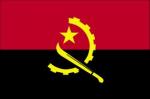
Flag of Angola
In January, Angolan President João Lourenço inaugurated the country’s first satellite control center. Its main task is to monitor the activity of the satellite “ANGOSAT 2“, launched in October with the help of Russia. The inauguration took place at Funda area within Luanda, the capital city of Angola and fully equipped with technical and technological means.
The same month, the African Union inaugurated the African Space Agency based in Cairo to highlight the importance of the space industry among all the goals for development of the continent.
Flag of Uganda
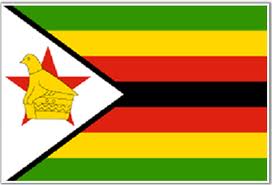
Uganda and Zimbabwe launched their satellites last November. The satellites named PearlAfricaSat-1 for Uganda, and ZimSat-1 for Zimbabwe, were launched aboard a Northrop Grumman Cygnus resupply spacecraft, which lifted off from NASA’s Wallops Flight Facility in Virginia.
Africa has long been considered a latecomer in the space area. There are enormous needs across the continent, particularly in communication, education, agriculture, and science, thus reinforcing the need for Africa to quickly develop its space industry. The African space industry is expected to top $22 billion by 2026. In 2022, countries allocated a total of $539 million to their respective space programs.
Flag of Zimbabwe
The report says satellites could address agricultural challenges by measuring crop health, improve water management by monitoring drought, and track tree cover for more sustainable forest management. In a continent where less than a third of the population has access to broadband, more communication satellites could help people connect to the internet.
We applaud the amazing work, however how will the little countries in Africa benefit from these bursts from the neighboring countries? Is this a joint effort or just individual countries? We, as Africans, should unite! The enemies are too numerous for one to do it by itself. Will this not bankrupt some, and lead the projects to fail? All this brings to mind all the efforts Kadhafi had put in place to have a continental spaceport, space program and satellites to benefit the entire continent. Africa is ready: united we stand, divided we fall, and we need to unite for our efforts to have real impact the way Kwame Nkrumah and Muammar Gaddafi (Kadhafi) envisioned.