Pendant Ivory mask representing Queen Idia, Iyoba of Benin City (16th Century)
A British man recently decided to return looted art that his grandfather had taken (stolen?) away during the 1897 Benin City Massacre. The article about the art returning is on BBC. I do salute the man for doing it; and I wish the British museums and museums around the world will return art looted by Europeans in African countries and countries around the world. True, the man excuses his grandfather’s acts by saying: “We are taught from a very young age that the killing of enemy combatants under the umbrella of statehood is a regrettable necessity of life.” And excuses the art looting by saying, “To him [his grandfather], it was probably no more than picking up stuff that’s washed up on the beach, because people had fled and nobody owned them any longer.” But he is happy they are now back in Benin City. “These objects are part of the cultural heritage of another people… to the people of Benin City, these objects are priceless.”
I also decided to link back to the story I wrote a while ago about the Benin City Massacre.
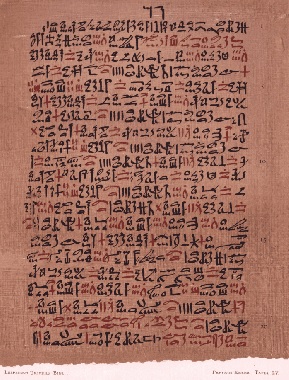
Today, we will be talking about the Papyrus Ebers or Ebers Papyrus, which is among the oldest and mostimportantmedicalpapyri of Ancient Egypt and of the world. This papyrus is a medical papyrus of herbal knowledge, and dates back to c.1550 BC. It is believed to have been copied from earlier texts. It is 110-page scroll, and is about 20 m long. It is among the world’s oldest preserved medical documents.
From c. 33rd century BC until Persian invasion in 525 BC, Egyptian medicine remained one of the world’s most advanced, and was used in some non-invasive surgery, setting of bones, and an extensive set of pharmacopeia. Even Homer of the Odyssey recognized this when he said, “In Egypt, the men are more skilled in medicine than any of human kind” and “the Egyptians were skilled in medicine more than any other art“.
Georg Ebers
The Papyrus Ebers is one of the oldest medical papyri still well-preserved. It was given the name Ebers, after the man who purchased it in Luxor (Thebes) in the winter of 1873-74, Georg Ebers, a German Egyptologist and novelist. It is written in hieratic Egyptian writing and preserves the most voluminous record of ancient Egyptian medicine known. It contains about 700 magical formulas and remedies, for things such as asthma, evacuation of belly, bowels, birth control, guinea worms (this remedy is still the standard practice today, over 3500 years later), and even cancer. There is also a chapter titled Book of Hearts, which deals with mental disorders such as depression and dementia.
Ebers Papyrus – remedy for asthma
One of the most common remedies described in the papyrus is ochre, or medicinal clay, which was prescribed for intestinal and eye complaints. Yellow ochre was prescribed as a remedy for urological complaints.
The Papyrus Ebers is currently kept at the Leipzig University‘s library (Ebers was chair of the Egyptology department there) in Germany. If you are in Leipzig, go visit. Please check out the Ancient Egyptian Medicine website, which talks in details not only about the Ebers Papyrus, but also about other famous Papyri such as the Edwin Smith Papyrus (c. 1600 BC), the Kahun Gynecological Papyrus (c. 1800 BC), and herbal remedies, and nutrition of Ancient Egypt.
I had to share with you this Feb. 16, 1959 Time Magazine gem of an article on President Sekou Toure of Guinea, the first country to say ‘NO’ to France. As you will see, even the so-called ‘dictators’ of the world have graced the cover of Time Magazine when they were still ‘deemed’ good. Some of the article is a bit a mockery of Africans for wanting independence from their colonial masters, as it is referred to as ‘haste’ in the article (could you really have faulted Africans for wanting freedom?). Enjoy! The full article can be found at: WebGuinee.net. Below are a few words.
==============
Finally, Sékou Touré, 37 President of the new Republic of Guinea, a trim figure in a European busine suit, rose and raised his arm. “Vive l’indépendance!” he shouted, and three times the crowd roared back, “Vive l’indépendance!” “Vive l’Afrique!”he shrieked in a voice close to frenzy. Once again, the cry was three times repeated. There was no reason for Touré to do more. The crowd had seen and heard him, and that was enough.
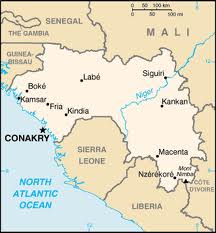
Guinea-Conakry
Broad-shouldered and handsome. Sékou Touré is as dynamic a platform performer as any in all Black Africa. He is the idol of his 2,500.000 people, and the shadow he casts over Africa stretches far beyond the borders of his Oregon-sized country. As the head of the only French territory to vote against De Gaulle‘s constitution and thus to choose complete independence, he has been suddenly catapulted into the forefront of the African scene. ….
Part dedicated idealist and part ruthless organizer-perhaps the best in Black Africa-Guinea’s Touré should have problems enough just coping with the disruption that inevitably came with independence. But he, too, has dreams as wide as a continent. “All Africa,” says he, “is my problem.”
Samori Toure holding the Coran
In a sense, he was born in the right place and with the right ancestry to favor a big role. Though Africa was, until the Europeans came, the continent that could not write, it had known its times of glory. Guinea was once part of the powerful Mali Empire that stretched from the French Sudan, on the upper reaches of the Niger, to just short of West Africa’s Atlantic Coast. When its 14th century ruler, the Mansa (Sultan) Musa, made his pilgrimage to Mecca, he traveled with a caravan of 60,000 men, and among his camels were 80 that each bore 300 lbs. of gold. … he turned the fabled city of Timbuktu into a trading center and a refuge for scholars. … But the legend lived on of the warrior Samory, whom Sékou Touré claims as his grandfather.
Sekou Toure, one of Samori Toure’s grandson
When De Gaulle stopped off at Conakry on his swift tour of Africa before the referendum, Touré thundered in his presence: “We prefer poverty in liberty to riches in slavery.” Angrily, De Gaulle canceled a diner in time he was to have had with Touré, and the split was final. A few weeks later, 95% of the people of Guinea voted no to the De Gaulle constitution.
The Cape Coast Castle is one of the 30 slave forts of Ghana. In 2009, the US president Barack Obama and his family, made a point to visit the Cape Coast Castle. So why should you learn about it?
Well, it took 50 years to build the three-story building that forms today’s Cape Coast Castle. It was originally built by the Swedes (the Swedish Africa Company), starting in 1653 (it was then known as Fort Carlsborg or Carolusborg) for timber and mineral exportation, and then taken over by the Dutch before the British wrestled it away. The original cannons, cannon balls, and mortars used to defend the fort can still be seen today, facing the Atlantic Ocean.
Cape Coast Castle in 1682
The brick courtyard of the castle, which Ghanaians commonly refer to as Cape Coast Dungeon, has two 18-foot water wells and four graves. The first grave is for the Rev. Phillip Quarcoo, the first black Anglican pastor in the area. Beside him lies C.B. Whitehead, 38-year old British soldier who was killed by a Dutch soldier in the courtyard. Besides them are the graves of Letitia Elizabeth Landon, and her husband George MacLean, the British governor of Cape Coast from 1830 to 1844. I am not sure how a woman could possibly live next to such atrocities; maybe by rationalizing that the people being imprisoned, were not human beings?
The open auditorium on the top floor of the former administration building now hosts an exhibit chronicling the history of slavery on Ghanaian shores.
Cape Coast Castle in 1890 (National Archives UK – Wikimedia)
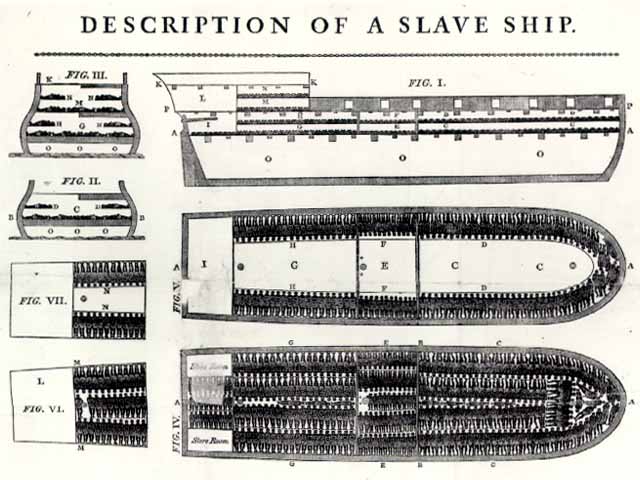
During the 17th and 18th centuries, the Cape Coast slave fort imprisoned about 1000 men and 300 women for any given 3 months period, before they were crammed into ships bound for a life of slavery in the Americas. Its corridors are full of dungeons where only dim light coming from tiny windows let the light and air in. 200 males will be kept in space meant for 50 people or less, where they will spend over 23h a day for three months, and will only be brought briefly out to eat. Ironically, Christian services were held in the fort while these poor souls were screaming for their lives underneath.The majority of captives ranged between 15 and 35 years of age.
Women were locked in 2 similar dungeons, 150 of them per chamber. They will be raped daily by the British soldiers, who would come into the cells and select the ones to spend the night with. Any slave who challenged the authorities was thrown into the condemned cell, which held 30 – 50 in a room no bigger than most walk-in closets. There, they would die deprived of food, water, light, and oxygen, clawing the brick walls and floors as they suffocated.
Cape Coast Castle (WZM – Wikipedia)
To descend into the exposed brick castle feels like entering the depth of the underworld (I can only imagine how those captives felt going through there). There are five dungeon chambers for men. The strongest ones were separated during branding, when hot iron rods were used to mark their chests, and then chained and shackled together in the first chamber. The last cell has a hole in the wall, which leads into a deep dark tunnel which was used to take slaves underneath the castle’s courtyard, leading them to the “door of no return.” Cape Coast Castle was once the most active slave trading hub in West Africa.
Slavery was not just a European affair, but an African one as well, since many African chiefs traded slaves (rarely their own people – but people from other nations) to the Europeans in exchange for goods. Thus, the Ghana House of Chiefs – a body comprising all the country’s traditional kings and chiefs- has placed a plaque on one of Cape Coast castle’s walls, asking for forgiveness to the souls of those who were sold. When will European nations also ask for forgiveness?
Last week, an exhibition organized by the Schomburg Center for Research in Black Culture of The New York Public Library, in Delhi recently showcased the “forgotten” stories of Africa’s role in India’s history. The exhibition reminded me a lot of the article I wrote about the Siddis, a tribe of Indians of African descent.
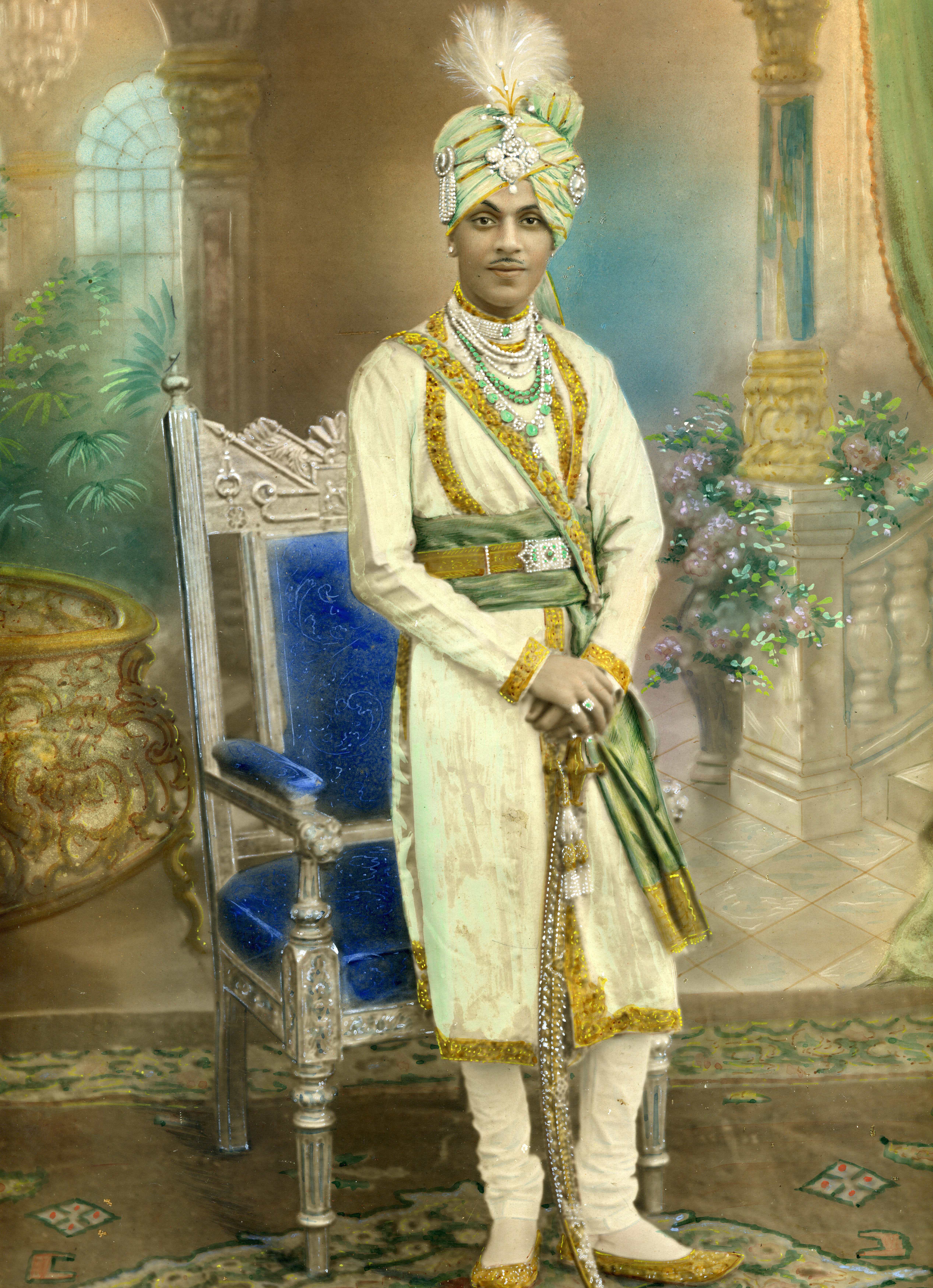
Nawab Sidi Mohammed Haider Khan (Source: The Kenneth and Joyce Robbins Collection)
Well it turns out, that many Africans travelled to India either as traders or as slaves centuries ago; their presence dates as far back as the 4th century AD. They mostly came from the horn of Africa and were referred to as Abyssinians, Siddis, or Habshis (Ethiopians), or Zangis (East Africans). They really flourished as traders, artists, rulers, architects and reformers between the 14th Century and 17th Century. They played an important role in India’s history or kingdoms, conquests, and wars, and rose through the ranks of society, some becoming generals or rulers. Due to their fighting prowess, many became soldiers in the armies of conquerors and sultans all over India’s princely states. The most important one of them is Malik Ambar (1548-1626) of Ahmadnagar, in Western India, who was an important ruler, and military strategist. His mausoleum still exists in Khuldabad, near the Aurangabad district; somehow, Indian history forgot to mention that he was African. There was also Nawab Sidi Haidar Khan, ruler of the African-ruled state of Sachin established in 1791 in Gujarat; the state had its own cavalry and state band which included Africans, its own coat of arms, currency, and stamped paper.
Ibrahim Rauza Tomb, designed by architect Malik Sandal
Other Africans flourished as artists, reformers, and architects, such as Malik Sandal who designed a funerary complex after 1597 in Bijapur, the Ibrahim Rauza tomb (in present-day southern Karnataka state).
Painting of a Sidi couple of Bombay (by M.V. Dhurandhar, from the book ‘By-Ways of Bombay’, 1912)
Africans not only rose to prominence in the Deccan Sultanates of southern India, but also on the western coast of India. They sometimes seized power for their group like they did in Bengal – where they were known as the Abyssinian Party – in the 1480s; or in Janjira and Sachin (on the western coast of India) where they established African dynasties. They also took power on an individual basis, as Sidi Masud (also written Siddi Masud) did in Adoni (in southern India), or Malik Ambar in Ahmadnagar (in western India).
The main African figures of the past have not been forgotten but their ethnicity (as in many places in the world) has been erased, consciously or unconsciously. How many more prominent Africans are there in Indian history, whose ethnicity was erased? Please enjoy this photojournal of the Schomburg exhibition from the BBC, Africans in India: From Slaves to Rulers, and if you get a chance, do attend the exhibition, the pictures are simply amazing.
Last month, the Nguon festival took place in Foumban (also spelled Fumban), in the Noun region of Cameroon, celebrating its 545th edition. So what is this centuries’ old tradition called the Nguon?
Celebrated every two years by the Bamoun people (also spelled Bamun, Bamoum, Bamum) of the Noun region of Cameroon, the Nguon festival is over 600 years old. It is a true display of the rich culture and tradition of the Bamoun people. The Nguon festivities are spread over 7 days, with each day marked by several activities such as traditional dances, ritual ceremonies, conferences, and great food showcasing the richness of the Bamoun culture.
List of the Rulers of the Bamoun Kingdom
During the Nguon, the Bamoun people gather to express their ideas and grievances. The pinnacle of the festivities occurs when the King is deposed, judged on his governance and achievements for the last two years and eventually reinstated. Talk about an example of democracy! The Nguon thus allows the king to connect with his people; it is a time when the distinctions and hereditary privilege classes cease to exist.
So why the name Nguon, you might ask? Well, the Nguon is the name of a species of locust whose large presence in the fields announced the period of harvest of millet, maize and other cereals. It is a celebration of the harvest, of good times. That is the reason why this centuries’ old festival was always held during the harvest period, usually in late July, or early August. In the old days, it was celebrated once a year, but since 1996, it has become a biennial celebration. On the first day of the celebration, all the lights at the King’s palace are turned off. Slowly, the owners of the Nguon enter into the royal court, in total darkness accompanied by the sound of drums, giving it a mystical touch.
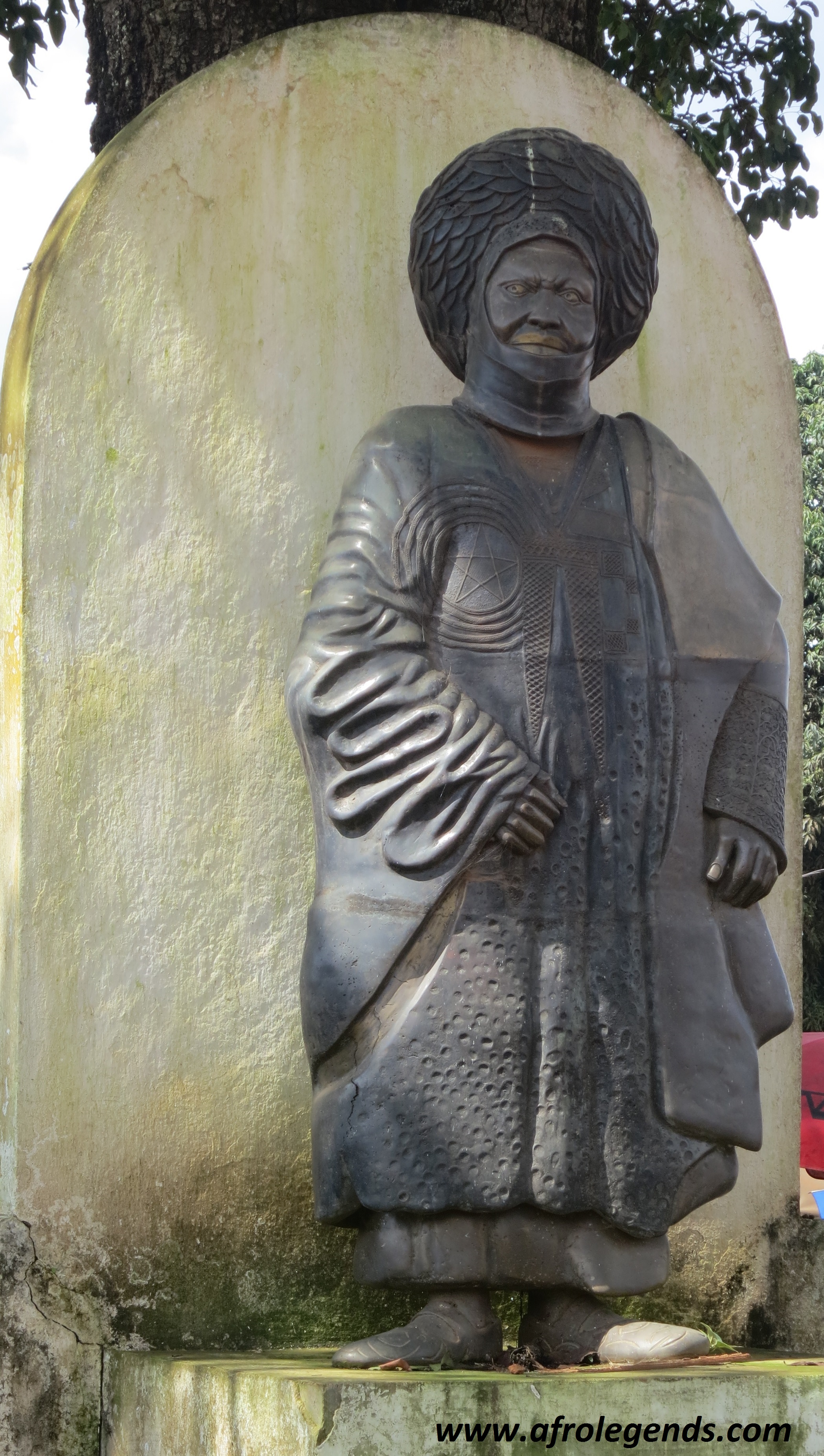
Sultan Njoya’s Monument
It was all started in 1394 by Nchare Yen, the founder of the Bamoun kingdom (this will be for another day). After Nchare Yen established his kingdom on the shores of the Noun River, he befriended Mfo Mokup, a neighboring king who had a secret society called Nguon, which ensured the supply and equitable distribution of food across his kingdom (like Joseph in Egypt in the Bible). Every year, during the harvest period, the Nguon owners (members of the secret society) roamed the village to ensure that villagers brought their harvest to the king’s palace; in turn, the king redistributed the products of the harvest to all his subjects across the kingdom. Any surplus was stored in an attic in preparation for hard times. The gathering ended in 3 days of celebration known as the Nguon festival.
Upon seeing this, King Nchare Yen adopted this governing method whereby Nguon owners would not only travel throughout the kingdom to ensure good food supply, but would also gather all of the people’s grievances, and detect abuses committed in the name of the King. Their responsibility was thus to keep the king aware of any problems, and in touch with his constituency. During colonial times, the French did not appreciate this way of governing, as it gave too much power to the local King; so they banned the Nguon in 1924 after deposing Sultan Njoya. It was fully restored by his successor Sultan Njimoluh Njoya after Cameroon’s independence. Since 1996, the current monarch, Sultan Ibrahim Mbombo Njoya, has made it a biennial celebration, and transformed it into an international event attracting tourists from around the world.
Bamoun sculptures
According to His Majesty Sultan Ibrahim Mbombo Njoya the Nguon is the “cultural identity of the Bamoum”. It is a celebration of the people’s warmth, and joy at sharing their cultural heritage. It is extremely beautiful to see people celebrate their culture that way, dressed in full attire: the warriors demonstrating their skills, reenacting centuries’ old traditions, telling centuries’ old stories, great music, great dancers, delicious food, the women dressed like true African queens, and the euphoric ambiance. The blog My African Chronicles has great pictures of the event two years ago.
Elmina Castle (Source: Ghana.nl)Inner courtyard at Elmina Castle (Source: Ghana.nl)
The Elmina Castle is one of the 30 slave forts along the coasts of Ghana. It was built in 1482 by Portuguese traders on the site of a town called Amankwaor Amankwakurom. It was the first European slave-trading post in all of sub-saharan Africa. The Portuguese gave it the name of São Jorge da Mina, or St. George’s of the mine, or simply “Elmina” (the mine). At four storeys high, it was one of the most imposing coastal forts, and for many years the largest one. It was originally build by the Portuguese as a warehouse to protect the gold trade, but later it became the center of the Dutch slave trade, after its capture by the Dutch in 1637. The British attacked the city in 1782, but it remained in Dutch hands until 1872, when the Dutch Gold Coast was sold to the British.
16th Century map of West Africa with Fort Elmina
Slaves were typically captured inland, and then brought to the fort on an arduous journey that often lasted many days. Half of all captives did not even make it to the coast. Once at the fort, the slaves would wait, often for a long period of time ranging from 3-9 months, until a ship arrived. Imagine waiting in crammed conditions, packed in cells like sardines for 3 or more months!
Painting of Elmina Castle in 1668; notice the ships and sea in the front
Elmina, like other West African slave fortresses, housed luxury suites for the Europeans in the upper levels. The slaves were kept in cramped and filthy cells below, each cell often housing as many as 200-600 people at a time, without enough space to even lie down. Staircases led directly from the spacious governor’s chambers on the third level to the women’s cells below, making it easy for him to select personal concubines from amongst the women to “service him” every night.
There was also a discipline cell for “freedom fighters” : those who disobeyed were shut in this cell until they suffocated or starved to death. Ironically, Elmina also held Christian church services for the Europeans, on the second floor of the castle.
Slave holding cell in Elmina (Wikimedia Commons – KD)
On the seaboard side of the castle was the Door of No Return, the infamous portal through which slaves boarded the ships that would take them on the treacherous journey across the Atlantic ocean known as the Middle Passage. At Elmina, the door of no return was a child-size window that slaves squeezed through to board the ship.
British bombing of Elmina – 13 June 1873
By the 18th century, at least 30,000 slaves on their way to the Americas had passed through Elmina each year. That is 30,000 slaves each year for at least 250 years: about 7.5 millions! Appalling!!
Today, Elmina’s economy is sustained by tourism and fishing. Elmina Castle is preserved as a Ghanaian national museum and the monument was designated as a World Heritage Monument under UNESCO in 1979. It is a place of pilgrimage for many African Americans seeking to connect with their long lost heritage. Enjoy the video below which is very educational!
I am going to start a series on reclaiming our history. I will be talking about slave forts across Africa. There were over 30 slave forts in Ghana only. How many in other countries?We will find out through this exercise. These fortified trading posts were built between 1482 and early 1800s by Portuguese, British, Swedish, English, Danish, Dutch, and French traders that plied the African coast. Initially, they had come in search of gold (in Ghana), ivory (in Ivory Coast), pepper (along the Pepper Coast) and then later, they discovered cheap labor: thus was born the slave trade. There was intense rivalry between those European powers for the control of the West African coast from Senegal, to as far south as Angola.
Slaves marching after capture
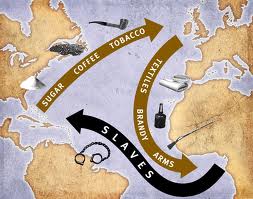
It is estimated that over 20 million Africans were sold into slavery during the Atlantic slave trade; this does not account for those who died during the trip aboard the ship (about 1/3), and those who were killed during the capture. Slaves were taken to North America, the Caribbeans, and Brazil. Moreover, this is an estimate for the transatlantic slave trade only, but did you know that slaves were also taken by Arabic sailors from the East Coast of Africa, to places like Saudi Arabia and as far as India?
The Transatlantic slave trade
The Portuguese began dealing in black slaves from Africa in the 15th century. Initially, they purchased slaves from Islamic traders, who had established inland trading routes to the sub-Sahara region. Later, as the Portuguese explored the coast of Africa, they came upon the Senegal River, and found that they could purchase slaves directly from Africans. The European slave trading activity moved south along the African coast over time, as far south as Angola. On the east coast of Africa and in the Indian Ocean region, slaves were also taken from Mozambique, Zanzibar and Madagascar. Many of the slaves were from the interior of Africa, having been taken captive as a result of tribal wars, or else having been kidnapped by black slave traders engaged in the business of trading slaves for European goods. These slaves would be marched to the coast to be sold, sometimes traveling hundreds of miles. Many perished along the way. The captured Africans were held in forts or slave castles along the coast. They remained there for months crammed in horrible conditions inside dungeons for months before being shipped on board European merchant ships chained at the wrists and legs with irons, to North America, Brazil, and the West Indies.
Slaves on board a ship
Some African rulers were instrumental in the slave trade, as they exchanged prisoners of war (rarely their own people) for firearms which in turn allowed them to expand their territories. The slave trade had a profound effect on the economy and politics of Africa, leading in many cases to an increase in tension and violence, as many kingdoms were expanding.
Inspection of slave for sale
The slave trade was responsible for major disruption to the people of Africa. Women and men were taken young, in their most productive years, thus damaging African economies. The physical experience of slavery was painful, traumatic and long-lasting. We know this from the written evidence of several freed slaves. Captivity marked the beginning of a dehumanizing process that affected European attitudes towards African people. Can you imagine losing 1/3 or more of your active population? It is hard to fathom what crippling effect that will have on any country’s progress. That is why, in upcoming months, I will be talking and trying to identify slave forts in Africa, in an attempt to reclaim our history. I know this is a touchy subject, but it is history: the bad, the ugly, the beautiful, the joyous. It is important to know history in order to be able to claim the future fully, without any baggage.
After learning about the origin of the name Addis Ababa, from Empress Taytu Betul‘s visit to its location, I could not help but talk about the Empress herself. Who was Taytu Betul?
Well, Taytu Betul was Emperor Menelik II‘s third wife and was thereby Empress of Ethiopia. She was his confidante, a loyal wife, a commander, and a brilliant military strategist.
Taytu Betul (also Taitu Betul), whose name Taytu means Sunshine, was a sunshine for her nation when it was about to fall into the hands of the Italian colonizer. Perhaps, there would not have been the famous Battle of Adwa on March 1, 1896, which marked the Ethiopian victory against colonialism, without Empress Taytu, for she inspired it.
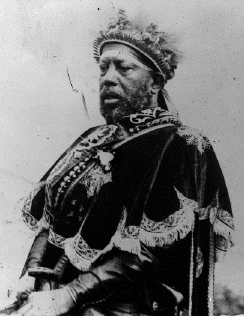
Emperor Menelik II, of Ethiopia
Empress Taytu Betul was born in Wollofrom a Christian and Muslim family. She had a comprehensive education and was fluent in Ge’ez, the classical Ethiopian language; which was a rare achievement for a woman at the time, as education was mostly reserved for boys. Taytu was the third of four children in an aristocratic family related to the Solomonic dynasty of Ethiopia. Her uncle, DejazmachWube Haile Maryam, was the ruler of Tigray and much of Northern Ethiopia in the 1840s, and a rival of Emperor Tewodros II. Her father’s family were the ruling family of Semien province, claiming descent from Emperor Susenyos I. Her grandfather was Ras Gugsa, a member of the powerful ruling family of Yejju, of Oromo origin, which had ruled as Regents in Gondar during the Zemene Mesafint (“Era of the Princes”). After four failed marriages, Taytu Betul was married to Emperor Menelik II (he was still King of Shewa at the time) in 1883 in a full communion church service and thus fully canonical and insoluble, which Menelik had not had with either of his previous wives (whom he had divorced). Their marriage was not just about romance but was also a political marriage sealing alliances with the northern regions of Begemder, Lasta, Semien, and Yeju. She remained his wife until his death in 1913.
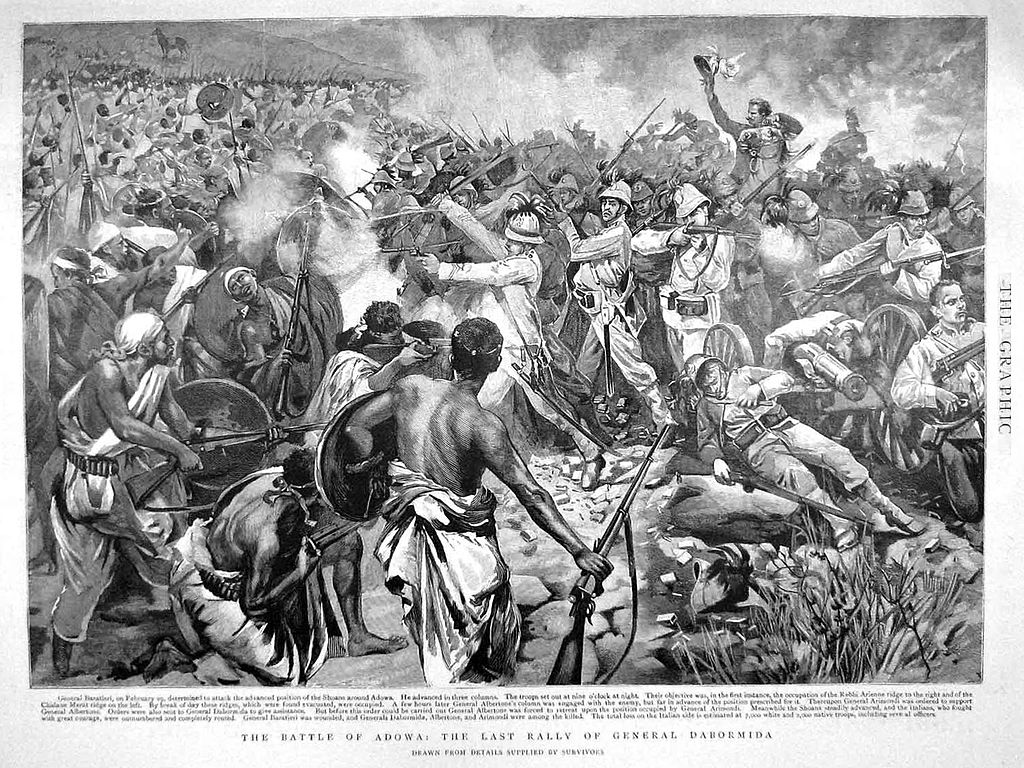
The Battle of Adwa, 1896
Empress Taytu was a loyal and respectful wife to her husband Emperor Menelik II. According to royal historians, she was co-equal with Menelik, who always consulted her prior to making important decisions. She was the one who pushed him to declare war against Italy at the Battle of Adwa—tearing up the 1889 Treaty of Wuchale between the Ethiopian Empire and Italy, a treaty whose article 17 had two different meanings in Amharic and Italian versions: The Amharic version recognized the sovereignty of Ethiopia and its relationship with Italy as just a diplomatic partnership, while the Italian version made Ethiopia Italy’s protectorate. The moment that discrepancy was uncovered, Empress Taytu was the first to agitate the hesitant Emperor and other men to stand up for liberty, dignity and against Italian aggression.
Edition of the Petit Journal of August 1896 titled: “Negus Menelik II at the Battle of Adwa”
Empress Taytu, as a military strategist, facilitated the downfall of Italy at the Battle of Adwa. She had her own battalion, which she bravely commanded in the battlefield, fighting in the frontline and motivating men against retreat. She also mobilized women, both as fighters and nurses of wounded soldiers. At the Battle ofMekelle, she advised Ras Mekonen to cut off the water supply to the Italians in order to disgorge them from their entrenched and heavily fortified positions at Endeyesus Hillon the eastern part of Mekelle City. Taytu was also the receiver and analyzer of intelligence information collected by spies, which historians have characterized as of crucial importance to the Ethiopian victory at the battle. This information enabled Menelik to attack the Italians, at a site of his choosing, at Adwa instead of Adigrat, near the Eritrean border where the Italians expected to have a relative logistical advantage. The Italians were hoping that Menelik would meet them in Adigrat, close to where they had a well-protected military base.
Empress Taytu Betul in Le Petit Journal of March 1896
Independence and cooperation defined Taytu’s relationship with Emperor Menelik II. Their marriage was that of equals characterized by trust, respect and reciprocity. After Menelik was incapacitated due to strokes in 1906, she essentially governed the country, angering all the rivals to the throne. She was ousted from power in 1910. After Menelik II’s death in 1913, she was banished to the old palace at Entoto.
Taytu Betul was an authentic Ethiopian leader. Her deeds at a critical moment in Ethiopian history not only saved Ethiopia from European colonization, but it also paved the way for the decolonization of Africa. Her advice and action resulted in the defeat of the Italian army at the 1896 Battle of Adwa, a mighty European army defeat at the hands of Africans. Taytu strongly defended national interests by overcoming challenges both from within and from without. Just as there was no Menelik II without Taytu Betul, there would have been no Ethiopia without Taytu’s great strength, courage, devotion, and determination. Taytu Betul was truly Ethiopia’s sunshine, and should forever be remembered as one of the greatest empresses of Ethiopia and of Africa as a whole. Please check out Tadias.com which has outstanding information on this great empress. Enjoy this video about the Battle of Adwa.
The Adinkra symbols are believed to originate in Gyaman, a former kingdom in modern day Côte d’Ivoire. According to an Ashanti (Asante) legend, Adinkra was the name of a king of the Gyaman kingdom, Nana Kofi Adinkra. King Adinkra was defeated and captured in a battle. According to the legend, Nana Adinkra wore patterned cloth, which was interpreted as a way of expressing his sorrow on being taken to Kumasi, the capital of Asante. He was finally killed and his territory was annexed to the kingdom of Asante. The Asante people, around the 19th century, took to painting of traditional symbols of the Gyamans onto cloth, a tradition which has remained to this day.
Adinkra work, 1825
The arrival of the adinkra in Akan culture seems to date as far back as 1817, when the English T.E. Bowdich collected a piece of adinkra cotton cloth from the city of Kumasi. The patterns on it were printed using carved calabash stamps and a vegetable-based dye. The cloth featured fifteen stamped symbols, including nsroma(stars), dono ntoasuo (double Dono drums), and diamonds, and is currently hosted at the British Museum in London.
Sankofa symbol
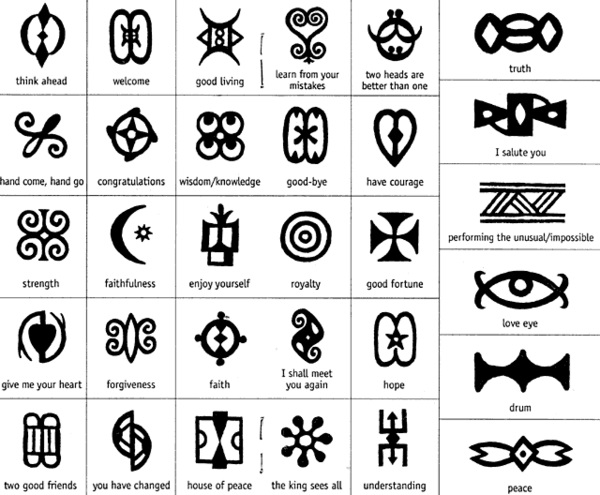
Adinkra symbols are visual representation of conceptsand aphorism developed by the Akan people of Ghana. Adinkra symbols are extensively used in fabrics, pottery, logos, and advertising. They can also be found on architectural buildings, as well as on traditional Akan gold weights, and sculptures as well as stools used for traditional rituals. The adinkra symbols are not just decorative objects, or drawings, but actual messages conveying ancient traditional wisdom relevant to aspects of life or the environment. A lot of the Adinkra symbols have meanings linked to proverbs, such as the sankofa symbol. Sankofa, in the Twi language, translates in English to ” reach back and get it” (san – to return; ko – to go; fa – to look, to seek and take) or the Adinkra symbol of a bird with its head turned backwards taking an egg off its back, or of a stylised heart shape. It is often associated with the proverb, “Se wo were fi na wosankofa a yenkyi,” which translates “It is not wrong to go back for that which you have forgotten.” Other Adinkra symbols depict historical events, human behavior and attitudes, animal behavior, plant life, and objects’ shapes.
Adinkra means ‘goodbye’ or ‘farewell’ in the Twi language of the Akan ethnic group, to which the Asante belong. No wonder the Akan people, and particularly the Asante, wore clothes decorated with Adinkra symbols mostly for funerals as a way to show their sorrow, and to bid farewell to the deceased.
Some Adinkra symbols
Adinkra cloths were traditionally only worn by royalty and spiritual leaders for funerals and special occasions. They were also hand printed on undyed, red, dark brown, or black hand-woven cotton fabric depending on the occasion and the wearer’s status. Today, adinkra is worn by anyone, women, men or children, and it is frequently mass-produced on brighter colored fabrics. The 3 most important funerary Adinkra are: the dark – brown (kuntunkuni), the brick – red (kobene), and the black (brisi). There are however, other forms of which cannot be properly called mourning cloth. Their bright and light backgrounds classify them as KwasiadaAdinkra or Sunday Adinkra meaning fancy clothes which cannot be suitable for funerary contents but appropriate for most festive occasions or even daily wear.
Adinkra symbols and their meaning
The center of traditional production of adinkra cloth is Ntonso, 20 km northwest of Kumasi, the city where the Englishman was first given it in 1817. Dark Adinkra aduro pigment for the stamping is made in Ntonso, by soaking, pulverizing, and boiling the inner bark and roots of the badie tree (Bridelia ferruginea) in water over a wood fire. Once the dark color is released, the mixture is strained, and then boiled for several more hours until it thickens. The stamps are carved out of the bottom of a calabash piece, and measure on average 5 to 8 cm2.