When I was younger, in my village, in some cases when someone had a high fever, the person will be given a hot tea with Lantana flowers (infused) to drop the fever; it was very efficient. Now, not all Lantana plants were used, there was a particular species of it… but I love the idea of using our own medicinal herbs for our use. So it is a mistake today, after having had the Kahun Gynecological Papyrus, or the Ebers papyrus centuries ago, to assume or act as if African traditional medicine is all bogus or full of charlatanism, and that the only alternatives for us Africans, are the pills that we buy in pharmacy made abroad in some laboratories in the Western hemisphere to address mostly their needs with no respect for our environments and realities. I am not saying to go out and cut all the plants out there, or not to buy drugs in pharmacies, but I am saying that African traditional medicine is rich, and we should also cherish and enhance it. I am sure there is so much that African herbs and medicine could add to the world. We just have to develop it, and to develop it, we need to start cherishing and valuing what we have, not leaving that to Western tourists on visit to claim to have discovered something that was ours and was there all along! African, start loving who you are, appreciating what you have, and enhancing what nature gave you (when it is good, of course)!
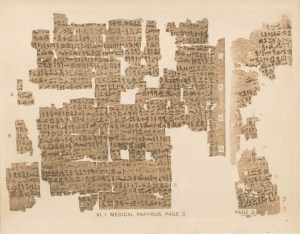
Kahun Gynecological Papyrus: Page 1 and part of Page 2
Today, we will be talking about the Kahun Papyrus, which is among the oldest and most important medical papyri of Ancient Egypt and of the world. This is a papyrus dealing with women’s health – gynecological diseases, fertility, pregnancy, and contraception; it dates back to the Twelfth Dynasty of Egypt, c. 1800 BCE. It is a three page document, 1 m long and about 33 cm wide. The name Amenemhet III was written in the right upper corner behind third page name. The document was torn in places and patched with gum and papyrus.
Head of Pharaoh Sobekneferu. British Museum
It was found at El-Lahun (Faiyum, Egypt) by Flinders Petrie in 1889 and first translated by F. Ll. Griffith in 1893 and published in The Petrie Papyri: Hieratic Papyri from Kahun and Gurob. The later Berlin Papyrus and the Ramesseum Papyrus IV cover much of the same ground, often giving identical prescriptions. ‘Kahun’ is the name Petrie gave to the Lehun town site, which in 1825 BC had been a thriving, prosperous town; the name was probably a misspelling from this European in contact with a foreign language (see Abidjan). The papyrus had been so heavily used that its ancient owner had to repair it, with a patch bearing an administrative fragment visible at one point on the back. This gynecological papyrus originates from the Middle Kingdom (Twelfth Dynasty of Egypt) to the reign of the childless female-king Sobekneferu, whose interest in gynecology might have been sparked by her elder sister dying at an early age.
The text is divided into thirty-four sections, each section dealing with a specific problem and containing diagnosis and treatment; no prognosis is suggested. Treatments are non-surgical, comprising of the application of medicines to the affected body part or swallowing them. The womb is at times seen as the source of complaints manifesting themselves in other body parts.
Kahun Gynecological Papyrus, part of page 2 and Page 3
The first seventeen parts have a common format starting with a title and are followed by a brief description of the symptoms, usually, though not always, having to do with the reproductive organs. The second section begins on the third page, and comprises eight paragraphs which, because of both the state of the extant copy and the language, are almost unintelligible. Despite this, there are several paragraphs that have a sufficiently clear level of language as well as being intact which can be understood.
Paragraph 19 is concerned with the recognition of who will give birth; paragraph 20 is concerned with the fumigation procedure which causes conception to occur; and paragraphs 20-22 are concerned with contraception. Among those materials prescribed for contraception are crocodile dung, 45 ml of honey, and sour milk.
The third section (paragraphs 26-32) is concerned with the testing for pregnancy. Other methods include the placing of an onion bulb deep in the patients flesh, with the positive outcome being determined by the odor appearing to the patients nose.
Isis and Horus: Mother and child
The fourth and final section contains two paragraphs which do not fall into any of the previous categories. The first prescribes treatment for toothaches during pregnancy. The second describes what appears to be a fistula between bladder and vagina with incontinence of urine “in an irksome place.”
To learn more about it, check out “The Kahun Gynaecological Papyrus: Ancient Egyptican Medicine” by L. Smith, J Fam Plann Reprod Health Care 37 (2011) 54. University College London also has an extensive page on the manuscript with its translation, as the manuscript for the health of mother and child.
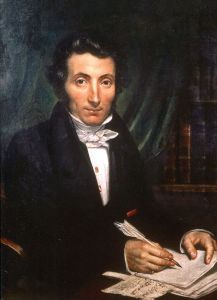
Here is a description of the Market of the city of Djenné, another one of the crown jewels of the Empire of Mali, by the French explorer René Caillié. Bear in mind that René Caillié was the first westerner to return from Timbuktu, Mali. Also note the description of Suya by a European in 1825!
====
“The Kolamerchants stand at one end of the market, placed in two lines, each having in front of them a small basket of Kola nuts that they sell in retail, eight or ten cowries* each : the low price came from the large quantity of these fruits found in the entire country ; but they are normally worth fifteen to twenty cowries.
La grande mosquee de Djenne (Mali – heritage du grand empire du Mali)
A few Butchers were established in the market; they lay their meat like in Europe: they also put in skewers small pieces of meat that they dry with smoke, and which they sell in retail. There is in this market a lot of fresh fish and dry ; earthen pots, calabashes, mats, and salt which is sold in retail, because that which is sold wholesale stays in shops.
René Caillié’s house in Timbuktu
We see an infinite number of merchants in the streets carrying their merchandise and yelling like it is done in Europe : these are fabrics of the country, things homemade, kola nuts, honey, vegetable butter and animal, milk, firewood. This last item is rare here; women bring it from 12 to 15 miles around. Millet stubble is also sold in the market; during my stay in this city, every night I saw negro women who had bought this fuel for 10 cowries, to cook their supper …”
René Caillé, Journal d’un voyage à Tombouctou et à Jenné dans l’Afrique centrale. Tome 2, P. 199 et s. English translation by Dr. Y., Afrolegends.com
*Cowry: small white sea shells used as trade money in Africa up until a recent times.
Last month, we talked about the griot tradition of West Africa. This African tradition of long lineages of storytellers, historians, and history repositories of the society, extends beyond West Africa, to all over the continent. For the Ndebele of Zimbabwe, the griot is known as the imbongi.
Below is a praise poem celebrating the Ndebele King Lobengula. The poem was recited in Ndebele by imbongi(griot/poet) Mtshede Ndhovu to T.J. Hemans around c.1970. Mtshede Ndhlovu was born when Mzilikazi (Lobengula’s father) was still on the throne, that is, before 1868, making him some 105 years old. His son, Bova Ndhlovu, acted as interpreter, assisting Hemans with the translation.
For the entire poem, with the Ndebele version, please check out African Poems .
====
King Lobengula of Matabeleland
Praise Poem for Lobengula
It roared like a calf. (1) He who has books is at the river crossing. (2) The cumulus cloud which rains from overcast sky. (3) The words of a mountain, King of Mgabi Ndwandwe. (4) The bird that builds with its beak pointing to a pool of water, some say catch it some say leave it that it the way it builds. (5) The black lion of Mabindela. Grass does not burn in the Kalahari, some burns and bends. (6) He was furious and then the tribes and commissioners were angry. (7) Spoor of the leopard that disappears in rivers. (8) The bush buck that strikes with its hooves and damaged the stones. (9) Watch him, the destroyer, because he destroyed the commoners. (10) He who is food they feed from for many many years, when he dies where will they feed from, they will eat jackals and roots. He whose majesty is like that of his father Matshobana. Cattle have popularity, they are lowing and attract afar. He whose path is winding like that of ants. The small bird of the spear, so small it can sit on the spear.
Praises Given to the Kings of the Amandebele, T.J. Hemans, Nada X, 3 (n.p., 1971).
The Ruud Concession
(1) This praise-poem was recorded c.1970, when a new war for Zimbabwe was in progress. Lobengula is contrasted with Mzilikazi for failing to protect the nation. He is a calf compared to a bull and his roaring is not impressive.
(2) Lobengula signed the Rudd Concession in 30 October 1888, granting mining rights to the British South African Company. He assumed the miners would accept his kingship, but it was soon evident that the BSA were coming as colonizers. He who has books is Charles Rudd, the treaty bearer, and the river crossing is the Limpopo, the southern border to Ndebele territory.
(3) A reference to Lobengula’s responsibility as rainmaker. Later in praise [line] 12, he comes food they feed from.
(4) Unlike Mzilikazi, Lobengula drew his legitimacy as chief from his ancestry. See also praises 6 and 13.
(5) Lobengula’s succession was controversial, and his performance as king was disputed.
(6) Mzilikazi was called the tall grass in the Kalahari desert that will burn with men’s leather loin cloths (praise 6). Lobengula is the grass that does not burn.
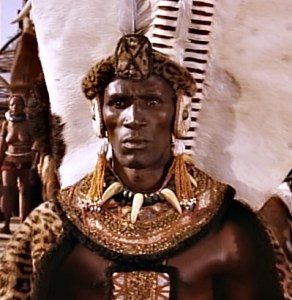
King Shaka of the Zulu people
(7) The signing of the Rudd Concession led to anger on all sides, culminating the war of 1893.
(8) Lobengula’s policies were difficult to follow. See also praise 15, where his course iswinding like that of ants.
(9) Again, this contrasts with Mzilikazi, the bush buck that steps carefully on the rocks, implying diplomatic skills such as wariness.
(10) Mzilikazi’s victories, starting with Shaka, were against enemies of stature. Lobengula is credited with no military virtues and his anger is directed at commoners.
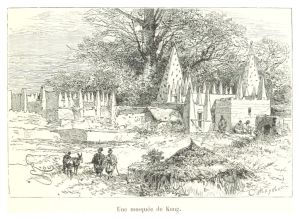
Below is a description of Kong, the last capital of Samori Touré, by a French explorer back in 1892. In 1892, it was a delight to the eyes, and even the French explorers and conquerors were stunned by its beauty! Enjoy!
=======
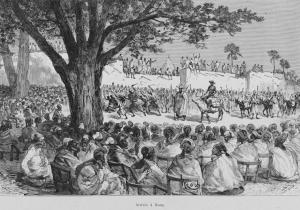
Arrival of the French explorer Louis-Gustave Binger in Kong in 1888
“Kongis infinitely less dirty that Bondoukou, even though its population is six (6) or seven (7) times higher. The deleterious miasmas are less persistent probably because of the altitude (about 700 meters). At these heights, the wind beats any infection. Built on an elongated rump, the city is freshened up by the least breeze. The surroundings, except a few groups of large trees used as sheds for animals, are deforested as far as the eye can see. At this time of the year, this immensity is of a deep green similar to English lawns, the whole landscape is of an exquisite charm. – And the grace, charm, are rare things on this
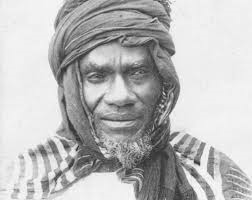
Samori Touré
morose continent ! – The city, especially from the northwest, gilded by the setting sun, with its pyramidal minarets of its five mosques, the palm trees separating their thin silhouette from the sky, the superimposed terraces where groups of faithful appear at the time of prayer, is an unforgettable vision. This is how Binger saw Kong for the first time, and I can imagine what must have been his surprise.”
Marcel Monnier, France Noire, Plon ed. Paris, p. 204, 1894 . Translation to English by Dr. Y. Afrolegends.com
Sibo Bangoura is a griot from Guinea, West Africa, now living in Australia. In this TEDx talk, he shares the traditions of his musical heritage with people from all over the world. While playing the Kora, a musical instrument from West Africa, Sibo sang a traditional West African song, Nan Fulie, about the importance of the Griot people – the West African musicians, storytellers, custodians and teachers of tradition through music and dance. Enjoy!
Africa has a strong, deep, and rich oral tradition. In many countries across West Africa, this tradition is often preserved by the griots, who are historians, storytellers, praise singers, poets, and/or musicians. Often, the griot is the preserver of the history of a family, a clan, and sometimes of the nation. This is done by narrating how the family/clan/tribe/nation was founded and its outstanding achievements. In essence, the griot is a repository of the oral tradition, and is often seen as a societal leader due to his or her traditional position as advisor to kings and leaders. The griot’s praises centers around the leader of the clan, of the tribe, and of the nation. Thus, great kings throughout history had griots: Sundiata Keita, Kankan Musa, and many others.
The Mali Empire (Malinke Empire), at its height in the middle of the 14th century, extended from central Africa (today’s Chad and Niger) to West Africa (today’s Mali and Senegal). The empire was founded by Sundiata Keita, whose exploits remain celebrated in Mali today. In the Epic of Sundiata, King Naré Maghann Konaté offered his son Sundiata a griot, Balla Fasséké, to advise him in his reign. Balla Fasséké is considered the founder of the Kouyaté line of griots that exists to this day.
Mali Empire (Wikipedia)
Each aristocratic family of griots accompanied a higher-ranked family of warrior-kings or emperors, called jatigi. Moreover, most villages and prominent clans also had their own griot, who told tales of births, deaths, marriages, battles, hunts, affairs, and hundreds of other things.
The Cameroonian author Francis Bebey writes about the griot in his book African Music, A People’s Art (Lawrence Hill Books): “The West African griot … knows everything that is going on… He is a living archive of the people’s traditions… The virtuoso talents of the griots command universal admiration. This virtuosity is the culmination of long years of study and hard work under the tuition of a teacher who is often a father or uncle. The profession is by no means a male prerogative. There are many women griots whose talents as singers and musicians are equally remarkable.”
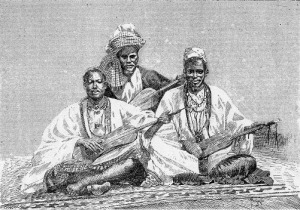
Griots of Sambala with the King of Medina (Fula people of Mali) c.1890
In Mande society, the jeliwas an historian, advisor, arbitrator, praise singer (patronage), and storyteller. Essentially, these musicians were walking history books, preserving their ancient stories and traditions through song. Their inherited tradition was passed down through generations. Their name, jeli, means “blood” in Mandinka language. They were said to have deep connections to spiritual, social, or political powers as music is associated as such. Speech is said to have power as it can recreate history and relationships.
Youssou N’Dour (Source: fanart.tv)
In addition to being singers and social commentators, griots are often skilled musicians. Their instruments include the kora, the khalam (also spelled xalam), the goje (called n’ko in the Mandinka language), the balafon and the ngoni.
Griots can be found throughout Africa and bear different names from country to country. A world-renowned singer and grammy award winner descending from a family of griots is Senegalese singer, Youssou N’Dour. Below is the trailer to the movie Griot. Enjoy!
Imagine stumbling across your history, and learning that you are the descendant of a very powerful king? Imagine that all your life, you have lived a tough life, unconscious of your heritage, doing things, and just knowing that somehow, somewhere things should be different? Well, in 2013, during a trip to Ghana, Promise Adamah who has lived in England for over 50 years, found out that her grandfather was a very prominent Ewe King in Ghana, King Togbui Adamah II. She was handed a lot of papers in plastic bag by her aunt, and when she got home, opened it, and found out the truth about herself, and her family. Her family then decided to donate over 100 old letters and papers, official and personal documents, dating as far back as the 1880s to the Black Cultural Archives (BCA) in Brixton, London. These give a snapshot into the life for an Ewe Fia (king). Togbui Adamah II was a paramount Ewe Fia of Some in south eastern Ghana. The findings are believed to be the first of its kind to be found in such quantity and entirety in the Ewe community. Promise Adamah’s rich family history is now exposed at the Black Cultural Archives of London, it is Family Ties – The Adamah Papers exhibition. Enjoy the video below from the BBC.
Prince Alemayehu, son of Emperor Tewodros II, as photographed in 1868 by Julia Cameron
Here is another outrageous article about British looting in Africa, and particularly in Ethiopia. The remains of Prince Alemayehu, son of the Emperor Tewodros II are still in Great Britain 150 years after his death. How preposterous is this! When the Ethiopian government asks, the British say that they cannot identify his bones, when in this day and age the remains of King Richard III of England have been identified 500 years after his death (Body found under parking lot is King Richard III, scientists prove). This makes you wonder: After King Mkwawa, and Prince Alemayehu, how many African kings, princes, and queens’ remains are still stuck in Europe?
Below are snippets of the article; for the full version, go to: The Guardian.
=====
For150 years, Ethiopians have been asking when Prince Alemayehuwill come home. The orphan prince, a descendant of Solomon, was taken to England – some say “stolen” – after British soldiers looted his father’s imperial citadel following the Battle of Magdala in1868. The fortress was looted and razed to the ground. It is said to have taken 15elephants and 200 mules to remove the loot.
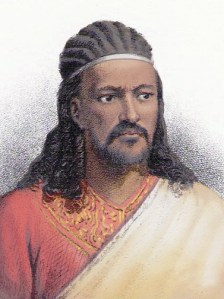
Emperor Tewodros II
He died at the age of18, after an unhappy childhood, and was buried at St George’s Chapel at Windsor Castle at the request of Queen Victoria. Now, as discussions take place with the Victoria & Albert Museum about the return of royal treasures taken by British forces during the battle, the Ethiopian government told the Observer it is “redoubling” its efforts to finally bring back the prince’s remains. Last week there were celebrations in Addis Ababato commemorate the life of the prince’s father, Tewodros II, on the 150th anniversary of his death in the battle. A selection of the objects in the V&A’s possessionwent on display last week.
[The poet Lemn Sissay said:] “The first corrupt theft of an Ethiopian child was this one in 1868,” Sissay said. “He was taken from his family. He deserves, too, for his remains to go back to Ethiopia, back to where he was stolen from.”
In the aftermath, as the British forces carried off crowns, scrolls and fine clothing, a war artist cut a lock of Tewodros’ hair. The lock of hairis now at the National Army Museum in London. Sissay and others believe that a DNA test could establish whether any of the remains in the grave match it. …
After the sacking of Maqdala, a British officer named Tristram Speedy took the prince and his mother, the Empress Tiruwork Wube, to Britain. The empress died on the way and before the party was due to embark on a ship from Alexandria in Egypt, the officer ordered all the other Ethiopians to return. …
The intensity of feeling among Ethiopians is growing, according to the Ethiopian embassy. “Ethiopians revere Prince Alemayehu as a young prisoner of war – he was only seven years old when taken hostage,” it said in a statement. “Prince Alemayehu remains the son of a hero, who chose to end his own life, rather than surrender to foreign soldiers. Ethiopians view the Prince with the same level of affection and respect.”

















 African Heritage