This is another all-time favorite… The second-most popular post on Afrolegends.com: the history of Adinkra symbols and the Rich Akan culture of the Akan people of Ghana and Côte d’Ivoire. Enjoy!
As we revisit this favorite, please let us know if there are other things you would like to learn on the topic, and we will try to add more.
The Adinkra symbols are believed to originate in Gyaman, a former kingdom in modern day Côte d’Ivoire. According to an Ashanti (Asante) legend, Adinkra was the name of a king of the Gyaman kingdom, Nana Kofi Adinkra. King Adinkra was defeated and captured in a battle. According to the legend, Nana Adinkra wore patterned cloth, which was interpreted as a way of expressing his sorrow on being taken to Kumasi, the capital of Asante. He was finally killed and his territory was annexed to the kingdom of Asante. The Asante people, around the 19th century, took to painting of traditional symbols of the Gyamans onto cloth, a tradition which has remained to this day.
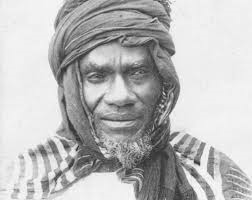
This post on Samori Touré has been an all-time favorite post on Afrolegends.com . I am reblogging it here, because on this 10-year anniversary of the African Heritage Blog, it has been the most viewed and loved article. As you know, Samori Touré, grandfather to the African president Sekou Touré (another resistant to French imperialism – Guinea: the country who dared say ‘NO’ to France), was a leader and ruled over a vast empire which spanned big areas of West Africa from Guinea all the way to modern-day Côte d’Ivoire. He was a strong fighter to France imperialism in Africa, and opposed a great resistance to the French several times. This is to one of Africa’s great kings, warriors, and resistant.
One of the great kings, and fighters of African freedom was the great Samori Touré. Over 100 years ago, Samori Touré was captured by the French and deported to Gabon where he died of pneumonia.
But who was Samori Touré?
Well, Samori Touré was born in 1830 in Manyambaladugu (some texts mentionSanankoro instead), a village southeast of Kankan in present-day Guinea. Samori was a great warrior who fought imperialism in the 19th century such as many leaders today. He refused to submit to French colonization and thus chose the path of confrontation using warfare and diplomacy.
Until the age of 20, Samori was a trader. After his mother was captured in a slave raid by the king Sori Birama, he offered to serve in his army and excelled by his military prowess and skills.
Samori Touré had a vision of unity for the Malinké people, and…
As I stated before, Sudan has more pyramids than Egypt, and at one point its pharaohs ruled Egypt for over a century. Only in recent years, has Nubia (Africa’s Forbidden Pyramids: Meroe, Nubia, and Sudan) attracted the attention of more archaeologists. One archaeologist used scuba diving to explore one of the pyramids at the ancient royal burial site of Nuri; making it the first time it is used in Sudan. He unearthed some amazing pottery figurines and gold leaves. The expert below is from theBBC; for the full article, follow thelink.
=====
Nuri Archaeological expedition / Pearce Paul Creasman (Source: BBC)
An underwater archaeologist has told the BBC of the extraordinary lengths he went to to access a pharaoh’s tomb underneath a pyramid.
Pearce Paul Creasman and his team were the first people to go into the tomb for 100years and, in that time, it has become harder to access because of the rising water level. Mr Creasman told BBC Newsday that this was the first time underwater archaeology had been carried out in Sudan, the location of the ancient royal burial site of Nuri.
He found pottery figurines and gold leaf.
“The gold offerings were still sitting there – these small glass-type statues had been leafed in gold. And while the water destroyed the glass underneath, the little gold flake was still there,” he told Newsday.
He believes these offerings were for Nastasen, a minor pharaoh who ruled the Kush kingdom from 335 BC to 315 BC.
Mr Creasman told the BBC that the team “dug as far as we could” down a 65-step stairway which led to the tomb entry. …
Nuri archaeological expedition / Pearce Paul Creasman (Source: BBC)
He described what he found as “remarkable“:
“There are three chambers, with these beautiful arched ceilings, about the size of a small bus, you go in one chamber into the next, it’s pitch black, you know you’re in a tomb if your flash lights aren’t on. And it starts revealing the secrets that are held within.”
The tomb is part of the ancient site of Nuri which is spread across more than 170 acres in northern Sudan.
These pyramids mark the burials of Kushite royals who are sometimes referred to as “black pharaohs“. The Kush kingdom lasted for many hundreds of years and, in the 8th Century BC, it conquered Egypt which it ruled for almost a century.
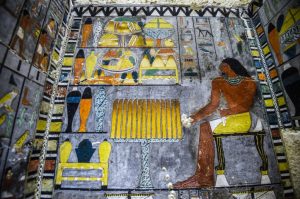
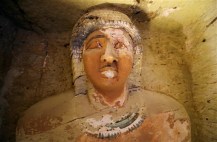
This picture taken on April 13, 2019 shows a view inside the newly-dicovered tomb of the ancient Egyptian nobleman “Khewi” dating back to the 5th dynasty (24942345 BC), at the Saqqara necropolis, about 35 kilometres south of the capital Cairo. (Photo credit should read MOHAMED EL-SHAHED/AFP/Getty Images)
As I read the article about the discovery of this 4,300 years-old Egyptian tomb bursting with colors, I was stunned to see that NO article stated the obvious conclusion: Ancient Egyptians were Black! NO articles stated it: they wonder who the nobleman, Khewi, in whose tomb this was found is, what his link to the Pharaoh is, … they ask a thousand other questions, instead of addressing the reality! This reinstate what we already knew and what the great Cheikh Anta Diop always said, that Ancient Egyptians were black and that their descendants are today’s Subsaharan Africans! One of the statues found inside the tomb beautifully shows its very broad nose, clear symbol of its Black-ness/African-ness, and of course its skin color. Enjoy! Below are excerpts; for the full article, please go to Fox News.
=====
A view inside the newly discovered tomb of the ancient Egyptian nobleman “Khewi” dating back to the 5th dynasty at the Saqqara necropolis, about 35 kilometers south of Cairo. (Photo by Mohamed el-Shahed / AFP)
Egyptianofficials announced astunning discoveryover the weekend: a 4,000-year-old tomb of a dignitary bedazzled in colorful paintings and inscriptions.
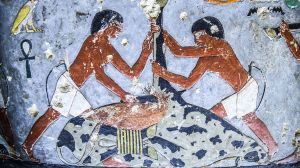
Egypt’s Ministry of Antiquitiesunveiled Saturdaythe ancient resting place of the senior official named “Khuwy, [Khewi in other sources]” noting that he served during the reign of King Djedkare, a pharaoh who ruled Egypt during the Fifth Dynasty — from the late 25th century to early 24th century BC. The next day, the Egyptian government released footage that showcased what it called “exceptionally painted” limestone walls.
“The remarkable well-preserved colours on the inscriptions are considered royal colours,” the ministry said in an originalvideo posted online.
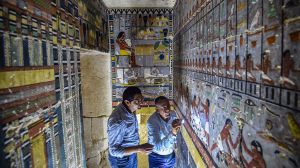
Mohamed Mujahid, head of the Egyptian mission that discovered the tomb of the ancient Egyptian nobleman “Khewi,” inspects the tomb’s walls inside the Saqqara necropolis on April 13. (Photo by Mohamed el-Shahed / AFP)
[…] “The L-shaped Khuwy tomb starts with a small corridor heading downwards into an antechamber and from there a larger chamber with painted reliefs depicting the tomb owner seated at an offerings table,” Mohamed Megahed, who led a team of archaeologists in digging up the tomb,told the Egyptian newspaper.
Every inch of the tomb is covered in markings, which archaeologists are carefully studying. So far, the inscriptions have raised questions about Khuwy’s impact on the ancient community as well as his specific relationship with the pharaoh — whose elaborate tomb sits just “a stone’s throw away,” per the ministry.
[…] Mostafa Waziri, secretary general of the Supreme Council of Antiquities, called the burial “one of a kind in the last decades.”
Statue inside the tomb. (Photo by Mohamed el-Shahed / AFP)
“The color is almost intact even though the tomb is almost4,400 years old,” Waziri said in a statement at the time.
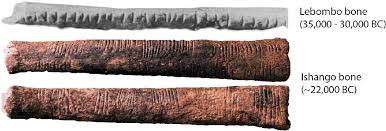
Have you ever heard of the Lebombo Bone? It is even older than the Ishango bone. It is indeed the oldest known mathematical artifact in the world. Discovered in the 1970s in Border Cave, a rock shelter on the western scarp of the Lebombo Mountains in an area near the border of South Africa and Swaziland (now Eswatini). The bone was found on the Eswatini side, and dates from 35,000 BC. It consists of 29 distinct notches that were deliberately cut into a baboon’s fibula.
The bone is between 44,200 and 43,000 years old, according to 24 radiocarbon datings. This is far older than the Ishango bone with which it is sometimes confused. Other notched bones are 80,000 years old but it is unclear if the notches are merely decorative or if they bear a functional meaning.
According to The Universal Book of Mathematics, the Lebombo bone’s 29 notches “may have been used as a lunar phase counter, in which case African women may have been the first mathematicians, because keeping track of menstrual cycles requires a lunar calendar.” However, the bone is clearly broken at one end, so the 29 notches may or may not be a minimum number. In the cases of other notched bones since found globally, there has been no consistent notch tally, many being in the 1–10 range. The Lebombo bone resembles a calendar used by the early men of the area, coming from the San clans of Namibia; this way of making tallies is still used by the San people today.
Top image: Lebombo bone. Bottom: Ishango bone with prime numbers engraving (J.D. Loreto and D.H. Hurlbert Smithsonian)
According to The Universal Book of Mathematics, the Lebombo bone’s 29 notches “may have been used as a lunar phase counter, in which case African women may have been the first mathematicians, because keeping track of menstrual cycles requires a lunar calendar.” However, the bone is clearly broken at one end, so the 29 notches may or may not be a minimum number. In the cases of other notched bones since found globally, there has been no consistent notch tally, many being in the 1–10 range. This resembles a calendar used by the early men of the area, coming from the San clans of Namibia. These represent the earliest unambiguous evidence for modern human behavior. An article in the Proceedings of the National Academy of Sciences (PNAS) on recent archaeological discoveries, “Early evidence of San material culture represented by organic artifacts from Border Cave, South Africa” , has shown that bone tools were already present 75,000 years ago and were used in San culture.
To anyone who ever doubted it, Africa is indeed the cradle of humanity… and women (if it is indeed a lunar tool) were quite advanced mathematicians 35,000 years ago, using calculators to make lunar calendars!
A few years back, a Malagasy friend of mine was telling me how upset he had been to find out that his name’s short version, Togo, had been made by Americans to sound like ‘to-go‘ as in ‘to-go containers‘ as opposed to ‘Togo‘ (pronounce ‘Tow – go’ or ‘Taw -go’) as it was supposed to be. This got me thinking about the name of one of the smallest countries in Africa, Togo, which had undoubtedly also gone through that transformation to sound like ‘to-go containers.’ Well, do you think the meaning of Togo could in some way be related to leftover containers or food-on-the-run?
Togo lies in the Bight of Benin, surrounded by Ghana in the west; Benin in the east; and Burkina Faso in the north. To many, the name Togo stands for “land where lagoons lie“. In reality, the name Togo was the name of a small village Togodo which means in the Ewe language, “the land (or city) beyond the cliff” or “land on the other side of the shore.” This became Togoville, a town and canton in southern Togo, lying on the northern shore of Lake Togo; it was originally known as Togo. The country took its name from the town of Togoville when Gustav Nachtigal signed a treaty with the town’s chief, Mlapa III, on 5 July 1884, from which Germany claimed ownership over what became Togo. Togoland, a German colony, was born. The village which gave its name to the country, mean originally “city or land beyond the cliff” and not “city beyond the river.” It is in reality located on the edge of a very shallow lagoon, whose name is Lake Togo, which had the effect of misleading many people about the origin of the word.
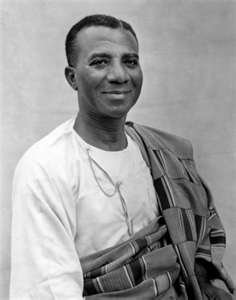
Sylvanus Olympio
Archaeological finds indicate that ancient tribes which inhabited the area were able to produce pottery and process iron. From the 11th to the 16th century, various tribes entered the region from all directions. From the 16th century to the 18th century, the coastal region was a major trading center for Europeans to search for slaves, earning Togo and the surrounding region the name “The Slave Coast“. In 1884, a treaty was signed at Togoville with King Mlapa III, whereby Germany claimed a protectorate over a stretch of territory along the coast and gradually extended its control inland; its borders were defined after the capture of hinterland by German forces and signing agreements with France and Britain. In 1905, it officially became the German colony of Togoland. After Germany lost the First World War, the land was divided between France and Great Britain to be ruled as mandates. After World War II, these mandates became UN Trust Territories. In 1957, the residents of British Togoland voted to join the Gold Coast as part of the new independent nation of Ghana; while French Togoland became an autonomous republic within the French Union in 1959, as France (as always) retained the right to control the defense, foreign relations and finances. The Togolese Republic was proclaimed on 27 April 1960. In the first presidential elections in 1961, Sylvanus Olympio became the first president of the country. Since the coup that led to his assassination in 1963, Togo has been ruled 3 presidents, the most notorious being Olympio’s murderer Gnassingbé Eyadéma, who ruled Togo for 38 years, and after his passing, his son Faure Gnassingbé has now been president.
Beach in Lome, Togo (Wikipedia)
The coast of Togo in the Gulf of Guinea is 56 km long and consists of lagoons with sandy beaches; thus the reason why people think its name is associated with lagoons and mean “land where lagoons lie“. If you ever visit Togo, do not forget to check out its lagoons, its sandy beaches, and above all its people.
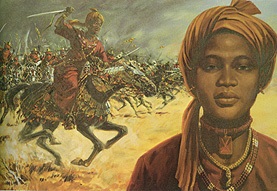
A few years ago, I wrote about Queen Amina of Zazzau: the Great Hausa Warrior born to Rule, the woman remembered today in Nigeria as ‘Amina, rana de Yar Bakwa ta San’ (Amina, daughter of Nikatau, woman as capable as a man). Crowned queen of Zazzau in 1576, Amina expanded her kingdom’s boundaries down to the Atlantic coast; she founded several cities, and personally led an army of 20,000 soldiers to numerous battles. During her 34-year reign, she commanded the construction of a defensive mural around each military camp that she established. Later, those camps evolved into prosperous cities within those walls, and some can still be seen today in northern Nigeria. Those cities are known as walls ‘ganuwar of Amina’ or ‘Amina’s walls‘.
Queen Amina’s achievement was the closest that any ruler had come in bringing the region now known as Nigeria under a single authority.Enjoy this trailer for the movie Aminaby Izu Ojukwu and the website for it: AminaQueenOfZazzau.com; the BBC also made a cartoon about her. With Hollywood’s recent lack of imagination and appropriation of other people’s culture, I would not be surprised that they copy her story to bring it onto big screen. However, Africans should put forward their own stories and value them… not wait for some imagination-hungry entity to come grab it, to all of a sudden value their own history (Black Panther).
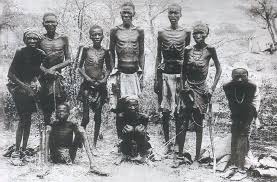
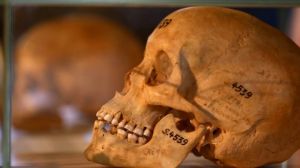
I know this dates from last August, 2018, but I had to share. Note that out of the hundreds of skulls taken by Germany, only a bit over 25 were returned; if the German racial study has been discredited, why not return all of them? The excerpt below is from the BBC; for the full article, go to the BBC. As a reminder, the first genocide of the 20th century occurred in Namibia, on African soil. It was perpetrated by Germans on the Herero and Nama people of Namibia. It was extremely brutal and almost wiped out all Herero people. It was a campaign of racial extermination and collective punishment that the German Empire undertook in German South-West Africa (modern-day Namibia) against the Herero and Nama people. It took place between 1904 and 1907 during the Herero Wars. Today it is known as the Namibian genocide or the Herero and Namaqua genocide.
======
Namibian skulls (Reuters)
Germany has handed back the human remains of indigenous people killed during a genocide in colonial Namibia (German South-West Africa) more than 100years ago.
… The bones had been sent to Germany for now-discredited research to prove the racial superiority of white Europeans.
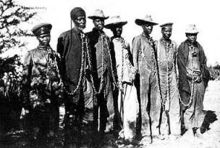
Tens of thousands of Herero and Nama people were murdered in response to an anti-colonial uprising.
Their descendants are still waiting for an apology from the German government.
The genocide began in 1904 after a Herero and Nama rebellion in response to the German expropriation of their land and cattle.
The head of the military administration in what was then known as German South West Africa, Lothar von Trotha, issued an extermination order in October 1904.
Chained Herero men
The Herero and Nama were forced into the desert and any who were found trying to return to their land were either killed or put into concentration camps.
There is no agreed figure of how many died but some estimates have put it as high as 100,000.
It is thought that 75% of the Herero population and half of the Nama population died.
… There are thought to be hundredsof Namibian skulls in Germany and on Wednesday more than 25 remains were handed back.
Skulls from Germany’s other African colonies, including modern day Cameroon, Tanzania, Rwanda and Togo, were also used in the discredited studies.
In 2016, Germany said it was prepared to apologize in principle but it is still negotiating with the Namibian government over the form of the apology and how to deal with the legacy of the genocide. [Funny how, when it was time to kill, they never negotiated]
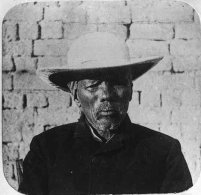
Hendrik Witbooi, Namaqua Chief and freedom fighter
… Germany has argued that it has given Namibia millions of dollars in development aid to support all people in the country. [They forget to tell you that they are still benefiting from the mines and resources of Namibia]
… But descendants of the victims are angry that there has been no apology and no agreement of reparations.They are also unhappy that they are not part of the negotiations. …
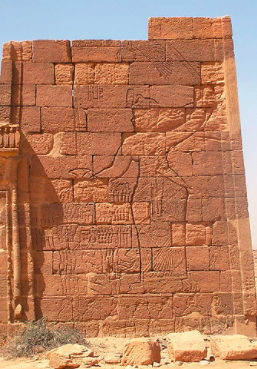
Sculpture of Candace Amanirenas on a pyramid wall in Barwa, Sudan
Amanirenas was a great Candace, queen, of the Nubian kingdom, mother to queen Amanishakheto, and grandmother to queen Amanitore. Amanirenas was a great warrior queen. She built considerable pyramids and temples at Wad Ban Naqa, where she was buried with great treasures.
Her full name and title was Amnirense qore li kdwe li (“Ameniras, Qore and Kandake“). She reigned from about 40BC to 10BC, and is one of the most famous Kandakes, because of her role leading Kushite armies against the Romans in a war that lasted five years, from 27 BCE to 22 BCE. After an initial victory when the Kushites attacked Roman Egypt, they were driven out of Egypt by Gaius Petronius and the Romans established a new frontier at HiereSycaminos (Maharraqa).Amanirenas was described as brave, and blind in one eye. Some say that her name means ‘Amani is her name’. Amani is the Nubian name for Imana/Amon, Unique God of Africa.
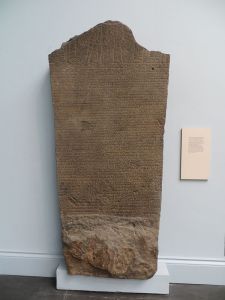
Hamadab stela showing Queen Amanirenas and Prince Akinidad facing various Egyptian deities Amun and Mut
Meroitic inscriptions give Amanirenas the title of qoreas well as Kandakesuggesting that she was a ruling queen. She is usually considered to be the queen referred to as “Candace” in Strabo‘s account of the Meroitic war against the Roman Empire. Her name is associated with those of Teriteqas and Akinidad. King Teriteqas died shortly after the beginning of the war. She was succeeded by Akinidad (possibly the son of Teriteqas) who continued the campaign with his mother Amanirenas. Akinidad died at Dakka c. 24BC. The loss of one eye during battle made Amanirenas even stronger and braver. She despised death, and her fearlessness forced the admiration of Strabo, the Greek historian, who said, “this queen has a courage above that of her gender.”
When Aelius Gallus, the Prefect, or chief magistrate, of Egypt, was absent on a campaign in Arabia in 24 BC, the Kushites launched an attack on Egypt. Amanirenas and Akinidad defeated Roman forces at Syene and Philae, and drove the Jews from Elephantine Island. They returned to Kush with prisoners and loot, including several statues of Emperor Augustus ; the Queen buried a bronze likeness of the Emperor beneath the entranceway to her palace so that she and all who came and went could tread on the head of her enemy. The head, found in Meroë in 1912, now resides in the British Museum
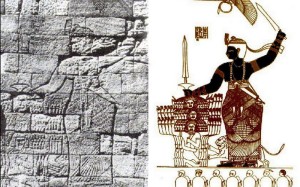
Stela showing Candace Amanirenas crushing Roman enemies. This also appears in Cheikh Anta Diop’s book cited below
The Kushites were driven out of Syene later in the year by Publius Petronius, who now held the office of Roman Prefect in Egypt. According to a detailed report made by Strabo, the Roman troops advanced far into the Kingdom of Kush, and finally reached Napata. Although they withdrew again to the north they left behind a garrison in Qasr Ibrim (Primis), which now became the border of the Roman Empire. The Kushites made a renewed attempt to seize Primis, but Petronius forestalled this attempt.
A peace treaty was signed between the Meroites and Augustus in the year 21/20 BC, which continued until the end of the third century AD, with relations between Meroë and Roman Egypt remaining generally peaceful during this time. However, the Kingdom of Kush had begun to fade as a power by the first or second century AD.
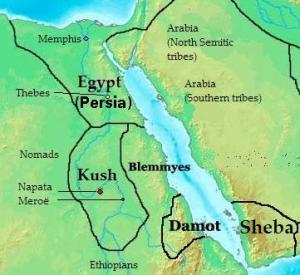
Nubia or the Kingdom of Kush in 400BC
Thereafter a preponderant place falls to two queens, Amanirenas and
Amanishakheto. Their husbands remain forgotten and we do not even know the name of Amanishakheto’s. The throne was also occupied for some years by a king, the former prince Akinidad, son of Queen Amanirenas and King Teriteqas. Nevertheless, it is important which of these two queens came first, both of them ‘Candace’, which is the transcription of the Meroitic title Kdke according to the tradition of the classical authors.
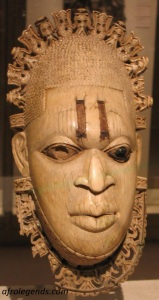
Pendant Ivory mask representing Queen Idia, Iyoba of Benin City (16th Century) – exposed at the MET
France, like so many European countries, is being urged to return looted art to Africa. Below is the article. For the full article, go to the Guardian.
=====
A report commissioned by Emmanuel Macron will call for thousands of African artworks in French museums taken without consent during the colonial period to be returned to the continent.
Unless it could be proven that objects were obtained legitimately, they should be returned to Africa permanently, not on long-term loan, said the authors of the report, the Senegalese writer and economist Felwine Sarr and the French historian Bénédicte Savoy.
They have recommended changing French law to allow the restitution of cultural works to Africa, after Macron announced that he wanted it to begin within five years.
… “I cannot accept that a large part of the cultural heritage of several African countries is in France,” the French president said last year in Ouagadougou, the capital of Burkina Faso. “There are historical explanations for this but there is no valid, lasting and unconditional justification. African heritage cannot be only in private collections and European museums – it must be showcased in Paris but also in Dakar, Lagos and Cotonou. This will be one of my priorities.” [Politicians always make promises, but never deliver. Let’s wait and see if Macron can do anything. In 2015, Francois Hollande, then French President Acknowledged French Genocide in Cameroonwhile in visit in Cameroon, without ever apologizing!]
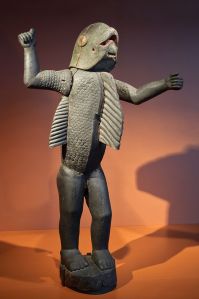
Fon statue symbolizing King Behanzin, the Man-Shark by Sossa Dede (c. 1890) – currently exposed at the Musee du quai Branly in Paris
The extent to which France, Britain and Germany looted Africa of its artefacts during colonialism is not known, but according to the report, which will be released this Friday, about 90% of Africa’s cultural heritage currently lies outside the continent.
… The report’s authors travelled to Mali, Senegal, Cameroon and Benin and looked through the works held by the Musée du quai Branly, a museum focused on non-European cultures in Paris, and found that about 46,000 of its 90,000 African works were “acquired” between 1885 and 1960 and may have to be returned.


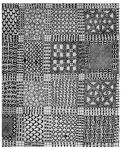 Adinkra in 1817
 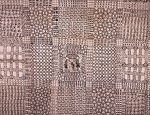 Adinkra work, 1825