Rooibos and Recognition for the Indigenous KhoiSan People

Rooibos_1
Prepared rooibos (source: Wikipedia)

Have you ever heard of rooibos ? Have you ever tasted rooibos tea? Well, as it is named, rooibos stands for red bush in Afrikaans, as denoted by its color. It is very popular in Southern Africa and has been consumed for centuries by the local indigenous Sān and  Khoi people. It grows exclusively in South Africa, in the Cederberg mountains north of the city of Cape Town. The leaves are used in a herbal tea, whose color is red like that of hibiscus tea. Traditionally, the local Sān people would climb the mountains and cut the fine, needle-like leaves from wild rooibos plants. They then rolled the bunches of leaves and brought them down the steep slopes using donkeys. The leaves were then chopped with axes and bruised with hammers, before being left to dry in the sun. Later on, once the European settlers had taken over the trade, no recognition to the indigenous people knowledge and input was given… until last week! Check out excerpts from the article published on South Africa’s Mail and Guardian below, and do not forget to follow the link for the full article.

=====

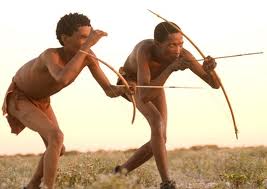
San (Basarwa/Bushmen) hunters

Transformation in the rooibos sector has been slow. The genocide of the indigenous San people and the virtual enslavement of the Khoi people in rooibos-growing landscapes of the Cape centuries ago, coupled with a government-controlled monopoly during the apartheid years, has led to a highly skewed and fractured industry.

Today, this R300-million local enterprise remains in the hands of about 300 white commercial farmers who cultivate 93% of the planted area. About 200 small-scale coloured farmers — largely confined to the dryer, more marginal parts of the winter rainfall fynbos region — produce only 2% of all rooibos tea.

A benefit-sharing agreement announced today by the minister of environmental affairs — between the rooibos industry and representatives of San and Khoi organisations — could signal the beginning of a change. 
More than R10-million a year — depending on weather, volumes and the price of rooibos — is likely to be distributed to trusts set up by San and Khoi organisations.

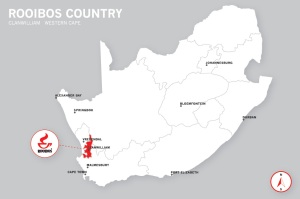
rooibos-country
Rooibos region in South Africa (source: rooibosltd.co.za)

If implemented judiciously and strategically, this could well change the face of rooibos in South Africa.

[…] At the agreement’s core is an annual traditional knowledge levy of 1.5% of the price that is paid by processors to farmers per kilogram of harvested rooibos. After being deposited into the government’s bioprospecting trust fund, the levy will be paid in equal parts to the San Council and National  KhoiSan Council. “Rooibos indigenous farming communities” — defined as “rural farming communities in rooibos growing areas who consist of descendants of original Khoi-Khoi peoples” — are to receive a portion from the trust set up for the Khoi people although the exact proportion has not yet been determined.

Non-monetary benefits will also be “explored” and could include the creation of employment opportunities, bursaries, development schemes, mentoring and the facilitation of livelihoods.

rooibos-tea
A cup of rooibos tea (source: MedicalNewsToday)

The agreement is a landmark, not only because it acknowledges the indisputable contribution made by traditional knowledge holders towards the establishment of the industry, but also because it could bring significant material benefits to indigenous San and Khoi people, many of whom remain marginalised and poverty stricken.

That the agreement offers restorative justice is undeniable, but the road ahead is far from smooth. Questions of how exactly benefits will be shared at a local level remain unresolved, and could result in conflicts. The long and troubled history of these oppressed communities has included dislocation, fracturing of family and community structures, and the undermining of people’s own initiatives.

The presence of strong, effective and transparent governance structures and sound external support will be essential to manage conflicting priorities proactively and ethically so that real benefits can be derived by all of the intended beneficiaries. …

Why the Name: Annaba ?

Annaba_Ancient city of Hippo Regius
Ruins of the Ancient city of Hippo Regius, modern-day Annaba (Source: Wikipedia)

I always loved the name of the city Annaba in Algeria. From the name, one could think that we are talking about a city in subsaharan Africa. I used to think that the origin of its name would be Berber or from somewhere in sub-Saharan Africa.

Annaba is the 4th largest city of Algeria, after AlgiersOran, and Constantine. It is a coastal city which has grown tremendously, like most cities around the globe, in the 20th century. Present-day Annaba grew up on the site of Aphrodisium, the seaport of the Roman city Hippo Regius. The modern city has since expanded south over Hippo’s ruins as well. Its former names Bône and Bona derived from “Ubbo“, a local form of the name Hippo. Its informal name “Land of the Jujubes” derives from that abundance of that fruit in the region.

Algeria_Annaba
Bona, Algeria in 1899 (modern-day Annaba)

Annaba, as one of the most ancient cities of Algeria, founded in 1295 BC, has had different names during her life: Ubbo, Hippo Regius, Hippone, Bona, Bled El Aneb, Bône, and nowadays Annaba. It was known as Balad al-Unnab or the “Land of the jujubes” from which the name Annaba is derived, because of the abundance of that fruit in the region.

During the rule of France (empire and republics), the city was called Bône. It was one of the main French settlements, and it still has a sizeable minority of the “Pied-Noir” to this day. During World War II in 1943, Bône was a crucial highway and sea location for the invasion of Tunisia, and thence the driving of the Axis Powers (Germany and Italy) out of Africa in May 1943. Bône remained in Allied hands until the end of the war in 1945, and then it remained a part of French Algeria until the independence of Algeria in 1962.

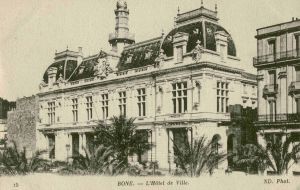
Annaba_Bone Hotel de ville epoque coloniale
Bone, Hotel de Ville during the colonial period

The city is an important hub of the world steel industry with the steel complex of El Hadjar, eight kilometres south of the city. It is the largest in Africa. Phosphate and metal industries are also prominent in the area. Other industrial sectors, private, focus on agri-food, metal processing, wood products, and construction.

Annaba is an important centre for tourism, and is one of the major tourist attractions in the western Mediterranean. It is located in the north east of the country, at 536 km east of Algiers and 105 km from the Tunisian border.

Annaba_panorama sea front
Panoramic view of Annaba’s sea front (Source: Wikipedia)

The downtown district of Annaba is on the sea-front, and includes the promenade called the Concours de la Revolution (previously called Le Cours Bertagna) which is a lively area, brimming with arcades and all kinds of covered restaurants, terraced cafes and kiosks. If you visit Annaba, remember to taste the Jujubes and enjoy the sea!!!

18th Century Ethiopian Crown to be Returned Home from Netherlands

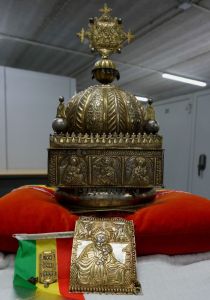
Ethiopian Crown 18th Century
The crown is currently being stored in a highly secured facility in the Netherlands (Source: BBC/AFP/Getty)

This was a good news and had to be shared. Enjoy! It is from the BBC.


=====

An 18th Century Ethiopian crown will finally be returned home after being hidden in a Dutch flat for 21 years.

Ethiopian Sirak Asfaw, who fled to the Netherlands in the late 1970s, discovered the crown in the suitcase of a visitor and realised it was stolen.

The management consultant has protected it until he felt safe to send it back.

Finally it is the right time to bring back the crown to its owners – and the owners of the crown are all Ethiopians,” he told the BBC.

Ethiopian crown netherlands
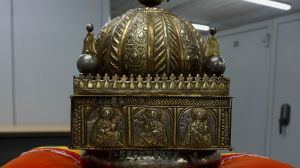
18th Century Ethiopian crown with depictions of Jesus Christ (Source: SkyNews)

The crown is thought to be one of just 20 in existence. It has depictions of Jesus Christ, God and the Holy Spirit, as well as Jesus’ disciples, and was likely gifted to a church by the powerful warlord Welde Sellase hundreds of years ago.

It is currently being stored at a high security facility until it can be safely returned.

… “I want this crown to be a symbol of unity and togetherness,” Mr Sirak said. “The crown will be celebrated by all of us Ethiopians, even Africans.”

At the Almamy Samori Touré’s Court

Samori Toure holding the Coran
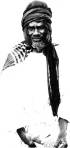
Samori Toure

What happens when a colonizer visits the court of an African King in the 19th century? How do the two cultures collide? Below is a description of an audience at the court of the great king Samori Touré, by the French commander Marie Étienne Péroz who even wrote a book later “Au Soudan français : souvenirs de guerre et de mission,” C. Lévy, 1889.  As you can see, the European man is in awe at what he sees in court, the arrangement, and most importantly the calm confidence and simplicity emanating from  Samori Touré. Also note the importance of Samori’s griot, Ansoumana, “without whom no decision is taken.” Enjoy! The original in French can be found on p. 281 of Les Africains, Vol.1, Editions du Jaguar, 1977. The English translation is brought to you by Dr. Y., Afrolegends.com.

======

The number of important personalities who had been summoned to it [the meeting], the riches and the pomp of the occasion, indicated the importance the almamy attached to it.

We were, ourselves, very impressed by the skill of the décor of which the original setting of the mosque, dungeon, high huts and ramparts of the palace had been done to enhance its brilliance (beauty). We slowly get closer, guided by Karamoko, towards the large canopy which shelters the Almamy and its court.

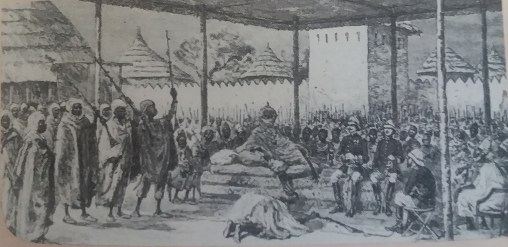
The Almamy is half lying on an elevated tara where blankets with bright patterns are piled up. He is simply dressed: Moorish boots, a black turban, a dark-colored caftan under which can be seen a white boubou. His headgear, a kind of diadem in finely chiseled gold and a necklace of the same metal deliciously crafted are the only insignia revealing his rank. His entourage, on the contrary, sitting on very low armchairs, brings out the severity of this costume by means of garments in showy colors in which they are clothed: this variegation of colors gives a warm tone to the entire scene. On his left, squatting on the ground and against his tara, Ansoumana, his family griot, without whom no decision is taken: he is wearing a blue boubou, and a black smock. Then, on the same side, Kissi, the head of treasury, whose green boubou constellated with grigris, throws the first happy note.

Samory does not get up when we dismount [from the horse]. We stop in front of him after greeting him and he extends his hand in a very affable way. From all sides explode the raucous accents of the horns, adding into the hum of the tam-tams, and the rumbling of the Almamy’s war drum. […]

20190804_172909_1
Vivid reception at the Almamy’s court (Les Africains, Vol.1 , P. 281, editions Jaguar)

The dreadful noise of instruments of all kinds greeting our arrival prevents at the beginning of all conversation, and covers the words of welcome he addresses us in a veiled tone; thus do we take this reprieve to admire in all sincerity the striking spectacle taking place in front of us.

What strikes us at first sight is the form he affects as a whole: the crescent. Just as his entourage is arranged in such a way which may appear to be the results of chance, but which, in reality, is very skillfully calculated so as to form a happy harmony of colors and forms, just as the security escorts of the different leaders who accompany him form in front of his dais a perfect half-oval, which leaves between him and them a vast place covered with white sands brought in from the river.  

Commandant Péroz

French Sudan

Robert Mugabe and His Contribution to Africa

Robert Mugabe Ave in Namibia_3
Robert Mugabe Avenue, next to the Parliament, in Windhoek, Namibia

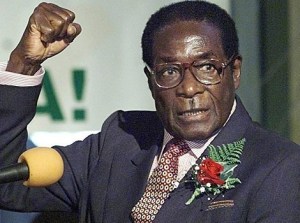
Namibia’s Founding President Sam Nujoma has described the late Zimbabwean President Robert Gabriel Mugabe as one of the continent’s most iconic leaders who fought for the liberation of his country and that of Africa at large. “He will be remembered as one who stood firm when others wavered. He was an iconic Pan-Africanist,” Nujoma said.

Robert Mugabe_7
Zimababwe’s President Robert Mugabe chants Zanu PF slogans with supporters gathered at the Harare International Conference Centre in Harare, Wednesday May 3, 2000. Mugabe launched the Zanu PF’s election manifesto which bears the slogan “Land is the Economy and the Economy is Land”. (AP Photo/Christine Nesbitt)

Robert Mugabe’s contribution to the freedom of Namibia, and all of Southern Africa and Central Africa is so immense that there are streets named after him throughout the region; for instance, an avenue bears his name in downtown Windhoek, the capital of Namibia. He worked tirelessly for the liberation of most of Southern Africa, including his very own country of Zimbabwe. Many countries such as Mozambique, Namibia, South Africa (with the fall of the Apartheid regime), Angola, owe their freedom to his unwavering support. Even in the  Democratic Republic of the Congo, (DRC), his support, sending troops there, helped avert total chaos. Joseph Kabila, former president of the DRC said, “We will forever remember the worthy son of Africa, who came to our rescue when our country was victim of a foreign aggressor. The continent has lost one of its pan-African leaders, a hero of independence.

Don’t agree with everything you read online, in the Western newspapers. When an African leader stands for his people and is fighting for their freedom, the western press calls him a dictator, a heretic: Laurent Gbagbo, Muammar KadhafiKwame Nkrumah at the end of his life, Sekou TouréPatrice Lumumba, … When he serves western interests in pillaging his country, he is a democrat and a friend: Paul Biya, Omar BongoAlassane Ouattara,  Mobutu Sese Seko, and countless others. Pay attention and you will see… and since the media are controlled by the west, we get a different version, very far from reality.

Robert Mugabe - Fidel Castro in Namibia1
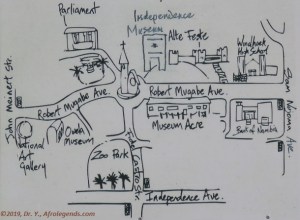
Map of Windhoek’s city center on the plate of the National Museum of Namibia, showing the Robert Mugabe Ave and the Fidel Castro St., as well as the Sam Nujoma Ave.

Everybody is stricken by some amnesia and forgets that the economic problems of Zimbabwe stemmed from economic sanctions imposed on them by Western powers such as the UK, US, and Europe. Before Mugabe fought for land restoration, he was knighted by the Queen of England, when he asked for the land of his forefathers to be returned to their rightful owners, he became a dictator. Go figure!

No wonder, Julius Malema of the EFF said “We must not allow our enemies to tell us how to remember [Robert Mugabe]; we know our heroes.”


Amanishakheto, Warrior Queen of Nubia

Nubia_Stele of Amanishakheto from the temple of Amun in Naqa
Stele of Amanishakheto (center) from the temple of Amun in Wad ban Naqa (Wikipedia)

Amanishakheto was a great queen of Nubia and is known as a great warrior and pyramid builder; she built numerous pyramids and temples at Meroë. She is also the daughter of Amanirenas, the fearless and one-eyed queen who defeated the Romans, and the mother of Amanitore, another great queen. Today, vestiges of her palace which had been destroyed and plundered by the Italian explorer Giuseppe Ferlini can still be seen at Wad ban Naqa, and her jewelry (looted by the same Italian), are now on display at the Egyptian Museum of Berlin, and at the Egyptian Museum of Munich.

Dr. Y.'s avatarAfrican Heritage

Candace Amanishakheto on a mural Candace Amanishakheto on a mural

Great women are often left out of history.  Rarely do we hear or read about African queens.  It is already hard enough to read about great African men and leaders in history books, but as for African women… it is more like impossible.  How many have heard of the great warrior queen of Nubia, Amanishakheto, who defeated a Roman army?  Who has heard of this great queen whose pyramid/tomb was leveled to the ground by an Italian treasure hunter, Giuseppe Ferlini, in 1832? Who has heard of this woman who led her people with a strong arm, and built pyramids in Meroë?  Who has heard of this great candace, whose daughter Amanitore, also queen of Nubia, is mentioned in the Bible (Acts 8:27) … yeah the Queen of Sheba is not the only African…

View original post 379 more words

Scarification: an ‘Ancient’ African Tattoo Culture

Congo_Batetela woman Lualaba Kassai_1905
Tetela woman with intricate ritual scarification designs ca 1905, Lualaba – Kasai

Today, we will reblog our article on scarification, an ‘ancient’ African tattoo culture. Not too long ago, scarification, as practiced in Africa, was much more than art work on skin. For many, it was a way of identification (the ethnic group you belonged to), a right of passage (boyhood to manhood, girlhood to womanhood, …), symbols of beauty and status, protection against evil spirits, and a rich tradition passed on from generations to generations. So next time you think about tattooing yourself, remember the ancient ways and designs of yore.

Dr. Y.'s avatarAfrican Heritage

Image of a young woman's face (agnautacouture.com) Image of a young woman’s face (agnautacouture.com)

These days, many of my fellow African brothers and sisters sport tattoos of some European or foreign symbols on their skins. These symbols are usually alien to our cultures, traditions, thinking, and history. So I thought about talking about scarification, which could be called an “ancient” African culture of tattoos.

For starters, Africa has a rich culture of scarification. Many cite HIV, and ugliness as being the reason why they would not do scarification and why the practice has been abandoned. I neither agree nor disagree with them, but I would like to give a history of scarification and why, this is something to be cherished as part of our history, even if it is no longer practiced and/or needed today.

Sculpture of a Mangbetu person, in Congo (this sculpture is exposed at the MET) Sculpture of a Mangbetu person, in Congo (exposed at the MET)

In the past, a woman or man would have scarification marks that…

View original post 621 more words

History of African Fabrics and Textiles

As I share this other great favorite on African textiles, I am preparing to write another piece on this subject next month… so stay tuned.

Dr. Y.'s avatarAfrican Heritage

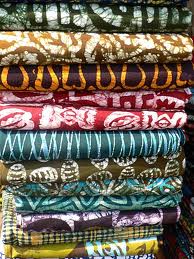
Wax Hollandais Wax Hollandais

Very often, Africans are depicted on old pictures as naked people, walking around without any clothing.  This seems to be quite at odd with the fact that the Dutch textile company VLISCO has been installed in Africa, more precisely in Togo, since 1846.  So how could pictures from the 1800s and early 1900s only show naked Africans?  The BBC recently ran a story on VLISCO and African textile tradition actually being European.  The New York Times claimed that Africa’s fabric was entirely Dutch.  I find this quite appalling, and I call this a falsification of history.

For starters, before VLISCO, Africa had a very rich textile industry as noted by Kankan Moussa‘s entire delegation being clothed from cotton woven with golden threads in 1300s during his pilgrimage to the Mecca (this will be a story for another day), or the Kanembu clothing tradition which dates as far…

View original post 568 more words

Adinkra Symbols and the Rich Akan Culture

Sankofa symbol
The Sankofa symbol

This is another all-time favorite… The second-most popular post on Afrolegends.com: the history of Adinkra symbols and the Rich Akan culture of the Akan people of Ghana and Côte d’Ivoire. Enjoy!
As we revisit this favorite, please let us know if there are other things you would like to learn on the topic, and we will try to add more.

Dr. Y.'s avatarAfrican Heritage

Adinkra in 1817 Adinkra in 1817

Today, we will talk about Adinkra symbols of the Akan people of Côte d’Ivoire and Ghana.

The Adinkra symbols are believed to originate in Gyaman, a former kingdom in modern day Côte d’Ivoire.  According to an Ashanti (Asante) legend, Adinkra was the name of a king of the Gyaman kingdom, Nana Kofi Adinkra.  King Adinkra was defeated and captured in a battle.  According to the legend, Nana Adinkra wore patterned cloth, which was interpreted as a way of expressing his sorrow on being taken to Kumasi, the capital of Asante.  He was finally killed and his territory was annexed to the kingdom of Asante.  The Asante people, around the 19th century, took to painting of traditional symbols of the Gyamans onto cloth, a tradition which has remained to this day.

Adinkra work, 1825 Adinkra work, 1825

The arrival of the…

View original post 610 more words

Samori Touré: African Leader and Resistant to French Imperialism!

Samori
Samori Touré

This post on Samori Touré has been an all-time favorite post on Afrolegends.com . I am reblogging it here, because on this 10-year anniversary of the African Heritage Blog, it has been the most viewed and loved article. As you know, Samori Touré, grandfather to the African president Sekou Touré (another resistant to French imperialism – Guinea: the country who dared say ‘NO’ to France), was a leader and ruled over a vast empire which spanned big areas of West Africa from Guinea all the way to modern-day Côte d’Ivoire. He was a strong fighter to France imperialism in Africa, and opposed a great resistance to the French several times. This is to one of Africa’s great kings, warriors, and resistant.

Dr. Y.'s avatarAfrican Heritage

Samori Toure holding the Coran

One of the great kings, and fighters of African freedom was the great Samori Touré. Over 100 years ago, Samori Touré was captured by the French and deported to Gabon where he died of pneumonia.

But who was Samori Touré?

Well, Samori Touré was born in 1830 in Manyambaladugu (some texts mentionSanankoro instead), a village southeast of Kankan in present-day Guinea. Samori was a great warrior who fought imperialism in the 19th century such as many leaders today. He refused to submit to French colonization and thus chose the path of confrontation using warfare and diplomacy.

Until the age of 20, Samori was a trader. After his mother was captured in a slave raid by the king Sori Birama, he offered to serve in his army and excelled by his military prowess and skills.

Samori Touré had a vision of unity for the Malinké people, and…

View original post 935 more words