Understanding Sahara’s Climate shift from Savannah to Desert through Fish ?

Sahara_ancient sea creatures
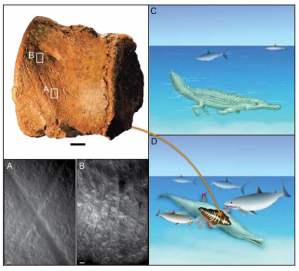
Some of the sea creatures that lived underwater in the location where the Sahara desert is today. (Source: American Museum of Natural History 2019)

In October, we talked about how the Sahara had been home to world’s largest sea creatures. Given that Africa is the cradle of humanity, it totally makes sense that it would also be the place where some the world’s largest sea creatures hail from. Now, scientists have charted the climate of the Sahara desert thousands years ago based on the diet of the people there, identifying it as a place which was plentiful with fish: a lot of catfish and tilapia (or rather ancestors of these!). Enjoy excerpts from this The Guardian article.

=====

Sahara desert from space
View of the Sahara desert from space

The Sahara’s shift from savannah with abundant lakes to a largely arid expanse has been traced in the remains of fish eaten thousands of years ago.

Researchers analysing material found in a rock shelter in the Acacus mountains in south-west Libya say they have found more than 17,500 animal remains dating from between 10,200 and 4,650 years ago, 80% of which are fish. About two-thirds of the fish were catfish and the rest were tilapia. The team say telltale marks on the bones reveal the fish were eaten by humans who used the shelter.

It is not the first time fish remains have been found in what are now dry regions of the desert, but the team say it is the first time the ancient climate of the region has been traced through animal remains.

All the other finds are surface finds, [from] just one layer, one period, one event. Whereas what we have here is a 5,000-year sequence with a lot of bones – so that makes it special,” said Dr Wim van Neer from the Royal Belgian Institute of Natural Sciences, a co-author of the study.

The discovery is the latest in a string of finds from the large Takarkori rock shelter, a site, about 50-60 metres long and 30 metres high, that is thought to have been first used by hunter gatherers more than 10,000 years ago.

Sahara petroglyph in the Fezzan giraffes
Rock art in the Sahara desert (Source: Wikipedia) 

Prof Savino di Lernia, a co-author of the study from Sapienza University of Rome, said previous finds at the shelter included evidence of rock art, the earliest signs in Africa of wild cereals being cultivated and their seeds stored, and evidence from pottery shards of dairy practices in Africa dating back nearly 7,000 years ago.

… Writing in the journal Plos One, Van Neer and colleagues report that fish account for about 80% of the animal remains discovered at the site during the 5,000-year period it was used by humans, with mammals making up just over 19%. Birds molluscs and other animals such as turtles account for the rest.

The team found the predominance of fish was not steady but fell from about 90% in the earliest layers to about 48% in those from the most recent period of its occupation.

The amount of fish is decreasing through time and the contribution of mammals increases, showing that people at Takarkori focussed gradually more on hunting and livestock keeping,” the authors write. But, they add: “It is unclear if this was an intentional process or if this shift could be related to increasing aridity, which made the environment less favourable for fishes.” …

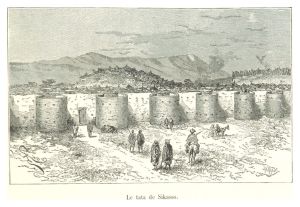
The French Capture of the Tata of Sikasso on May 1, 1898

Mali_Tata de Sikasso
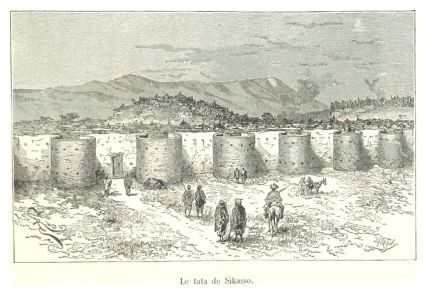
The tata of Sikasso, illustration by Édouard Riou published in Du Niger au golfe de Guinée, Hachette, 1892, by L.G Binger, p. 95

In 1898, the French colonial forces attacked the Tata of Sikasso which had resisted the tireless assaults of Samori Touré and his army for 15 months a decade earlier. Despite strong resistance from Babemba Traoré and his people, they could barely resist the French canons and barbary, and succumbed on May 1, 1898.  As always, the French used treachery: the French colonel Marie Michel Alexandre René Audéoud wanted to install a garrison at Sikasso; but Babemba Traoré flatly refused. This resulted in a war between the French colonial forces and the people of Sikasso, which lasted 2 days. In the end, Babemba Traoré, the king, ended his life, abiding by the famous Bamanankan saying “Saya ka fisa ni maloya ye” (literally: death is preferable to shame). The city was then ransacked and plundered.

Below is an account of the barbary of the French colonel Audéoud and his men after their victory in Sikasso. The original in French can be found here on Jacques Morel’s page; the translation to English is brought to you by Dr. Y., Afrolegends.com .

====

Mali_Tieba Traore
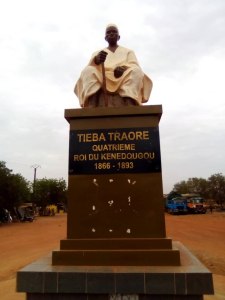
Monument of Tieba Traoré in Sikasso (Source: Wikipedia)

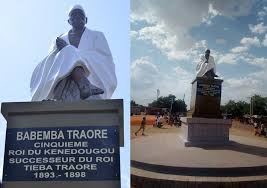
In April 1898, the colonel Audéoud who is looking for a boost for his promotion, sends captain Morisson demand from Babemba, Tieba’s successor, the “Fama” of Sikasso (in modern-day Mali), and ally – imprudent – of the French in their war against Samori, the establishment of a French garrison in his capital. Babemba refuses. It is war, and the siege of Sikasso where violent counter-attacks of the besieged repeatedly endanger the French troops. But with only three remaining enclosures still standing after resisting for fifteen months to Samori, “the fortress does not last two days when faced with modern artillery,” says Gilbert Comte.

Sikasso resists street by street. A French officer, taking part in the capture of Sikasso, describes the city as such:

“After the siege, the assault. Babemba kills himself. We give the order to plunder. Everything is taken or killed. All the captives, roughly 4000, are herded together.

The colonel [Audéoud] starts the distribution. He himself used to write in a notebook, then gave it up saying, “Share this among yourselves!”. The sharing took place with arguments and blows. Then back on our way! Each European is given a wife of his choice… On our way back we did intervals of forty kilometers with these captives. Children and all those who are tired are killed with the butt of the gun and the bayonet…

Babemba Traore
Monument of Babemba Traoré in Sikasso (Source: Face2FaceAfrica.com)

The corpses were left by the roadsides. A woman is found crouching. She is pregnant. We push her with the butt of the gun. She gives birth standing while walking. Has cut the umbilical cord and abandoned the child without looking back to see whether it’s a boy or a girl.

During those intervals, the men requisitioned on the way to carry millet stay five days without rations; receive fifty strokes of rope if they take a handful of the millet they are carrying. 

The sharpshooters got so many captives that it was impossible to house and feed them.”

Sources: P. Vigné d’Octon, La Gloire du sabre, Paris, Flammarion, 1900; cité par Jean Suret-Canale, Afrique Noire, Occidentale et Centrale, Éditions sociales, 1968, page 274-275; Gilbert Comte, L’empire triomphant, Denoël, 1988, page 85-86.

The Tata of Sikasso: an African Fortifying Wall

Mali_Tata de Sikasso
The tata of Sikasso, illustration by Édouard Riou published in Du Niger au golfe de Guinée, Hachette, 1892, by L.G Binger, p. 95

Have you ever heard about the Tata of Sikasso or Sikasso Tata, a fortifying wall built in Mali which sustained attacks by some of the greatest conquerors of its time, including none other than the great Samori Touré ? and which was destroyed by the French colonial army ? This structure was probably stronger than some forts found in Europe. This defensive wall is quite reminiscent of the Great Wall of China.

Mali_Tieba Traore
Monument of Tieba Traore in Sikasso (Source: Wikipedia)

The Tata of Sikasso, locally known as Tarakoko, is a fortress built during the reign of King Tieba Traoré between 1877 and 1897, in modern Mali. Tieba Traoré, whose mother came from Sikasso, became King of the Kénédougou Empire and moved its capital to the city of Sikasso. He established his palace on the sacred Mamelon hill and constructed a tata or fortifying wall to defend against the attacks of both the Malinke conqueror Samori Touré and the French colonial army. The city withstood a long siege from 1887 to 1888 but fell to the French in 1898. This fortified wall was reinforced by Babemba Traoré, Tieba Traoré’s brother, who had succeeded him as king.

The Tata of Sikasso was built for the protection of the city, in a military style. It used to extend through an area of 41 hectares, with its walls reinforced with the addition of earthen walls, bars, and alternate stone beds; the intervals of which were filled with ferrous gravel, earth, and stones. At the time of Samori Touré’s unsuccessful siege, which lasted 15 months from March 1887 to June 1888, the tata had three concentric enclosures.

The exterior of the tata was 9 km long, 6 m (∼20 ft) wide at the base and 2 m (∼7 ft) high at the summit. Its height varies between 4 to 6 m.

Samori
Samori Touré

The intermediary tata walls were not as big, and also not as wide. Those were meant for merchants, soldiers and nobles.

The inner enclosure encircled the Dionfoutou, which was the part of the city inhabited by the king and his family.

The fortress is still visible today in the actual landscape of the city of Sikasso in neighborhoods such as Mancourani, Medina, Wayerma, Bougoula city and Fulasso. Seven monuments, in the shape of doors, have been built with modern materials on the site of the passages of yesteryear to preserve their memory.

The Tata of Sikasso has been inscribed in the UNESCO World Heritage Tentative list: « Le Tata de Sikasso ».

Stolen 18th Century Crown Returned to Ethiopia

Ethiopian Crown 18th Century
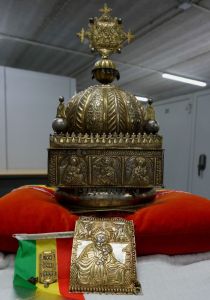
The crown is currently being stored in a highly secured facility in the Netherlands (Source: BBC/AFP/Getty)

Following our article back in October of last year, 18th Century Ethiopian Crown to be Returned Home from Netherlands, it is with great joy that we announce the official return of the crown to Ethiopia. Below is from the BBC.

====

The Ethiopian government has received an 18th Century crown that had been stolen then hidden in a flat in the Netherlands for 21 years.

The crown is thought to be one of just 20 in existence. It has depictions of Jesus Christ, God and the Holy Spirit, as well as Jesus’ disciples, and was likely gifted to a church by the powerful warlord Welde Sellase hundreds of years ago.

Ethiopian Sirak Asfaw, who lives in the Netherlands, discovered the crown in the suitcase of a visitor he was hosting.

Upon realising that it was stolen he held onto it until 2018 when Prime Minister Abiy Ahmed was elected to office. He then reached out to art historian Arthur Brand and Dutch police to help keep it safe until its return home to Ethiopia.

On Thursday, Mr Abiy tweeted photos of him receiving the crown from a delegation that included Dutch Minister for Foreign Trade and Development Cooperation Sigrid Kaag.

Description of African Dressing in 1400s

Van Sertima_They came before Columbus
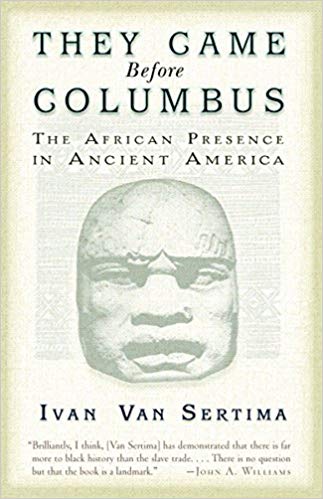
‘They Came Before Columbus, The African Presence in Ancient America’ by Ivan Van Sertima

As I have always said in the past, I truly despise the claim of  The New York Times that Africa’s fabric is Dutch. This is simply a case of falsification of history. As I have proven before, African Fabrics and Textiles traditions is large, existent, and real; it is not just VLISCO-based. Below is an account by a European of African dressing in the 1400s! And yes… the Africans he met wore garments.

They numbered seventeen, of considerable size. Checking their course and lifting up their oars, their crews lay gazing. … We estimated on examination that there might be about one hundred and fifty at the most; they appeared very well-built, exceedingly black, and all clothed in white cotton shirts: some of them wore small white caps on their heads, very like the German style, except that on each side they had a white wing with a feather in the middle of the cap, as though to distinguish the fighting men.

“A Negro stood in the prow of each boat, with a round shield, apparently of leather, on his arm. They made no movement towards us, nor we to them. Then they perceived the other two vessels coming up behind me and advanced towards them. On reaching them, without any other salute, they threw down their oars, and began to shoot off their arrows.

Bogolan
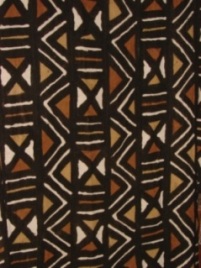
A piece of Bogolan

This encounter between the Portuguese and the boatmen on the Gambia occurred in 1455. It is the only account of West African riverboats documented by Europeans before the coming of Columbus.

G.R. Crone, The Voyages of Cadamosto, London, the Hakluyt Society, 1937, pp. 57-59

Ivan Van Sertima, They Came Before Columbus, The African Presence in Ancient America, Random House, 1976, p.54

French Colonial Treaty in Madagascar : 18 January 1896

Madagascar
Madagascar

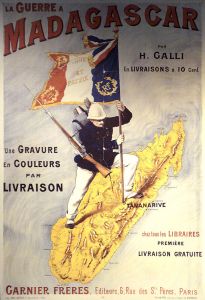
The treaty below with the Queen of Madagascar marked the full possession of Madagascar by France. It also marked the end of the Kingdom of Madagascar, or Merina Kingdom, officially known as Kingdom of Imerina. In essence, Ranavalona III, the last monarch of the Kingdom of Madagascar, tried to stave off the French colonization of her land by strengthening trade and diplomatic relations with the United States and Great Britain throughout her reign; however, French attacks on coastal port towns and an assault on the capital city of Antananarivo ultimately led to the capture of the royal palace in 1895, ending the sovereignty and political autonomy of the century-old kingdom. France officially annexed Madagascar on January 1, 1896.

As you read the treaty below, you could see the beginning of the schemes for the FCFA and the 11 Components of the French Colonial Tax in Africa we talked about a while back. Note that Madagascar was banned from dealing directly economically with foreign powers: everything had to go through France… isn’t this a predecessor to the FCFA?

=====

Ranavalona_III_of_Madagascar
Queen Ranavalona III of Madagascar

H.E. the Queen of Madagascar, after reading the declaration of possession of the Island of Madagascar by the government of the French Republic, declares to accept the following conditions below:

Article I

The government of the French Republic will be represented to the Queen of Madagascar by a Resident General.

Article II

The government of the French Republic will represent Madagascar in all external relations.

The resident general will be in charge of relations with the agents from foreign powers. Matters of interest to foreigners pertaining to Madagascar will be dealt with by through him.

The diplomatic and consular agents of France in foreign countries will be in charge of the protection of Malagasy subjects and interests.

Article III

The government of the French Republic reserves the right to maintain in Madagascar the military forces necessary for its authority.

Article IV

Ranavalona III conceded defeat to the French in Sept 1895
Ranavalona III conceded defeat to the French in September 1895

The Resident General will control the internal administration of the Island.

H.E. the Queen of Madagascar commits herself to proceed to the reforms that the French government will judge useful for the economic development and the progress of civilization.

Article V

The government of H.E. the Queen of Madagascar is prohibited from contracting any loan without the authorization of the government of the French Republic.

Antananarivo, January 19, 1896

Hoy Ranavalomanjaka III

Mpanjakany Madagascar

Bronze Cockerel from Benin Kingdom to be returned to Nigeria

Benin Kingdom_Okukor2
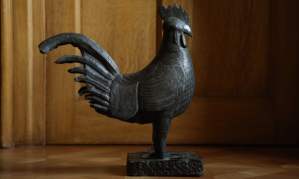
Bronze cockerel ‘Okukor’ at Jesus College in Cambridge (Source: The Guardian)

Another return of an artifact from a Western institution to an African country, which I applaud… but I remain guarded. Why am I skeptical? Well, because if over 50% of artifacts in the great museums of this world (Louvre, British Museum, MET, Tervuren, etc) which generate a lot of money, and knowledge to western schools, researchers, etc, is made up of looted treasures… will the benefactors of the loot willingly return these? And if they return these, who is to say that it is the real thing? One should not expect a thief not to cheat you again! Below are excerpts from the article in The Guardian. Enjoy!

====

Rooster from Benin Kingdom (18th century)
Rooster from Benin Kingdom (18th century) at the Metropolitan Museum of Art (the MET)

A bronze cockerel taken by British colonial forces and donated to Jesus College Cambridge is to be returned to Nigeria in an unprecedented step that adds momentum to the growing repatriations movement.

The Okukor, described by the college as a “royal ancestral heirloom”, will be one of the first Benin bronzes to be returned to Nigeria by a major British institution since the punitive expedition in 1897 when thousands of bronzes were stolen from Benin City by British forces.

No specific date for return has been released but the college stated that the bronze cockerel “belongs with the current Oba at the Court of Benin”. The return was recommended by Jesus College’s Legacy of Slavery Working Party (LSWP), a group dedicated to looking at the institution’s connections to slavery, which confirmed the piece was donated in 1905 by the father of a student.

[…] Victor Ehikhamenor, a Nigerian artist and member of the Benin Dialogue Group, said: “No matter how small the gesture may look, it is a huge step towards the realisation of restitution of the works from the Benin Kingdom that were looted by the British. This is very important example, which I hope other Europeans, especially British institutions, will follow without any excuses or delays.”

Dan Hicks, a professor of archaeology at the Pitt Rivers Museum in Oxford and a representative of the Benin Dialogue Group, said: … In the past, our attention on this matter was focused on national collections like the British Museum and the V&A – but in reality such loot is held in dozens of institutions across the regions: city museums, art galleries and the collections of universities.”

[…] The Jesus College announcement comes almost exactly 12 months after the release of a report commissioned by the French president, Emmanuel Macron, which recommended the return of colonial-era artefacts by France.

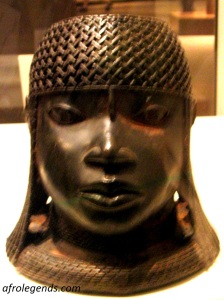
Queen from Benin kingdom
Queen from Benin kingdom (at the MET)

The report’s authors, the Senegalese economist Felwine Sarr and the French art historian Bénédicte Savoy, told the Guardian that the British Museum, which houses a huge collection of the Benin bronzes, was acting like “an ostrich with its head in the sand” by not acting faster on repatriations.

[…] Since the release of the report, Ivory Coast, Senegal and the Democratic Republic of the Congo have made formal requests for the return of artefacts. European countries including France and Germany have committed to handing back objects, with the Rijksmuseum in Amsterdam opening talks with Sri Lanka and Indonesia and describing the Netherlands’ failure to return stolen artefacts as a “disgrace”.

The news comes a week after Open Society Foundations (OSF) announced a $15m initiative aimed at strengthening efforts to “restore cultural objects looted from the African continent”. …

France Returns Sword of Senegalese Hero Omar Tall … Temporarily

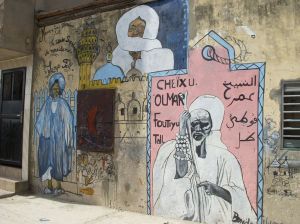
Omar Tall
Mural in Dakar showing Omar Tall (Source: Wikipedia)

At first I was thrilled by the news that France had returned the sword of the Senegalese hero Omar Tall, … until I read the fine prints! Then I read that this was a temporary return, more like a 5-year loan to Senegal, until the French parliament approves whether to permanently return it or not. Moreover, the sword was already on loan at a Museum in Senegal. Nevertheless, you will notice like me that the media titled it a ‘return.‘ In reality, this is more like a publicity campaign for the French who seemingly appear to be returning looted treasures.

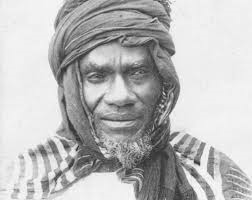
Before delving into the excerpt below from the BBC article, it is good to say a few words about Omar Saidou Tall or Umar Tall, and why he is so venered by Senegalese. Omar Saidou Tall was a religious, political, and military leader who fought against French colonization in the region then known as French Sudan which encompassed Senegal, Mali, and Guinea. He opposed a fierce resistance to the French from 1857 to 1859. Senegalese tend to remember him as a hero of anti-French resistance, while Malian sources tend to describe him as an invader who paved the way for the French by weakening West Africa. We will go deeper into his life and legacy in the next post.

======

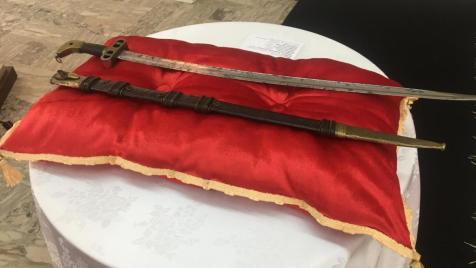
France has restored to Senegal a sabre that belonged to a 19th Century Islamic scholar and ruler.

It is part of a commitment to return to its former West African colonies key items of their cultural heritage.

The artefact originally belonged to the revered west African leader Omar Saidou Tall, who led an anti-colonial struggle against the French.

… Mr Philippe [France’s prime minister] said it was “the first step” in a project aimed at returning more Senegalese artefacts currently in French museums, which hold at least 90,000 artefacts from sub-Saharan Africa.

Last year a group of experts commissioned by France’s President Emmanuel Macron recommended that African treasures in French museums be returned to their countries of origin.

sabre_0
Omar Tall’s Sword (Source: RFI)

Their official report states that most of the Africa collection in Paris’ Quai Branly museum – approximately 46,000 pieces – was acquired with some degree of duress [not sure that they will return all these artefacts and leave their museums empty].

It’s symbolic. It had been lent to us before, but now it is being restored to us,” the head of Dakar’s Museum of Black Civilisations Hamady Bocoum told AFP news agency about the sabre.

The curved iron, brass and wood sword has been kept in its leather sheath in the museum in Senegal’s capital on loan from France. But Sunday’s ceremony saw the item formally returned for a period of five years.

The next stage will be for French MPs to vote on whether to permanently return this and other artefacts.

The Sahara was Home to World’s Largest Sea Creatures

Sahara_ancient sea creatures
Some of the sea creatures that lived underwater in the location where the Sahara desert is today. (Source: American Museum of Natural History 2019)

Given that Africa is the cradle of humanity, it totally makes sense that it would also be the place where some the world’s largest sea creatures hail from. The excerpt below from the Guardian reveals that the Sahara was home to some of the world’s largest sea creatures. Enjoy!

=====

Scientists reconstruct extinct species using fossils found in northern Mali from ancient seaway

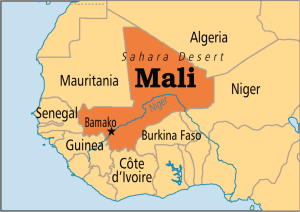
Some of the biggest catfish and sea snakes to ever exist lived in what is today the Sahara desert, according to a new paper that contains the first reconstructions of extinct aquatic species from the ancient Trans-Saharan Seaway.

Mali4
Map of Mali with its capital Bamako

The sea was 50 metres deep and once covered 3,000 sq km of what is now the world’s biggest sand desert. The marine sediment it left behind is filled with fossils, which allowed the scientists who published the study to build up a picture of a region that teemed with life.

Between 100 m and 50 m years ago, today’s arid, boulder-strewn northern Mali “looked more like modern Puerto Rico”; the sun shone on some of the earliest mangroves, and molluscs lined the shallow seabed, according to Maureen O’Leary, the palaeontologist who led the study.

Sahara_ancient sea creatures_1
Reconstruction of sharks feeding on a dyrosaurid crocodily form. (Source: American Museum of Natural History 2019)

The study also formally named the geological units, literally putting the area on the geological map for the first time, showing how the sea ebbed and flowed over its 50 m years of existence, and building up information about the K-Pg boundary, the geophysical marker of one of Earth’s five major extinction events, in which the non-avian dinosaurs became extinct.

With 1.6 m catfish, 12.3 m sea snakes and 1.2 m pycnodonts – a type of bony fish – O’Leary and the other scientists developed the idea that in the late Cretaceous and early Paleogene period, the animals were experiencing gigantism.

Evolutionary biologists have long talked about the phenomenon of island gigantism, where species that live on small islands can sometimes develop very large bodies, possibly because they have more resources or there are few predators, or both.

… 

The African Crow: The Crow with a Nike Collar

Nike Crow_1
A crow snacking on some bread

A few years back, my father was visiting Melbourne in Australia, when he heard a bird crowing around. So he asked an Australian lady nearby what bird that was, and she answered the crow… and my dad went on to tell her that in his country, the crow had a white collar, and sounded just like that… so the lady chuckled and said, “so you have a Nike-collar crow in your country.” So meet the Nike-collared Crow.

Nike Crow_Rwanda_1
Crows in Rwanda

When I first moved to the West, I never understood why people taught of the crow as a bad bird, or rather a bird of bad omen. When I asked, they told me because of its black coat, and black feathers, and because of its cry. This sounded totally weird to me… why? Because in African culture, the crow is not a bad bird, or a bird bringing ominous news. It is actually a good bird. Not only that, but the crow is not an all-black bird, but it has a white collar. I was surprised to find this white-collared bird in Cameroon, in Rwanda, and in other places, thus telling me that the white-collared crow is indigenous to Africa.

With the white collar, isn’t your perception of the crow changed?

Nike Crow_Cameroon_2
Crows in Cameroon