A blog about African history, and heritage, through audio and video files.
Author: Dr. Y.
I am an African in love with the history of the world, and particularly that of Africa. I am a child of love, an artist, a scientist, a lover, a friend, a human.
I am in love with nature and beautiful things, art, history, geography, travel, dance, food, science, and technology, and much more.
The treaty below with the Queen of Madagascar marked the full possession of Madagascar by France. It also marked the end of the Kingdom of Madagascar, or Merina Kingdom, officially known as Kingdom of Imerina. In essence, Ranavalona III, the last monarch of the Kingdom of Madagascar, tried to stave off the French colonization of her land by strengthening trade and diplomatic relations with the United States and Great Britain throughout her reign; however, French attacks on coastal port towns and an assault on the capital city of Antananarivo ultimately led to the capture of the royal palace in 1895, ending the sovereignty and political autonomy of the century-old kingdom. France officially annexed Madagascar on January 1, 1896.
As you read the treaty below, you could see the beginning of the schemes for the FCFA and the 11 Components of the French Colonial Tax in Africa we talked about a while back. Note that Madagascar was banned from dealing directly economically with foreign powers: everything had to go through France… isn’t this a predecessor to the FCFA?
=====
Queen Ranavalona III of Madagascar
H.E. the Queen of Madagascar, after reading the declaration of possession of the Island of Madagascar by the government of the French Republic, declares to accept the following conditions below:
Article I
The government of the French Republic will be represented to the Queen of Madagascar by a Resident General.
Article II
The government of the French Republic will represent Madagascar in all external relations.
The resident general will be in charge of relations with the agents from foreign powers. Matters of interest to foreigners pertaining to Madagascar will be dealt with by through him.
The diplomatic and consular agents of France in foreign countries will be in charge of the protection of Malagasy subjects and interests.
Article III
The government of the French Republic reserves the right to maintain in Madagascar the military forces necessary for its authority.
Article IV
Ranavalona III conceded defeat to the French in September 1895
The Resident General will control the internal administration of the Island.
H.E. the Queen of Madagascar commits herself to proceed to the reforms that the French government will judge useful for the economic development and the progress of civilization.
Article V
The government of H.E. the Queen of Madagascar is prohibited from contracting any loan without the authorization of the government of the French Republic.
Below is the original article published by Mawuna R. Koutounin on Mondialisation.ca on Feb 20th 2014. I had accessed it on April 17 2017. Today, this article has disappeared from the website. This article is the basis for The 11 Components of the French Colonial Tax in Africa. Enjoy and share with all!
=====
Le saviez-vous ? 14 pays africains contraints par la France à payer l’impôt colonial pour les « avantages » de l’esclavage et de la colonisation
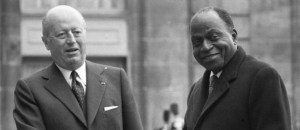
Photo : Foccart & Houphouet-Boigny, les pères fondateurs de la françafrique
Le saviez-vous? Aujourd’hui encore, beaucoup de pays africains continuent de payer un impôt colonial en France, et ce malgré l’indépendance !
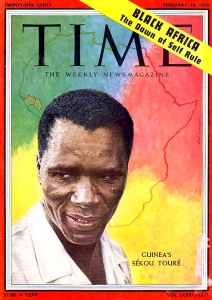
Lorsque Sékou Touré de Guinée décida en 1958 de sortir de l’empire colonial français, et opta alors pour l’indépendance du pays, l’élite coloniale française à Paris était s’est indignée, et dans un acte de fureur historique, demanda à son administration alors en place en Guinée de détruire, dans tout le pays, ce qui représentait, à leur yeux, les avantages de la colonisation française.
Trois mille Français quittèrent le pays, en prenant tous leurs biens et détruisant tout ce qui ne pouvait être déplacé: les écoles, les crèches, les bâtiments de l’administration publique furent détruits, les voitures, les livres, les médicaments, les instruments de l’institut de recherche, les tracteurs ont été écrasés et sabotés; les chevaux, les vaches dans les fermes ont été tués, et les nourritures entreposées furent brûlées ou empoisonnée.
Sekou Toure, Cover Time Magazine, Feb. 16, 1959
Le but de cet acte scandaleux était bien évidemment, d’envoyer un message clair à tous les autres colonies sur les conséquences du rejet de la France.
Le fait est que peu à peu, la peur s’empara des Élites Africaines, et après ces événements aucun autre pays ne trouva jamais le courage de suivre l’exemple de Sékou Touré, dont le slogan était « Nous préférons la liberté dans la pauvreté à l’opulence dans l’esclavage ».
Pour les pays nouvellement indépendant il fallut trouver des compromis avec la France. Sylvanus Olympio, le premier président de la République du Togo, un petit pays d’ Afrique de l’Ouest, trouva une solution susceptible de calmer les Français :
Ne voulant pas continuer à subir une domination française, il refusa de signer le pacte colonisation proposé par De Gaule, mais accepta en contrepartie de payer une dette annuelle à la France pour les soi-disant avantages obtenus lors de la colonisation française.
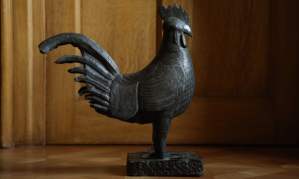
Bronze cockerel ‘Okukor’ at Jesus College in Cambridge (Source: The Guardian)
Another return of an artifact from a Western institution to an African country, which I applaud… but I remain guarded. Why am I skeptical? Well, because if over 50% of artifacts in the great museums of this world (Louvre, British Museum, MET, Tervuren, etc) which generate a lot of money, and knowledge to western schools, researchers, etc, is made up of looted treasures… will the benefactors of the loot willingly return these? And if they return these, who is to say that it is the real thing? One should not expect a thief not to cheat you again! Below are excerpts from the article in The Guardian. Enjoy!
====
Rooster from Benin Kingdom (18th century) at the Metropolitan Museum of Art (the MET)
A bronze cockerel taken by British colonial forces and donated to Jesus College Cambridge is to be returned to Nigeria in an unprecedented step that adds momentum to the growing repatriations movement.
The Okukor, described by the college as a “royal ancestral heirloom”, will be one of the first Benin bronzes to be returned to Nigeria by a major British institution since the punitive expedition in 1897 when thousands of bronzes were stolen from Benin City by British forces.
No specific date for return has been released but the college stated that the bronze cockerel “belongs with the current Oba at the Court of Benin”. The return was recommended by Jesus College’s Legacy of Slavery Working Party (LSWP), a group dedicated to looking at the institution’s connections to slavery, which confirmed the piece was donated in 1905 by the father of a student.
[…] Victor Ehikhamenor, a Nigerian artist and member of the Benin Dialogue Group, said: “No matter how small the gesture may look, it is a huge step towards the realisation of restitution of the works from the Benin Kingdom that were looted by the British. This is very important example, which I hope other Europeans, especially British institutions, will follow without any excuses or delays.”
Dan Hicks, a professor of archaeology at the Pitt Rivers Museum in Oxford and a representative of the Benin Dialogue Group, said: … “In the past, our attention on this matter was focused on national collections like the British Museum and the V&A – but in reality such loot is held in dozens of institutions across the regions: city museums, art galleries and the collections of universities.”
[…] The Jesus College announcement comes almost exactly 12 months after the release of a report commissioned by the French president, Emmanuel Macron, which recommended the return of colonial-era artefacts by France.
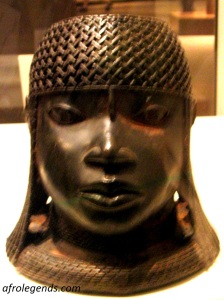
Queen from Benin kingdom (at the MET)
The report’s authors, the Senegalese economist Felwine Sarr and the French art historian Bénédicte Savoy, told the Guardian that the British Museum, which houses a huge collection of the Benin bronzes, was acting like “an ostrich with its head in the sand” by not acting faster on repatriations.
[…] Since the release of the report, Ivory Coast, Senegal and the Democratic Republic of the Congo have made formal requests for the return of artefacts. European countries including France and Germany have committed to handing back objects, with the Rijksmuseum in Amsterdam opening talks with Sri Lanka and Indonesia and describing the Netherlands’ failure to return stolen artefacts as a “disgrace”.
The news comes a week after Open Society Foundations (OSF) announced a $15m initiative aimed at strengthening efforts to “restore cultural objects looted from the African continent”. …
Trimobe (Source: La Mozeration @Tokikycity, Mada-Actus Info)
A little girl who has been abandoned in the woods by her two evil sisters, meets the monster Trimobe, who tells her, “You will be my daughter, Rafara.” He takes her home, locks her in his den and feeds her with food. His plan is to “eat her when she will be well-fed and plump.”… Days go by.
One night, a small hungry mouse asks Rafara for food. Rafara, listening only to her good heart, gives the mouse food. To thank her, the mouse gives her a staff, a rock, and one egg, while advising her to flee as quickly as possible.
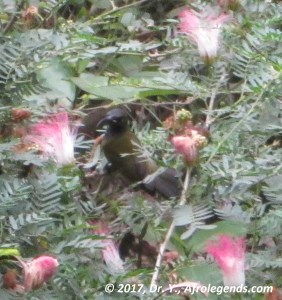
The bird
Rafara runs away. The monster pursues the little girl and quickly catches up to her. Rafara throws her staff while saying, “Dear staff, gift of the mouse, turn into a lake,” and the staff becomes a lake. But Trimobe in a few sips drinks it all. The little girl then throws the rock while saying, “Dear rock, gift of the mouse, turn into a forest,” and instantly the rock turns into a forest. Trimobe, thanks to his powerful and sharp tail, cuts all the trees down. Rafara then throws the egg while saying, “Dear little egg, gift of the mouse, turn into a mountain!” She finds herself at the top of the mountain. The bird Vovondreo who was passing by, agrees to take her with him in exchange for colorful rocks.
Her father welcomes her with joy. He wants to punish the two evil sisters but Rafara, so kind, intercedes on their behalf in front of her father. Rafara grows up to be so beautiful that the king’s son asks for her hand in marriage.
This is a short version of the tale on Contes a Rever, translated to English by Dr. Y. Afrolegends.com
Jacques Rabemananjara (Project for Innovative Poetry – PIP)
Today, we will join the poet Jacques Rabemananjara in singing the praises of the Great Island… you know the one and only, Madagascar! Published in 1956 in Présence Africaine, Antsais an ode to the Great island, a love song to Rabemananjara’s land of birth, Madagascar. Jacques Rabemananjara, like Léon Gontran Damas, was also part of the Negritude movement in France; he was said to be the most prolific writer of the negritude generation after Léopold Sédar Senghor, and he had the first négritude poetry published. He was a Malagasy politician, playwright and poet, who served as a government minister, and later rose to the rank of Vice President of Madagascar under Philibert Tsiranana. He was one of the heroes of the Malagasy independence.
Madagascar
As you read Antsa, enjoy the island of syllables of flame, feel the love, the sweetness sweeter than honey, the patriotism expressed like the most ardent lover, the most faithful, feel the oneness with the homeland as no owl’s cry or burning could disturb the love the author feels for his motherland. Enjoy it, and try expressing it for the land of your birth… not the people… the land and its beauty!
Antsa par Jacques Rabemananjara
Ile !
Ile aux syllabes de flammes !
Jamais ton nom
Ne fut plus cher à mon âme !
Ile,
Ne fut plus doux à mon cœur !
Ile aux syllabes de flamme,
Madagascar !
Quelle résonnance !
Les mots
fondent dans ma bouche :
Le miel des claires saisons
Dans le mystère de tes sylves,
Madagascar !
Je mords la chair vierge et rouge
Avec l’âpre ferveur
Du mourant aux dents de lumière
Madagascar !
Un viatique d’innocence
dans mes entrailles d’affamé,
Je m’allongerai sur ton sein avec la fouge
du plus ardent de tes amants,
du plus fidèle,
Madagascar !
Qu’importent le hululement des chouettes
le vol rasant et bas
des hiboux apeurés sous le faîtage
de la maison incendiée !oh, les renards,
qu’ils lèchent
leur peau puante du sang des poussins, du sang auréolé des flamants-roses !
Nous autres, les hallucinés de l’azur,
nous scrutons éperdument tout l’infini de bleu de la nue,
Madagascar !
Antsa by Jacques Rabemananjara
Island!
Island with syllables of flames!
Never your name
Was so dear to my soul!
Island,
So sweet to my heart!
Island with syllables of flames,
Madagascar!
Such resonance!
The words
Melt in my mouth:
The honey of clear seasons
In the mystery of your forests,
Madagascar!
I bite the virgin and red flesh
With the bitter fervor
Of the dying with bright teeth
Madagascar!
A viaticum of innocence
In my guts filled with hunger,
I will lie on your breast with the passion
Of the most ardent of your lovers,
Of the most faithful,
Madagascar!
No matter how much the owls hoot,
The low flying and frightened owls under ridge
Or the burning house! Oh the foxes,
May they lick
Their pungent skin from the chicks’ blood, the haloed blood of pink flamingoes!
We, the hallucinated of the azure,
We madly scour the infinite of the blue from the clouds
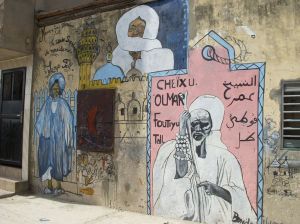
Mural in Dakar showing Omar Tall (Source: Wikipedia)
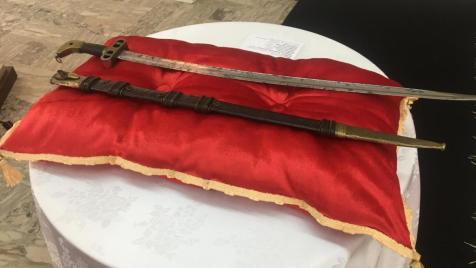
At first I was thrilled by the news that France had returned the sword of the Senegalese hero Omar Tall, … until I read the fine prints! Then I read that this was a temporaryreturn, more like a 5-year loan to Senegal, until the French parliament approves whether to permanently return it or not. Moreover, the sword was already on loan at a Museum in Senegal. Nevertheless, you will notice like me that the media titled it a ‘return.‘ In reality, this is more like a publicity campaign for the French who seemingly appear to be returning looted treasures.
Before delving into the excerpt below from the BBC article, it is good to say a few words about Omar Saidou Tall or Umar Tall, and why he is so venered by Senegalese. Omar Saidou Tall was a religious, political, and military leader who fought against French colonization in the region then known as French Sudan which encompassed Senegal, Mali, and Guinea. He opposed a fierce resistance to the French from 1857 to 1859. Senegalese tend to remember him as a hero of anti-French resistance, while Malian sources tend to describe him as an invader who paved the way for the French by weakening West Africa. We will go deeper into his life and legacy in the next post.
======
France has restored to Senegal a sabre that belonged to a 19thCentury Islamic scholar and ruler.
It is part of a commitment to return to its former West African colonies key items of their cultural heritage.
The artefact originally belonged to the revered west African leader Omar Saidou Tall, who led an anti-colonial struggle against the French.
… Mr Philippe [France’s prime minister] said it was “the first step” in a project aimed at returning more Senegalese artefacts currently in French museums, which hold at least 90,000 artefacts from sub-Saharan Africa.
Their official report states that most of the Africa collection in Paris’ Quai Branly museum – approximately 46,000 pieces – was acquired with some degree of duress [not sure that they will return all these artefacts and leave their museums empty].
“It’s symbolic. It had been lent to us before, but now it is being restored to us,” the head of Dakar’s Museum of Black Civilisations Hamady Bocoum told AFP news agency about the sabre.
The curved iron, brass and wood sword has been kept in its leather sheath in the museum in Senegal’s capital on loan from France. But Sunday’s ceremony saw the item formally returned for a period of five years.
The next stage will be for French MPs to vote on whether to permanently return this and other artefacts.
Le chien s’est dechiré la gueule en mangeant de trop grands morceaux (Proverbe Azande – République Centrafricaine, République Démocratique du Congo (RDC), Sud Soudan). – Ne pas avoir les yeux plus grands que le ventre.
The dog tore its mouth while eating very big pieces (Azande proverb – Central African Republic, Democratic Republic of Congo (DRC), South Sudan). Do not have eyes bigger than the stomach.

 Le passé appartient aux ancêtres, l’avenir appartient à Dieu, seul le présent t’appartient (proverbe malgache – Madagascar).














 African Heritage