Why were those African Countries invited to the White House for the US-Africa Summit? The Case of Mauritania

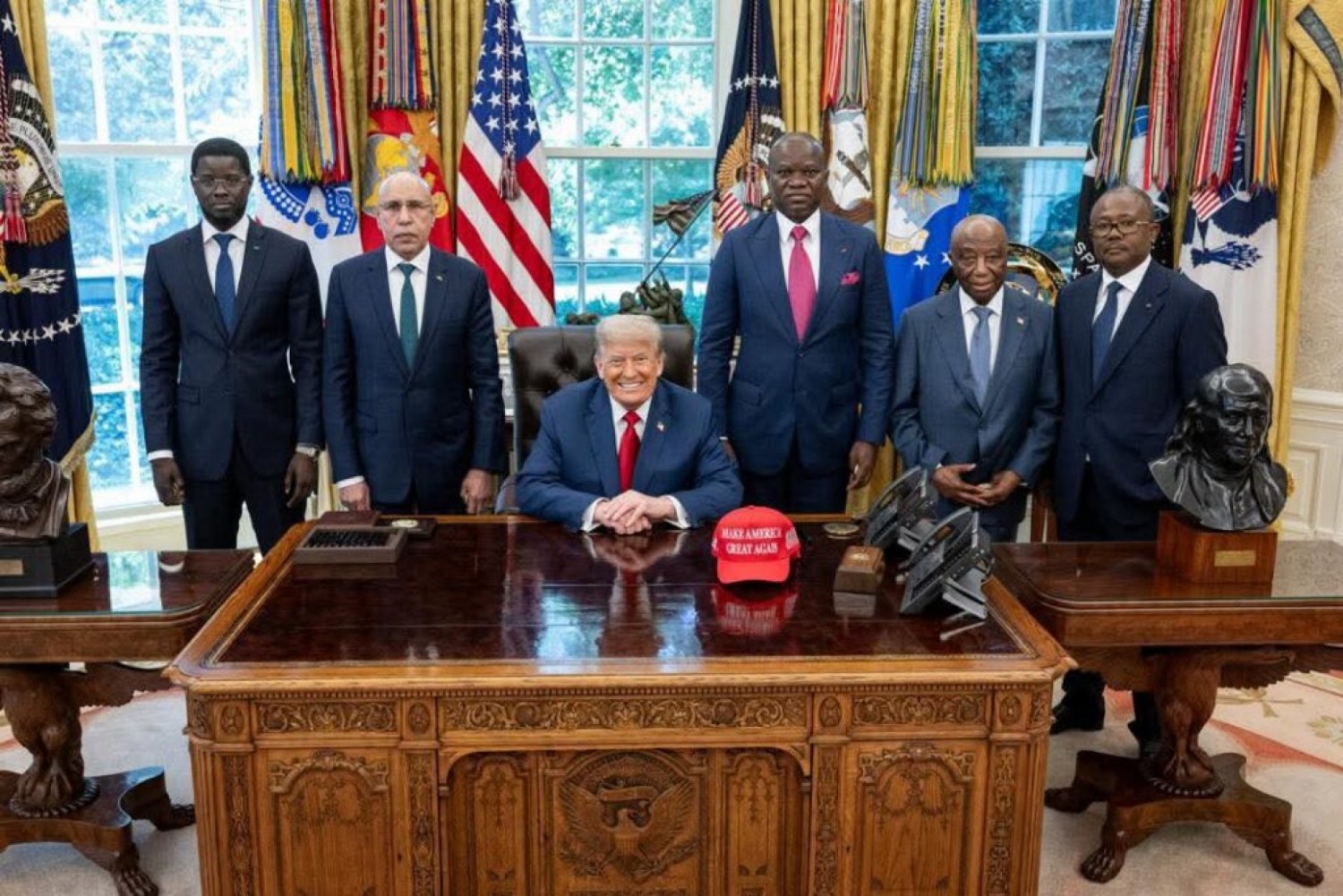
American President Donald Trump and his 5 peers from Africa at the US-Africa Summit. From left to right: Bassirou Diomaye Faye of Senegal, Mohamed Ould Cheikh El-Ghazouani of Mauritania, Donald Trump of US, Brice Oligui Nguema of Gabon, Joseph Boakai of Liberia, and Umaro Embalo Sissoco of Guinea Bissau (Source: Koaci.com)

In July 2025, the presidents of 5 “unusual” African countries were invited to the White House to dine with the President of the United States at the US-Africa Summit. “Unusual” because these were not the normal countries used to being invited to the White House, they were less common choices : Senegal, Gabon, Liberia, Guinea-Bissau, and Mauritania (Why were those African Countries Invited to the White House for the US-Africa Summit ? The Case of Gabon). Today, we will focus on the case of Mauritania. How many Americans know that the capital of Mauritania is Nouakchott or can even spell it?

The case of Mauritania is particular because we know that when the American general Langley who lied about President Ibrahim Traore of Burkina Faso in front of congress, Americans ran to Mauritania to strengthen their military presence via the AFRICOM bases. Moreover, Mauritania is one of the bordering countries to the Alliance of the Sahel States (AES) via its huge border with Mali which is about 2,236 km (1,389 miles) long. Officially we are told that the visit was about natural gas and fisheries. In April 2025, Mauritania entered a new era as a natural gas producer and exporter with the Greater Tortue Ahmeyim (GTA) project, which is a deepwater offshore liquefied natural gas (LNG) project on the maritime border with Senegal developed with BP, Kosmos Energy, Petrosen and SMHPM. With water depths up to 2,850 m, it is the deepest offshore project in Africa. Its reserves are estimated at 1,400 billion cubic meters of gas reserves with production potential spanning 30 – 50 years. This would make Mauritania the 3rd largest African gas exporter behind Nigeria and Algeria.
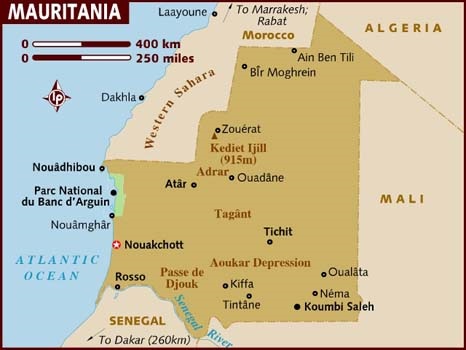
Map of Mauritania

However, unofficially, we know that the most important aspect of these agreements though, is the security aspect or rather counter-terrorism as it was stated on paper. The use of the word counter-terrorism, in the case of Mauritania, clearly show where Mauritania lays on the geopolitical chessboard. It is no secret that the biggest US drone base in the world was built in Niger, and that the West has not been happy with losing the AES and has openly talked about mounting attacks against the AES. It is being used as a way to mount attacks against the AES. Thus, as recently in June 2026, U.S. B-52H bombers conducted a joint flyover over Atar, Mauritania, alongside partner forces to showcase power projection and interoperability. The West has profited from the division among African countries; this has allowed them to keep many under a stranglehold and get easy access to cheaper resources; thus, it does not see a union like the AES which has joined their resources and negotiate together for good prices for their people. Coup against Ibrahim Traoré and Worldwide Support for Him; The French Army Gets an African Command Center. Remember how the Retired French General Lecointre stated, paraphrasing, “we cannot let these poor Africans live in chaos just on our doorstep… within a few years, Africans will have a population boom like no other continent [why do Africans having babies, bother them so much?] … Europe should act as a political entity that defends its own interests, including through military commitment… We must return and help these African countries [nobody asked for your help].”; The Vultures are Getting Ready.

Like I stated before, this looks a lot like The New Scramble for Africa in full gear. What do you think?

Why the Name: Nouakchott?

map_of_mauritania
Map of Mauritania

What comes to mind when you say the name of the capital of Mauritania, Nouakchott? Well, to me, instant thoughts of sandy dunes, the Atlantic ocean, and the desert come to mind. So does its name come close to any of these?

Nouakchott or‎‎ Nuwākshūṭ in Arabic, is originally derived from the Berber Nawākšūṭ, or “place of the winds,” and is the capital and largest city of Mauritania, as well as being one of the largest cities in the Sahara. From the different transcriptions, the name of the city, Nouakchott or Noiakchott gave rise to different translations, among which 5 principal ones:

  • Mauritania_flag
    Flag of Mauritania

    place where water appears when a well is dug

  • land where shells abound
  • place with salted pasture
  • place where the wind blows
  • without ears

Chott may mean beach or foreshore or batture. Noua in hassaniya Arabic (Moor dialect) means “bay.” Thus, Nouakchott literally means “the beach of the bay.” Even though the Mauritanian shoreline does not present any bays on the outskirts of Nouakchott, the shape of the coastline is slightly hollow there.

Nouakchott_2002
Aerial view of Nouakchott 2002 (Wikipedia)

Nouakchott was a small fortified fishing village (ksar) in pre-colonial times and during French rule. Early in colonial times, the city was a French military camp where Mauritanians were not allowed to stay. In 1958, it was chosen by Moktar Ould Daddah, the country’s first president, as the capital of the nascent nation of Mauritania. The village was selected as the capital city for its central location between Saint-Louis, Senegal, the city from which the colony of Mauritania was governed, and Nouadhibou, Mauritania’s second largest city.

Nouakchott_Peche
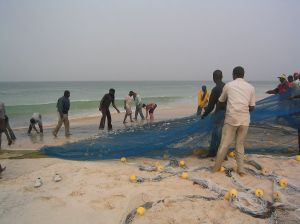
Fishermen in Nouakchott (Wikipedia)

Nouakchott is located on the Atlantic coast of the Sahara Desert. It is largely flat, and only a few meters above sea level. It is daily exposed to sand dunes. Nouakchott is built around a large tree-lined street, Avenue Gamal Abdel Nasser, which runs northeast through the city centre from the airport. It divides the city into two, with the residential areas in the north and the medina quarter, and shantytowns to the south. The main neighborhoods are Arafat, Dar Naim, El Mina, Ksar, Riyadh, Sebkha, Tevragh-Zeina, and Toujounine.

Nouakchott_camel_market
Camel market in Nouakchott (Wikipedia)

Today, the city is the heart of the Mauritanian economy and is home to a deepwater port and one of the country’s two international airports. It also hosts the University of Nouakchott. If you visit Nouakchott, don’t forget to visit the camel market, a very big attraction in a country where a lot of its population is nomadic.

Azougui: First Capital of the Almoravid Dynasty

Azougui
Azougui

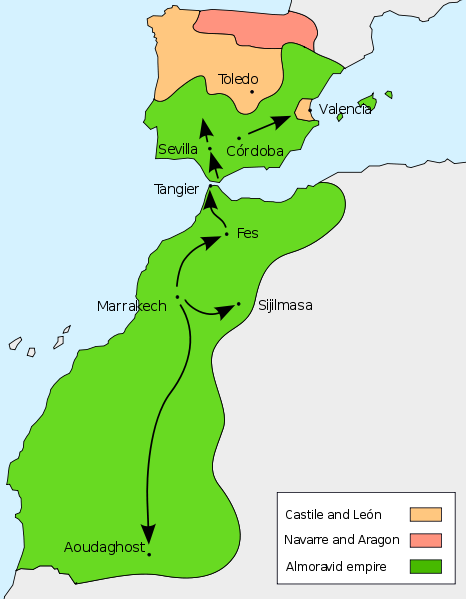
Map of Almoravid Empire

Azougui was a town in the northwestern part of Mauritania, lying on the Adrar Plateau, north west of Atar, 450 km north of Nouakchott.  In the 11th century, it was a base for the Almoravid dynasty (this will be the subject of another post), who conquered a territory stretching from the Ghana Empire to Morocco and the Iberian peninsula.  The chronicler Al-Zuhri, writing in the 1150s, called Azougui the “capital of the Almoravids.”

Azougui was an important transit place for the trans-Saharan trade route from Morocco and Ghana.  The birth/ apparition of the oasis is strongly linked to the creation of Azougui.  Today, this palm grove is the site for over 20,000 palm trees.  The archeological site was added to the UNESCO World Heritage tentative list on June 14, 2001.

Archaelogical Site of Azougui

An Almoravid Soldier

Azougui, as the first capital of the Almoravids, was a stone fortress with a wall and several concessions.  This fortress was enlarged with time, which explains the urbanization inside the enclosure on an area expanding over several kilometers.  The site was reported in 1068 by Al Bakri, and mentioned by several Arabic chroniclers such as Ibn Said, El Kalakshandy, and Ibn Khaldun.  The Almoravid movement was a political formation at its origin, which was born in the midst of Sanhaja tribe of Lamtuna (or Lemtouna), and Gudala (Guedala) in Adrar, under the authority of a spiritual leader of extraordinary religious rigor, Abdallah ibn Yasin.  This movement was able to unify west Africa, the Maghreb, and the Iberian peninsula for several centuries, after investing the Empire of Ghana, the Idrissides, and the kingdom of Barghawata (or Berghouata).  The site’s excavation started in 1979, and continues until today.  Its excavation has shed light on the importance of Azougui in the trans-Saharan trade.