Cameroon – History Repeats Itself ?

Flag of Cameroon

Africans, it is so important to know our history, so as to be better equipped so it does not repeat itself again and again and again. I would like to publish here the words of the Cameroonian filmmaker Jean-Pierre Bekolo, who highlights the fact that history is repeating itself in Cameroon. Although many may not totally agree with him, the similarities between the events of 1955 and 2025 are numerous. In 1955 in Cameroon, the Union of the People of Cameroon (UPC) of Um Nyobe (Ruben Um Nyobé: Fighting for the independence of Cameroon), was shut down as it was fighting for the total independence of Kamerun. In reality, Cameroon never got its independence as the then colonial regime and later the puppet government killed the independence movement, and Cameroon’s freedom was confiscated. Today, the same thing is happening again: the main candidate who represents a change, whatever it is, a new chapter in the life of the country (the current leader has been in power for 43 years now, and was in the high levels of power – minister and prime minister – 20 years before that) has been blocked from participating in the upcoming elections by some “magic” trick. The 12 October 2025 elections will go on without him even though he has a major support of the population, and this is starting to look like a carbon copy of the events of 1955. Truth be told, Cameroon, like many Francophone African countries never got its independence. Thus, maybe the real battle is to break the chains of bondage, and resume the fight our forefathers started? Let’s have Millions of African Leaders: Be the Leader You Want to Have!

The excerpts below is from Actu Cameroun based on Jean-Pierre Bekolo Facebook’s post. Enjoy!

=====
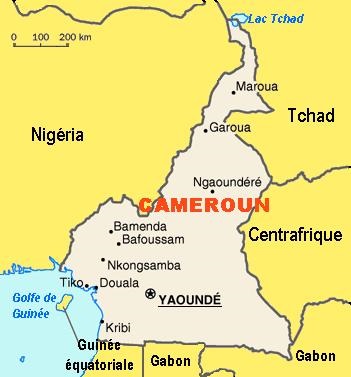
Map of Cameroon, with the capital Yaoundé

“Is it possible to compare what happened in 1955 in Cameroon with what we are experiencing today? Yes, we can say—with all the caution required for such a historical comparison—that the Cameroon of 2025 resembles, in many ways, that of 1955. If we need our history, it is not to complain, but to move forward. However, in Cameroon, history has not freed us: it has chained us. The events we are experiencing today, and which we will experience until October 12, could well be an almost exact repetition of a drama already played out during the colonial era—and never closed.

… It’s 1955. Two camps are facing off. On one side, those who want Cameroon to belong to its children. On the other, a colonial power that gives nothing away without repression. And between the two: collaborators, opportunists, wheeler-dealers, those who know where the truth lies but hope for crumbs. These don’t really believe in the system, but they find it to their advantage. They don’t support the regime out of conviction, but out of comfort, cowardice, or calculation. They know exactly what needs to be done for this country to change—but they prefer to wait for their appointment, their per diem, their prestigious position. They are the same people Fanon described: local elites who serve domination without bearing its name, intellectuals who rent from the established order, journalists of silence. In 1955, the colonial power identified two targets to be destroyed: the radicals, who must be killed, and the moderates, who must be bought or neutralized. Any voice in favor of an independent Cameroon is then a threat. We must divide, oppose, buy, crush…

… In May 1955, while Cameroon is still officially under French rule, the Union of the People of Cameroon (UPC) embodies a strong desire for independence. Its vision is clear: to build a free, sovereign nation, free from colonial rule and compromise. But this ambition is perceived as subversive. On May 20, 1955, the colonial government banned the UPC. In the following days, many cities go up in flames: Douala, Yaoundé, Ebolowa… The repression is brutal. It marks the beginning of what is now called the war of liberation, with its trail of violence, clandestinity, and sacrifices. Um Nyobè and his comrades are forced to flee, then to engage in armed struggle. In July 1955, the official ban on the UPC is confirmed. The nationalist movement is criminalized, the 1956 elections take place without it, and the independence project carried by the Cameroonian people is confiscated.”

German Colonial Treaties in Africa : German Treaty in Bimbia – 11 July 1884

Flag of Deutsch Kamerun 1914

We are introducing you to the German colonial treaty signed with the Chiefs of Bimbia in Cameroon in July 1884. In a few days, we will tell you a lot more about Bimbia and its important place in the transatlantic slave trade along the gulf of Guinea. By 1898, the Jantzen & Thormählen German trading firm had their headquarters in Bimbia, in the Victoria District, and lands in DebundschaIsongo Udje and Mokundange. As we read the text, we can still find the River Bimbia in today’s geography of the locality, but what does River Mofinioselle, which sounds like a European butchering of a local name, correspond to?

=====

Agreement with Chiefs of Bimbia.

Adolf Woermann, owner of the Woermann-Linie, which was at the time the largest ship line in the world, and a biggest German trader to West Africa

WE, the undersigned independent Chiefs of the country called Bimbia, situated between the River Bimbia on the south side, the River Mofinioselle on the north side, and up to 5 miles on the sea shore, have, in a meeting held to-day in the German factory on King William’s Beach, voluntarily concluded as follows:—

We give this day our rights of sovereignty—the legislation and management of this our country—entirely up to M. Edward Schmidt, acting for the firm of C. Woorrmann [Woermann], and M. Johannes Vos, acting for Messrs. Johnson and Thormeihlen [Thormälen], both in Hamburgh, and for many years trading in this river.

We have conveyed our rights of sovereignty, the legislation and management of this our country, to the firms mentioned above, under the following reservations:—

  1. Under reservation of the rights of third persons.
  2. Reserving that all friendships and Commercial Treaties made before with other foreign Governments should have full power.
  1. That the land allotted or occupied by us now, and the plains the towns are built on, shall be the property of the present owners and successors.
  2. That the “dash” shall be paid as before.

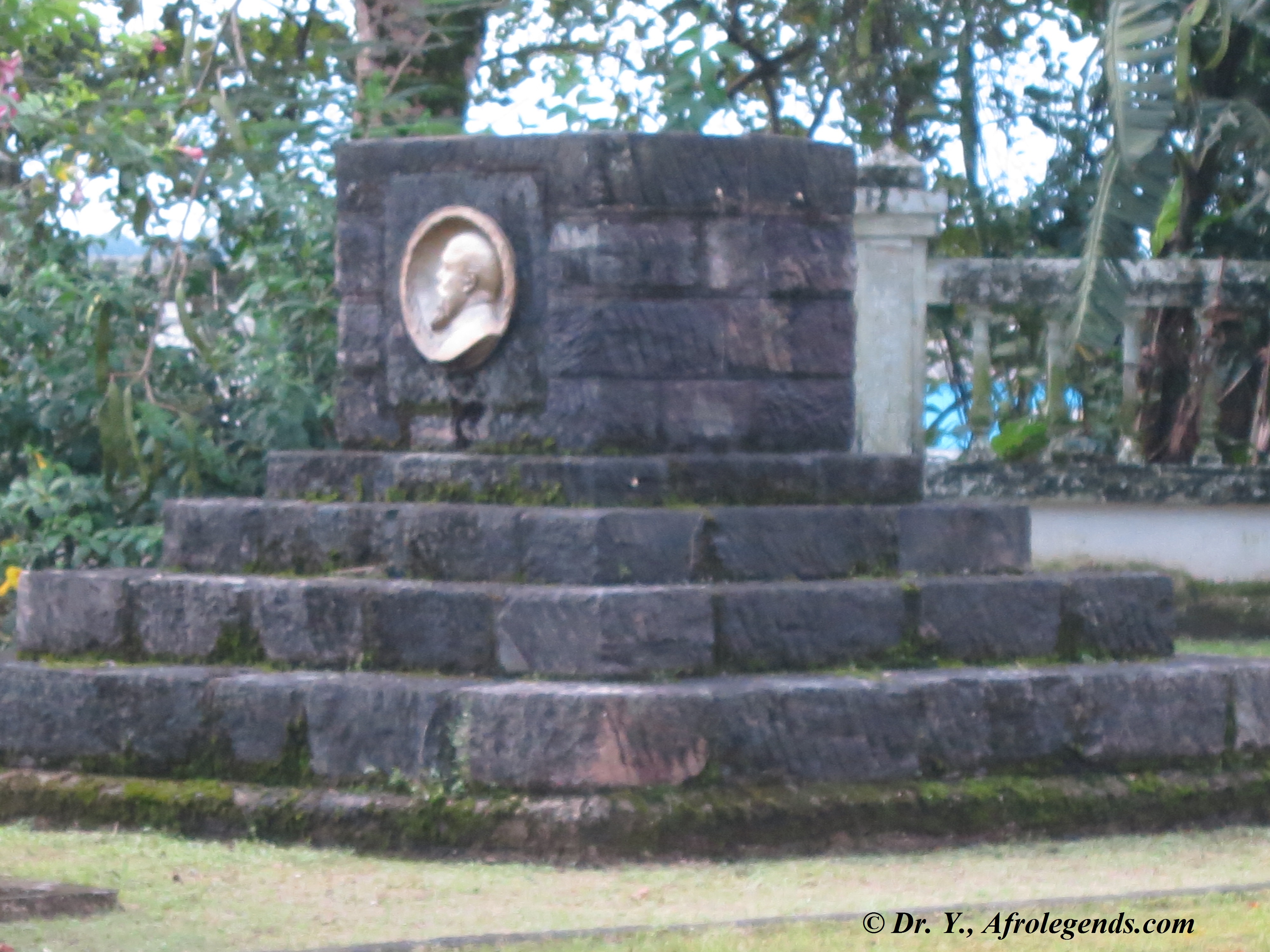
Adolf Woermann Monument in Douala, Cameroon

King William’s Town—

(Signed)

QUAN, his X mark.

EKONGOLA, ditto.

FREEBORN, ditto.

MAT KING, ditto.

NEVERWASH, ditto,

DAUBE KING WILLIAM, ditto.

CHARLES ERN ART, ditto.

BIMBIA PINISO, ditto.

JOHN PINISO, ditto.

Two Chiefs of Eciollo Town.

Money Town—

(Signed)

MONEY, his + mark.

JOHNNY MONEY, ditto.

(And 8 Chiefs).

Signed at Bimbia, German Factory, Hanusa, July 11, 1884.

The German King: A Movie Series about Rudolf Douala Manga Bell, one of Cameroon’s First Resistants to Colonization

Rudolf Douala Manga Bell – ca 1900s

For anyone who has been watching the acclaimed series, The Chosen about the life of Jesus, projects from the Angel Studios are always of great quality. An upcoming series coming from the Angel Studios will be the series, The German King directed by Adetokunboh M’Cormack, entirely based on the life of Rudolf Duala Manga Bell, one of the resistants to German colonization, as a young prince born in Kamerun, raised in Germany alongside Kaiser Wilhelm II, and who fought for the freedom of his people upon his return.  When Rudolf Duala Manga Bell returned home to assume the throne of the Duala people in 1910, he led a rebellion against the oppressive German rule. In 1910, the German governor of Kamerun, Theodor Seitz, approved an urbanization project for the city of Douala (Kamerunstadt had been renamed Douala) set to turn it into one of the largest ports of Africa. The project outlined a plan to relocate the Douala people inland from the Wouri river to allow European-only settlement of the area (European-Only Neighborhoods in African Cities before Independence).  Neighborhoods such as Neu Bell, Neu Akwa, and Neu Deido were to be created for the indigenous people; these new allotments were going to be separated from the ‘European city’ by a barrier 1 km wide (early version of apartheid!).  The expropriations affected most of the Douala clans, who were angered and formed a united front behind Manga Bell.  Rudolf Duala immediately refused, and told the Germans that the treaty signed in 1884 did not stipulate the removal/expulsion of the locals from their lands, and that this separation constituted a form of apartheid. For his rebellion, Duala Manga Bell was later condemned and hanged in 1914.

Rudolf Douala Manga Bell, Leader of Douala people

A poignant scene from the movie is where Rudolf’s wife tells him, as he is torn, having grown with Kaiser Wilhelm II whom he considers a friend and brother: “Wilhelm is not your family! Your family is here! You may talk like them, act like them, dress like them, but you will never be them. Your skin will always be the color of the rich Cameroonian soil, and they will always walk over it, as if they own it. … Rudolf, you do this so that your sons, and your sons’ sons, and their sons will have a land they can call their own.”

I cannot wait for the series to come out, as it shows a very important part of the history of Kamerun during German colonization as well as other leaders like Sultan Njoya, Martin Paul Samba, and others. Please check out the story on the Angel Studios’ website, and above all, do not forget to support the project. Let us all celebrate Rudolph Douala Manga Bell,  the Tét’èkombo (the king of kings), a uniter of Cameroon (already reaching out to other kings), and one of Cameroon’s biggest resistant.

Writings by Ruben Um Nyobe: Political Constant of Unity Practiced by Ruben Um Nyobe – 1959

Ruben Um Nyobé
Ruben Um Nyobé

In celebration of the life of  Ruben Um Nyobé, I chose to share with you his writings below on this day, 13 September, the day of his assassination in 1958 by French troops in Cameroon. These writings by  Ruben Um Nyobé, leader of the UPC, were published in 1959. The book was published as “Constante politique d’unité pratiquée par Ruben Um Nyobe – 1959,” by Union des Populations du Cameroun (UPC). The text below by Ruben Um Nyobe served as a preface to the book, and has been translated to English by Dr. Y. Afrolegends.com . For the original, go to gallica.fr

======

Flag of the UPC
Flag of the UPC

Political Constant of Unity practiced by Ruben Um Nyobe – 1959

 Author: Union des Populations du Cameroon

Inform to Enlighten by Ruben Um Nyobe, General Secretary of the Union the Populations du Cameroun (UPC), Leader of the National Resistance for the Liberation of Cameroon

The national aspiration, which has just cumulated in the recognition of our independence, Is the concrete and objective expression of the result of the struggle of our people. No one can claim that independence has been granted to us, we have conquered it. All those who fought for this national liberty, whether dead or alive, have sealed their names in the history of our motherland, their glory will be immortal! But now at the term of a crowned struggle, instead of concord uniting all members of the coalition, a storm of jealousy and hatred, still sweep over our poor little country. Until when obscene passions and the most execrable hypocrisies cease to brave virtue and honesty! Why will cruel selfishness and blind ambitions not recoil before the honor and national dignity? In this flood of provocations and hatreds, where is the future of our children, the tranquility of our homes, the future of the country? Is it possible to build a country without its population? Is there independence without independent citizens? Answer! Yes answer! All those who oppress our people and those who aim to exploit it.

I say that we must give the people the means to hope and the opportunity to have confidence in them. To reach that goal we have some preliminary work to do.

  1. Present the people with clear options for his future.
  2. Prepare for the people a climate of cordiality and put an end to insecurity.
  3. Train the people’s judgment through civic and political culture / instruction.

All this is feasible/possible, so long as it is wanted. No need to dodge the work by creating tribal oppositions.   

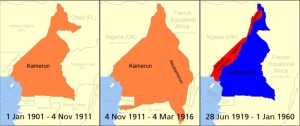
Kamerun_Map 1901-1960
Map of Kamerun from 1901 to 1960 (Wikipedia)

I add that all those who sow hatred and call for crimes, throw the boomerang, which unfortunately does not clarify the future. In politics, there is good sense and virtue, notwithstanding the apprentices of Machiavelli! In politics, truth is also necessary, even if it hurts and displeases because we do not define the future of the people in lies and slanders! Yes, we have to be realistic! To all my compatriots, I formally repeat this: our enemies in this crucial hour of our history, are those who divide us, because they expose us weakened to the solicitations and appetites of the foreigner…

When one reflects on current events, one reaches a first observation: it is the conception of power and sovereignty which is at stake. If it is true (and it cannot be otherwise) that power comes from the people, is it not up to the people to freely designate their interlocutors? Why pretend to take the place of the people? Why seek to abuse and deceives the masses? To get elected and impose a dictatorship, isn’t it? Finally, we believe that the events of the past should make the darkest adventurers retreat. It is only in ignorance that a dictatorship can be imposed, even if it is subtle. In these conditions our task is clear: to enlighten the people. We must do it and we will do it against all adventures. Our goal is to safeguard the national dignity and sovereignty of Kamerun.

Colonial Treaties in Africa: 15 July 1884 treaty in Cameroons

Here is the text of the 15 July 1884 treaty signed between the Chiefs of Jibarret (Djebale) and Sorrokow (Sodiko) and the German merchants of the Adolph Woermann and Jantzen & Thormählen firms in Cameroons. It basically does not show the entire text, but rather cites the treaty signed on 12 July 1884 between Kings Bell and Akwa and the Germans. It is pictured here:

We the undersigned chiefs of Jibarret and Sorrokow, under King Bell’s juridiction declare herewith that we are perfectly agreeing with the treaty made by Mr. Edouard Schmidt acting for the company C. Woermann and Mr. John VoK acting for Misters Jantzen & Thormählen both of Hamburg, with the said King Bell.

The treaty has been properly explained to us and we have signed this paper as follows.

Cameroons the fifteenth day of July one thousand eight hundred and eighty four.

Source: Abretungs-Urkunde Jibarret und Sorrokow, 15-7-1884 DZA-potsdam 4204 f.192.

Cameroon_Traite Germano Douala.jpg
15 July 1884 treaty between the Chiefs of Jibarret (Djebale) and Sorrokow (Sodiko), and the German merchants

Colonial Treaties in Africa: Pre-treaty to the 12th July 1884 Germano-Duala Treaty

Cameroon_Kamerun 12 Juillet 1884.jpg
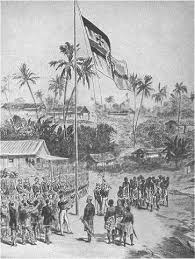
German flag on the Joss plateau in Cameroons Town (Douala) on 14 July 1884

Here is the text to the Pre-treaty approved by King Ndumbé Lobé Bell and King Akwa of Cameroons River (Wouri River, Douala) before agreeing to signing the 12th July 1884 Germano-Duala treaty. It is called the “Wünsche der Kamerun” (or the Cameroonians’ wishes) and was signed by the German consul. Note that only the German consul signed to engage his country into this pre-treaty; and no Cameroonian party signed it.  It is only once this was done, that the Kings Bell, and Akwa signed the treaty of sovereignty. Here is the text of the pre-treaty.

Cameroons River, July 12th, 1884

Our wish is that white men should not go up and trade with the Bushmen, nothing to do with our markets; they must stay here in this River, and then give us trust so that we will trade with our Bushmen.

We need no protection; we should like our country to annex with the government of any European Power.

We need no alteration about our marriages, we shall marry as we are doing now.

Our cultivated ground must not be taken from us, for we are not able to buy and sell as other countries.

We need no Duty or Custom House in our country.

We shall keep bullocks, pigs, goats, fowls as it is now and also no duty on them.

No man should take another man’s wife by force or else a heavy fine.

We need no fighting and beating without fault and no imprisonment on paying the trust without notice and no man should be put to Iron for the trust.

We are the Chiefs of Cameroons.

The Imperial German Consul

Emil Schulze

Source: L’Afrique s’annonce au rendez-vous, la tête haute! Du Pr. Kum’a Ndumbe III, P. 145-146, Ed. AfricAvenir/Exchange & Dialogue 2012

Rudolf Douala Manga Bell: One of Cameroon’s first Resistant

Rudolf Douala Manga Bell - ca 1900s
Rudolf Douala Manga Bell – ca 1900s

Today, I would like to talk about one of the heroes of Cameroonian history, Rudolf Douala Manga Bell, who stood against the Germans in the 1910s in Kamerun.  His courage, and strong determination earned him the right of martyr and hero in the history of the Douala (or Duala) people, and thus of Cameroon.

Rudolf Douala Manga Bell was born in 1872, and studied in Cameroontown (modern-day Douala).  He was the first son of King Manga Ndumbe Bell, of the Douala people.  After completing his primary education and part of his secondary school in Cameroon, he went to study at the Lycée of Aalen in Bonn (Germany) finishing secondary school.  He later went on to study law at the university there.

Kamerun (German Cameroon)

Manga Bell married Emily Engome Dayas, the daughter of an English trader and a Douala woman after his return home in 1896.  He also became a civil servant.  On 2 September 1908, he succeeded to his father as Paramount Chief (Chef Supérieur) of the Bell dynasty (founded since 1792) which encompassed the Bonamandone, Bonapriso, Bonadoumbe, all owners and inhabitants of the Plateau Joss in Douala.  In those days, Douala was composed of several tribes: Bakole, Bakweri, BambokoIsubu (or Isuwu), Limba (or Malimba), Mungo, and Wovea.  Among those chiefs, some of them including the famous King Akwa, signed a Germano-Douala treaty on 12 July 1884, which placed Cameroon under German protection.  Cameroontown thus became Kamerunstadt.

Rudolf Douala Manga Bell, Leader of Douala people

In 1910, the German governor of Cameroon, Theodor Seitz, approved an urbanization project for the city of Douala (Kamerunstadt had been renamed Douala) set to turn it into one of the largest ports of Africa.  The project outlined a plan to relocate the Douala people inland from the Wouri river to allow European-only settlement of the area.  Neighborhoods such as Neu Bell, Neu Akwa, and Neu Deido were to be created for the indigenous people; these new allotments were going to be separated from the ‘European city’ by a barrier 1km wide (early version of apartheid!).  The expropriations affected most of the Douala clans, who were angered and formed a united front behind Manga Bell.  Rudolf Douala immediately refused, and told the Germans that the treaty signed in 1884 did not stipulate the removal/expulsion of the locals from their lands, and that this separation constituted a form of apartheid.  Manga Bell then enlisted the help of Hellmut von Gerlach, a German journalist.  Gerlach managed to secure a suspension order from the Reichstag Budget Commission in March, but the order was overturned when Colonial Secretary Wilhelm Solf convinced elements of the press, businessmen in the colony, politicians, and other groups to finally rally behind the expropriation. Manga Bell and the Douala requested permission to send envoys to Germany to plead their case, but the authorities denied them.  In secret, Manga Bell sent Adolf Ngoso Din to Germany to hire a lawyer for the Douala and pursue the matter in court.

Adolf Ngosso Din, Assistant to Rudolf Manga Bell
Adolf Ngoso Din, Assistant to Rudolf Manga Bell

Manga Bell then turned to other European governments and to leaders of other African ethnic groups for support.  His envoys to other Cameroonian leaders reached Bali, Balong, Dschang, Foumban, Ngaoundéré, Yabassi, and YaoundéCharles Atangana (Karl Atangana), leader of the Ewondo and Bane peoples, kept Manga Bell’s plan secret but urged the Douala leader to reconsider.  In Bulu lands on the other hand, Martin-Paul Samba agreed to contact the French for military support if Manga Bell petitioned the British.  However, there is no evidence that Manga Bell ever did so.  In Foumban, Ibrahim Njoya, sultan of the Bamum people, rejected the plan and informed the Basel Mission on 27 April 1914 that Manga Bell was planning a pan-Kamerun rebellion.  The missionaries alerted the Germans.
Noticing the German lack of respect of the signed law, who started removing locals from their lands, Bell allied with other chiefs of Cameroon to counter the colonial plans.  During the mutiny, the Germans arrested the Douala leader and Ngoso Din on 10 May 1914 accusing him of high treason.  Their trial was held on 7 August 1914.  World War I had just begun, and an attack by the Allied West Africa Campaign in Kamerun was imminent; accordingly, the trial was rushed. On 8 August 1914, Rudolf Douala Manga Bell and Ngoso Din were hanged.

Let us all celebrate Rudolph Douala Manga Bell,  the Tét’èkombo (the king of kings in Douala), the first, the uniter of Cameroon (already reaching out to other kings), and one of Cameroon’s biggest resistant.  Enjoy this old rendition by Charles Ewandje (probably recorded in the 70′s) of Tet’Ekombo an ode to resistance and to the land.  The song was written in 1929 in memory of Rudolf Douala Manga Bell.