I answered a dating ad on the internet, and I was getting ready to go on my first date with this girl that I had never met before.
I was anxious, so I told my friend Usuofia about it: “What do I do if she is ugly? We are supposed to meet at the restaurant, and I will be stuck with her for the entire evening … Don’t you have an idea to get me out of this, if she is ugly?”
My friend Usuofia replied: “Don’t worry. When you enter the restaurant, simply move towards her. If you like what you see, no problem for your evening. But if she is ugly, then you will just fall on the floor, and fake an epileptic seizure, screaming « Aaaaaauuuggghhh ! ».”
That night, I enter the restaurant, and quickly spot the young lady who is wearing a clear sign for the date.
She is gorgeous! I can’t believe my luck, she is so beautiful! I get close and when I am about to talk to her… the girl falls on the ground and screams « Aaaaaauuuggghhh! »
She is taken to the emergency room. And that’s when I scream Gwééééééééééééééééé !!!
I really do not understand what happened! Could somebody tell me what that means?
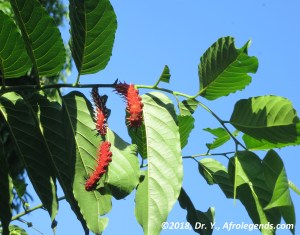
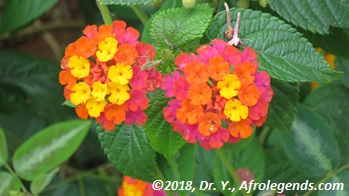
When I was younger, in my village, in some cases when someone had a high fever, the person will be given a hot tea with Lantana flowers (infused) to drop the fever; it was very efficient. Now, not all Lantana plants were used, there was a particular species of it… but I love the idea of using our own medicinal herbs for our use. So it is a mistake today, after having had the Kahun Gynecological Papyrus, or the Ebers papyrus centuries ago, to assume or act as if African traditional medicine is all bogus or full of charlatanism, and that the only alternatives for us Africans, are the pills that we buy in pharmacy made abroad in some laboratories in the Western hemisphere to address mostly their needs with no respect for our environments and realities. I am not saying to go out and cut all the plants out there, or not to buy drugs in pharmacies, but I am saying that African traditional medicine is rich, and we should also cherish and enhance it. I am sure there is so much that African herbs and medicine could add to the world. We just have to develop it, and to develop it, we need to start cherishing and valuing what we have, not leaving that to Western tourists on visit to claim to have discovered something that was ours and was there all along! African, start loving who you are, appreciating what you have, and enhancing what nature gave you (when it is good, of course)!
Solar-powered electric cars made in Africa by Africans for Africans. I love these ideas, and I had to share with you. Check out the first electric solar cars made in Togo by Togolese for Togolese. I love the intervention of the company’s founders who talked about providing farmers with ways to take their harvest to the market efficiently without having to worry fuel prices. They make tricycles and pickups for the transport of goods. The rechargeable car batteries have an autonomy of 180 km, and the solar panel a power of about 250 W; inside there is also a mini-fan and a camera for reverse parking. I salute their work which is full of ingenuity, determination, and above all is environmentally friendly! Bravo!
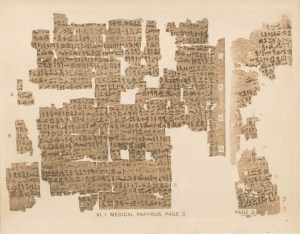
Kahun Gynecological Papyrus: Page 1 and part of Page 2
Today, we will be talking about the Kahun Papyrus, which is among the oldest and most important medical papyri of Ancient Egypt and of the world. This is a papyrus dealing with women’s health – gynecological diseases, fertility, pregnancy, and contraception; it dates back to the Twelfth Dynasty of Egypt, c. 1800 BCE. It is a three page document, 1 m long and about 33 cm wide. The name Amenemhet III was written in the right upper corner behind third page name. The document was torn in places and patched with gum and papyrus.
Head of Pharaoh Sobekneferu. British Museum
It was found at El-Lahun (Faiyum, Egypt) by Flinders Petrie in 1889 and first translated by F. Ll. Griffith in 1893 and published in The Petrie Papyri: Hieratic Papyri from Kahun and Gurob. The later Berlin Papyrus and the Ramesseum Papyrus IV cover much of the same ground, often giving identical prescriptions. ‘Kahun’ is the name Petrie gave to the Lehun town site, which in 1825 BC had been a thriving, prosperous town; the name was probably a misspelling from this European in contact with a foreign language (see Abidjan). The papyrus had been so heavily used that its ancient owner had to repair it, with a patch bearing an administrative fragment visible at one point on the back. This gynecological papyrus originates from the Middle Kingdom (Twelfth Dynasty of Egypt) to the reign of the childless female-king Sobekneferu, whose interest in gynecology might have been sparked by her elder sister dying at an early age.
The text is divided into thirty-four sections, each section dealing with a specific problem and containing diagnosis and treatment; no prognosis is suggested. Treatments are non-surgical, comprising of the application of medicines to the affected body part or swallowing them. The womb is at times seen as the source of complaints manifesting themselves in other body parts.
Kahun Gynecological Papyrus, part of page 2 and Page 3
The first seventeen parts have a common format starting with a title and are followed by a brief description of the symptoms, usually, though not always, having to do with the reproductive organs. The second section begins on the third page, and comprises eight paragraphs which, because of both the state of the extant copy and the language, are almost unintelligible. Despite this, there are several paragraphs that have a sufficiently clear level of language as well as being intact which can be understood.
Paragraph 19 is concerned with the recognition of who will give birth; paragraph 20 is concerned with the fumigation procedure which causes conception to occur; and paragraphs 20-22 are concerned with contraception. Among those materials prescribed for contraception are crocodile dung, 45 ml of honey, and sour milk.
The third section (paragraphs 26-32) is concerned with the testing for pregnancy. Other methods include the placing of an onion bulb deep in the patients flesh, with the positive outcome being determined by the odor appearing to the patients nose.
Isis and Horus: Mother and child
The fourth and final section contains two paragraphs which do not fall into any of the previous categories. The first prescribes treatment for toothaches during pregnancy. The second describes what appears to be a fistula between bladder and vagina with incontinence of urine “in an irksome place.”
To learn more about it, check out “The Kahun Gynaecological Papyrus: Ancient Egyptican Medicine” by L. Smith, J Fam Plann Reprod Health Care 37 (2011) 54. University College London also has an extensive page on the manuscript with its translation, as the manuscript for the health of mother and child.
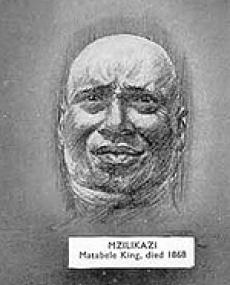
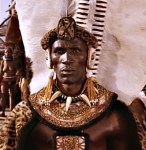
Mzilikazi (meaning The Great Road), was a Southern African king who founded the Matabele kingdom (Mthwakazi), Matabeleland, in what became Rhodesia and is now Zimbabwe. He was born ca. 1790 near Mkuze, Zulu Kingdom (now part of South Africa). The son of Matshobana whom many had considered to be the greatest Southern African military leader after the Zulu king, Shaka. In his autobiography, David Livingstone referred to him as the second most impressive leader he encountered on the African Continent. He was also the father of Lobengula.
King Shaka
The territory of the Northern Khumalo was located near the Black Umfolozi River, squeezed between the lands of two strong rival groups: the expanding Mthethwa empire of Dingiswayo and the land of the equally ambitious and much more ferocious Zwide of the Ndwandwe. Mzilikazi’s boyhood was spent in the household of his grandfather Zwide. Inevitably, as he grew to manhood he observed the less powerful Khumalo being drawn into the conflict between Dingiswayo and Zwide.
Bayethe! Ndebele Nation! You are the knobkerrie that menaced Tshaka. You are the big one who is as big as his father Matshobana. You are the string of Mntinti and Simangele Simangele son of Ndaba. You are the string of Mntitni and Ndaba The string they made until they wet tears You are the sun that rose from the ear of the elephant, It rose where upon the birds announced to each other. You are the son of Simangele who was kicked! Who was kicked by long feet and by the short ones. You refused to eat the gift of meat in Bulawayo. You are the fighter who has marks of fighting, You are the cattle that opened the closed pen with their horns, Because they opened the Ngome forests and left. You are the moon the people said had set Yet it was just rising; It rose in the year of Mpeyana. You are the cow that showed its face from the crowd. You are the log from which the Zulus cut firewood until they left it. You are the cow that, while it was just emerging made progress.
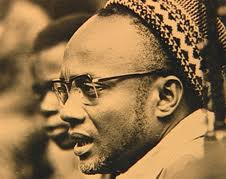
« Always bear in mind that people are not fighting for ideas, for the things in anyone’s head. They are fighting to win material benefits, to live better and in peace, to see their lives go forward, to guarantee the future of their children.» (Amilcar Cabral).
Here is a poem by Patrice Lumumba (1925–1961), published on Pambazuka News. Patrice Lumumba was elected the first prime minister of the Democratic Republic of the Congo (DRC). Assassinated by Belgian colonialists and the CIA, Lumumba was a founder member of the Movement National Congolais (MNC), which led the Congo to independence. Patrice Lumumba is the symbol of aspirations of an entire continent, and he continues to serve as an inspiration to contemporary Congolese and African politicians. His spirit lives on, and his pride is ours!
=======
Dawn in the Heart of Africa
For a thousand years, you, African, suffered like beast, Your ashes strewn to the wind that roams the desert. Your tyrants built the lustrous, magic temples To preserve your soul, reserve your suffering. Barbaric right of fist and the white right to a whip, You had the right to die, you also could weep. On your totem they carved endless hunger, endless bonds, And even in the cover of the woods a ghastly cruel death Was watching, snaky, crawling to you Like branches from the holes and heads of trees Embraced your body and your ailing soul. Then they put a treacherous big viper on your chest: On your neck they laid the yoke of fire-water, They took your sweet wife for glitter of cheap pearls, Your incredible riches that nobody could measure. From your hut, the tom-toms sounded into dark of night Carrying cruel laments up mighty black rivers About abused girls, streams of tears and blood, About ships that sailed to countries where the little man Wallows in an ant hill and the dollar is king, To that damned land which they called a motherland. There your child, your wife were ground, day and night In a frightful, merciless mill, crushing them in dreadful pain. You are a man like others. They preach you to believe That good white God will reconcile all men at last. By fire you grieved and sang the moaning songs Of a homeless beggar that sinks at strangers’ doors. And when a craze possessed you And your blood boiled through he night You danced, you moaned, obsessed by father’s passion. Like furry of a storm to lyrics of a manly tune From a thousand years of misery a strength burst out of you In metallic voice of jazz, in uncovered outcry That thunders through the continent like gigantic surf. The whole world surprised , wakes up in panic To the violent rhythm of blood, to the violent rhythm of jazz, The white man turning pallid over this new song That carries torch of purple through the dark of night.
The dawn is here, my brother! Dawn! Look in our faces, A new morning breaks in our old Africa. Ours alone will now be the land, the water, mighty rivers Poor African surrendered for a thousand years. Hard torches of the sun will shine for us again They’ll dry the tears in eyes and spittle on your face. The moment when you break the chains, the heavy fetters, The evil cruel times will go never to come again. A free and gallant Congo will rise from black soil, A free and gallant Congo-black blossom from black seed!














 On ne conduit pas chez le coiffeur un enfant qui n’est pas encore né
 African Heritage