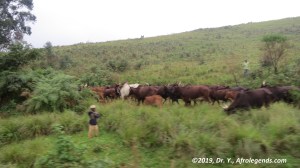
There was once, in a village, a very rich man who owned many herds of cows, goats, and sheep. He had only one child, a son, still very young whose mother had passed away after giving him life!
When the old man felt his own death coming, he worried: who was going to advise his son so that he would not get devoured by the man-eating worms, the man-eating worms that migrated between the two great rivers where every day he went to water his flocks? The villagers could not do it. On the contrary, they would be jubilant at the idea of seeing his son devoured by the man-eating worms. They would happily split his herds among themselves!
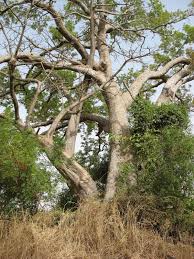
Cailcedrat (Source: paysdelaTeranga blog)
He was going to entrust his son to a tree, an old cailcedrat :
I am going to die, he said. I entrust my son to you so that you counsel him.
Then he passed away.
In the morning, before taking his flocks to pasture, the young boy would sing to the tree.
My father entrusted me to you, great cailcedrat. Should I take my flocks to Toubalitou? Or should I lead them to Diabalidia?
The tree shook its heavy branches laden with leaves three times, and said:
Go to Toubalitou. Do not go to Diabalida. The man-eating works will be at Diabalida today!
The young boy led his flocks to Toubalitou, and in the evening came back safe and sound to the village. The villagers were astonished and furious. Someone must be advising the boy for him not to be eaten by the worms! They were going to find out who was counseling him. They hired a hunter for that task, who brought back the secret. They cut down the tree, burnt it, and threw the ashes in the river.
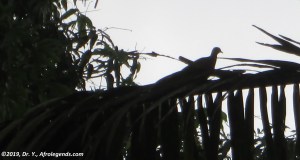
A turtledove at dusk
When the orphan came for counsel, he found nothing. He cried, and still sang his song. One never knew. It was a turtledove who answered him. And once again he got home safe and sound. People were once again surprised. They were furious at the hunter, he had lied to them.
The hunter once again told them the new secret, and promised them that he would kill the turtledove. However, he never could. He became insane, and still runs to this day firing shots at the sky taking it for his turtledove.
Since that day, wise men and women tell their children never to kill a turtledove.
Celui qui marche sur le fumier, devra se laver les pieds(Proverbe Bahumbu – République Démocratique du Congo (RDC)). – Qui s’y frotte, s’y pique.
Whoever walks on manure, will have to wash his feet (Bahumbu proverb – Democratic Republic of Congo (DRC)). – If you go looking for trouble, you will find it.
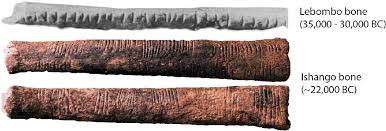
Have you ever heard of the Lebombo Bone? It is even older than the Ishango bone. It is indeed the oldest known mathematical artifact in the world. Discovered in the 1970s in Border Cave, a rock shelter on the western scarp of the Lebombo Mountains in an area near the border of South Africa and Swaziland (now Eswatini). The bone was found on the Eswatini side, and dates from 35,000 BC. It consists of 29 distinct notches that were deliberately cut into a baboon’s fibula.
The bone is between 44,200 and 43,000 years old, according to 24 radiocarbon datings. This is far older than the Ishango bone with which it is sometimes confused. Other notched bones are 80,000 years old but it is unclear if the notches are merely decorative or if they bear a functional meaning.
According to The Universal Book of Mathematics, the Lebombo bone’s 29 notches “may have been used as a lunar phase counter, in which case African women may have been the first mathematicians, because keeping track of menstrual cycles requires a lunar calendar.” However, the bone is clearly broken at one end, so the 29 notches may or may not be a minimum number. In the cases of other notched bones since found globally, there has been no consistent notch tally, many being in the 1–10 range. The Lebombo bone resembles a calendar used by the early men of the area, coming from the San clans of Namibia; this way of making tallies is still used by the San people today.
Top image: Lebombo bone. Bottom: Ishango bone with prime numbers engraving (J.D. Loreto and D.H. Hurlbert Smithsonian)
According to The Universal Book of Mathematics, the Lebombo bone’s 29 notches “may have been used as a lunar phase counter, in which case African women may have been the first mathematicians, because keeping track of menstrual cycles requires a lunar calendar.” However, the bone is clearly broken at one end, so the 29 notches may or may not be a minimum number. In the cases of other notched bones since found globally, there has been no consistent notch tally, many being in the 1–10 range. This resembles a calendar used by the early men of the area, coming from the San clans of Namibia. These represent the earliest unambiguous evidence for modern human behavior. An article in the Proceedings of the National Academy of Sciences (PNAS) on recent archaeological discoveries, “Early evidence of San material culture represented by organic artifacts from Border Cave, South Africa” , has shown that bone tools were already present 75,000 years ago and were used in San culture.
To anyone who ever doubted it, Africa is indeed the cradle of humanity… and women (if it is indeed a lunar tool) were quite advanced mathematicians 35,000 years ago, using calculators to make lunar calendars!
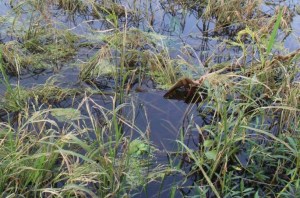
Les eaux stagnantes sont mangeuses d’hommes (Proverbe Luba – République Démocratique du Congo (RDC), Zambie, Angola). Méfiez-vous des gens qui ne disent rien.
Stagnant waters are man eaters (Luba proverb – Democratic Republic of Congo (DRC), Zambia, Angola). Beware of people who do not say anything.
For this year’s Mother day, I decided to post Lesline’s rendition of “Sweet Mother” by Prince Nico Mbarga. As I told you in my past post, Mbarga’s ‘Sweet Mother‘ is the most loved and most popular African song of all times. Enjoy Lesline’s rendition of this African classic on The Voice Afrique Francophone season 1, and remember to love and pamper your mother this Sunday! Happy Mother’s day.
Below is the translation of a letter in which the Kings and Chiefs of Little Popo and Grigi in Togoland (actual Togo) are asking for their lands to be placed under the protection of the German Imperial Majesty the Kaiser, i.e. to be placed under German protection, or rather placing (not knowing the full extent) their lands under German protectorate. This was signed on March 5th of 1884. Remember that Little Popo is now known as Aného in Togo. Grigi might have been the town of Glidji.
====
Map of Togoland in 1885
I. We, the signatories, Kings and chiefs of Little Popo and Grigi, express our gratitude to Your Majesty for having assisted us in upholding peace in our land.
II. There would be no threat and no uncertainty, if the British government would refrain from interference in the affairs of our lands, which it desires, while we desire her not to have it.
III. We ask Your Majesty to provide us with protection and to avoid such an annexion.
IV. We implore Your Majesty to come to our aid, as we have placed ourselves fully under your protection.
V. We humbly request to take quick action.
signed King Aiaushi Agbanor of Little Popo and Grigi, Caboceer Quadjovi, chief Pedro Quadjo and 11 other signatures

 Un grand voyage par eau, on ne part pas précipitamment (Proverbe Ekonda – République Démocratique du Congo (RDC)). – Réfléchir avant d’agir.













 African Heritage