“Afrique 50” The First French Anti-Colonization Documentary

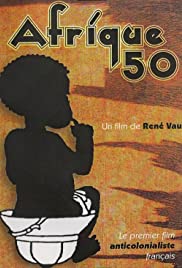
Afrique 50 by Rene Vautier

I recently watched a documentary made by René Vautier, Afrique 50. This documentary is the first French anti-colonization movie ever made.  Vautier was assigned to French West Africa to make an educational film, but upon arrival he witnessed the appalling conditions of the Africans and the crimes committed against them by the French troops. The result was Afrique 50. For making this documentary, he was thrown in jail, and the documentary was banned for 40 years.

I loved Afrique 50 because it showed West Africa in 1950, a different side of it, and the African society with some of its strong culture and identity. It was a society of togetherness. Vautier tried to show different aspects of a normal day: artisans, farmers, weavers, women cooking, a hairdressing for both boys and girls, men called for prayers, fishermen, boat makers, herders, just normal life under the African sun.

He also showed colonization and its nefarious effects on African cultures and the fact that colonization did not help, but rather empoverished the Africans. He says, “a school is opened when the big companies need an accountant” (On ouvre une école quand les grosses companies ont besoin de comptables), or “a doctor is sent, when the big colonial companies risk running out of manpower” (on envoie un médécin quand les grosses compagnies coloniales risquent de manquer de main d’oeuvre).
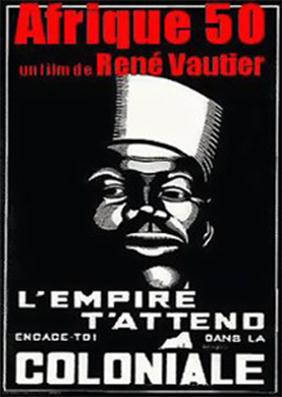
Afrique 50 by Rene Vautier – The Empire Awaits you, Join the colonial

In his documentary, Vautier shows how the French destroyed entire villages, killed people, women, kids, pregnant women, etc, because the people were not able to bring in a quota of bananas, or cocoa, or rubber, i.e. to pay the tax which was the penny sum of 3700F.

Vautier says, “colonization is the reign of the vultures,” and these vultures are the big multinationals. He cites, Société Commerciale de l’Ouest Africain (650 millions F of profit in 1949), Compagnie française de l’Afrique occidentale (actuelle CFAO) (365 millions of profit in 1949), Dabom (180 millions of profit), L’Africaine Française, le Niger Français, La Compagnie Française de la Côte d’Ivoire, Unilever who made 11 billions 500 millions of profit in a year / 40 millions a day. Not much has changed today!

It also shows why Africa always looks underdeveloped. Isn’t it surprising to notice that today, lots of large-scale agriculture is not industrialized in sub-saharan Africa? Well because it costs less to these multinationals to have Africans labor fields with hoes, machetes, and more, than buying and maintaining turbines, or tractors. This is cheap labor!

Vautier says “A machine will do the job of 20 Blacks of course, but 20 blacks for 50F a day cost less to the company than the machine, so let’s use the Black” (Une machine ferait le travail de 20 noirs bien sûr, mais 20 noirs à 50F par jour reviennent moins cher qu’une machine, alors usons le noir).

Banana plantation in Cameroon

To this day, 70 years later, not much has changed in the rubber plantations of Liberia, or the cocoa plantations of Côte d’Ivoire, or the banana plantations of Cameroon, or in the forests of Gabon.

Africans are still asking for their lands which were taken by the multinationals (Did You Know about the 999-year Lease granted to Europeans in Kenya ?), and to this day the reply is always brutal and violent; when in the past they had the French administrator and police burn down villages, today they have their puppet governments installed everywhere on the continent crushing the people.
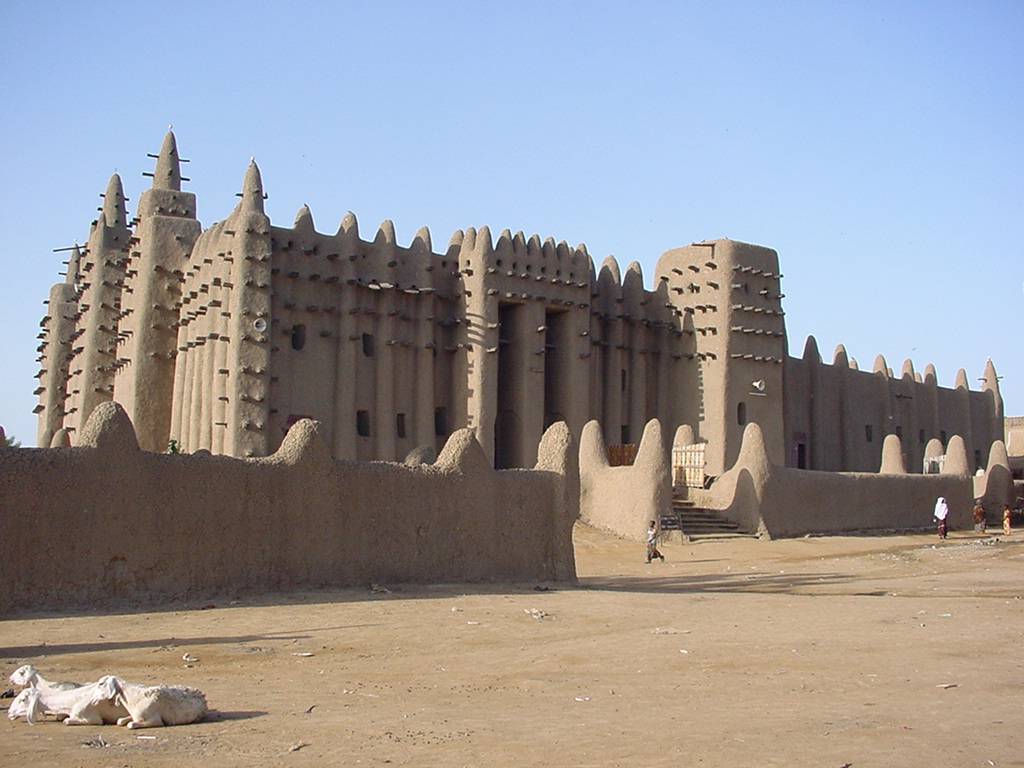
La grande mosquee de Djenne (Mali - heritage du grand empire du Mali)
La grande mosquee de Djenne (Mali – heritage du grand empire du Mali)

What I also liked in Afrique 50, was that in 1950, the architecture in Africa was still that of our ancestors. One can see Séguéla, Dimbokro, Kétékre, Daloa, Bouaflé, Palaka, etc… it still looks like the great architecture of Timbuktu and Djenné, sublime, and upstanding. The French came, destroyed, and burnt down those villages, and kingdoms. In the Bamiléké highlands of Cameroon, some kingdoms have no real palaces anymore, or the king’s house is made of zinc roofing, because the colonizers had them burnt down (such as the Bazou royal palace) in the 1950s during the maquis years (French President Acknowledges French Genocide in Cameroon) and before. The mud huts seen today across Africa are a result of years of being crushed and under constant attack by foreigners. When you are constantly attacked, you barely have time to rebuild the old ways, and also with time those with the architectural know-how pass away without passing on their knowledge, and more, we are told that building like the Europeans is sign of modernism even if it not adapted to our environment!

Please enjoy this documentary… It is a real eye-opener! Very little has changed in 70 years, the name has morphed from colonization to neo-colonization, to globalization, to cheap labor, and more!

Where Joseph Merrick was Mentioned … and his Pioneer Missionary Work in Cameroon

Cameroon_flag
Flag of Cameroon

Below are more descriptions of Joseph Merrick, the Jamaican Baptist Minister, and his pioneering missionary work on the coast of Cameroon, by some of his contemporaries, or in the case of Emily Saker, the daughter of his colleague Alfred Saker. Enjoy!

======

“In 1844 Merrick found King William more accommodating. The following year, Merrick initiated work along the coast, opening a station among the Isubu of Bimbia and two stations at Aqua Town and Bell Town along the Wouri River estuary. Unaware of difficulties that made the river largely unnavigable, he hoped that the system of creeks might ultimately provide access to the interior. However, Merrick´s first task was to “prepare the way for the preaching of the gospel among the Isubu and the Dualas.” This he did by forming churches and schools and learning the Isubu and Duala [Douala] languages. A gifted linguist, he soon was able to preach in both tongues. He arranged to print some texts and scripture.” Memoir of Joseph Merrick, Missionary to Africa by J. Clarke, London: Benjamin L. Green.
n.d. Journals. BMS Archives A/2. 1850.

Cameroon_Victoria 1889_Thomas Comber book
Bird’s eye view of then Victoria, now Limbe, and Ambas Bay, Cameroon, in 1884

“The Rev. Joseph Merrick was a native of Jamaica, and of African descent. He was educated in the Society’s schools, and as a youth began in 1837 to preach. He was soon after associated with his father in the pastorate of the church at Jericho. He entered on mission work in Africa in 1843, and laboured most diligently among the Isubu tribe on the Bimbia river. He quickly learned to speak their language with great readiness and precision, and translated a portion of the New Testament into the Isubu tongue. It was partially printed by himself, but was completed at press by Mr. Saker. He died on the 22nd October, 1849, on his passage to England.” Alfred Saker, Missionary to Africa: A Biography, by E.B. Underhill, Baptist Missionary Society, UK, 1884 p.52

“Having set” in order the things wanting in the church “at Clarence [Malabo], Mr. Saker paid a brief visit to Bimbia, where he collected the manuscripts and Isubu translations of the lamented Merrick. Leaving directions for their printing with Joseph Fuller,… ” Alfred Saker, Missionary to Africa: A Biography, by E.B. Underhill, Baptist Missionary Society, UK, 1884 p.52

Cameroun_Joseph Merrick_at_Isubu_funeral in 1845
Joseph Merrick at an Isubu funeral in Bimbia (1845)

“On the mainland, north from Fernando Po [Bioko], towered the volcanic mountain of Cameroons [Mount Cameroon]. Its highest peak-then unexplored-lifted itself 13,700 feet into the blue. Its spurs and outlying hills reached to the sea frontage. On one of its headlands Mr. Merrick was even now at work reducing the language of that particular people – the Isubus – to writing.” Alfred Saker Pioneer of the Cameroon by Emily M. Saker, 2nd Edition London: The Carey Press, 1929, p.42

“The time which had been spent in Bimbia had not been wasted. Earnestly had Mr. Saker co-operated with Mr. Merrick in labour for the welfare of the Bimbians. Inland villages had been visited with the glad tidings of great joy ; chiefs had been seen and taught ; the idlers in the market-places, the fishermen by the seashore, … ” Alfred Saker Pioneer of the Cameroon by Emily M. Saker, 2nd Edition London: The Carey Press, 1929, p.44

Cameroon_Limbe_Victoria_1908 painting
1908 painting by R. Hellgrewe of the town of Victoria (now known as Limbe) – Mt Cameroon can be seen in the background

“Mr. Saker was detained in Bimbia for some weeks owing to storms. During his detention he printed at the press some Isubu manuscripts left by the late Mr. Merrick.” Alfred Saker Pioneer of the Cameroon by Emily M. Saker, 2nd Edition London: The Carey Press, 1929, p.119

“On the Friday I made my way to the home of our excellent brother Duckett, about seven miles distant. You will remember him as one of the band who sailed with Mr Clarke in the Chilmark from Jamaica to Africa; he was the most able and devoted of the number. My dear wife knew him well as a faithful co-worker with the sainted Merrick.” The Missionary Herald: Containing Intelligence, at Large, of the Proceedings, The Native Pastors of Jamaica, p. 52 1882

Mugabe and Nkrumah: the Tale of Two Red Cockrells

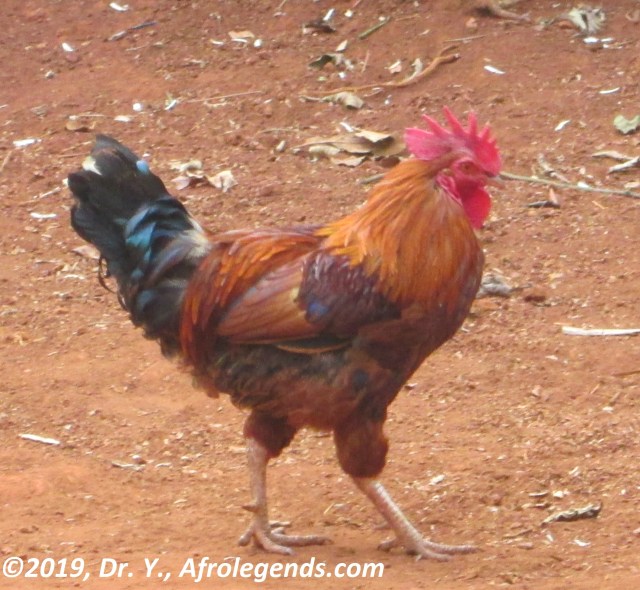
A cockerel

Below are excerpts from an article posted on Pambazuka by Akyaaba Addai-Sebo, where the author compares the obstables faced by the regimes of presidents Kwame Nkrumah and Robert Mugabe almost 40 years later. As you read on, you can see that the British used the same tactics to destroy both economies, when they could not destabilize both men. Such similitudes! Enjoy! For the full article, go to Pambazuka.

Robert Mugabe (History.com)

=====

Despite some shortcomings in his policies, Mugabe could not be pushed to betray the people of Zimbabwe and Africa in general.  

Tony Blair’s New Labour purposefully undermined and sabotaged the political economy of Zimbabwe from late 1997. The double-face and double-crossing British politicians therefore crippled the Zimbabwe African National Union-Patriotic Front (ZANU-PF) Red Cockrell in the same manner as Harold Wilson undermined and sabotaged the Nkrumah regime and the Convention People’s Party (CPP) Red Cockrell from 1964.

Kwame Nkrumah
Kwame Nkrumah

Harold Wilson was the Labour Party prime minister then. Rhodesia was then at the heart of the conflict between Ghana and Britain. Harold Wilson fought President Kwame Nkrumah to maintain and sustain white supremacist stranglehold as Tony Blair fought Mugabe to maintain and sustain white supremacist stranglehold on Zimbabwean land and finance capital, itself created by the land and the labour of the people.

It must be stated clearly that there can be no capital without land and labour. Capital has no existence of its own. Apartheid and settler colonialism are a politico-military act of land appropriation and enslavement of labour for the crafted purpose of capital accumulation.

Tony Blair’s New Labour party funded and created the opposition Movement for Democratic Change led by Morgan Tsvangirai, a trade union leader. Harold Wilson’s Labour Party aided Kofi Busia, Komla Gbedemah and JWK Harlley to overthrow Nkrumah.

Red cockerel, “Forward Ever, Backward Never”: Convention People’s Party logo and slogan

Whereas Tony Blair and subsequent British prime ministers could not overthrow Mugabe, they destroyed the Zimbabwean economy and created a quicksand underneath the ZANU-PF regime…as did the Wilson government to the CPP regime.

….

Proverbe Zulu sur les Fautes / Zulu Proverb on Making Mistakes

Oeil / Eye

L’oeil peut se blesser quand il regarde (Proverbe Zulu – Afrique du Sud, Zimbabwe, Lesotho, Eswatini, Malawi, Botswana, Mozambique). – Tout le monde peut se tromper.

The eye can be wounded while looking (Zulu proverb – South Africa, Zimbabwe, Lesotho, Eswatini, Malawi, Botswana, Mozambique). – Everybody can make mistakes.

Blombos Cave: Earliest Known Drawing by a Human found in Africa old of 73,000 years

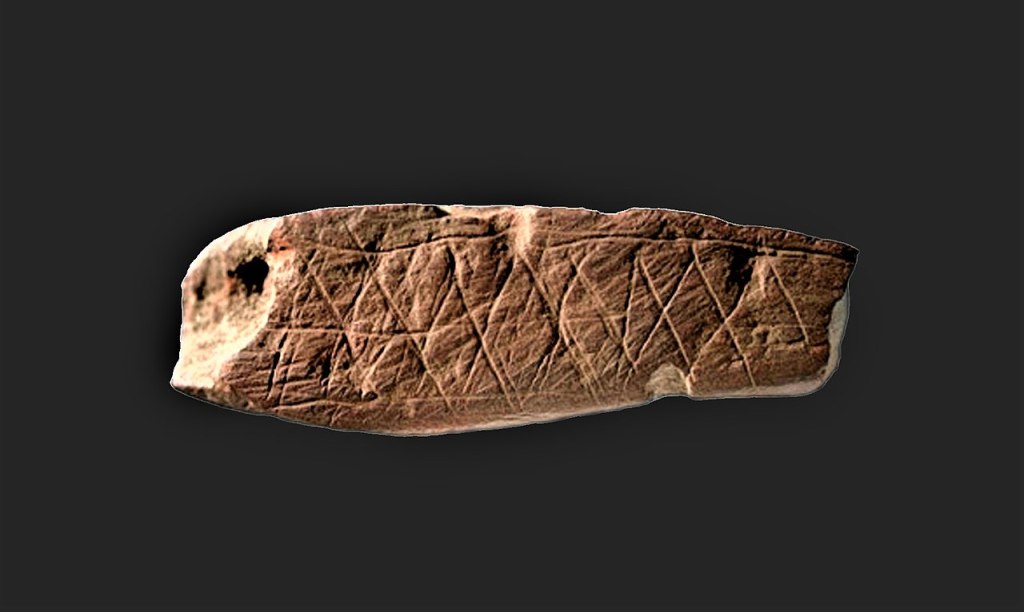
Rock Art from Blombos Cave (Source: C. Henshilwood, Wikipedia)

We take drawing for granted, and we know that our ancestors, ancient humans thought of drawings as a very good communication tool, as depicted in petroglyphs found in a thousand places on the African continent, in Europe, Asia, and the Americas.

This may be old news to some, but the earliest evidence of a drawing made by humans has been found in the Blombos Cave in the southern Cape province of South Africa. Blombos Cave contains material dating from 100,000—70,000 years ago.

The drawing, which consists of three red lines cross-hatched with six separate lines, was intentionally drawn on a smooth silcrete flake about 73,000 years ago. This predates previous drawing from Africa, Europe and Southeast Asia.

Oldest Drawing by Homo Sapiens, dated to be 73,000 years old, found in the Blombos Cave (Source: Wikipedia)

Excavations at the world-famous archeological Blombos Cave site, have yielded many important riches. These include delicately crafted stones and bone implements preceding comparable European artifacts by more than 80,000 years, and at least 8,000 pieces of ochre, used as colour pigment by early humans. This indicates that our ancestors already had an acute sense of colors, and the different properties of these oxidizing colors (ferrous oxide), suggesting a strong understanding of the chemistry behind the colors’ composition.

… the drawings were made with an ochre crayon, with a tip of between 1 and 3 millimetres thick. Further, the abrupt termination of the lines at the edge of the flake also suggested that the pattern originally extended over a larger surface, and may have been more complex in its entirety.

Before this discovery, Palaeolithic archaeologists have for a long time been convinced that unambiguous symbols first appeared when Homo sapiens entered Europe, about 40,000 years ago, and later replaced local Neanderthals,” says Pr. Christopher Henshilwood from the University of Witswatersrand. “Recent archaeological discoveries in Africa, Europe and Asia, in which members of our team have often participated, support a much earlier emergence for the production and use of symbols.”

The archaeological layer in which the Blombos drawing was found also yielded other indicators of symbolic thinking, such as shell beads covered with ochre, and, more importantly, pieces of ochres engraved with abstract patterns. Some of these engravings closely resemble the one drawn on the silcrete flake.

Bifacial silcrete point from M1 phase (71,000 BCE) layer of Blombos Cave, South Africa (Source: Wikipedia)

This demonstrates that early Homo sapiens in the southern Cape used different techniques to produce similar signs on different media,” says Henshilwood. “This observation supports the hypothesis that these signs were symbolic in nature and represented an inherent aspect of the behaviorally modern world of these African Homo sapiens, the ancestors of all of us today.

To find out more, please read this article written by Christopher Henshilwood and his team in Nature, as well as this article in the National Geographic.

Somali Proverb on Stereotypes

Flag of Somalia

Barasho horteed ha I nicin (Somali proverb – Somalia). Get to know me, before you reject me (don’t hate and stereotype something or someone before you get to know them)

The Safou and Hazel Trees

The storm was doing her frequent incursions in the forest and, like a raptor that rushes on from the sky and only leaves each time with a chick, she uprooted a tree. Each victim was left to his fate. For the survivors, the attack was only the business of the one who had succumbed.  Each closed his door on his blissful quietude.

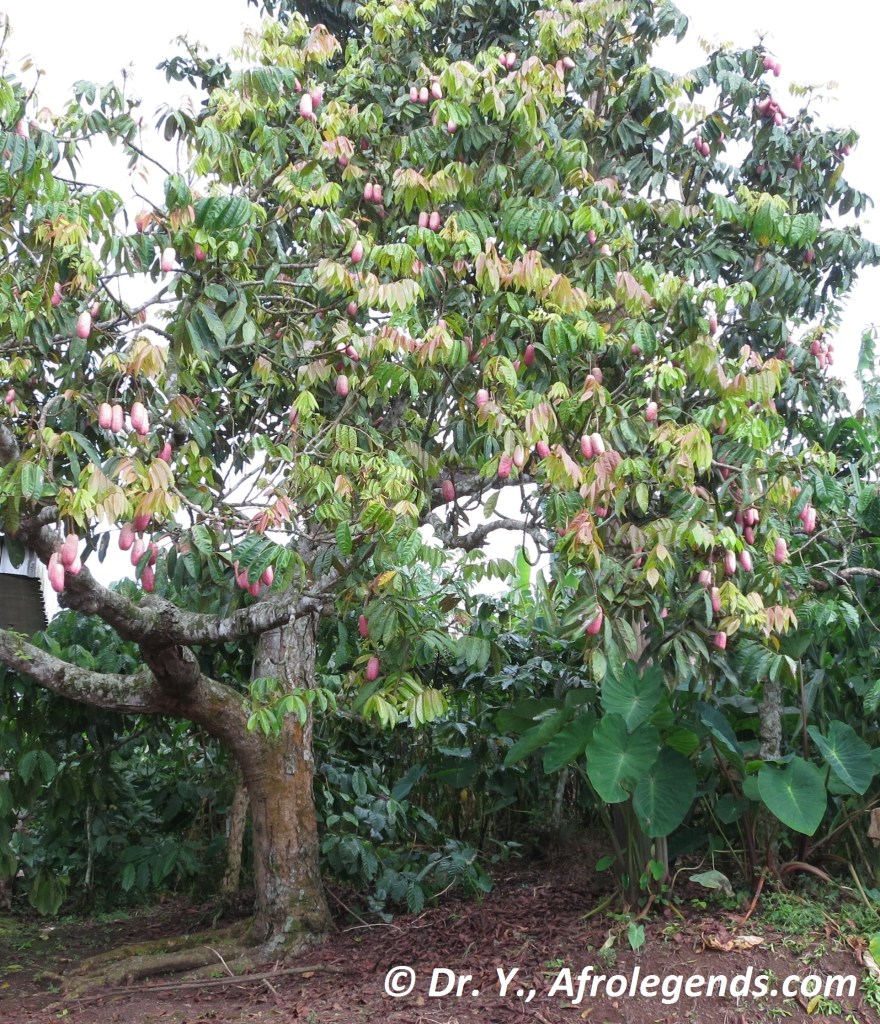
The safou tree

One morning, the insatiable grim reaper [the storm] stopped in front of the safou tree and started ruffling his hair. Then she [the grim reaper] shook him in all directions to make him understand that his time had come.

The safou tree tried to organize his defense. The storm rushed, retreated to regain strength, came back with more violence, snatched off and dispersed under her breath the hair of the assaulted. Not being able to take it anymore, the safou tree sent out a distress call in the direction of the hazel tree, his neighbor.

  • Here is, he said, the brigand who for many years, depopulates our country. Come help me get out of his claws. I am out of strength.
  • I never get involved in anything that doesn’t concern me, said the hazel tree. I do not deal with either the storm or the wind. Give back to the brigands what you owe them.

This said, the hazel tree closed his door to find the softness and calm of his home.

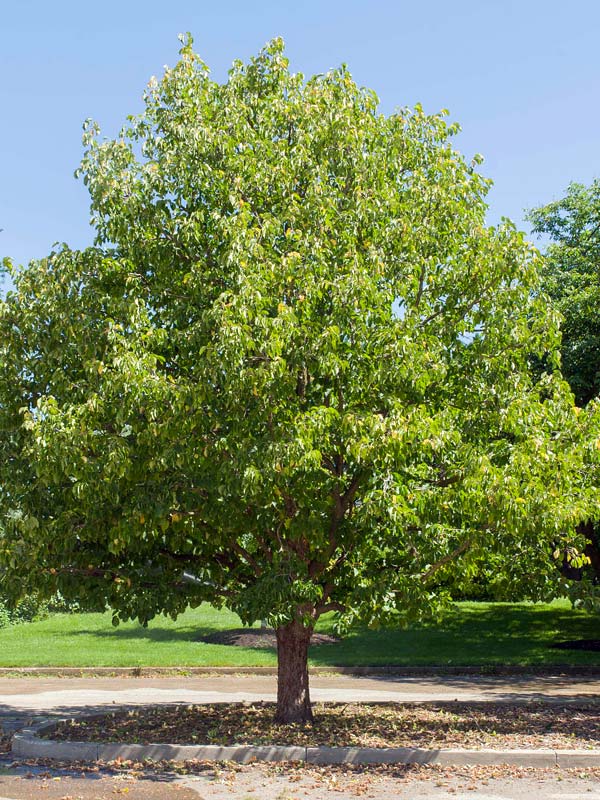
Turkish hazel tree (Source: Chicago Botanic Garden)

Under the storm’s assaults, the safou tree collapsed. In his last breath, he grumbled that what was happening to him will not miss the hazel tree.

And two days later , it was the turn of the hazel tree to pay the storm the ransom of weakness and individualism of the people of the forest.

Fables des Montagnes de Patrice Kayo, Collection Les CLES de l’avenir, Editions CLE, Yaounde, p. 9 (1998). Translated to English by Dr. Y., Afrolegends.com

Re-Discovery of the Elephant Shrew in Djibouti

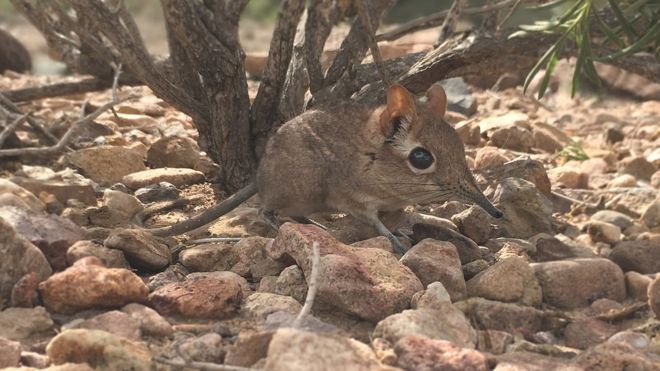
Elephant shrew (sengi) in Djibouti (source: Steven Heritage – BBC)

When I heard about the re-discovery of the elephant shrew, I wondered how could the elephant go missing and I didn’t hear about it? Since when? … then I realized that the elephant shrew was a sort of tiny rodent which is common on the horn of Africa; in the case at hand, it used to be common in Djibouti, but disappeared about 50 years ago. Not sure why it is called ‘elephant’ shrew. They say that it is related to the elephant, but how? Maybe the original scientist who said that had a little too much to drink? Or just looked at its pointed trunk-like nose and decided? Excerpts below are from an article on the BBC. As a side note, we really need to preserve our fauna (and flora), because we do not need a day when the elephant, the real one, will go missing

====

A little-known mammal related to an elephant but as small as a mouse has been rediscovered in Africa after 50 years of obscurity.

Flag of Djibouti

The last scientific record of the “lost species” of elephant shrew was in the 1970s, despite local sightings.

The creature was found alive and well in Djibouti, a country in the Horn of Africa, during a scientific expedition.

Elephant shrews, or sengis [the name is of Somali origin], are neither elephants nor shrews, but related to aardvarks, elephants and manatees.

They have distinctive trunk-like noses, which they use to feast on insects.

There are 20 species of sengis in the world, and the Somali sengi (Elephantulus revoilii) is one of the most mysterious, known to science only from 39 individuals collected decades ago and stored in museums. The species was previously known only from Somalia, hence its name.

Steven Heritage, a research scientist at the Duke University Lemur Center in Durham, US, and a member of the expedition to the Horn of Africa in 2019, said he was thrilled to put the species “back on the radar”.

He told the BBC: …”We did not know which species occurred in Djibouti and when we saw the diagnostic feature of a little tufted tail, we looked at each other and we knew that it was something special.”

The scientists had heard reports of sightings in Djibouti, and Houssein Rayaleh, a Djiboutian research ecologist and conservationist who joined the trip, believed he had seen the animal before.

He said while people living in Djibouti never considered the sengis to be “lost” [seems like a case of ‘only Europeans discover things’ like Columbus and the Americas], the new research brings the Somali sengi back into the scientific community, which is valued.

For Djibouti this is an important story that highlights the great biodiversity of the country and the region and shows that there are opportunities for new science and research here,” he said.

Proverbe sur la Prudence / Proverb on Caution

Marais / Swamp

Ne jetez pas le bâton avant d’avoir traversé le marais (Proverbe Douala – Cameroun).

Do not throw the stick until you have crossed the swamp (Duala proverb – Cameroon).

Writings by Ruben Um Nyobe: Political Constant of Unity Practiced by Ruben Um Nyobe – 1959

Ruben Um Nyobé
Ruben Um Nyobé

In celebration of the life of  Ruben Um Nyobé, I chose to share with you his writings below on this day, 13 September, the day of his assassination in 1958 by French troops in Cameroon. These writings by  Ruben Um Nyobé, leader of the UPC, were published in 1959. The book was published as “Constante politique d’unité pratiquée par Ruben Um Nyobe – 1959,” by Union des Populations du Cameroun (UPC). The text below by Ruben Um Nyobe served as a preface to the book, and has been translated to English by Dr. Y. Afrolegends.com . For the original, go to gallica.fr

======

Flag of the UPC
Flag of the UPC

Political Constant of Unity practiced by Ruben Um Nyobe – 1959

 Author: Union des Populations du Cameroon

Inform to Enlighten by Ruben Um Nyobe, General Secretary of the Union the Populations du Cameroun (UPC), Leader of the National Resistance for the Liberation of Cameroon

The national aspiration, which has just cumulated in the recognition of our independence, Is the concrete and objective expression of the result of the struggle of our people. No one can claim that independence has been granted to us, we have conquered it. All those who fought for this national liberty, whether dead or alive, have sealed their names in the history of our motherland, their glory will be immortal! But now at the term of a crowned struggle, instead of concord uniting all members of the coalition, a storm of jealousy and hatred, still sweep over our poor little country. Until when obscene passions and the most execrable hypocrisies cease to brave virtue and honesty! Why will cruel selfishness and blind ambitions not recoil before the honor and national dignity? In this flood of provocations and hatreds, where is the future of our children, the tranquility of our homes, the future of the country? Is it possible to build a country without its population? Is there independence without independent citizens? Answer! Yes answer! All those who oppress our people and those who aim to exploit it.

I say that we must give the people the means to hope and the opportunity to have confidence in them. To reach that goal we have some preliminary work to do.

  1. Present the people with clear options for his future.
  2. Prepare for the people a climate of cordiality and put an end to insecurity.
  3. Train the people’s judgment through civic and political culture / instruction.

All this is feasible/possible, so long as it is wanted. No need to dodge the work by creating tribal oppositions.   

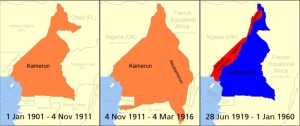
Kamerun_Map 1901-1960
Map of Kamerun from 1901 to 1960 (Wikipedia)

I add that all those who sow hatred and call for crimes, throw the boomerang, which unfortunately does not clarify the future. In politics, there is good sense and virtue, notwithstanding the apprentices of Machiavelli! In politics, truth is also necessary, even if it hurts and displeases because we do not define the future of the people in lies and slanders! Yes, we have to be realistic! To all my compatriots, I formally repeat this: our enemies in this crucial hour of our history, are those who divide us, because they expose us weakened to the solicitations and appetites of the foreigner…

When one reflects on current events, one reaches a first observation: it is the conception of power and sovereignty which is at stake. If it is true (and it cannot be otherwise) that power comes from the people, is it not up to the people to freely designate their interlocutors? Why pretend to take the place of the people? Why seek to abuse and deceives the masses? To get elected and impose a dictatorship, isn’t it? Finally, we believe that the events of the past should make the darkest adventurers retreat. It is only in ignorance that a dictatorship can be imposed, even if it is subtle. In these conditions our task is clear: to enlighten the people. We must do it and we will do it against all adventures. Our goal is to safeguard the national dignity and sovereignty of Kamerun.