I thought this was a good news to share with all: a rare species of chameleon last seen 100 years ago (last seen in 1913) in Madagascar has been spotted again. Like I have said before, I do not agree with people using words like “re-discovered,” as if the chameleon did not exist before then, even though it was probably just roaming far from human’s eyes, or rather from foreign eyes; like Columbus discovering a continent which already existed. Excerpts are from an article on the Guardian.
=====
…
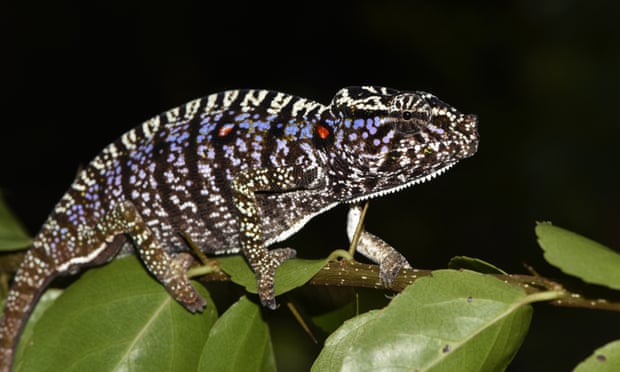
Scientists have found an elusive chameleon species that was last spotted in Madagascar100 years ago.
Researchers from Madagascar and Germany said on Friday they had discovered several living specimens of Voeltzkow’s chameleon during an expedition to the north-west of the African island nation.
One of the Voeltzkow’s chameleons spotted in Madagascar. Photograph: Frank Glaw/AP (Source: The Guardian)
In a report published in the journal Salamandra, the team, led by scientists from the Bavarian State Collection of Zoology (ZSM), said genetic analysis determined that the species was closely related to Labord’s chameleon.
Researchers believe that both reptiles only live during the rainy season – hatching from eggs, growing rapidly, sparring with rivals, mating and then dying during a few short months.
…
Researchers said the female of the species, which had never previously been documented, displayed particularly colourful patterns during pregnancy, when encountering males and when stressed.
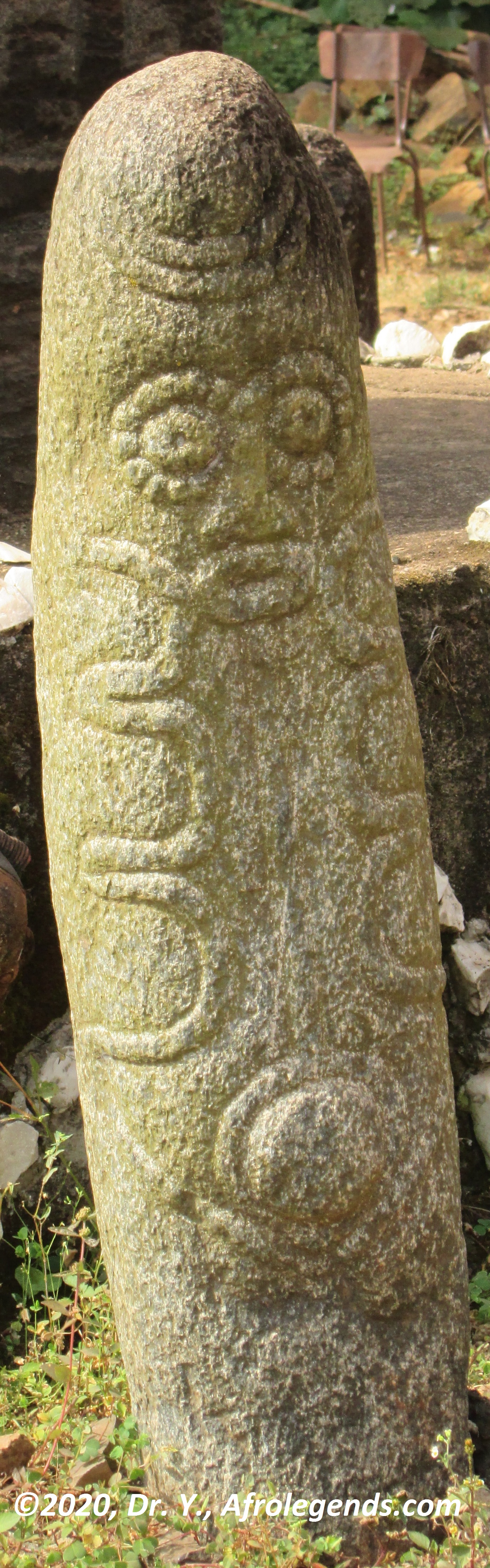
Monolith in Western Cameroon: notice the designs around the eyes and the body, and the ring on the head, could it be a crown or hat?
Today we will talk about the Alok Ikom stone monoliths of Nigeria and Cameroon. I told you on Monday that the US customs recently seized a few of these coming from Cameroon. Many years ago, I was quite fortunate to stumble upon these treasures which date as far back as 200 AD. At the time, even though I knew I was looking at something special, I did not realize (insouciance of youth?) that I was in front of relics of some ancient civilization of Central Africa. Fast forward many years, and I now just learn that they are on the UNESCO World Heritage Tentative List.
The Ikom or Alok Ikom monoliths are about 300 upright carved stones, arranged in perfect circles usually facing each other and standing erect, except in cases where they have been tampered with by weather, time, erosion, or man. These carved stones are found in the Ikom area of Eastern Nigeria in the Cross River state, and in some areas of Western Cameroon. They are thought to be at least 1500 years old.
Monolith in Western Cameroon
Often found in the center of villages or central meeting place of elders, or in sacred areas, researchers initially counted about 450 in Eastern Nigeria, but now because of diverse issues, only about 300 can be found. They vary in height, from 1 to 2 meters. Given that parts of Eastern Nigeria and Western Cameroon’s soils are volcanic, it is not surprising that the monoliths are mostly carved out of basaltic stone and in some cases out of sandstone or shelly limestone. On these stones are carved images and texts which to this day have not been deciphered. For many, these prehistoric carvings are a form of writing and visual communication.
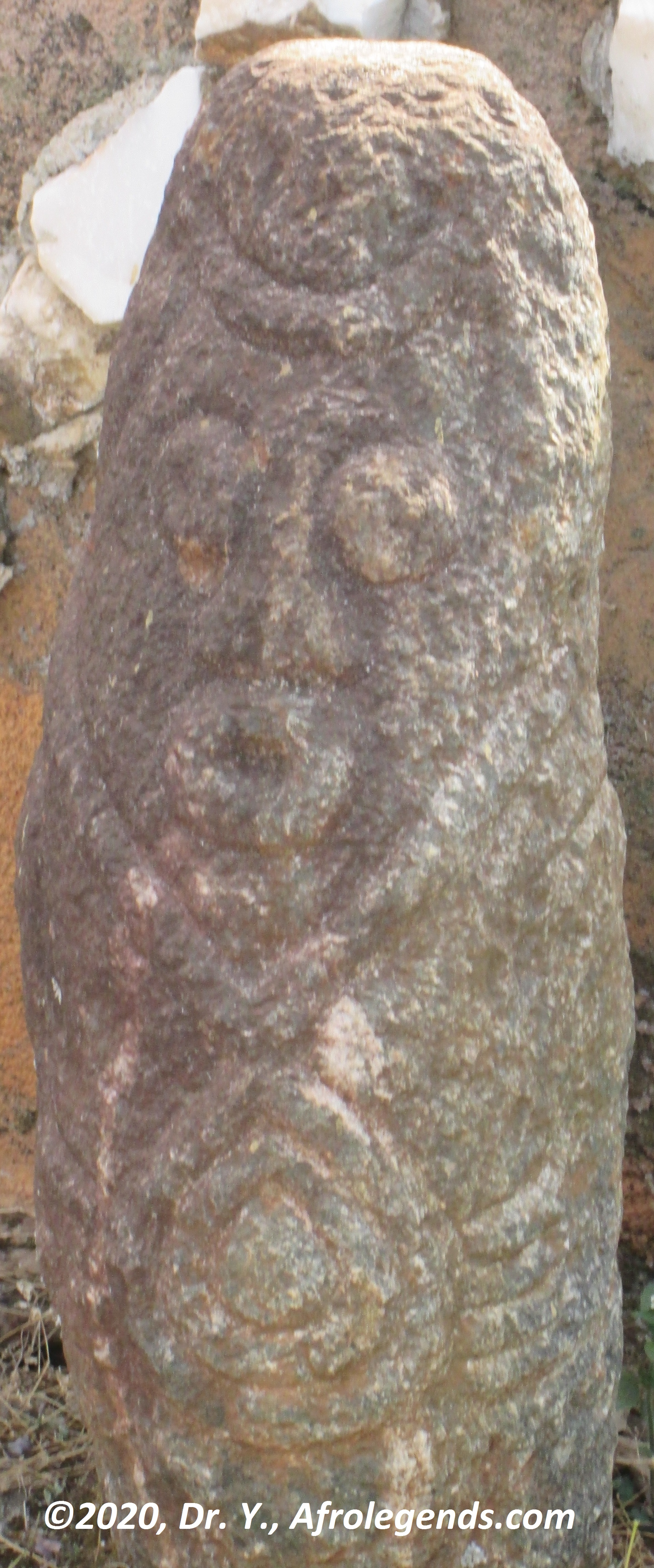
Monolith in Western Cameroon: notice the motifs
Some of the carvings form complex geometric motifs. The carvings have anthropomorphic features and depict a human being from the torso up, with a big emphasis placed on the face; in some of the stones, one can pick out the navel. At the time I saw these, I was told that the monoliths represented the ancestors, and they were 12 of them arranged in a circle. If I could travel back in time, there is so much I would ask about these monoliths: who made these? what was the purpose? Why the circular arrangement? what is the meaning of the intricate motifs? and more importantly which civilization is this? One thing is for sure, from the features, it was definitely a Black civilization! Enjoy!
Monolith in Western Cameroon: notice the intricacies of the design. This one almost looks feminine?
Two weeks ago, the US customs seized 1000 to 1800 years old monoliths from Cameroon. These were the Ikom monoliths which are found in Nigeria and Western parts of Cameroon. It is important to note the age of these artifacts, 200 – 1000 AD !!! We will write a piece on the Ikom monoliths which are on the UNESCO World Heritage Tentative List. Enjoy! Excerpts below are an article on the Barron’s website.
US customs officials in Miami on Tuesday said they seized ancient carved stones from Cameroon known as Ikom monoliths that had been exported to the United States using fake documents.
Experts believe the stone sculptures were made sometime between 200 and 1,000 AD, the US Customs and Border Protection (CBP) said in a statement.
According to UNESCO the carvings “bear a form of writing and a complex system of codified information .. each stone, like the human finger print, is unique from every other stone in its design and execution.“
The Ikom monoliths come from the area round the town of Ikom, in the state of Cross River in southern Nigeria bordering with Cameroon.
“Of the people who follow the king’s religion, only he and his heir presumptive, who is the son of his sister, may wear sewn clothes. All the other people wear clothes of cotton, silk, or brocade, according to their means. All men shave their beards and women shave their heads.”
I found this very short video about the Ghana Empire which I am sharing below. This is just to wet your appetite. There are quite a few really good documentaries out there on the Ghana Empire. Two of them stand out to me, Lost Kingdoms of Africa, Episode 4: Western Africa by Gus Casely-Hayford, and The History of Africa, Episode 10: Desert Empires by Zeinab Badawi based on UNESCO‘s General History of Africa, which I cited earlier.
Below are accounts from Al-Bakri, the 11th century geographer, who described the court of the Ghana Empire: Great and Magnificent Ancient Kingdom of Africa. As you read, notice that this was a very wealthy state, and also very well organized with great hierarchy. Enjoy! This is from the Corpus of Early Arabic Sources for West Africa, Levtzion, N., Cambridge Press (1981).
=====
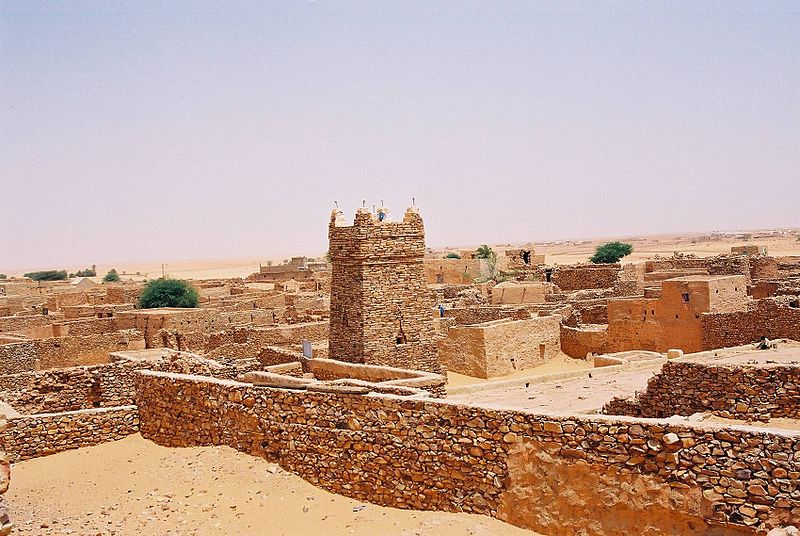
Chinguetti, a town which was part of the Ghana Empire (Wikipedia)
“The king has a palace and a number of domed dwellings all surrounded with an enclosure like a city wall. Around the king’s town are domed buildings and groves …”
“The King adorns himself like a woman wearing necklaces round his neck and bracelets on his forearms and he puts on a high cap decorated with gold and wrapped in a turban of fine cotton. He holds an audience in a domed pavilion around which stand ten horses covered with gold-embroidered materials…and on his right, are the sons of the vassal kings of his country, wearing splendid garments and their hair plaited with gold.”
Map of the Ghana Empire ca 300 -1200
“He sits in audience or to hear grievances against officials in a domed pavilion around which stand ten horses covered with gold-embroidered materials. Behind the king stand ten pages holding shields and swords decorated with gold, and on his right are the sons of the kings of his country wearing splendid garments and their hair plaited with gold. The governor of the city sits on the ground before the king and around him are ministers seated likewise. At the door of the pavilion are dogs of excellent pedigree that hardly ever leave the place where the king is, guarding him. Around their necks they wear collars of gold and silver studded with a number of balls of the same metals.”
Let me tell you about one of the greatest Ancient kingdoms of Africa, the Ghana Empire, a place known to its northern neighbors as the “Land of Gold“. No, I am not talking about the modern-day country of Ghana, which used to be called the Gold Coast and was named in honor of the great long-gone Ghana Empire by its first president, Kwame Nkrumah.
The Ghana Empire predates the modern-day country of Ghana by almost a millennium; it went from ca 300 to 1100 AD. It was a West African empire located in the area of present-day southeastern Mauritania, and western Mali. As you can see today, the Ghana Empire was actually located about 400 miles northwest of current Ghana, and was significantly bigger.
Folio from the Tarikh al-Fattash at the Mamma Haidara Library (Timbuktu, Mali) where Mahmud Kati chronicles the early years of the Ghana Empire
Its real name was Wagadou, but is known mostly by the title given to its ruler, the Ghana. It is not clear when the Ghana Empire ruling dynasty started, but explorer Muḥammad ibn Mūsā al-Khwārizmī gave us the first written records in 830, while in the 11th century the Cordoban scholar Al-Bakri traveled to the region and gave a detailed description of the kingdom. According to contemporary accounts such as those by al-Yakqubi (872 AD) al-Masudi (c. 944 AD), Ibn Hawqal (c. 977 AD), al-Biruni (c. 1036 AD), as well as Abu-Ubayd al-Bakri, the empire was a purely African kingdom, founded, and ruled by Africans, Soninke people. Ghana was said to be a sophisticated state with advanced methods of administration and taxation, large armies, large population, and lots of gold.
Chinguetti, a town which was part of the Ghana Empire (Wikipedia)
Its capital was Koumbi-Saleh, on the edge of the Sahara desert (when the Sahara was not as arid as today). According to the description of the town left by Al-Bakri in 1067/1068, the capital was actually two cities 10 kilometres (6 miles) apart from each other but, “between these two towns are continuous habitations“, so that they might be said to have merged into one. The king’s residence, known as El-Ghaba, was the major part of the city. It was protected by a stone wall; very similar to the Tata of Sikasso: an African Fortifying Wall. Like in many African states today, the city contained a sacred grove of trees where the priests lived. The king’s palace was the grandest structure in the city, surrounded by “domed buildings.” The other section of the city, which was the primary business district, was surrounded by wells with fresh water, where vegetables were grown. It was inhabited almost entirely by Muslims along with twelve mosques. During the time span of the Ghana Empire, Islam was introduced to the area. The king of the Soninke people who founded Ghana never fully embraced Islam, but had very good relations with Muslims.
Aerial view of Oualata which was north west of Koumbi Saleh, and part of the Ghana empire. Ruins of the ancient city can be seen (Wikipedia)
The economy of the empire was based around gold, salt, copper, and other goods. The imports included textiles, ornaments, and other materials. Many of the handcrafted leather goods found in old Morocco also had their origins in the Ghana empire. As expected, the main center of trade was Koumbi Saleh. The introduction of the camel to the region around the 3rd centuryAD opened the way to increased and more efficient trans-Saharan trade. Today, Koumbi Saleh is being excavated, and many cities that were part of the Ghana Empire, such as Ouadane, Chinguetti,or Oualata, are also on the UNESCO World Heritage List.
Ghana Empire and its Trans-Saharan trade routes (Wikipedia)
The empire’s wealth and power made for a rich and stable economy which lasted several centuries. The Ghana Empire was very populated and had many people from outside the kingdom travel through in order to trade with those from the Kingdom of Ghana or to trade with other outsiders, making Ghana a focal point trading center. The Empire of Ghana had many trade routes, and a very well-trained military to protect them, which encouraged further safe commerce and exchanges in the region. Ghana was essentially a melting pot, spreading ideas, culture, technology and other aspects of what makes different societies what they were.
The Moorish nobleman who visited the empire in the 11th century, Al-Bakri, wrote of the king: “He sits in audience or to hear grievances against officials in a domed pavilion around which stand ten horses covered with gold-embroidered materials. Behind the king stand ten pages holding shields and swords decorated with gold, and on his right are the sons of the kings of his country wearing splendid garments and their hair plaited with gold. The governor of the city sits on the ground before the king and around him are ministers seated likewise. At the door of the pavilion are dogs of excellent pedigree that hardly ever leave the place where the king is, guarding him. Around their necks they wear collars of gold and silver studded with a number of balls of the same metals.”
Ghana appears to have had a central core region and was surrounded by vassal states. One of the earliest sources to describe Ghana, Al-Ya’qubi, writing in 889/90 (276 AH) says that “under his authority are a number of kings” which included Sama and ‘Am and so extended at least to the Niger valley. These “kings” were presumably the rulers of the territorial units often called kafuin Mandinka.
Ouadane old town – the city was part of the Ghana Empire (Wikipedia)
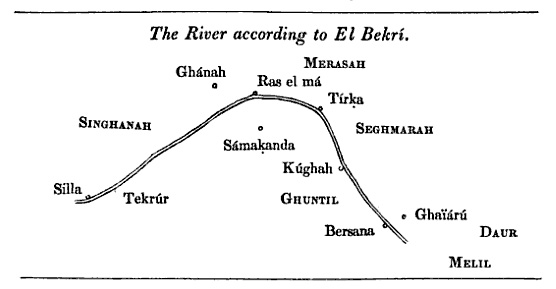
Al-Bakri mentioned that the king had officials (mazalim) who surrounded his throne when he gave justice, and these included the sons of the “kings of his country” which are presumably the same kings that al-Ya’qubi mentioned in his account nearly two hundred years earlier. Al-Bakri‘s detailed geography of the region shows that in his day, or 1067/1068, Ghana was surrounded by independent kingdoms, and Sila, one of them located on the Senegal River, was “almost a match for the king of Ghana.” Sama is the only such entity mentioned as a province, as it was in al-Ya’qubi’s day.
The Senegal River according to Al-Bakri, which shows some sites of the Ghana Empire
Eventually the Ghana Empire’s power declined. It was attacked by other kingdoms in need of their resources. The Ghana Empire eventually merged with the Mali Empire, which became one of the largest empires in African history and one of the richest as well.
On October 4th, 1984, Thomas Sankara addressed the General Assembly of the United Nations. It was a historical speech, as only he, the great orator, could speak. It was moving, it was strong, and it was good. Below is an extract of his speech. For the whole speech, go to thomassankara.net. Enjoy!!!
============
“I speak on behalf of the millions of human beings … thrown out of work by a system that is structurally unjust and periodically unhinged, who are reduced to only glimpsing in life a reflection of the lives of the affluent. I speak on behalf of women the world over, who suffer from a male-imposed system of exploitation. … Women who struggle and who proclaim with us that the slave who is not able to take charge of his own revolt deserves no pity for his lot. This harbors…










 African Heritage