Mali – Burkina Faso – Guinea Agree to form a Tri-Country Axis

Map of Mali with its capital Bamako

It is no secret that 14 African countries today are still under the French colonial tax (The 11 Components of the French Colonial Tax in Africa), and that every year, France takes home upwards of 500 billion dollars (Africa is funding Europe!) from its currency imposed upon those countries. After all, France has no gold mines on its soil but yet is the 4th world producer of gold, gold coming from Mali, while Mali is among the world’s poorest countries on the planet. It is also no secret that Mali has been trying to free itself from this colonial tax (The French Colonial Tax at the Heart of Mali-France Tensions), and has been working tirelessly to revoke at least 8 of the 11 rules. With the unrest in Burkina Faso brought by the Jihadists from the north who were well protected by the French army brought in to protect Burkinabe interests, but who instead have created further unrest in the area, it is no surprise that Burkina Faso has joined forces with Mali, and now Guinea, to create a strategic axis which will focus on military and trade agreements between the 3 countries. Although we do not particularly trust the Guinean leader, we applaud the union between the two brothers Mali and Burkina Faso, faced with sanctions from the puppet organization that is ECOWAS. We also applaud this ‘federation’ which will give Mali and Burkina Faso access to the sea via Guinea, thus opening up these land-locked territories to further trade. Enjoy excerpts below from the People’s Dispatch; check out also the write-up on AfricaNews.

Like Thomas Sankara said, “La patrie ou la mort, nous vaincrons!

====

Burkina Faso
Burkina Faso

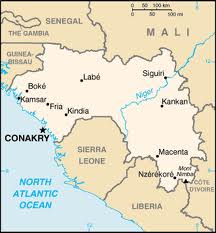
The three West African countries, all of whom have recently undergone military takeovers amid rising public anger against France, have agreed to a Bamako-Conakry -Ouagadougou axis, with enhanced cooperation on matters ranging from trade to the fight against insecurity.

As France is getting ready to withdraw its troops from Burkina Faso by the end of the month, signs of a possible realignment in the region are emerging with a tripartite meeting between the foreign ministers of Burkina Faso, Mali, and Guinea—Olivia Ragnaghnewendé, Morissanda Kouyate, and Abdoulaye Diop—held in Burkina Faso’s capital Ouagadougou on February 8 and 9.

The leaders discussed a range of issues, “in particular the success of the transition processes leading to a return to a peaceful and secure constitutional order,” and, importantly, the “revitalization of the Bamako-Conakry-Ouagadougou axis” to make it a “strategic and priority area” on matters including trade and economic exchanges, mining, transport, roads and railway links, and the “fight against insecurity.”

Guinea-Conakry
Guinea-Conakry

The communique issued following last week’s tripartite meeting condemned the “mechanical imposition of sanctions which often fail to take into account the deep and complex causes of political change,” adding that these measures “affected populations already battered by insecurity and political instability,” “undermine sub-regional and African solidarity,” and “deprive ECOWAS and the AU of the contribution of the three countries needed to meet their major challenges.”

While calling for “technical, financial, concrete, and consistent support” for security efforts and the return to a normal constitutional order, the three countries have agreed to “pool their efforts and undertake joint initiatives for the lifting of the suspension measures and other restrictions.”

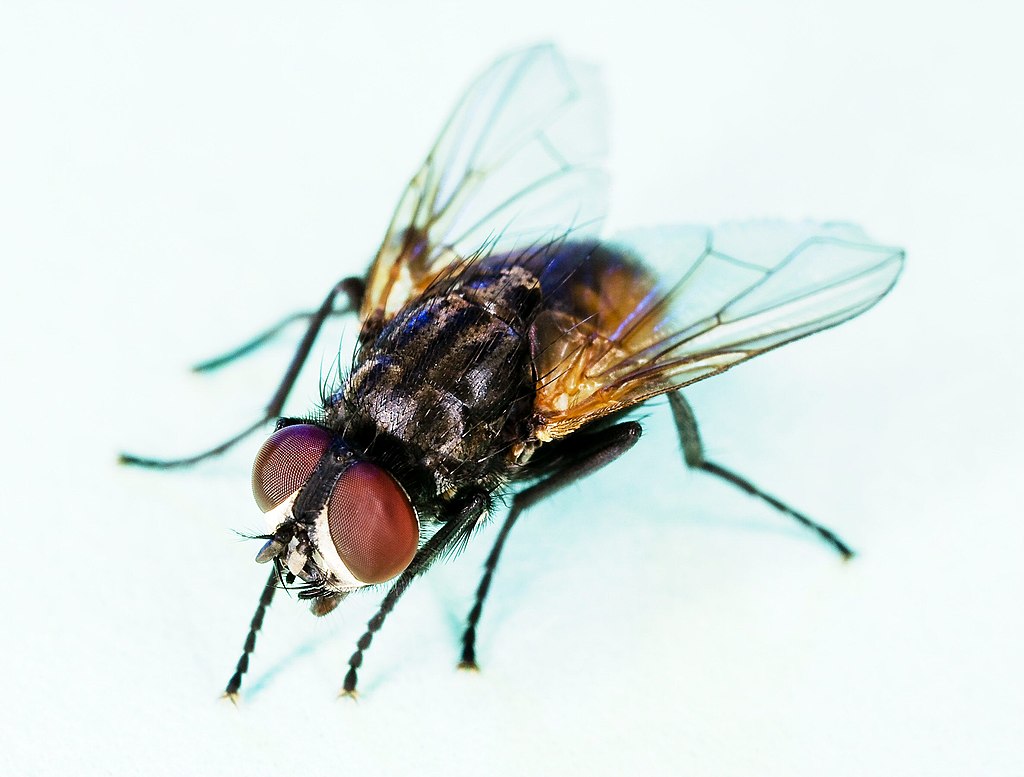
Dieu protège le faible / God Watches over the Weak

Mouche / Fly

C’est Dieu même qui chasse les mouches de l’animal dépourvu de queue (proverbe Minah, Ehwe – Ghana, Togo).

It is God Himself who drives away the flies from the animal without a tail (proverbe Minah, Ehwe – Ghana, Togo).

“Love the African Way” by Esmeralda Yitamben

L’amour / Love

Today, I will share with you a beautiful poem by author Esmeralda Yitamben, “Love, the African Way.” As you remember, I shared the poem ‘African Hair’ by Esmeralda Yitamben which, in my humble opinion, should be published in school books… and which I dearly love. Here is another one, for the lovers out there, and the historians as well. Every part of this poem is rich in history, history of the African continent, of the race, and combines the ancient and the modern faces of Africa : from the scholarly city of Timbuktu, one of the first universities of the world, to the second longest river of Africa, the Congo River and the great Congo Empire, to the libraries of Alexandria, to the sandy beaches of Senegal, from the dunes of The forgotten kingdom of Nubia to the streets of Douala. Imagine climbing the tallest mountain of Africa for someone you love, going to battle like Shaka Zulu, and winning them all like Menelik II (Battle of Adwa)… Imagine a love founded on the rock of the great Egyptian pyramids, and rising like the sphinx, never faltering. No doubt that this is a celebration of victory, of wealth, of the conquest of all battles, and above all… of love. The original poem can be found on Kalaharireview.com. Enjoy!

====

Love, the African Way” by Esmeralda Yitamben

I want to love you in Bambara

And take you to the sacred city of Timbuktu.

Nakupenda Malaika

Is what I will tell you, my angel, in Kiswahili.

Wapi Yo” my dear?

I will speak Lingala and navigate the Congo River looking for you from Kinshasa to Lubumbashi.

On my way, I will stop to contemplate the okapi, whose beauty and grace reminds me so much of yours.

I will climb Mt Kilimandjaro and stand fearlessly like a Maasai warrior.

I will rise on the wings of the sphinx at Thebes,

and revive the rolls of papyri from the burnt libraries of Alexandria,

to read you centuries’ old love poems

And walk the dunes of the ancient kingdom of Nubia at Meroë.

I will celebrate my long lost love on the beach of Dakar, and claim how much I miss you in Wolof “Namm naa la”.

Mase fi mi sile my love, don’t go, is what I will say in Yoruba, so that you never leave me.

You belong to me, natondi wa, I love you, and I will dance to the rhythm of makossa in the streets of Douala.

Like Chaka Zulu, I will be the warrior of your heart, I will fight a thousand battles for you.

And like Menelik II, great emperor of Ethiopia, I will win them all for you, precious one!

Together, we will build an empire as great as the Empire of Mali and our love will be talked about throughout the universe.

And when we finally meet again, I will say M’Bifé, I love you.

Glossary

Wapi Yo = “Where are you?” In Lingala (Congo)

Nakupenda Malaika = “I love you angel” in Kiswahili (Kenya, Tanzania)

Namm naa la = “I miss you,” in Wolof (Senegal, Gambia)

Mase fi mi sile = “don’t leave me” in Yoruba (Nigeria)

Na tondi wa = “I love you” in Douala (Cameroon)

Makossa is a musical style from Cameroon

M’Bifé = “I love you,” in Bambara (Mali)

Les temps difficiles ne durent pas éternellement / Dark Times do not Last Forever

Lu metti yàggul te ku muñ muuñ

Ce qui fait mal ne dure pas toujours, et celui qui persèvere sourit. (Proverbe Wolof – Senegal, Gambie) – Continuez à avancer car les temps difficiles ne durent pas éternellement

Whatever is painful does not last, and whoever perseveres smiles. (Wolof proverb – Senegal, Gambia) Keep going as dark times don’t last forever.

Thomas Sankara re-Burial Boycotted by Family

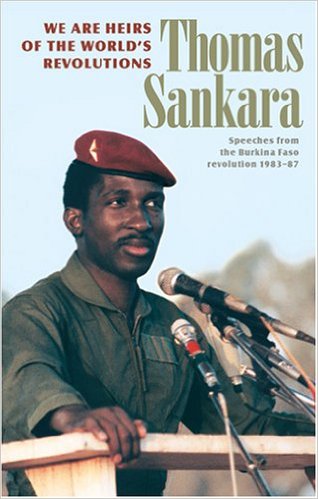
“We are heirs of the revolution” by Thomas Sankara

Almost 4 decades after Thomas Sankara and his 12 companions were treacherously murdered, they are given a burial at the memorial erected in Sankara’s honor in front of the place where they were assassinated, at the Conseil de l’Entente. His family has boycotted the ceremony because, as they say, how can you bury such a hero in the place where he was murdered? In a press release, they said, “We believed and continue to believe that it is fundamental that a space be found that allows to gather and appease hearts, and not to divide and increase resentment,” the Sankaras added in their statement on Sunday, calling the place chosen by the government “conflictual and controversial”. I know that Thomas Sankara now belongs to the entire nation of Burkina Faso, and even to the continent of Africa, but shouldn’t his family have a say as to where he is buried?

At the time of Thomas Sankara and companions’ murders in 1987 ordered by Blaise Compaore and his croonies, Sankara and his comrades were buried in some common fields with no names. Later, their bodies were exhumed in 2015 for legal proceedings.

What do you think? Is it okay to bury Thomas Sankara, our true panafricanist and anti-imperialist revolutionary, who fought for our freedoms, in the place where he was murdered?

As Sankara always said, Homeland or death, we shall overcome!

France to Withdraw Troops from Burkina Faso

Flag of Burkina Faso

This is about 2 weeks old news, but it is a victory nonetheless. France has agreed to a request from Burkina Faso’s military leaders to withdraw all its troops from the country within a month. Remember that, as part of the colonial tax forced upon the Burkinabe people by France (and all other 14 past French colonies in Africa – The 11 Components of the French Colonial Tax in Africa, agreement #6), there is one rule which links Burkina Faso to France via defense agreements where France is supposed to help Burkina Faso in case of external attacks. As we have seen, France has not held its part of the bargain, instead funding and letting jihadists proliferate on the Burkinabe territory and committing abuses against the local populations. There were other defense agreements signed in 2018; this is a rescinding on the 2018 agreements. It is the third African country from which France is forced to move out its troops: Central African Republic, Mali, and now Burkina Faso. It is a victory; Little by little…  As Agostinho Neto said, “A luta continua, e la vitoria e certa.” Enjoy excerpts below from Al Jazeera. For more, read also the piece by Ramzy Baroud on GulfNews.

====

France will withdraw its troops from Burkina Faso within a month after the West African country’s military rulers asked it to leave, the French foreign ministry said, in a move that will further reduce its presence in a region facing growing violence from armed groups.

In a statement released on Wednesday, the French ministry said it had received notice the previous day that a 2018 agreement on the status of French troops in the country had been terminated.

In accordance with the terms of the agreement, the denunciation takes effect one month after receipt of the written notification. We will comply with the terms of this agreement by complying with this request.”

France retains some 200 to 400 special forces in its former colony.

On Monday, Ouagadougou said it had decided to end a military accord that allowed French troops to fight armed groups on its territory because the government wants the country to defend itself.

Burkina Faso’s national television reported on Saturday that the government had suspended a 2018 military accord with Paris on January 18, giving France one month to pull its troops out.

Protests against the French military presence have surged in Burkina Faso, partly linked to perceptions that France has not done enough to tackle the violence that has spread in recent years from neighbouring Mali, whose military rulers asked French forces to leave last year and deployed Russian private security contractors instead.

The Pope Visits the Democratic Republic of Congo and South Sudan

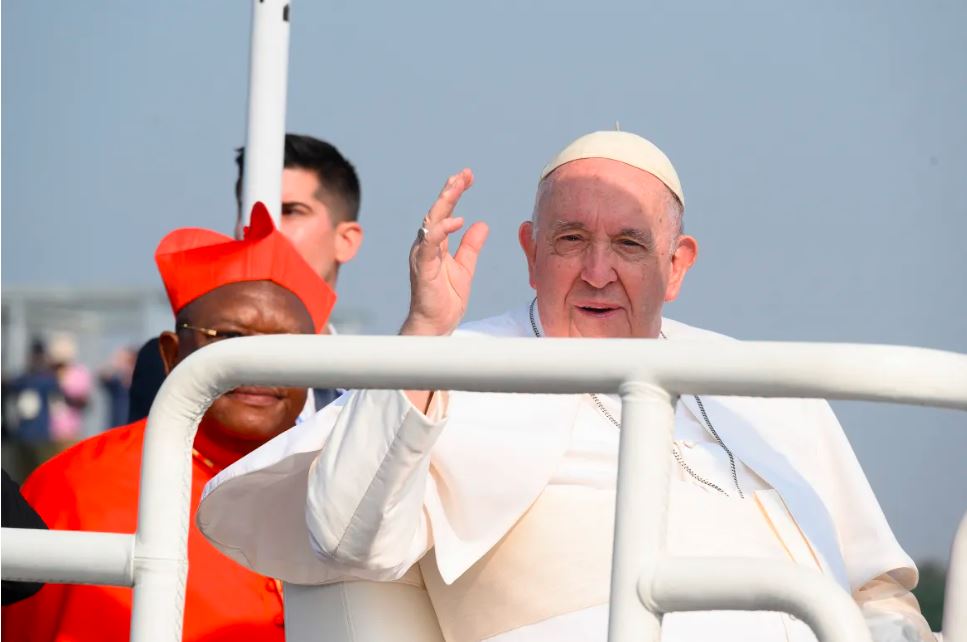
Pope Francis (R) waves as he arrives on the popemobile for the mass at the N’Dolo Airport in Kinshasa. [Source: Arsene Mpiana/AFP – Al Jazeera]
There are no coincidences. Is it a surprise that the Pope is visiting the Democratic Republic of Congo (DRC) just after the big signing of cobalt and copper mines to the US? Or South Sudan oil fields (3rd largest in Africa behind Nigeria and Angola)? This is the first visit of the Holy See in the DRC in 37 years, and his second visit to South Sudan! To all the religious people out there, this is not an attack on religion or the Pope, it is just asking questions: let’s face it, your prayers are not the reason the Pope is visiting the DRC or South Sudan; your resources are! Some people tell me that it is because Africa is the future of Catholicism with the largest growing population of Catholics, but why is there no true African presence at the Vatican then? Others say that the Pope is trying to preach peace… President Charles De Gaulle of France once said that, “states do not have friends, they only have interests.” It is best for Africans not to think of love or friendship, but rather in terms interests.

Flag of Mozambique

Remember how the Pope visited Mozambique just before the major signing of the biggest gas fields in the world to the French firm Total and a condominium of commercial banks from around the world descended upon it? Ever since that 15 billion dollars contract with the French firm Total for the oil in Cabo Delgado, and the discovery of one of the largest oil, gas, diamonds, rubies fields in the world, peace in northern Mozambique has become evasive (Who/What did we say goodbye to in Africa in 2020?). Now they want us to believe that there is an Islamist insurgency in Mozambique of all places! The Islamists passed over Congo, Sudan, Kenya, Tanzania, to land in… Mozambique! After his Mozambican visit, Pope Francis sent money to help the people and children of Mozambique who have been displaced by conflict! … Why did the Vatican not help the government of Samora Machel in their fight for independence back in the days? Lastly, to help with peace in Mozambique, Rwandan troops have been sent there. Rwanda today is a world producer of minerals it does not have on its soil, and we know that neighboring Congo is the real provenance of those. Is it then a coincidence that the same Rwanda that is in conflict in DRC, is the same deployed in Mozambique to protect TotalEnergies’ interests in the region?

Flag of the Democratic Republic of Congo

To come back to the Pope’s visit to the DRC and South Sudan, I wish that while visiting the country, instead of asking the faithful to pray (1-million mass to celebrate the Pope visit in DRC), the Pope could ask for roads or hospitals… the country probably took out of its coffers the money needed for hospitals or roads, to accommodate his visit. Couldn’t he ask that for his next visit, he would like to go from Kinshasa to Lubumbashi by road or rail (not possible at the moment)? The Pope made a grand speech saying all the things Africans love to hear Pope says Hands off Africa: “Hands off the Democratic Republic of the Congo! Hands off Africa! Stop choking Africa, it is not a mine to be stripped or a terrain to be plundered.” However, for the new African generation, the era of words is over, actions speak louder! There is no secret that since the Ukraine war, many foreign leaders have been visiting Africa in search of the next energy source, even the King of Belgium visited Congo in 2022 for the first time since independence and offered words as usual (King Philippe of Belgium’s Visit to the Democratic Republic of Congo (DRC)); after all, Africa is relatively easy to tame: no united governments, poor governance, corrupt leadership, no cohesion, 54 countries, etc. So it is easy to sign a deal for Nigeria’s oil and gas for X amount, and not give a dime to Niger (France’s backyard) for its uranium for instance. This is where the African Union (AU), had it been an organization at the service of its constituents and not external financial backers, would have played an important role.

DRC and Zambia Sign Over Cobalt and Copper Resources Rights to the United States?

Flag of the Democratic Republic of Congo

I was stunned by the recent signing of the DRC and Zambia cobalt and copper mines to the USA!!! You heard me right! Last month during the US-Africa summit, the puppets that are the African leaders, leaders of Zambia and DRC, Hakainde Hichilema and Felix Tshisekedi, signed the total surrender of the supply chain and production of cobalt and copper. Hello? Is this 2023 or what? Did Tshisekedi or Hilema ask the people of their countries before signing these treaties? Was this discussed at the parliament? Not that the parliament is any better, but still, is it not my country? We know that these countries are deep in debt (Zambia Sovereign Debt Crisis), but shouldn’t the citizens know that their lives and resources are being signed away to foreigners? Shouldn’t they have a say? As you know, the DRC supplies 70% of the world’s cobalt, while Zambia supplies 70% of the world’s copper. In the west we are being told that the future is the electric car, which everyone should embrace with the Teslas and all those car brands, but none of this is possible without the DRC resources. The claim is that the agreement is to manufacture electric batteries near the mines or rather facilitate the development of value chain in electric battery and clean energy… but in a place where there are no roads, how much of it will be done on the ground? How much of it is real? It’s like the signing of the trade agreements between the EU and Africa in recent years, where the idea on ‘paper’ was the opening of African markets to Europe and vice versa, but instead the reality is that Africa is submerged with uncontrolled European products, and the local farmers/industries suffer, while there is no real export of African products to Europe.

Zambian flag
Zambian flag

The worst part is that these big multinationals will make billions, but will not even build roads in these countries, not even a single road or hospital! In some countries, when the locals asked for roads or hospitals (Niger, Guinea, etc) they were beaten up, imprisoned, killed, and more. When one learns about the 999-year lease in Kenya (Did You Know about the 999-year Lease granted to Europeans in Kenya ?), one thinks, it happened over a century ago, the locals were illiterate, or not versed in European languages, or in the particular case of the 999-year lease the locals were not even present at the signing table; but today… what is the excuse? Except that maybe we have a lot of traitors, spineless leaders, corrupt leaders, and puppets in our ranks? It is unacceptable!

For the press release of the document, go to the state department website; more articles can be found here, and check out the article by Conor Gallagher via NakedCapitalism on Markets Insider about the race for resources in Congo.

@lesothotribune

MoU was signed that will have the governments of DRC & Zambia surrender the supply chain and production of copper and cobalt to American control for EV market #lesothotribune #zambiantiktok🇿🇲 #drctiktok

♬ original sound – LesothoTribune

The Geological Scandal that is the Democratic Republic of Congo (DRC)

Democratic Republic of Congo (DRC) mineral map (Source: Atlas du continent africain, Jeune Afrique et editions Jaguar, 2000)

Last week, a reader asked us why the Democratic Republic of Congo (DRC) is often referred to as a “geological scandal” of nature. For starters, the DRC is one of the world’s richest countries in natural resources, with the richest concentrations of precious metals and minerals on earth, with large deposits of gold, diamonds, uranium, copper, cobalt, tungsten, coltan, bauxite, cassiterite, and much more. According to the United Nations Environment Program (UNEP), it has about 75% of the world’s coltan, the material at the heart of the mobile phone revolution; about 70% of the world’s cobalt reserves, over 30% of diamond, 10% of copper. The uranium used for the bombs that detonated over Hiroshima and Nagasaki came from the DRC. The electrical car battery revolution is all based on Congo’s wealth; there is no way the West can sustain an electrical car industry without Congo and its reserves. Apart from mineral wealth, the DRC is also one of the most biodiverse areas in the world.

Unfortunately, this abundance of internationally valued minerals and natural resources has however failed to bring any kind of prosperity to the country. It began with colonial exploitation of the land and its people by King Leopold II (King Leopold II and The Congolese Genocide), and continued in bloody civil war; the Congolese have harvested nothing from their country’s natural riches but misery and poverty. The world’s bloodiest conflict since World War II is still going on today on Congo soil, and has made over five million deaths…

For more, check out the article by Colette Braeckman, The Looting of the Congo, BBC – DR Congo: Cursed by its natural wealth and the extensive articles written by a fellow blogger at WiPoKuli Schluter. We had found a good documentary a while back about Congo’s resources, but somehow it is no longer available. So I live you instead with The Race for Africa by Gravitas Plus, which actually helps to understand the importance of Africa (and Congo) today, and the race for its resources. Enjoy!

Electricity producing Stones found in the Democratic Republic of Congo (DRC)?

Map of the Democratic Republic of Congo

In recent days, there have been videos of rare electricity producing stones recently discovered in the Democratic Republic of Congo (DRC) trending on the internet. Online users claim that the ore is the fictitious Vibranium found in the Black Panther movies.  At first, I took the story to be internet hyped stuff, so paid no real attention. After all, isn’t Congo a geological scandal? Isn’t Congo the place with the biggest deposits of coltan, metal at the base of the cell phone revolution we have been experiencing in recent decades? Isn’t Congo the place where new minerals are found often? I paid no real attention until I saw an article on the BBC website published yesterday to address the ‘rumors’. That is when I thought to myself, tosilisi, We are finished! In the article, some scientists in several parts of the world were shown the videos and asked to give their opinions. As you probably guessed, most said that it was an impossibility. The real question is, if the thing is not real, why is the BBC bothering to address a ‘fake’ story? Why not just let it slide like we all did at first? Is it some sort of damage control until the ‘real’ experts are deployed on the ground to assess, and retain all rights to the mines containing this rare ore (like it is usually done in Africa)? Is it a way to make us lose interest so nobody looks until the major multinationals sign deals (remember Mozambique)? Although this will mark an amazing revolution in terms of energy if found to be true, it still makes us fear for the DRC which has been in the midst of civil wars for more than 25 years because of all its large mineral deposits, civil wars funded by foreign money. At this point, the words of anthropologist Coovi Gomez ring true, as he said, truly for Africa to be free, Congo needs to be free; by Congo, he meant the original Congo which encompasses most of Central Africa today.