When I was little, I always wondered why the name Cotonou was given to a major city in Benin. I used to think that the name was probably a French transcription of the word ‘coton’ (cotton) for ‘coton – ou’, and that maybe there used to be a lot of cotton there … but nowhere did I find cotton to be the main export or agriculture of Cotonou or Benin.
For starters, Cotonou is the largest city and the economic capital of the Republic of Benin. Cotonou is known in West Africa for its international market Dantokpa, which is hosted over 20-hectares, and is the largest market in the whole of West Africa, generating over 1 billion CFA-Franc per day. Cotonou is also well-known for its Zemidjans (or moto-taxis, similar to the Cameroonian bend-skins), and its pollution arising from its use of bad petrol (essence frelatée) also known as kpayo, which is fraudulously imported from neighboring Nigeria.
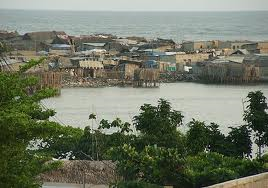
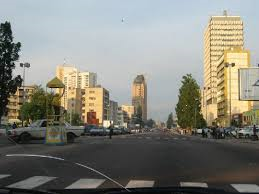
Cotonou, today.
Located on the coastal strip between Lake Nokoué, and the Atlantic ocean, Cotonou’s name comes from the Fon language and means “mouth of the river of death.” At the beginning of the 19th century, Kotonou(as it was then spelled) was a small fishing village. It was originally ruled by the Kingdom of Dahomey until a treaty made with the French by King Ghezo in 1851 allowed the French to establish a trading post at Cotonou. When Glèlè succeeded to his father Ghezo, the territory of Kotonou was ceded to France by a treaty signed on 19 May 1868. After Glèlè’s death in 1889, his son Behanzin tried, unsuccessfully, to challenge the treaty. The town Cotonou then developed itself quickly to become today the largest harbor in the region.
As the economic capital of the republic of Benin, Cotonou hosts 2/3 of the industries of the country, and is the seat of the main enterprises and banks of Benin. It also hosts many of the governmental institutions of the country. It is now the turntable of commerce in the region, especially because of its close proximity with the Nigerian border (and used to be a place for the conversion of the naira), and is the main port for its neighbor land-locked Niger, which is the world’s first producer of uranium. Enjoy this nice video of Cotonou by benin-passion.com.
Today, We will look at a poem by the most celebrated Ivorian writer Bernard Binlin Dadié. The poem below is titled “I Thank you God” or “I thank you my God,” and it is an ode to us Africans, raising the self-esteem. Dadié writes here about his pride of being born Black, around independence, when the colonizer had almost beaten out of us our pride of being Black, our pride of being ‘us’. Enjoy! a great poem from Bernard B. Dadié.
Je vous remercie mon Dieu, dem’avoir créé Noir, d’avoir fait de moi la somme de toutes les douleurs, mis sur ma tête, le Monde. J’ai la livrée du Centaure Et je porte le Monde depuis le premier matin.
Le blanc est une couleur de circonstance Le noir, la couleur de tous les jours Et je porte le Monde depuis le premier soir.
Je suis content de la forme de ma tête faite pour porter le Monde, Satisfait de la forme de mon nez Qui doit humer tout le vent du Monde, Heureux de la forme de mes jambes Prêtes à courir toutes les étapes du Monde.
Je vous remercie mon Dieu, de m’avoir créé Noir, d’avoir fait de moi, la somme de toutes les douleurs. Trente-six épées ont transpercé mon coeur. Trente-six brasiers ont brûlé mon corps. Et mon sang sur tous les calvaires a rougi la neige, Et mon sang à tous les levants a rougi la nature.
Je suis quand même Content de porter le Monde, Content de mes bras courts de mes bras longs de l’épaisseur de mes lèvres.
Je vous remercie mon Dieu, de m’avoir créé Noir, Je porte le Monde depuis l’aube des temps Et mon rire sur le Monde, dans la nuit crée le jour.
Ithank you God, for making me black, for making me the sum of all pains, putting on my head the world. I took the world to the Centaur And I have carried the world since the first morning.
White is a color of circumstance Black is the color of every day And I have carried the world since the first evening.
I am happy with the shape of my head shaped to carry the world, Satisfied with the shape of my nose which has to smell all the scents of the world, Happy with the shape of my legs ready to run all the steps of the world.
I thank you God, for having created me black for having made me the sum of all pains. Thirty-six swords have pierced my heart. Thirty-six brasiers have burned my body. And my blood for all the suffering reddened the snow, And my blood made the east red.
I am still Happy to carry the world, happy with my short arms of my long arms of my thick lips.
I thank you God, for having created me black, I carry the world since the beginning of times And my laughter on the world, at night created the day.
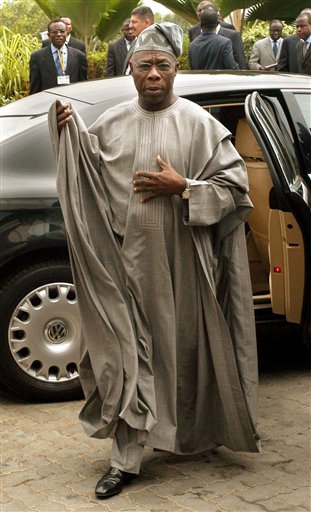
President Olusegun Obasanjo of Nigeria, famous for his grand boubous
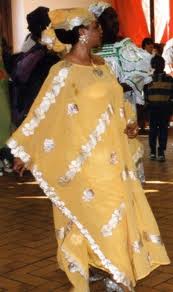
Yesterday I wore my green boubou with intricate gold embroidery in the front for a special African celebration. To say that I looked like royalty is simply an understatement. I looked majestic! So, for starters, you might ask me what is a boubou? Well, a boubou(or bubu, or grand boubou, or grand bubu) is an African garment worn by men and women in much of West Africa, and parts of Central Africa. The boubou generally consists of up to three pieces: a long-sleeved shirt, a pair of tie-up trousers that narrow at the ankles, and an open-stitched overflowing wide sleeveless gown worn over these two; all three are usually the same color, and were historically made from silk, but nowadays are made up of cotton or sometimes synthetic fabric made to resemble silk. The whole will be incomplete without a hat or chechia of any color. A woman’s boubou would differ from a man’s boubou by the fact that it will consists of two pieces: a wrapper at the bottom, and a large overflowing gown to top it all off, and of course an intricate headscarf. Its name comes from the wolof‘mbubb’, which made it into French, as boubou. In Yoruba, it is known as agbada; in Hausa, it is babban riga, while in Tuareg, it is k’sa grand boubou.
Woman wearing a boubou
The tradition of the boubou is old, and can be traced back to as far as the 8th century. Its origin lies with the clothing worn by the Islamized Tukulor (Toucouleur), Mandé, and Songhai peoples of the great Takrur and Ghana empires, and 13th century Mali and Songhai empires. In West Africa, the nobles of the different people were already wearing a garment more or less similar to the actual boubou. The different patterns in the embroidery already had precise meanings which varied for different ethnic groups and regions. The rest of the population, in majority craftsmen and farmers, wore garments similar to tunics for the upper body, and a wrapper or baggy trousers for the lower body.
In the past, in West Africa and Central Africa, only Islamized peoples used to wear the boubou: Fulani, Toucouleur, etc. … the other ethnic groups all had their own traditional garments of more or less similar genre. With trade among the peoples, the fashion industry, many African stylists (such as Alphadi) have specialized into the boubou and it has now gained international exposure.
The video below is short and simple, and addresses the boubou. It is a small documentary from Arte. Enjoy!
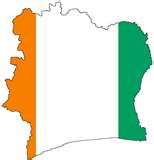
It was on 11 April 2011, exactly 2 years ago, that Côte d’Ivoire, the land of the elephants, was defaced! Yes… I remember the tears streaming down my cheeks as I watched an African country being bombed by a foreign country (France) for … frauds during elections. Before then, I had heard the term ‘francafrique‘, but always thought that it belonged to the past, and never for once thought that in this day and age, after African nations had just celebrated “50 years of independence”, we could be bombed. See the irony of everything? How could our people celebrate 50 years of independence in 2010, and then be bombed in 2011, because of internal affairs? Whether anybody likes it or not, what happened in Côte d’Ivoire was an internal affair: fraud during elections, and international observers sent in to monitor elections all said that there were frauds in the northern part perpetrated by the armed rebels of Alassane Dramane Ouattara (ADO). Since Gbagbo was the man to take down, we then heard that the ‘international community’ was summoning Gbagbo to step down. Who remembers this nice ‘international community’ summoning Bush to let Al Gore take power after election fraud in the US in 2000?
And ever since, France and the ‘developed’ nations have not stopped bombing us: they even ganged up to bomb Libya, now Mali, Central African Republic, … it’s like “who is going to be next?” Yes… centuries and years before, Africa was raped… but it never just stared you in the face like this… or rather they did not openly bomb us? Is it true? the Napalm bombs dropped in Cameroon during the independence war, or the bombs used in Algeria during the Algerian war, or in Madagascar claim otherwise. … I guess in 50 years of independence, our history books had always been written by others, and we willingly let ourselves be brainwashed.
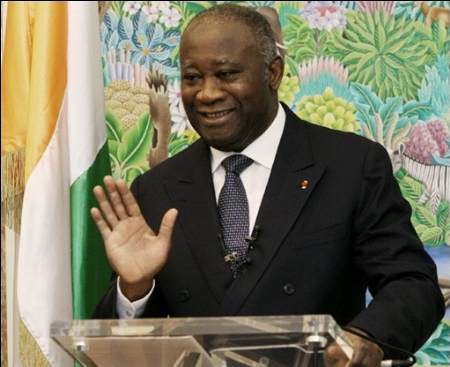
Laurent Gbagbo
Some may ask “why are you writing this now? what good will it do? ADO is in power, Gbagbo is in prison, so there is nothing else to do.” Well… my friends, you sound like losers. We owe it to future generations to write “our” story ourselves, tell “our” side of history. Everybody, or at least … nobody should spend 50 years thinking that they were independent like we did for the past 50. We all need to know that Gbagbo stood for a higher fight, and bravely stood for his country. Because of him we all openly saw what happened in Côte d’Ivoire: how the head of the electoral commission was ‘bribed’ by the French and American ambassadors in Côte d’Ivoire, how Africa was bribed with stupid temporary seats on the UN security council (South Africa, Nigeria and Gabon), how the Nigerian president was called 11 times in a day by the French one (Sarkozy) to force the CEDEAO and ECOMOG to military intervene in Côte d’Ivoire, how Jacob Zuma (the president of South Africa) abandoned Gbagbo (like he later did with Kadhafi, in a 360-degree turn), how the African Union was full of stupid cowards who all sided with the European union, how the international community declared an embargo on medicine (drugs), and refused to deliver any drugs as the country was being bombed, how they blocked cocoa from Côte d’Ivoire (the number one producer of Cocoa in the world) until after ADO took over, how the African intelligentsia just crucified Gbagbo and 50% of Ivorians in a go (without ever voicing a word of reason), how Gbagbo was betrayed by his main generals (Mangou and Kassaraté), and finally how France bombed the presidency of Côte d’Ivoire, murdering thousands on its way. The list is so long… and Yes… we all saw it… and today some are silent… we have to write… it is our duty to our children.
Our celebrated writer, Chinua Achebe said: “There is that great proverb — that until the lions have their own historians, the history of the hunt will always glorify the hunter.” … “It’s not one man’s job. It’s not one person’s job. But it is something we have to do, so that the story of the hunt will also reflect the agony, the travail — the bravery, even, of the lions.”
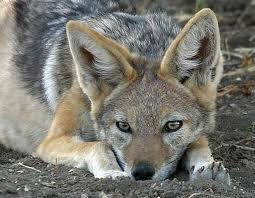
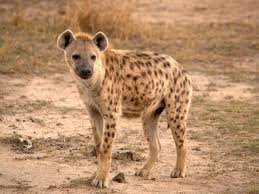
Jackal and Hyena were together, it is said, when a white cloud rose. Jackal descended upon it, and ate of the cloud as if it were fat.
When he wanted to come down, he said to Hyena, “My sister, as I am going to divide with thee, catch me well.” So she caught him, and broke his fall. Then she also went up and ate there, high up on the top of the cloud.
When she was satisfied, she said, “My greyish brother, now catch me. well.” The greyish rogue said to his friend, “My sister, I shall catch thee well. Come therefore down.”
He held up his hands, and she came down from the cloud, and when she was near, Jackal cried out (painfully jumping to one side), “My sister, do not take it ill. Oh me! Oh me! A thorn has pricked me and sticks in me.” Thus she fell down from above, and was sadly hurt.
Since that day, it is said that Hyena’s hind feet have been shorter and smaller than the front ones.
South African Folk Tales, by James A. Honey, 1910, Baker & Taylor Company.
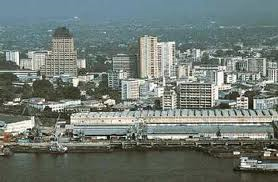
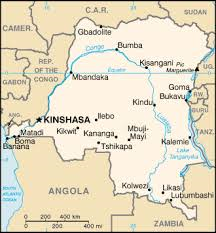
Today I would like to talk about Kinshasa, the capital and largest city of the Democratic Republic of the Congo (DRC). It is located on the Congo River, which happens to be Africa’s largest river, the deepest river in the world, and the third largest in the world by the volume it discharges. Kinshasa is a city of over 9 million inhabitants and directly faces Brazzaville, the capital of the Republic of the Congo: these two sister cities are separated only by the river Congo (the only place in the world where two capitals of two countries face each other). Residents of Kinshasa are known as Kinois.
When did it all start? Well, Kinshasa was founded in 1881 as a trading post by the explorer Henry Morton Stanley who named it Leopoldville in honor of the Belgian king Leopold II, who controled the immense territory of DRC as his private property and not just as a colony. Prior to 1920, all goods arriving by sea in Congo were carried by porters from Matadi (the main port city of Congo), and Leopoldville over 150 km from the coast. From 1886 to 1926, Boma (located on the Congo estuary) was the capital of the Belgian Congo; but after 1926, Leopoldville became the capital.
Kinshasa, seen from the Congo river
In 1965, Joseph-Desire Mobutu who had risen to power after coups d’etat against Patrice Lumumba in 1960, and a second one in 1965, renamed the city Kinshasain an effort to africanize the names of the people and places in the country. Kinshassa was the name of a village which used to be near the site of the present city. In Kikongo, Kinshasa means “the salt market“: “nshasa = salt” and locator ‘ki‘.
The region of Pool Malebo, where Kinshasa is located, has been inhabited since at least the first millenium before our era. However, before colonization, different Bantu groups have occupied the area. During the 16th and 17th centuries, the region of Pool Malebo became a major commercial hub between the river basin and the coastal regions. The Bobangis (also called Bangala, or people of the river) managed the major part of the commerce with the equatorial forest by navigating the river up to the Téké villages of Pool. During the 18th and 19th centuries, more villages develop themselves in the area, which became known as the Batéké plateau. The principal Téké villages were Nsasa with almost 5,000 inhabitants, and Ntambo with at least 3,000. By the time Henry Morton Stanley reached the area on 12 March 1878, the region was already home to 66 villages, and a total population of over 30,000 inhabitants. Stanley chose this location as it was the area where the Congo river became navigable.
Map of the DRC
By the time the city changed its name from Leopoldville to Kinshasa in 1966, the city rapidly grew due to rural exodus of people coming from all parts of the country in search of a better life. In 1974, Kinshasa hosted ‘The Rumble in the Jungle‘ boxing match, a historic match between Muhammad Ali and George Foreman, in which Ali defeated Foreman to regain the World Heavyweight title. This has been one of Ali’s most famous matches: if you watch the movie Ali, you can see scenes of Kinshasa there.
Situated in an area belonging to the Batéké and Bahumbu people, the lingua franca of the city is the Lingala, while the administrative language is French. Kinshasa is also a province of DRC (a bit like the district of Columbia in the US), and is the second largest francophone city in the world, after Paris. Its current population is 9 million inhabitants, making it Africa’s second largest cities after Lagos in Nigeria. Please check out the website for the city of Kinshasa, and Kinshasa-Congo travel to learn about the great city of music and art; I also liked the blog kosubaawate which goes through the evolution of Kinshasa then and now (i.e. before independence and now). Enjoy the video below which I enjoyed for its quality, music, and of course its great content.
Ibrahima Sambégou Diallo may have become the first African mathematician of the contemporary era to have elaborated a theorem. This Guinean journalist who recently reconverted himself into mathematics has found the solution to the Goldbach’s conjecture, which is one of the oldest best unsolved mathematics problems of all times. The Goldbach’s conjecture was elaborated 270 years ago by Christian Goldbach, tutor of the tsar Peter II, and employee in the Russian Foreign affairs’s ministry. In 1742, Goldbach sent a letter to Euler, stating the Goldbach’s conjecture: “Every even integer greater than 2 can be expressed as the sum of two primes.” For instance, 6 = 3 + 3; 8 = 3 + 5; 10 = 3 + 7 = 5 + 5; 30 = 11 + 19 = 13 + 17; 100 = 17 + 83 … This mathematical problem was so hard to solve that it took 270 years, and hundreds of mathematicians around the globe working on it.
It took Ibrahima 14 years of hard work to finally come up with the answer; this projects him in the court of the great mathematicians of this world. He had been in contest with some well-known and well-supported American researchers. Ibrahima Sambégou Diallo has been knocking at all doors to validate his work. Finding no support in his own country, Guinea, Ibrahima has decided to go to Dakar to validate his results at the mathematics institute there. He hopes to find support so as to become the first contemporary African to have elaborated a theorem. For the full article, go to diasporas-noires.com.
Africa just lost a giant… the world just lost a literary genius. Chinua Achebe was made of the cloth of kings. He was the emperor of words and just made reality seems so funny. He wrote in English, but yet made it his own; he made it African. Please hear the maestro in his own words.
“Age was respected among his people, but achievement was revered. As the elders said, if a child washed his hands he could eat with kings.” – Things Fall Apart.
“The white man is very clever. He came quietly and peaceably with his religion. We were amused at his foolishness and allowed him to stay. Now he has won our brothers, and our clan can no longer act like one. He has put a knife on the things that held us together and we have fallen apart,” – Things fall Apart.
Achebe was a man of character, who could not be corrupted by honors. He twice turned down the offer of a title Commander of the Order of the Federal Republic, once in 2004 from Nigeria’s then President Olusegun Obasanjo and again in 2011 from President Goodluck Jonathan. He explained on the BBC: “What’s the good of being a democracy if people are hungry and despondent and the infrastructure is not there,” … “There is no security of life. Parts of the country are alienated. Religious conflicts spring up now and again. The country is not working.” Declining the honor, he wrote that “for some time now I have watched events in Nigeria with alarm and dismay. I have watched particularly the chaos in my own state of Anambra where a small clique of renegades, openly boasting its connections in high places, seems determined to turn my homeland into a bankrupt and lawless fiefdom. I am appalled by the brazenness of this clique and the silence, if not connivance, of the presidency … Nigeria’s condition today under your watch is, however, too dangerous for silence. I must register my disappointment and protest by declining to accept the high honour awarded me in the 2004 honours list.”
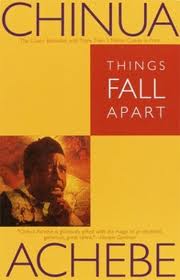
‘Things Fall Apart’ by Chinua Achebe
He wrote: “You see we, the little people of the world, are ever expendable.”
“It is sometimes good to be brave and courageous, but sometimes it is better to be a coward. We often stand in the compound of the fool and point at the ruins where a brave man used to live. He who has never submitted to anything will one day submit to his burial mat.” – Things fall apart.
“While we do our good works let us not forget that the real solution lies in a world in which charity will have become unnecessary.” – Anthills of the Savannah.
“To me, being an intellectual doesn’t mean knowing about intellectual issues; it means taking pleasure in them.”
“Nobody can teach me who I am. You can describe parts of me, but who I am – and what I need – is something I have to find out myself.”
“One of the truest tests of integrity is its blunt refusal to be compromised. ”
“We cannot trample upon the humanity of others without devaluing our own. The Igbo, always practical, put it concretely in their proverb Onye ji onye n’ani ji onwe ya: “He who will hold another down in the mud must stay in the mud to keep him down.” – The Education of a British-Protected Child: Essays.
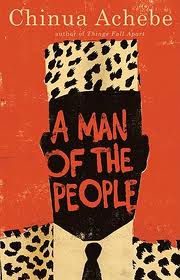
‘A Man of the People’ by Chinua Achebe
“‘It’s true that a child belongs to its father. But when a father beats his child, it seeks sympathy in its mother’s hut. A man belongs to his fatherland when things are good and life is sweet. But when there is sorrow and bitterness he finds refuge in his motherland. Your mother is there to protect you. She is buried there. And that is why we say that mother is supreme.” – Things fall Apart.
“Unfortunately, oppression does not automatically produce only meaningful struggle. It has the ability to call into being a wide range of responses between partial acceptance and violent rebellion. In between you can have, for instance, a vague, unfocused dissatisfaction; or, worst of all, savage infighting among the oppressed, a fierce love-hate entanglement with one another like crabs inside the fisherman’s bucket, which ensures that no crab gets away. This is a serious issue for African-American deliberation…. To answer oppression with appropriate resistance requires knowledge of two kinds: in the first place, self-knowledge by the victim, which means awareness that oppression exists, an awareness that the victim has fallen from a great height of glory or promise into the present depths; secondly, the victim must know who the enemy is.He must know his oppressor’s real name, not an alias, a pseudonym, or a nom de plume!” – The Education of a British-Protected Child: Essays.
“Women and music should not be dated.” – No Longer at Ease
“A man who pays respect to the great, paves the way for his own greatness.”
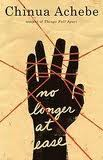
‘No Longer at Ease’ by Chinua Achebe
“I would be quite satisfied if my novels (especially the ones I set in the past) did no more than teach my readers that their past – with all its imperfections – was not one long night of savagery from which the first Europeans acting on God’s behalf delivered them.”
“Procrastination is a lazy man’s apology.” – Anthills of the Savannah
About his gift of writing, he said: “There is that great proverb — that until the lions have their own historians, the history of the hunt will always glorify the hunter. … Once I realized that, I had to be a writer. I had to be that historian.”… “It’s not one man’s job. It’s not one person’s job. But it is something we have to do, so that the story of the hunt will also reflect the agony, the travail — the bravery, even, of the lions.”
Tributes are pouring out from all corners of the world. Truly to have written a book which has been translated in over 50 languages is a great achievement for an African, and for anybody in this world. To boast over 20 literary works is amazing. As the Igbo proverb says: ” it is simply impossible for an iroko tree to fall and the forest to remain quiet.” A giant left us today, but his fingerprints will remain forever.
If the nobel prize was made to celebrate excellence, Chinua Achebe, should have certainly gotten it. Today his work is celebrated in every corner of the world!
This morning, I woke up to the horrible news of Chinua Achebe’s passing. Weird, how just yesterday I had ordered his latest book “There was a Country”, a memoir on the Biafran war. My goodness, how can Achebe be gone? I have all his books in my home library. Just yesterday, I was talking about how great his sense of humor was. My goodness, I was dreaming about reading more books from Achebe. What kind of thing is this?Chinua Achebe, you have inspired me… you have made me want to be a blogger… You have made me want to be a writer, an activist, and a truth speaker … hopefully, one day I will write books as funny as you did.
A friend’s dad went to school with Chinua Achebe, and he had this moral story to tell about Achebe: ” You can never be who you are not and never force your child to be what they were NOT meant to be. Achebe’s parents always wanted him to be a medical doctor. While in school, science was a struggle for him. But once he got back into himself and did what God had planned for him, the sky became his limit.”
So long to the Father of African literature, the inspiration to generations of writers, the maestro himself. Today, I truly felt like ‘things were falling apart.’
Here is a peace I wrote about him back at the very beginning of my blog: see… he was the first article I published in my ‘Great Literature’ section. Chinua Achebe: A Writer like No Other.
Regarde la paume de la main. Elle est toute striée de lignes. De lignes. Certaines sont longues et profondes. Les autres sont moins profondes mais plus serrées. C’est leur dessin qu’on appelle empreintes digitales.Et bien, il parait qu’autrefois nos ancêtres ne connaissaient pas ces lignes: la paume de leurs mains était parfaitement lisse. Si tu veux savoir comment elles sont apparues, écoute l’histoire que m’a racontée, un soir, le vieux koriste.
Un pécheur avait deux femmes. L’une, Ahou, était la mère de nombreux enfants. L’autre, Adjoua, ne pouvait en avoir: elle était stérile.
Naturellement, Ahou et ses enfants se moquaient sans cesse d’Adjoua et celle-ci ne pouvait que pleurer devant les railleries et les insolences de sa rivale.
Au début le pêcheur avait défendu Adjoua, mais peu à peu il se désintéressait d’elle et l’avenir, sans enfants, lui apparaissait bien triste.
Un jour qu’elle se sentait particulièrement malheureuse, Adjoua prit une décision : elle irait consulter la vieille Aya et grâce à ses remèdes, elle aurait des enfants.
Aya était une très vieille femme qui connaissait parfaitement toutes les plantes de la forêt. Elle connaissait non seulement le nom secret de ces plantes mais aussi la façon de les récolter, de les préparer pour obtenir des remèdes efficaces. On racontait que grâce à Aya beaucoup de femmes qu’on croyait définitivement stériles avaient pu avoir de nombreux enfants.
Seulement il n’était pas facile de se rendre auprès de cette guérisseuse car elle vivait à l’écart de tout village et bien des femmes l’avaient cherchée en vain. Les difficultés de l’entreprise ne découragent pas Adjoua. Pendant toute une lune, elle prépare soigneusement son voyage, en grand secret. Et le matin prévu pour le départ arrive. Le pêcheur est alors sur la lagune, en train de relever ses nasses. Ahou, la rivale, entourée de tous ses enfants, est occupée à piler des bananes plantations pour le foutou. Adjoua pose une grande calebasse sur sa tête et fait semblant d’aller chercher de l’eau au marigot. Mais dans la calebasse elle a dissimulé un petit ballot bien serré contenant des pagnes et tous les bijoux qu’elle possède.
Les mains
Les dernières cases du village dépassées, elle commence à courir. Elle pense: Si je ne rencontre pas Aya ou si ses remèdes sont impuissants, je ne rentrerai plus jamais au village ! Le voyage dure huit jours et pourtant elle s’arrête à peine pour se reposer. Le soir du huitième jour elle aperçoit la case de la guérisseuse. La vieille femme est occupée à écraser des graines rouges entre deux pierres. Sans lever la tête, sans interrompre son travail, elle prend la parole: Tu es Adjoua, je sais pourquoi tu viens me voir ton courage sera récompensé. Je t’ai préparé un remède qui te donnera l’enfant que tu désires. Prends le paquet de feuilles posé sur la pierre du foyer: tu en feras une infusion que tu boiras. Mais attention! Veille à ce que l’enfant ne pleure pas et, surtout, qu’il ne s’approche jamais de la lagune. Sinon, il ne serait plus à toi. Tu peux partir. Tu ne me dois rien.Et la vieille continue à écraser ses graines rouges sur la meule dormante. Elle n’a même pas levé la tête. Adjoua, stupéfaite, n’a même pas vu son visage. Elle se retrouve sur le chemin du retour, serrant contre elle son précieux paquet d’herbes.
Quelques mois plus tard, elle donne naissance à un garçon. Ahou est folle de jalousie. Ses enfants et elle cherche toutes les occasions possible de faire de la peine à Adjoua; ils appellent son fils : Enfant de plantes.
Adjoua fait semblant de ne pas entendre et l’enfant grandit heureux, serré dans un pagne sur le dos de sa mère. Un jour Ahou prétend que le fils d’Adjoua a mordu le doigt de sa fille. Elle frappe l’enfant et le chasse sur le sentier qui descend vers la lagune. Il avance de plus en plus vite, comme attiré par l’eau. Alertée par les hurlement de sa rivale, Adjoua ,qui est aux champs, accourt. Mais il est trop tard. Et il continue d’avancer, sourd aux appels de sa mère. Elle réussit à le rattraper et à l’empoigner par les cheveux. Hélas! seuls les cheveux lui restent dans la main. C’est tout ce qu’elle garde de son enfant.
Et c’est ce que nous conservons aussi dans la paume de nos mains.
Conte tiré de “Contes des Lagunes et Savanes,” Collection ‘Fleuve et Flamme,’ édition Edicef, 1975













 African Heritage