Since we are on the subject of Soweto 1976, and since last week Madiba (Nelson Mandela) gave us a scare, I decided to publish the song ‘Asimbonanga’ by Johnny Clegg. ‘Asimbonanga‘ or ‘We have not seen him’ was released by Johnny Clegg and Savuka, in the album Third World Childin 1987, and called for the release of Nelson Mandela, and also gave homage to three martyrs of the anti-apartheid struggle: Steve Biko, Victoria Mxenge, and Neil Aggett. I have posted the song with lyrics below (translation of the Zulu words to English is in italics). Enjoy, and don’t forget to visit Johnny Clegg’s website: johnnyclegg.com.
With the cleansing ceremony for the Marikana massacre taking place today, I couldn’t help but think about similarities, if any, between the Soweto uprisings of 1976, and the Marikana miners’ strike of 2012.
First of all, the Soweto uprising on June 16, 1976, was a movement of school children protesting against the use of Afrikaans as a medium in school and the fact that this was essentially limiting their career opportunities leading them to mostly menial jobs later in life; besides Afrikaans was the language of the oppressor, and in itself a symbol of oppression. The school children were reprimanded in blood by police from the apartheid government of John Vorster. It was a brutal repression. The pictures, particularly, that of Hector Pieterson‘s dead body being carried away by another student alongside his sister, were just heart-wrenching.
Soweto uprising 16 June 1976
Over 30 years later, Marikana happened, albeit not on the same giant scale. Miners protesting for wages were repressed in blood by the police on 16 August 2012; this time under the free government of the rainbow nation led by Jacob Zuma. The violence used by the police was just as shocking, and has been compared by the media to the Sharpeville massacre.
Hector Pieterson being carried away by Mbuyisa Makhubo, with his sister running alongside (Photo by: Sam Nzima)
The similarities are important: both events showed police brutality against unarmed school children (Soweto 1976), and unarmed miners (Marikana 2012); Note: there are some claims that one miner shot first at the police before the police opened fire at Marikana, and images show that some of the miners had machetes. Both events showed poor judgment (more like lack of judgment) from government, and police repressive use of force. Both events harbored bloodshed. What Marikana 2012 showed us is that police brutality is the same decades later. I always wondered why didn’t the police use fake bullets in both cases? If the police was trying to restore order in both cases, why not use common sense and use rubber bullets instead? They have the upper hand and the bullet proof vests (and the dogs), they should act like the adults in the play.
Miners demonstrating at Marikana
The main difference, is that unlike Marikana, where the police was dealing with adults, the police in Soweto dealt with school children. Where is this world going when we now attack, hurt, and kill children?Has the human race descended so low? And the apartheid government had a clear agenda against color and race, while the current government’s agenda seems to be driven by capitalism. The children of Soweto were demonstrating for a better education, while the miners of Marikana were workers demonstrating for increased wages…
In the end, Soweto 1976 cannot be compared to Marikana 2012, where the government did not even conduct an investigation, and did not present apologies (or did they?) as they did not consider the lives of these Black children relevant in the apartheid society. And even today, one can see the difference between both events in the length at which Marikana was covered in the South African press, and the small number of archives (accessible?) on Soweto 1976. Besides, Soweto 1976 marked a turning point in the end of the apartheid regime. One thing is for sure, both events should never happen in the history of a nation.
This is my two-cents on this… What do you think were the similarities between Marikana 2012 and Soweto 1976? Were there similarities in your opinion? As people protest around the world, how do you stop police brutality? How do we ensure that lives are preserved, while populations’ protests are taken into account?
Soweto uprising: children walking peacefully (Source: Ezakwantu.com)
The Soweto massacre or Soweto uprisings also known as June 16, were some of the biggest massacre of the apartheid regime in South Africa, mostly because it showed police repression against kids. On June 16, 1976, Black high school children in Soweto protested against the Afrikaans medium decreeof 1974 which forced the schools to use Afrikaans as one of the main languages in schools (50-50 with English): Afrikaans was to be used to teach mathematics, arithmetic, etc… In the 1950s, 60s, and 70s, many people preferred English as the school language, the commerce language, etc, because of the violence attached with Afrikaans which was the language of the oppressor.
Soweto Uprising: children running away (Source: kilimedia.com)
On June 16, 1976, over 20,000 school children took part in protests which left over 700 dead (the official numbers say 176, but we all know that this number could not be further from the truth). On that bright morning, 10,000 – 20,000 black students walked from their schools to Orlando stadium for a peaceful rally against the use of Afrikaans, the oppressor’s language, in school. The protest had been carefully planned by the Soweto Students’ Representative Council’s (SSRC) Action Committee, with support from the Black Consciousness Movement, and teachers from Soweto. The students were marching and they found out that police had barricaded the road along the intended route. The leader of the SSRC action committee then asked the crowd not to provoke the police, and the march went on on a different route, eventually ending up near Orlando High School. The students were marching, singing, and waving placards with slogans such as, “Down with Afrikaans“, “Viva Azania“, and “If we must do Afrikaans, Vorster must do Zulu.”
Hector Pieterson being carried away by Mbuyisa Makhubo, with his sister running alongside (Photo by: Sam Nzima)
One officer shot and fired his gun causing panic and chaos. Students started screaming and running, as more gunshots were being fired, and the police let out their dogs on children who responded by stoning the dogs. The police then began to shoot directly at the children. One of the first students to be shot dead was 13-year-oldHector Pieterson, who became the symbol of the Soweto uprisings. The picture of his dead body being carried away by another student while his sister ran beside them in tears, was captured by news photographer Sam Nzima, and made it worldwide. The police patrolled the streets throughout the night as the students came under intense attack. Emergency clinics were swamped with injured and bloody children. The police requested the hospitals to provide a list of all victims with bullet wounds, but the doctors refused to create the list, and recorded bullet wounds as abscesses. On the 17th of June, 1,500 heavily armed police officers were deployed to Soweto carrying automatic rifles, stun guns, and carbines. They were driving in armored vehicles with helicopters, while the South African army was ordered on standby… for repression onto school children.
In the end, the Soweto uprising established the leading role of African National Congress (ANC) against the apartheid regime; it marked the turning point in the opposition to white rule in South Africa. Formerly, the struggle had been fought outside South Africa, in neighboring countries (Rhodesia – Zimbabwe, South-West Africa – Namibia, and Angola), but from that moment forward, the struggle became internal as well as external.
June 16th is now celebrated in South Africa as a public holiday. Enjoy this quick collage about the events of June 16th, and please remember to commemorate the lives of innocent children killed on this day in South Africa, children whose future were ended too early. Don’t forget to check out these articles on BBC, Libcom.org, South Africa Info, and watch the video on Independent Lens on PBS.
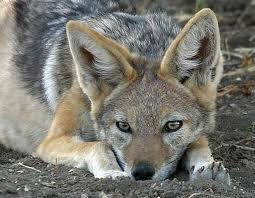
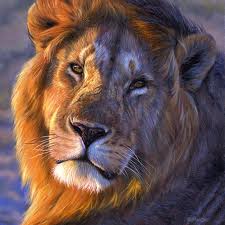
It so happened one day that Lion and Jackal came together to converse on affairs of land and state. Jackal, let me say, was the most important adviser to the king of the forest, and after they had spoken about these matters for quite a while, the conversation took a more personal turn.
Lion began to boast and talk big about his strength. Jackal had, perhaps, given him cause for it, because by nature he was a flatterer. But now that Lion began to assume so many airs, said he, “See here, Lion, I will show you an animal that is still more powerful than you are.”
They walked along, Jackal leading the way, and met first a little boy.
“Is this the strong man?” asked Lion.
“No,” answered Jackal, “he must still become a man, O king.”
After a while they found an old man walking with bowed head and supporting his bent figure with a stick.
“Is this the wonderful strong man?” asked Lion.
“Not yet, O king,” was Jackal’s answer, “he has been a man.”
Lion
Continuing their walk a short distance farther, they came across a young hunter, in the prime of youth, and accompanied by some of his dogs.
“There you have him now, O king,” said Jackal. “Pit your strength against his, and if you win, then truly you are the strength of the earth.”
Then Jackal made tracks to one side toward a little rocky kopje from which he would be able to see the meeting. Growling, growling, Lion strode forward to meet the man, but when he came close the dogs beset him. He, however, paid but little attention to the dogs, pushed and separated them on all sides with a few sweeps of his front paws. They bowled aloud, beating a hasty retreat toward the man. Thereupon the man fired a charge of shot, biting him behind the shoulder, but even to this Lion paid but little attention. Thereupon the hunter pulled out his steel knife, and gave him a few good jabs. Lion retreated, followed by the flying bullets of the hunter.
“Well, are you strongest now?” was Jackal’s first question when Lion arrived at his side.
“No, Jackal,” answered Lion, “let that fellow there keep the name and welcome. Such as he I have never before seen. In the first place he had about ten of his bodyguard storm me. I really did not bother myself much about them, but when I attempted to turn him to chaff, he spat and blew fire at me, mostly into my face, that burned just a little but not very badly. And when I again endeavored to pull him to the ground he jerked out from his body one of his ribs with which he gave me some very ugly wounds, so bad that I had to make chips fly, and as a parting he sent some warm bullets after me. No, Jackal, give him the name.”
South African Folk Tales, by James A. Honey, 1910, Baker & Taylor Company.
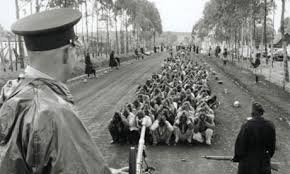
In a prison camp in Kenya during the Mau Mau rebellion (Source:The Guardian)
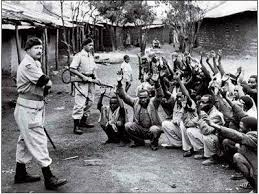
The British government finally recognized its wrong-doings in Kenya, during the Mau Mau uprising, and publicly apologized for it. The British colonial forces thoroughly tortured and murdered thousands of people during the Mau Mau revolt against British rule in Kenya in the 1950s. The British foreign secretary admitted last Thursday (06/06/2013) that: … ” on behalf of Her Majesty’s government, that we [the British government] understand the pain and grievance felt by those who were involved in the events of the emergency in Kenya.”… “The British government recognizes that Kenyans were subject to torture and other forms of ill-treatment at the hands of the colonial administration. The British government sincerely regrets that these abuses took place and that they marred Kenya’s progress towards independence.”
Under British guns, during the Mau Mau rebellion in Kenya in the 1950s
So today’s surviving victims, 5228 people will receive a payment of £19.9m for compensation. The compensation amounts to about £3,000per victim and applies only to the living survivors of the abuses that took place. As I read this… first I was happy that after so many years (over 60 years), the British government could finally acknowledge their atrocities in Kenya, and I think this opens the door for other colonial powers to openly recognize atrocities they perpetrated in their colonies: such as the massacre and genocides perpetrated by the French in Cameroon, Algeria, and Madagascar during the colonial era and after independence. However, when I read the amount given to every victim, I gasped in shock: 3000 pounds per person? what is that? Is that a joke? What would £3,000 do to somebody who has been tortured, raped, and beaten to death? Would it erase the debilitating pain, and all those years spent fighting for the British to acknowledge their wrongdoings? Finally what is money compared to the pain? What is the British government doing to ensure that no such thing would ever happen again? As we know, paying quickly so that nobody bothers you is easy, but has anything been put in place for this never to occur again? Or would other citizens of the world have to fight 50 or 100 years from now for yet another apology?
Enjoy the documentary below on the Mau Mau rebellion… no amount of money can erase this! The case in court used some of the work by Harvard professor Caroline Elkins.
The BBC recently had a photojournal article on the lost Africans of India, and I thought it wise to talk about our brothers from the Indian subcontinent. The Sidi or Siddi, or Sheedi, or Habshi, are said to have first arrived on the Indian subcontinent around 628 AD at the Baruch port. Several others followed; most Siddis are believed to be descendants of traders, sailors, soldiers, servants, and merchants of East Africa. The biggest wave of migration is said to have lasted between the 12th and 19th centuries. Most Siddis are Bantu descendants from southeast Africa. In the 13th and 14th centuries, most slaves were mainly drawn from countries in the Nile region: lower Egypt, Ethiopia, Somalia, and Sudan. Due to their fighting prowess, many became soldiers in the armies of conquerors and sultans all over India’s princely states. They were wanted mostly because of their loyalty and strength, and received grants of land in return for their valorous services. With the arrival of the Europeans, especially the Portuguese, into the slavery scene in the 16th century, Siddis were now drawn from the inner continent in regions such as the Congo, and as far down the East African coast as Mozambique, Malawi, and Tanzania.
The origin of the word Siddi is very controversial. Some believe that it was a term of respect in North Africa similar to the word sahib used in India; others believe that it derived from the title borne by the captains (known as sayyib) of the Arab vessels that first brought Siddi settlers to India; while others believe that the word habshi (another term for siddi) is derived from the common name for the captains of the Ethiopian/Abyssinian ships that also first delivered Siddi slaves to the subcontinent.
Siddi dancers of Goma music
Today, many Siddis reside in the Western states of Karnataka, Gujarat and Maharashtra, with some in the city of Hyderabad in India and Makran and Karachi in Pakistan. India counts about 20,000 to 50,000 Siddis. Their communities are very poor, and many have kept together, and do not marry outside. Siddis are mostly muslims, but some are christians; with few adopting Hindu as they could not fit appropriately in the Hindu caste society. Today, the Siddis are called a ‘scheduled caste‘, or ‘scheduled tribe‘, which simply gives them access to reserved quotas of government jobs, quotas in state schools, bursaries and subsidized housing. As is the case with the descendants of black slaves in the Americas, most of the Siddis of India do not know where their ancestors came from in Africa, but, amazingly, they have somehow preserved some of the musical and dance traditions of their long-lost forefathers (again, similar to Africans in the Western Hemisphere). Their African-derived music is known as the Goma and is clearly African in origin.
Siddi man from Karnataka
Many of the well-known Siddis in Indian history were war generals. One of them was Jamal-ud-Din Yaqut who rose to prominence in the Delhi Sultanate period prior to the rise of the Mughals of India, as a close confidant of Razia Sultana (1205–1240CE); it has been speculated that he was her lover. Many of the kingdom’s noblemen resented the relationship between Razia Sultana and Yaqut, first since she was the first female ruler of the Delhi sultanate, but also because she elevated him to the great title rank of Amir of Amirs. Other important Siddis have been Yakut Khan, a naval admiral and administrator of Janjira fort who served under the reign of the Mughal EmperorAurangzeb; and Malik Ambar who created an army of over 1500 men on his own; and general Hoshu Sheedi, who was a Supreme Commander of Sindh‘s Talpur army, who fought with valor against the British in the Battle of Dabbo and laid down his life in defense of his country.
Lastly, it is good to note that Africans have influenced civilizations around the world, and continue to influence them to this day: many great cities and empires were built thanks to them. Imagine that some of the great generals and confidants of the Mughal empire were of African descent… doesn’t that make you proud? To learn more about the Siddis of India, don’t forget to check out BBC’s photojournal. Please read the article on The Lost Indians on NigerianMasterweb.com, India’s Sidis on The East African journal, as well as the article in the International Business Times.
What comes to mind when I say Marrakesh? Well, for starters, when I hear the name Marrakesh, my mind is immediately submerged by thoughts of Arabian nights, Mediterranean scents, spices and flavors, camels, oasis, couscous, men in gabar, beautiful mosques, beautiful women, sandy dunes, etc… So how far am I from the truth and what is the origin of the name Marrakesh?
Located near the foothills of the snow-capped Atlas mountains in Morocco, Marrakesh was the most important of the four former imperial cities in Moroccan history. Spelled Merrakecin Berber or Marrakech in French, the name has its origin from the Amazigh (Berber) words ‘mur(n)akush‘ which means “Land of God.” Another interpretation will call it ‘thelandof journey.’ From Neolithic times, the city had been inhabited by the Amazighs people, and was founded in 1062 by Abu Bakr ibn Umar, sovereign and cousin of Yusuf ibn Tashfin. Led by the Almoravids, and later the Almohads, many mosques including the world-renowned Koutoubia mosque were built during the 12th century with Andalusian influence. Several palaces were built whose main characteristics were the carved domes, and lobed arches. The Andalusian influence merged with Saharan elements as well as West African, and all that was synthetized to give a very original architecture specially adapted for the weather of Marrakesh. The city became the capital of the Almoravid emirate which went from the shoreline of the Senegal river to the center of Spain, and from the atlantic littoral up to Algiers. The red walls of the city, built by Ali ibn Yusuf in 1122-1123, were built from red sandstone gave Marrakesh’s nickname as the ‘RedCity‘ or the ‘Ochrecity‘, as well as the ‘pearlofthesouth‘ or the ‘doortothesouth.’
A souk in Marrakesh
Marrakesh grew rapidly and established itself as a cultural, religious, and trading centre for the Maghreb and sub-Saharan Africa; Jemaa el-Fnaa or Djemaa el-Fnaa is one of the most famous squares in all of Africa and is the center of the city activity and trade, and has been declared UNESCO World Heritage site since 1985. After a period of decline, the city was surpassed by Fez, in the early 16th century, Marrakesh again became the capital of the kingdom and reestablished its former glory especially during the reigns of the wealthy Saadian sultans Mohammed El Mahdi, Abu Abdallah al-Qaim and Ahmad al-Mansur who embellished the city with sumptuous palaces such as the El Badi Palace (1578), and restored many ruined monuments. Under the Saadian reign, Marrakesh regained its position as a central point linking the Maghreb, the Mediterranean basin, and Sub-Saharan Africa via its caravan routes.
Today, Marrakesh is one of the busiest cities in Africa; it is a big tourist destination, and a major economic center. It has the largest traditional Berber market (souk) in Morocco, with over 18 souks selling anything from traditional Berber carpets to modern consumer electronics. It is also home to the Cadi Ayyad University, which is one of the major universities of Morocco.
I remember listening to this song on one of the Putumayo‘s CDs. Here is ‘So Long’ by Majek Fashek. This is a song to all Africans, and children of Africa, to arise and awake from their sleep. This is a song about unity, and remembrance of our great heritage. I had to share it with you all. Enjoy! and remember what Majek Fashek says: “Arise from your sleep Africa … There’s work to be done Africa … if we unite, we will be free … we’ve been sitting down for so ooo long …”
Arise from your sleep Africa Arise from your sleep America
There’s work to be done Africa There’s work to be done America
if we unite, we will be free so long, for too long so long, for too long
we’ve been sitting down for so oooo long we’ve been fooling round for too oooo long we’ve been sitting down for so oooo long
so long, so long for too long, for too long
Oh Lord, can you hear me now Oh Lord
Remember, remember, long long time ago when we used to live like prince and princess
Remember, remember, the pyramids of Egypt when we used to live like prince and princess
Remember, remember, Who had a dream for you Africa
Remember, remember, Martin luther King Who had a dream for you America
They say you are black, they say you are brown They say dem white, they say you are brown
But only the Angels of God is white But only the Angels of God is white
so long, so long for too long, for too long we’ve been sitting down for so oooo long we’ve been fooling round for too oooo long
Arise from your sleep Africa Arise from your sleep America
There’s work to be done Africa There’s work to be done America
if we unite, we will be free so long, for too long so long, for too long
Remember, remember, Who had a dream for you Africa
Remember, remember, Martin luther King Who had a dream for you America
Remember, remember, King Selassie Who was betrayed by his people
Remember, remember, Lord Jesus Christ Who died for you and I for salvation
They say you are black,[do you believe?] they say you are brown [do you believe?]
But only the Angels of God is white But only the Angels of Jah is white
we’ve been sitting down for so oooo long we’ve been fooling round for too oooo long
Avec l’approche de l’été, j’ai trouvé bon de vous introduire à un rafraîchissant favori des africains, et en particulier des camerounais. Durant les mois chauds de l’année, les camerounais adorent les fruits: les oranges, les pastèques, et les ananas (en fonction de la saison). Les marchands ambulants au bord des routes vous pèlent et vendent des oranges à longueur de journée. Je me suis toujours dit que la façon dont les oranges étaient pelées était très artistique: le marchand vous pèle l’orange à une de ces vitesses de telle sorte que les épluchures tombent sur le sol de façon géometrique; aucune machine ne pourrait competir avec cela. Dans la ville de Douala, en plus des oranges, les ananas et les pastèques sont particulièrement en vogue, et les vendeurs épluchent et coupent ces fruits et les arrangent géometriquement dans un contenaire géant en plastique transparent a la forme d’un seau cylindrique, et rempli de glaçons. Une tranche d’ananas ou de pastèque, aura tres vite fait de vous téléporter vers d’autres cieux. Amusez-vous à regarder cette video d’une vendeuse de fruits au Cameroun, et prêtez attention à la vitesse et précision avec laquelle elle épluche ses oranges!
==================
Pineapple (ananas)Watermelon (pastèque)
As summer approaches, I thought it wise to talk about one of the favorite refreshers of people in Africa, and most particularly of Cameroon. During the hot months, people in Cameroon particularly enjoy fruits: oranges, watermelons, and pineapples depending on the season. So the street hawkers will peel and sell you oranges. I always thought that the way the oranges were peeled was quite artistic: the seller peels it in a quick succession, and no machine could even compete. In the city of Douala, pineapples and watermelons are particularly en vogue, and the street hawkers will peel and cut the fruits and lay them out in an artistic and geometric way inside a transparent plastic in the shape of a cylindrical bucket full of ice. Once the customer places the order, one slice of pineapple or watermelon, and you are suddenly transported to heaven! Enjoy a video of a fruit seller in Cameroon, and pay attention to the precision with which she peels the oranges.
I would like to share with you this poem of the late president of Senegal, Léopold Sédar Senghor. This poem is an ode to the Black woman, but above all, to Senegal his country. Yes… after reading it several times, one realizes that Senghor was writing an ode to the Black woman, his mother, his sister, his daughter, but above all to Senegal which could be loved just like a woman, and whose “beauty stroke him to the heart like the flash of an eagle”, and whose “Savannah stretch[ed] to clear horizons, savannah shuddering beneath the East Wind’s eager caresses.” This poem was published in ‘Chants d’Ombre’ (1945), English translation by Melvin Dixon (in The Collected Poetry (CARAF books …)). As you read Senghor’s poem, do you see other meanings? who do you think was the intended audience? Do you feel, like me, that he is praising Senegal, the land of his ancestors? or is he talking about the woman of his dreams? Enjoy!
Femme noire
Femme nue, femme noire Vétue de ta couleur qui est vie, de ta forme qui est beauté J’ai grandi à ton ombre; la douceur de tes mains bandait mes yeux Et voilà qu’au cœur de l’Eté et de Midi, Je te découvre, Terre promise, du haut d’un haut col calciné Et ta beauté me foudroie en plein cœur, comme l’éclair d’un aigle
Femme nue, femme obscure Fruit mûr à la chair ferme, sombres extases du vin noir, bouche qui fais lyrique ma bouche Savane aux horizons purs, savane qui frémis aux caresses ferventes du Vent d’Est Tamtam sculpté, tamtam tendu qui gronde sous les doigts du vainqueur Ta voix grave de contralto est le chant spirituel de l’Aimée
Femme noire, femme obscure Huile que ne ride nul souffle, huile calme aux flancs de l’athlète, aux flancs des princes du Mali Gazelle aux attaches célestes, les perles sont étoiles sur la nuit de ta peau.
Délices des jeux de l’Esprit, les reflets de l’or ronge ta peau qui se moire
A l’ombre de ta chevelure, s’éclaire mon angoisse aux soleils prochains de tes yeux.
Femme nue, femme noire Je chante ta beauté qui passe, forme que je fixe dans l’Eternel Avant que le destin jaloux ne te réduise en cendres pour nourrir les racines de la vie.
Black Woman
Naked woman, black woman Clothed with your colour which is life, with your form which is beauty
In your shadow I have grown up; the gentleness of your hands was laid over my eyes. And now, high up on the sun-baked pass, at the heart of summer, at the heart of noon, I come upon you, my Promised Land, And your beauty strikes me to the heart like the flash of an eagle.
Naked woman, dark woman Firm-fleshed ripe fruit, sombre raptures of black wine, mouth making lyrical my mouth Savannah stretching to clear horizons, savannah shuddering beneath the East Wind’s eager caresses Carved tom-tom, taut tom-tom, muttering under the Conqueror’s fingers Your solemn contralto voice is the spiritual song of the Beloved.
Naked woman, dark woman Oil that no breath ruffles, calm oil on the athlete’s flanks, on the flanks of the Princes of Mali Gazelle limbed in Paradise, pearls are stars on the night of your skin
Delights of the mind, the glinting of red gold against your watered skin
Under the shadow of your hair, my care is lightened by the neighbouring suns of your eyes.
Naked woman, black woman, I sing your beauty that passes, the form that I fix in the Eternal, Before jealous fate turn you to ashes to feed the roots of life.





 African Heritage