
La tortue ne quitte pas sa carapace (Proverbe Basuto – Lesotho).
The tortoise does not leave its shell (Basuto Proverb – Lesotho).

La tortue ne quitte pas sa carapace (Proverbe Basuto – Lesotho).
The tortoise does not leave its shell (Basuto Proverb – Lesotho).
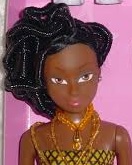
Growing up, the prominent option for dolls in the market were European dolls with European features, like Barbie dolls. The only other option was to make our own dolls with wool, bamboo, wood, raffia, and other materials. For a parent looking to offer his daughter, or niece, a “hip” doll, he/she basically had to get these European dolls that looked nothing like us (nothing wrong with that, but self-love starts with seeing one’s likeness in the most basic daily toy). Some of my friends resorted to coloring those dolls chocolate, so that the doll would look just like them, or braiding their hairs, and dressing them with left-over fabric from their Mommy’s wrappers or Boubou. I was quite pleased by the work of entrepreneur’s Taofick Okoya who created two lines of dolls: the Naija Princess, and the Queens of Africa. The Naija princess is more affordable for the average Nigerian family, and the Queens of Africa is the ‘haut-de-gamme’ of his collection.
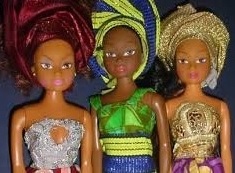
His dolls basically have ‘African’ features, and are from three of the main tribes of Nigeria: Nneka is from the Igbo region, Azeezah is Haussa, while Wuraola is Yoruba. The dolls all wear African clothing from their particular regions, and have their hairs in braids, Afro, or plated. It is simply beautiful. As Mr. Okoya said himself, he first started because his daughter was getting confused about her skin color wishing hers to be just like that of her doll. See… how, even as kids, we get brainwashed? This is where we teach young girls to love and appreciate who they are, their skin colors, and the gorgeous hair they were endowed with naturally and divinely. I am so proud of Okoya’s dolls, which has beaten Mattel’s Barbie on the Nigerian market, and are now sold around the globe. I raise my hat to him, and wish for him to keep up the work, and for others to make dolls more representative of our different cultures: i.e. having Maasai dolls, Bushmen dolls, Bamileke dolls, or making them more “hip” for our daughters. Please do check out the website of Taofick Okoya, Queens of Africa Dolls.

A British man recently decided to return looted art that his grandfather had taken (stolen?) away during the 1897 Benin City Massacre. The article about the art returning is on BBC. I do salute the man for doing it; and I wish the British museums and museums around the world will return art looted by Europeans in African countries and countries around the world. True, the man excuses his grandfather’s acts by saying: “We are taught from a very young age that the killing of enemy combatants under the umbrella of statehood is a regrettable necessity of life.” And excuses the art looting by saying, “To him [his grandfather], it was probably no more than picking up stuff that’s washed up on the beach, because people had fled and nobody owned them any longer.” But he is happy they are now back in Benin City. “These objects are part of the cultural heritage of another people… to the people of Benin City, these objects are priceless.”
I also decided to link back to the story I wrote a while ago about the Benin City Massacre.

Le Crapaud aime l’eau, mais pas l’eau chaude (Proverbe Toucouleur – Senegal, Mauritanie, Mali). – N’exagérons pas.
The toad likes water, but not hot water (Toucouleur proverb – Senegal, Mauritania, Mali). – Do not exaggerate.
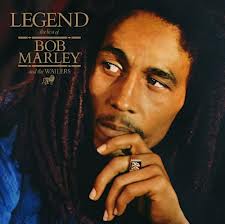
On February 6th, the world celebrated Sir Bob Marley‘s 70th birthday or earth day. People around the world gathered to commemorate the life of the great Reggae legend. There were lots of live performances and exhibitions in Jamaica, and around the world. From February 1-6, there were five-day celebrations featuring international reggae acts, tribute shows, art and food. All these festivities take us back to Bob Marley’s strong message of unity, oneness, and universality, or ONE LOVE: love for all mankind, love for our fellow brothers, love for ourselves, love for our planet, and above all love for our Creator. Someone said that if we were busy loving, there will be no war, and that is truly Sir Marley’s message: “One Love, One Heart. Let’s get together and feel all right.”

I read this love poem written by the Cameroonian writer Patrice Kayo. I thought it so deep, beautiful, and worth sharing with all. Enjoy this poem ‘A la princesse / To the princess’! The original was published in Paroles intimes 1972, P.-J. Oswald. The French version of the poem was taken from ‘Anthologie Africaine: Poesie, Jacques Chevrier, Hatier 1988, P.129.‘ Translated to English by Dr. Y., afrolegends.com .
| A la Princesse
Tu es l’innocence des fleurs et le sourire de l’aurore tu es le doux éclat du soir et la virginité de l’inconnu tu es la gaiété du ciel etoilé la candeur des clairs de lune.
Tu es la douceur des nuages des belles saisons tu es la corolle qui s’ouvre sur l’humble hauteur de ma colline mais le chemin est long qui mène jusqu’à toi tu es l’aube lourde de promesses et ton sourire, le murmure joyeux du vent sur la savane tu es le havre de mon Coeur déchiré lorsqu’y volète le papillon du doute et de l’angoisse.
Tu es la fertilité de la terre et la limpidité du matin tu es le beau pays de mes rêves le champignon que je voudrais cueillir au lever de l’aube de l’amour tu es l’eau pour ma soif tenace et dans le gouffre de mon silence je ne murmure que pour toi.
Tu es la hutte élevée par le destin sur mon chemin sans abri.
Tu es l’oiseau posé sur l’arbre de ma solitude et quand tu t’envoleras tu emporteras mon espoir.
Tu es le kolatier planté dans l’étroit champ de mon destin laisse tomber pour moi le salutaire fruit de l’accord pour que par le même chemin nous titubions ensemble vers la grande mer la mer de l’éternité
Ecoute je t’aime comme on meurt innocemment, totalement et je t’attendrai comme le bonheur : tous les jours.
|
To the Princess
You are the innocence of flowers and the smile of the dawn you are the soft evening glow and the virginity of the unknown you are the gaiety of the starry sky the candor of moonlights.
You are the clouds’ gentleness on beautiful seasons you are the corolla which opens on the humble height of my hill but the path is long that leads up to you you are the dawn heavy with promises and your smile, the joyous murmur of the wind on the savannah you are the haven of my broken heart as flutters the butterfly of doubt and anguish.
You are earth’s fertility and the morning’s clarity you are the beautiful country of my dreams the mushroom that I would like to pick at the dawn of my love you are the water for my tenacious thirst and in the pit of my silence I murmur only for you.
you are the hut elevated by fate on my way without shelter.
You are the bird resting on the tree of my solitude and when you will fly away you will take away my hope.
You are the kola tree planted in the narrow field of my destiny drop for me the salutary fruit of agreement so that by the same path we stagger together towards the great sea the sea of eternity
Listen, I love you as one dies innocently, totally and I will wait for you like happiness: every day.
|
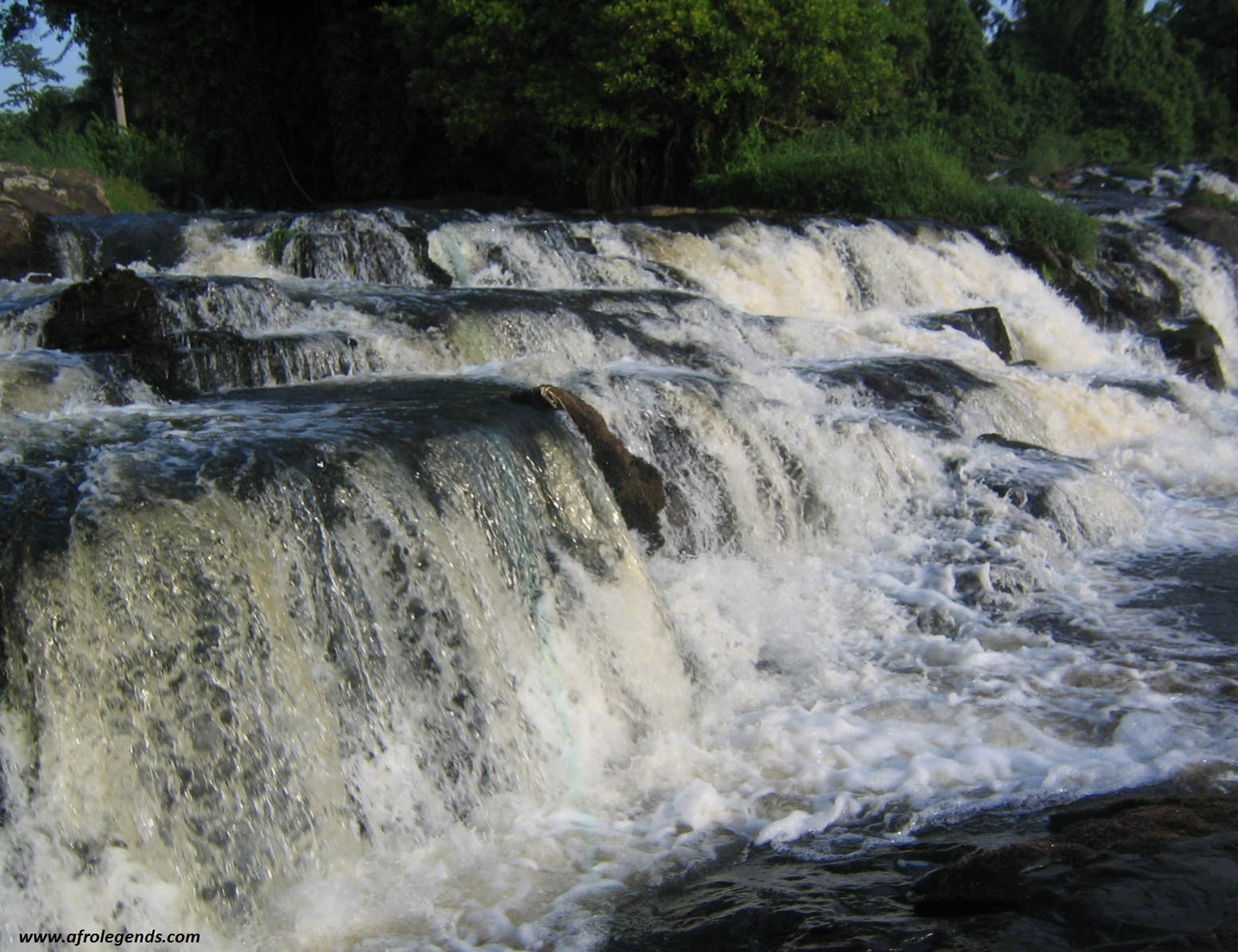
THERE was a frightful drought. The rivers after a while dried tip and even the springs gave no water. The animals wandered around seeking drink, but to no avail. Nowhere was water to be found. A great gathering of animals was held: Lion, Tiger, Wolf, Jackal, Elephant, all of them came together. What was to be done? That was the question. One had this plan, and another had that; but no plan seemed of value.
Finally one of them suggested: “Come, let all of us go to the dry river bed and dance; in that way we can tread out the water.”
Good! Everyone was satisfied and ready to begin instantly, excepting Rabbit, who said, “I will not go and dance. All of you are mad to attempt to get water from the ground by dancing.”

The other animals danced and danced, and ultimately danced the water to the surface. How glad they were. Everyone drank as much as he could, but Rabbit did not dance with them. So it was decided that Rabbit should have no water.
He laughed at them: “I will nevertheless drink some of your water.”
That evening he proceeded leisurely to the river bed where the dance had been, and drank as much as he wanted. The following morning the animals saw the footprints of Rabbit in the ground, and Rabbit shouted to them: “Aha! I did have some of the water, and it was most refreshing and tasted fine.” Continue reading “The Dance for Water or Rabbit’s Triumph”


In celebration of Valentine’s Day, I would like to talk about one of Africa’s great love songs, ‘AMI O‘. Many songs have made the entire continent shake, but few have had the dimensions of ‘AMI O‘ of Ebanda Manfred. ‘AMI O‘ is to Cameroonian and African music what ‘Guantanamera‘ is to Cuban and Latin music: a world classic. But ‘AMI O‘, ‘AMIO‘, ‘AMIE OH’, or ‘AMI OH’, or ‘AMIYO‘ is first and foremost a love song. It is a declaration of love, a love anthem. It has been reprised by over 20 world class artists among which, Bébé Manga, Papa Wemba, Francis Bebey, Angelique Kidjo, Manu Dibango, Monique Séka, Bisso Na Bisso, Nayanka Bell, Jacky Biho, Naima, Henri Salvador, André Astasié, and so many more.

Where did it all start? In 1960, 24-years old Ebanda Manfred fell head over heels in love with a teenage single mother from Yaoundé, Cameroon. The girl, Amié Essomba Brigitte, had to quit school to take care of her child. Madly in love, Ebanda Manfred told her of his feelings, but she told him that she could not start a love relationship until her child was weaned. Finding the wait too long, especially since he had to return to Douala the following year, Ebanda Manfred sang his despair and asked: “Amié, njika bunya so mo, oa mo o ma dubè no, na mba na tondi oa?”. Translation: “Amié, when will you finally believe in my love?” Thus the song “Amié ” was born. It became an instant hit when it came out in 1962. A year later, it was reprised by Francis Bebey. In 1980, the great Bébé Manga made an adaptation which brought her to the international stage, as she won the “Golden Maracas.” The song will be reprised by artists around the world, from the Carribbean to Latin America, and Europe.

In celebration of Valentine’s day, I live you with this great African love song. In Bébé Manga’s English version, the song clearly states “Amie (friend) oh, you are all I ever hoped for, everything I ever dreamt of, …” So tomorrow, don’t forget to sing AMI O to that special one, that one you longed for, and dreamt of, that special one in your life.

What comes to mind when I say Casablanca? If your thoughts went to the 1942 Hollywood romantic movie ‘Casablanca‘ which starred Humphrey Bogart and Ingrid Bergman, you are not the only one; even Google makes the same mistake. However, I will be talking about the city that inspired the movie, the Moroccan city of Casablanca.
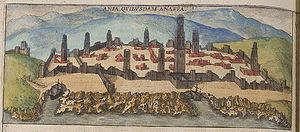
Have you ever wondered where the name Casablanca came from? Why would a Moroccan city not have an Arabic name, but a Spanish name? Why is there the color white in its name? Were all the houses painted in white when its name was chosen? After all, a literal translation of Casablanca is ‘Casa‘ and ‘Blanca‘ or ‘white house’ in Spanish. Was Casablanca a Spanish conquest? In reality, the modern name of the city comes from the Portuguese ‘Casabranca‘ or ‘white house’ which turned into Casablanca when the Portuguese kingdom was integrated into the Spanish kingdom.
The real name of the city was Anfa, founded as part of the Berber Kingdom of Barghawata in 744 AD. It is believed to have been one of the most prosperous cities on the Atlantic coast because of its fertile land. After the Portuguese wiped out the entire city in 1468, they used the ruins of Anfa to build a military fortress in 1515, and later renamed the city Casabranca. I wonder how many African cities were wiped out that way by Europeans; this is so reminiscent of the majestic Benin City which was burnt to the grounds by British soldiers in 1897.
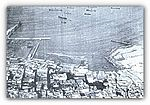
Between 1580 and 1640, the Crown of Portugal was integrated into the Crown of Spain, and the area was renamed Casablanca, even though it was still under an autonomous Portuguese administration. As Portugal broke ties with Spain in 1640, Casablanca came under full Portuguese control again. The Europeans abandoned the area completely in 1755 following an earthquake which destroyed most of the town, probably leaving the locals to fend for themselves.
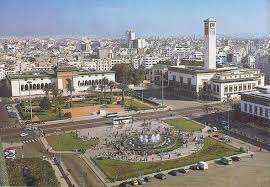
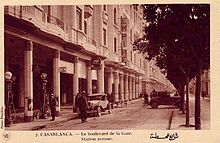
The town was finally reconstructed by Sultan Mohammed ben Abdallah (1756–1790), the grandson of Moulay Ismail, with the help of Spaniards from the nearby emporium. The town was called الدار البيضاء ad-Dār al-Bayḍāʼ, the Arabic translation of the Spanish Casa Blanca, meaning “white house”. The city came under French occupation at the beginning of the 20th century, as Morocco became a French protectorate.
Since Morocco gained independence from France in 1956, the city has become the economic and business center of the country. Located in the Chawiya plain, its very fertile lands have made it the breadbasket of Morocco. One of its most important exports is phosphate. Among other industries, there is also a big fishing and fish canning industry: who has not heard of the delicious Moroccan Sardines?
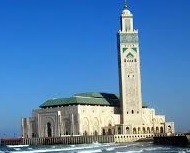
Apart from being the biggest city in the Maghreb, and being so modern with a twist of Hispano-Mauresque, and French architectures, Casablanca is also home to the Hassan II Mosque, with the world’s tallest Minaret. Locals affectionately call it ‘Casa‘, and it is a beautiful city to visit, with a very modern architecture. Enjoy the video below.

Yesterday’s final was the culmination of years of hard work for the so-called golden generation of Ivorian footballers. Yes, yesterday, Cote d’Ivoire defeated Ghana in the finals of the Africa Cup of Nations in penalty kicks. The Elephants of Côte d’Ivoire had been a strong team on the African continent for many years, and this generation was meant to win at some point. This was the last chance for many members of the Elephants team. So sad that Didier Drogba, one of its key players for so many years, could not be amongst his teammates to raise that trophy as well, for he made us proud for so long. My hat goes out to Yaya Touré, Kolo Touré, Gervinho, Boubacar Barry, Wilfried Bony, and all the other team players. The hero of the game for Côte d’Ivoire, was their goalkeeper Boubacar Barry who had replaced the regular keeper, was in pain throughout, but scored the winning penalty after making a crucial save from the Ghanaian keeper.

Truly, Ghana was the better of both teams for the first 120 minutes with more chances of scoring, but penalty kicks decided otherwise. It was actually quite a disappointing final to watch: no real outstanding moments from both sides. However, we raise our hats to all members of the Ghanaian squad, and hope to see them again at the next CAN, and in the finals. Thanks for a good cup.


 African Heritage