In celebration of Valentine’s day which is going to be this Sunday, the song ‘IyawoMi‘ by Nigerian singer Timi Dakolo seems appropriate. The song is about a promise of love to that precious one… it is a ‘forever and for always‘ promise. It is a beautiful song which can be played at weddings as well. And the beat is simply amazing; it is a classic. The chorus: “Iyawo mi, Ololufe mi, Ore mi, Alayo mi, I will love you forever.” In Yorùbá, Iyawo mi= my wife, Ololufe mi= mylover, Ore mi= my friend, Alayo mi= my joy (one who brings mejoy). It could be sung to a man as well, by substituting the words oko mi (myhusband) to iyawomi(mywife). Enjoy and happy Valentine’s day to all… and in reality, one day is not enough to tell that loved one about your love, everyday should be an occasion to declare your love, in some way, shape, or form; because in reality, all we have is today, the present (a gift)… make the best out of it!
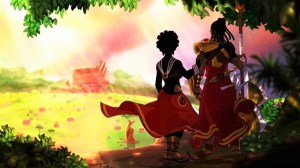
A game scene from ‘AURION: Legacy of Kori-Odan’ (source: kickstarter.com)
Video game players, and in particular African video game players will be excited by the latest, the first Gaming studio to see the light in Central Africa, and particularly in Cameroon. The games produced by this company embody African myths and culture. According to its founder, Olivier Madiba, the content of their games combine African characters and folklore. Kiro’o Games, Central Africa’s first video studio, latest project Aurion: Legacy of the Kori-Odan is an action-RPG (Role Playing Game) with which the studio intends to unify and transmit African culture by combining various myths, tales and traditional values into the gaming experience.
A game scene from AURION: Legacy of Kori-Odan (source: kickstarter.com)
“The history of our continent is rich … we took inspiration from local Cameroonian traditions, like the Ngondo Festival celebrated by the Sawa people, and we also incorporated symbolism adapted from that of the Akan people of Ghana, specifically the Adinkra writing style,” said Olivier. Aurion: Legacy of the Kori-Odan is set in a world of elemental energies and ancestral powers, where players assume the role of a traditional ruler, Enzo Kori-Odan, rightful ruler of the Zama kingdom, who uses the Aurion power granted him by his ancestors to regain control of his kingdom. To learn more, go to VenturesAfrica and TheNewAfrica. Kudos to Olivier Madiba and his team, all the best in their endeavor! Africa needs more of you.
L’écureuil est petit, mais il n’est pas l’esclave de l’éléphant(Proverbe Bornu – Tchad). Je ne vaux pas grand-chose, mais je ne suis pas ton sous-fifre.
Elephant
The squirrel is small, but it is not the elephant’s slave(Bornu proverb – Chad). I may not be worth much, but I am not your side-kick.
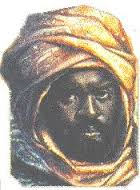
Today, I will be talking about Idris Alooma (also Idris Alaoma, or Idris Alauma), the only Bornu King whose name has survived the test of time. This article is long overdue, as it focuses on the Bornu and Kanem-Bornu empires.
Idris Alooma’s reign belonged to the great Sayfawa or Sefuwa dynasty which ruled the Bornu empire from the 16th and 17th centuries. According to the Diwan al-salatin Bornu, Idris Alaoma was the 54th King of the Sefawadynasty, and ruled the Kanem-Bornu empire located in modern-day Chad, Cameroon and Nigeria. In many works, he is known by his mother’s name, Idris Amsami, i.e. Idris, son of Amsa. The name Aloomais a posthumous qualificative, named after a place, Aloor Alao, where he was buried. He was crowned king at the age of 25-26. According to the Diwan, he ruled from 1564 to 1596. He died during a battle in the Baguirmi where he was mortally wounded; he was later buried in Lake Alo, south of the actual Maiduguri, thus the name Alooma.
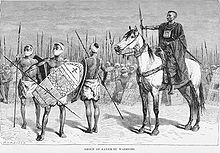
Group of Kanem-Bu warriors in the 1800s
Idris was an outstanding statesman, and under his rule, the Kanem-Bornu touched the zenith of its power. He is remembered for his military skills, administrative reforms and Islamic piety. His feats are mainly known through his chroniclerAhmad bin Fartuwa. During his reign, Idris avoided the capital Ngazargamu, preferring to set his palace 5 km away, near the Yo river (Komadugu Yobe), in a place named Gambaru. The walls of the city were red, leading to a new architecture using red bricks characteristic of his reign. To this day, some murals still exist in Gambaru and are over 3m tall. These are vestiges of a flourishing empire. Idris Alooma was known by the Kanuri title of Mai for king.
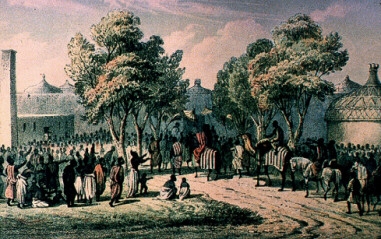
Kanem-Bornu court in the 1700s
His main adversaries were the Hausa to the west, the Tuareg and Toubou to the north, the Bulala to the east, and the Sao who were strongly implanted in the Bornu region (and will be decimated by Alooma’s military campaigns). One epic poem extols his victories in 330 wars and more than 1,000 battles. His innovations included the employment of fixed military camps with walls, permanent sieges and scorched earth tactics where soldiers burned everything in their path, armored horses and riders as well as the use of Berber camels, Kotoko boatmen, and iron-helmeted musketeers trained by Ottoman military advisers. His active diplomacy featured relations with Tripoli, Egypt, and the Ottoman Empire, which sent a 200-memberambassadorial party across the desert to Alooma’s court at Ngazargamu. Alooma also signed what was probably the first written treaty or ceasefire in Chadian history.
Alooma introduced a number of legal and administrative reforms based on his religious beliefs and Islamic law. He sponsored the construction of numerous mosques and made a pilgrimage to Mecca, where he arranged for the establishment of a hostel to be used by pilgrims from his empire. As with other dynamic politicians, Alooma’s reformist goals led him to seek loyal and competent advisers and allies, and he frequently relied on eunuchs and slaves who had been educated in noble homes. Alooma regularly sought advice from a council composed of heads of the most important clans. He required major political figures to live at the court, and he reinforced political alliances through appropriate marriages (Alooma himself was the son of a Kanuri father and a Bulala mother).
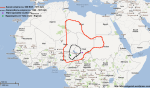
Map of the Kanem and Kanem-Bornu empires
Kanem-Bornu under Alooma was strong and wealthy. Government revenue came from tribute (or booty if the recalcitrant people had to be conquered) and duties on and participation in trade. His kingdom was central to one of the most convenient routes across the Sahara desert. Many products were sent north, including natron (sodium carbonate), cotton, kola nuts, ivory, ostrich feathers, perfume, wax, and hides, but the most profitable trade was in slaves. Imports included salt, horses, silk, glass, muskets, and copper.
Alooma took a keen interest in trade and other economic matters. He is credited with having cleared the roads, designed better boats for Lake Chad, introduced standard units of measure for grain, and moving farmers into new lands. In addition, he improved the ease and security of transit through the empire with the goal of making it so safe that “a lone woman clad in gold might walk with none to fear but God.” To learn more, check out the books: History of the first twelve years of the reign of Mai Idris Alooma of Bornu (1571-1533) by his Imam: Ahmed ibn Fartua; together with the “Diwan of the sultans of Bornu” and “Girgam” of the Magumi; and The Africans, ed. J.A. Tome 3, 1977.
The following words are from Nigerian photographer J.D. ‘Okhai Ojeikere who decided to take pictures of Nigerian Afro Hairstyles as a way of preserving history. The pictures were taken from 1950 – 1970s. You will see that some of the styles are no longer made today. The text below and the pictures can be found in André Magnin: J.D. ‘Okhai Ojeikere/ Photographs, First Scalo Edition 2000.
========
… I never stopped taking photographs as both a memory of the past and a witness to a culture in constant evolution.
Hairstyling is a practice to increase beauty. It is not specific to Nigeria. It is found throughout… the continent. There are hundreds of ethnic groups in Nigeria, each with its own language, traditions and as many different hairstyles. … The hairstyles are never exactly the same; each one has its own beauty. … Most of my pictures are of quotidian hairstyles, but there are also ceremonial hairstyles. …
The styles are determined by the type of ceremony, the social position of the family or of the woman and the artistic talent of the hairstylist. Some have lost their original meaning to new meanings assigned to them. You can easily identify a woman by her hairstyle: a woman who has become an adult; a woman who is preparing for marriage… It is difficult today to know the origins of some hairstyles because different groups mix and adapt to modern culture. … There are many new hairstyles everywhere, but many of them are inspired by older models.
Hairstyling is a form of art. When you see a hairstylist do this or that, every single movement is precise and rapid. She creates a hairstyle the way a sculptor would work – from nothing. It’s fascinating. These hairstyles pass from one woman to another; from one style to another without every repeating. It’s like a school, but some have a real talent that makes them stand out.
Different hairstyles as captured by J.D. ‘Okhai Ojeikere (Source: A. Magnin: J.D. ‘Okhai Ojeikere / Photographs)
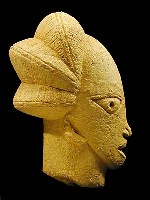
Have you ever looked at sculptures of women from the Nok civilization? Then you have probably noticed that Nok women wore their hair braided similar to the Fulani women of today, in beautiful goddess braids, and amazing styles. Ever looked at images of Queen Nzingha? She wore her hair in Afro, fully out.
Queen Nzingha of Angola
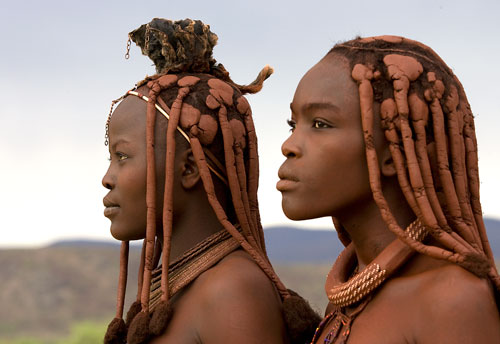
What about the great Amanishakheto of Nubia, well, hieroglyphs at Meroë, show her sporting a gorgeous ‘Fro. And the fierce amazons of King Behanzin wore either braids, or shaved their heads, or sported afros. Today the tradition persists: the Himba women of Namibia and Angola wear dreadlocks decorated with red ochre, while Maasaiwomen shave their heads and Maasai men sport dreadlocks. For their wedding, the Wodaabe women wear amazing braids decorated with cauris, and jewelry. In our culture, there were intricate hairstyles for different occasions: passage of a girl into womanhood, courting, weddings, funerals, etc.
Himba women (absoluteafrica.com)
Isn’t it amazing how our crown jewel, our hair, can be worn in so many different ways? Isn’t it amazing that one could change hairstyle every two-three weeks, or even
Fulani woman (Wodaabe)
every month? After all, nature gifted the African race with a lion’s mane, which can be dressed a thousand ways, why not take advantage of it? Nigerian photographer J.D. Okhai Ojeikerecaptured some of these different hairstyles from women in the 1960-70s. Many African women from the 1960s-70s can be seen wearing tresses; and if you ever dig up pictures of your parents, you will see your mothers wearing those as well. His collections and books are amazing. Enjoy!
Ever wondered where the name Memphis came from? No, I am not talking about Memphis the capital of Blues in Tennessee (USA), but rather, about Memphis, Egypt, the reason why Memphis Tennessee got its name.
Well, Memphisin Egypt, was the ancient capital of Aneb-Hetch, the first nome of Lower Egypt. Its ruins are located near the town of Mit Rahina, 20 km (12 mi) south of Giza. It is 20 km (12 mi) south of Cairo, on the west bank of the Nile. The modern cities and towns of Mit Rahina, Dahshur, Abusir, Abu Gorab, and Zawyet el’Aryan, south of Cairo, all lie within the administrative borders of historical Memphis. The city was also the place that marked the boundary between Upper and Lower Egypt (the 22nd nome of Upper Egypt and 1st nome of Lower Egypt).
Memphis and its necropolises
Memphis has had several names throughout its history which spans almost four millennia. Its Ancient Egyptian name was Inbu-Hedj (translated as “the white walls“). Because of its size, the city also came to be known by various other names that were actually the names of neighborhoods or districts that enjoyed considerable prominence at one time or another. For example, according to a text of the First Intermediate Period, it was known as Djed-Sut(“everlasting places“), which is the name of the pyramid of Teti.
The city was also at one point referred to as Ankh-Tawy(meaning “Life of the Two Lands“), stressing the strategic position of the city between Upper and Lower Egypt. This name appears to date from the Middle Kingdom (c. 2055–1640 BCE), and is frequently found in ancient Egyptian texts.
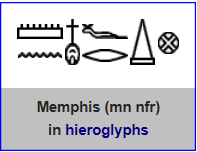
At the beginning of the New Kingdom (c. 1550 BCE), the city became known as Men-nefer(meaning “enduringand beautiful“), which became Menfein Coptic. The name “Memphis” is the Greek adaptation of this name, which was originally the name of the pyramid of Pepi I, located west of the city.
Hut-ka-Ptah
The Egyptian historian Manetho referred to Memphis as Hut-ka-Ptah(meaning “Enclosure of the ka of Ptah“). In the Bible, Memphis is called Mophor Noph.
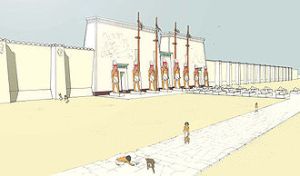
Depiction of the western forecourt to the Great Temple of Ptah in Memphis (Wikipedia)
According to legend related by Manetho, an Egyptian priest and historian from the 3rd century BC, the city of Memphis was founded by the pharaohMenes. It was the capital of Egypt during the Old Kingdom, and remained an important city throughout ancient Mediterranean history. It occupied a strategic position at the mouth of the Nile delta, and was home to feverish activity. Its principal port, Peru-nefer, harbored a high density of workshops, factories, and warehouses that distributed food and merchandise throughout the ancient kingdom. During its golden age, Memphis thrived as a regional center for commerce, trade, and religion. Its eventual downfall is believed to be due to the loss of its economic significance in late antiquity, following the rise of coastal Alexandria. Its religious significance also diminished after the abandonment of the ancient religion following the Edict of Thessalonica.
Alexander visiting the Temple of Apis in Memphis, ca 1898 (Wikipedia)
The ruins of the former capital today offer fragmented evidence of its glorious past. They have been preserved, along with the pyramid complex at Giza, as a World Heritage Site since 1979. The site is open to the public as an open-air museum.
Memphis became the capital of Ancient Egypt for over eight consecutive dynasties during the Old Kingdom. The city reached a peak of prestige under the 6th dynasty as a center for the worship of Ptah, the god of creation and artworks.
Memphis declined briefly after the 18th dynasty with the rise of Thebes and the New Kingdom, and was revived under the Persians before falling firmly into second place following the foundation of Alexandria. Under the Roman Empire, Alexandria remained the most important Egyptian city. Memphis remained the second city of Egypt until the establishment of Fustat in 641 CE. It was then largely abandoned and became a source of stone for the surrounding settlements. It was still an imposing set of ruins in the 12th century but soon became a little more than an expanse of low ruins and scattered stone.
So whenever you think of going to Memphis, Tennessee, or about the birthplace of Blues, remember Memphis, the capital of ancient Egypt, the heart of great pharaohs, and the “enduring, and beautiful” place which has now become an important part of world history and stored greatness throughout centuries. No wonder one of its names was “everlasting places”; it has actually been an everlasting place!
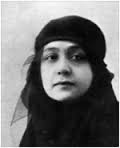
The poem below ‘To My Homeland’ by Huda Sha’arawi shows her love for her country and the extent to which she is willing to fight for her country’s well-being, for her country’s dignity. Her poem was written at the time when Egypt was under British rule, or had just gained independence. In the poem, one senses Huda’s love for her homeland which she refers to as if it were a woman, a mother. Enjoy! The original in French was published in L’Egyptienne, Number 69 of May 1931. The translation to English is brought to you by Dr. Y. on Afrolegends.com
Ama Patrie
J’ai fait voeu de t’offrir tout ce qui m’appartient
O ma belle Patrie,
mon bras, mon Coeur, mon âme ainsi que tous mes biens
sans excepter ma vie.
J’ai fait voeu de peiner, de lutter, de souffrir,
de braver l’infamie.
Sans froncer le sourcil, sans poser au martyre,
sans même une aide amie.
J’ai juré de franchir les frontières des mers
si ton honneur l’exige,
afin de rehausser, aux yeux de l’univers,
ton nom et ton prestige.
J’ai juré d’oublier les affronts des déments
Et la haine et l’insulte
que l’envie incita, contre mon dévouement
à ta cause et ton culte.
Peu m’importe l’exil, leur courroux, la prison,
j’accepte la mort même.
Puisque leurs vils exploits n’auront jamaisraison
de l’humble coeur qui t’aime.
To my Homeland
I vowed to offer you all that is mine
O my beautiful homeland,
my arm, my heart, my soul, as well as all my belongings
not excepting my life.
I vowed to struggle, to fight, to suffer,
to brave infamy.
Without frowning, without asking for martyrdom,
without even using a friend.
I have sworn to cross the borders of the seas
if your honor depends on it,
to enhance, in the eyes of the universe,
your name and your prestige.
I have sworn to forget the offenses of the demented
and the hatred and insult
Which prompted envy, against my dedication
To your cause and your worship.
I do not care about exile, their anger, the prison,



 Le chien ne retourne jamais là où on l’a frappé










 The city was also at one point referred to as


 Si un seul cheveu de votre tête tombe, cela ne gêne pas votre tête

 African Heritage